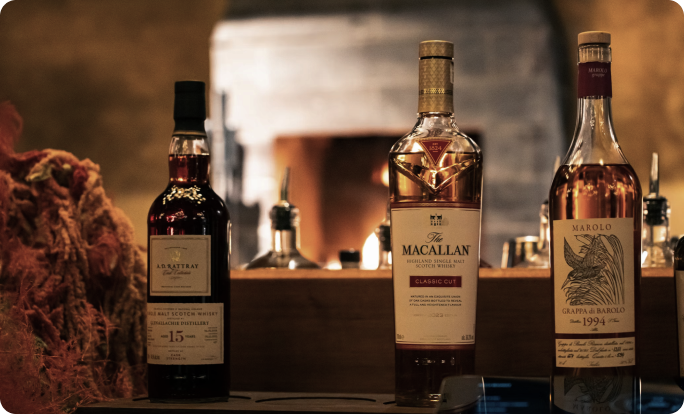
Blair Athol 8 Year Old (1980s Edition)
75cl / 40%
£99.00
- Malt type: Single Malt
- Region: Scotland
Tasting Notes

Leather, Wax, Fruits, Lime

Fruits, Spices, Lemon Juice, Plums, Honey, Mint

Medium Finish, Oaky, Leather, Honey
If you like this whisky, you will also like these
A highly collectible, vintage entry-level expression providing a historical benchmark for pre-Diageo Highland spirit.
At-a-Glance
| Field | Details |
| Distillery / Bottler / Country & Region | Blair Athol / Not stated by the producer / Scotland, Highland |
| Category | Single Malt Scotch Whisky |
| Age / Vintage / Bottled | 8 Years Old / Not stated by the producer / Circa 1980–1986 |
| ABV & Size(s) | Varies (40%, 43%) / 75cl, 70cl |
| Cask / Treatment | Not stated by the producer (Assumed ex-Bourbon refill) |
| Natural Colour | Not stated by the producer |
| Non-Chill-Filtered | Not stated by the producer |
| Cask Strength | No |
| Bottle count / Outturn | Standard release, large outturn for the era |
| Intended channel | Retail/Duty Free |
| Packaging | Standard glass bottle, likely screw cap or composite cork |
| Notes on discrepancies | ABV variations (40% vs 43%) are market-specific and crucial for valuation. |
Historical Context
This 8 Year Old expression represents a pivotal era for Blair Athol. It was positioned as an accessible, entry-level Single Malt, a factor reflected in its low original Recommended Retail Price (RRP) at the time of release. The bottling dates to the period before 1988, after which it was largely replaced by the 12 Year Old expression, signalling a strategic shift in the distillery’s core offering.
Significantly, these bottles were released prior to the major corporate restructuring and branding standardization that took place under UDV and subsequently Diageo in the early 1990s. This specific vintage association with earlier spirit stocks drives much of the current collector demand. The current high market value stands in stark contrast to its original commercial positioning. This appreciation differential, where scarcity derived from time elapsed since bottling compounds with the heritage value of pre-rationalisation spirit, makes this bottling a notable case study in rarity-driven demand.
Technical Specification & Variant Map
The key technical differentiation affecting secondary market value for this specific bottling is the variance in Alcohol by Volume (ABV). The UK and European Union markets typically received the more desirable 43% ABV version. In contrast, export markets, including the US, commonly received the 40% ABV bottling. This difference in proof is critical for market assessment and pricing.
Furthermore, size differentiation often assists in dating and market identification. The 75cl volume often suggests US or older export market distribution, whereas 70cl represents the common metric standard for the modern UK/EU market. Collectors exhibit a clear preference for the 43% ABV bottling. This preference often justifies a significant price premium, typically ranging between 15% and 25%, as collectors prioritise the perceived integrity and intensity of the liquid when exposed to higher proof, even if the difference in percentage is marginal.
Variant Matrix
| ABV | Volume | Market | Era cues | Relative desirability |
| 43% | 70cl | UK/EU | Metric volume marking, specific UK duty stamps | Highest (Enthusiast preference for strength) |
| 40% | 75cl | US/Export | Importer strip label, pre-metric volume | Standard collector entry point |
| 40% | 70cl | Duty Free/Export | Post-metric packaging, lower ABV | Moderate |
Packaging & authenticity checklist
Authentication of this vintage bottling requires careful scrutiny, primarily focusing on its condition due to the age and the era’s basic sealing technology. The closure type, typically a composite cork or screw cap, must be assessed for integrity, as closure quality directly influences the risk of evaporation over four decades.
Consequently, the fill level is the foremost condition indicator. For bottles of this age, collectors require a minimum fill level of High Shoulder (H/S). Examples falling below this threshold (e.g., Mid Shoulder or Low Shoulder) suffer a significant reduction in collector value due to the increased risk of oxidation and volume loss. Furthermore, when sourcing, verification of the specific 8 Year Old age statement is essential to prevent common confusion with later 12 Year Old official releases or non-age-statement bottlings from contemporary periods. The age statement is definitive and governed by Scotch Whisky Regulations (SWR).
Liquid Profile (from verifiable notes)
The liquid profile of the 8 Year Old is highly regarded for its clarity and soft Highland character. The aroma is characterized by gentle floral notes, subtle heather, and a pervasive sweetness reminiscent of light malt and honey. The texture on the palate is reported to be creamy and smooth, effectively showcasing defined honeyed malt, gentle orchard fruit notes, and the classic Highland characteristic of heather. The liquid carries a notable smoothness, indicating careful distillation and maturation, culminating in a medium duration finish that is notably clean. This profile, defined by its creamy texture and distillate-forward notes due to the assumed use of refill maturation casks, establishes a historical benchmark for Blair Athol, allowing enthusiasts to compare this pre-1988 spirit against the distillery’s modern output, which often presents a richer, more cask-influenced core range.
Distillery/Bottler Snapshot
Blair Athol distillery holds a critical, albeit often unseen, role in the Scotch industry, being integral to the formulation of Bell’s blend. Vintage single malt releases from Blair Athol are exceptionally valued precisely because the majority of the distillery’s spirit has historically been reserved for blending purposes. This dedication to blending stock means that single malt releases, especially older ones, represent a genuine scarcity, enhancing their appeal to collectors who seek pure examples of the house style.
Sourcing
For procurement purposes, it is advisable to target 1980s UK market labels and prioritize the 43% ABV expression. Key red flags to avoid include low fill levels, particularly below the lower shoulder, significant label staining, or the absence of crucial era-specific duty stamps. The minimum acceptable condition threshold is a High Shoulder (H/S) fill level, with neck fill preferred. Based on market analysis, these bottles offer high velocity; strong margins are most reliably achieved by strictly filtering stock based on pristine condition.