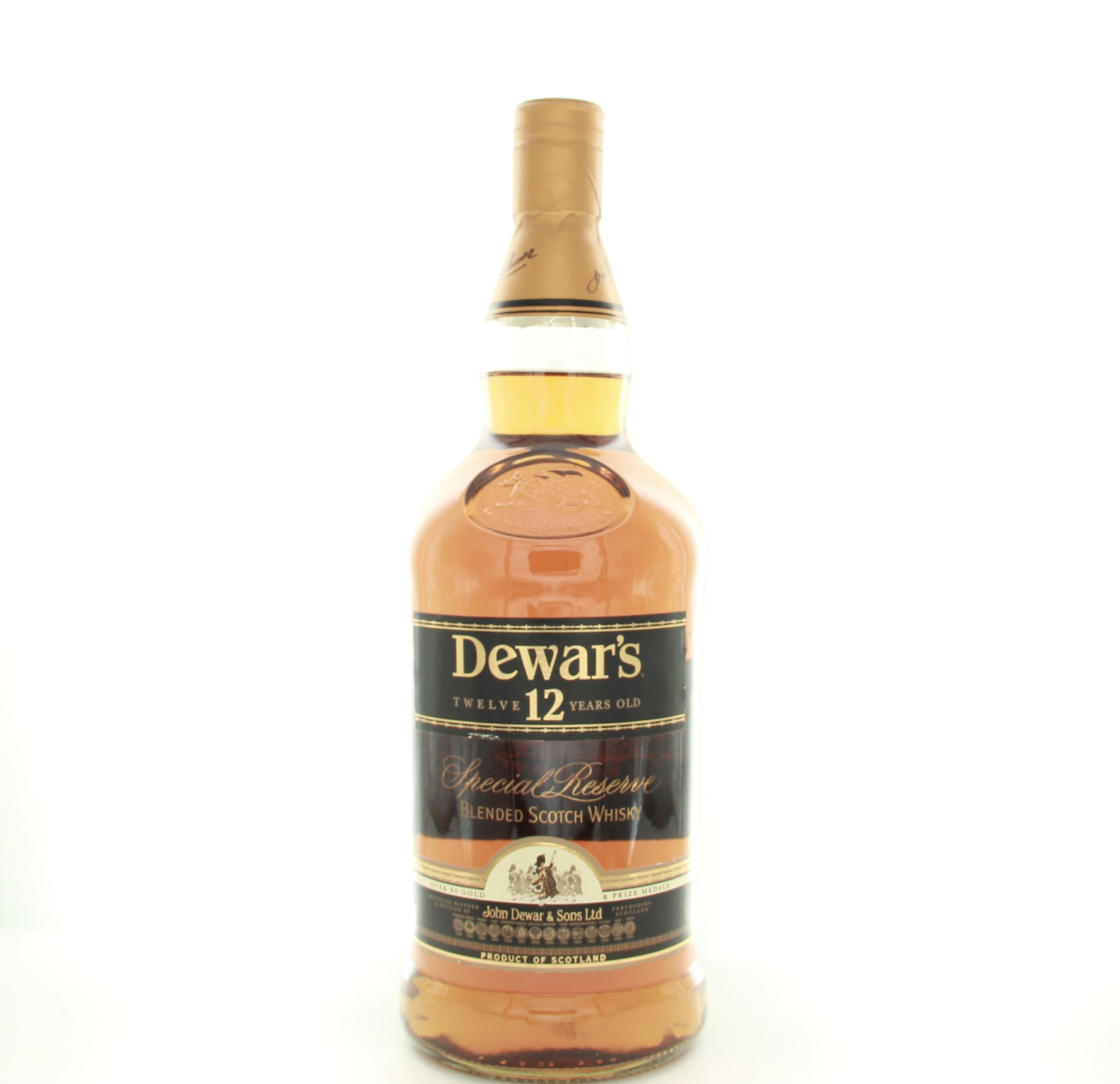
Dewar’s 12 Year Old Special Reserve
100cl / 43%
£100.00

- Malt type: Blended
- Region: Scotland
- Coloring: Yes
If you like this whisky, you will also like these


A globally recognized expression of blended Scotch excellence, meticulously refined through the proprietary 'double aging' maturation process.
At-a-Glance
| Field | Details |
| Distillery / Bottler / Country & Region | John Dewar & Sons Ltd. / Scotland (Malt components primarily Aberfeldy, Speyside/Highland focus) |
| Category | Blended Scotch Whisky |
| Age / Vintage / Bottled | 12 Years Old / Ongoing production, constant inventory |
| ABV & Size(s) | Typically 40% ABV (43% for some export/historical markets) / 70cl, 750ml, 1L |
| Cask / Treatment | Selected oak casks; features proprietary 'Double Aging' |
| Natural Colour | Not stated by the producer (Assumed E150a allowed under SWR regulations) |
| Non-Chill-Filtered | Not stated by the producer (Standard commercial practice suggests Chill-Filtered for consistency) |
| Cask Strength | No (Bottled at standard minimum strength) |
| Bottle count / Outturn | High-volume, ongoing commercial production |
| Intended channel | Global retail, Duty-Free, On-Trade |
| Packaging | Standard glass bottle with bespoke Dewar's embossing, distinct blue and gold label. |
| Notes on discrepancies | ABV variations (40% vs 43%) are critical for collector valuation and must be verified. |
Historical Context
John Dewar & Sons, founded in 1846, established its commercial dominance upon the global distribution of the White Label blend. The introduction of the Dewar’s 12 Year Old Special Reserve was a strategic portfolio move, establishing a definitive step-up product that solidified the brand’s presence in the critical premium age-stated blended Scotch segment. This expression serves a vital function in guiding consumers seeking greater complexity and maturity beyond the standard entry-level offerings.
The core technical identity and marketing narrative for the 12 Year Old revolves around its proprietary "double aging" process. This procedure stipulates that after the malt and grain whiskies have individually reached or surpassed the 12-year maturation threshold, they are blended together and then returned to selected oak casks for a secondary, extended period of maturation, often referred to as marrying. This production technique is employed specifically to mitigate any potential harshness or incomplete integration that can occur in high-volume, standard blending operations. The additional rest period is intended to thoroughly harmonise the disparate spirit components, resulting directly in the highly valued smooth finish and integrated flavour profile detailed in official product statements. This technical commitment to post-blending refinement is the principal justification for the product’s elevated market position and its premium pricing relative to the standard White Label.
The recipe and adherence to the double aging process for the 12 Year Old have been rigorously maintained, ensuring consistent product reliability across all global markets. This stability has been preserved despite multiple changes in corporate ownership, reinforcing the brand's commitment to the established product standard.
Technical Specification and Variant Map
The blend’s flavour architecture is heavily reliant upon Aberfeldy single malt, which is a key distillery asset for John Dewar & Sons. Aberfeldy contributes the characteristic honeyed and mildly fruity core that defines the blend. The 12-year minimum requirement ensures that the spirit has absorbed sufficient vanilla and spice notes from the oak influence, which are subsequently softened and unified by the mandatory double aging period.
Documented variants
The large majority of contemporary bottlings adhere to 40% alcohol by volume (ABV), which is the industry standard for cost-efficient global mass distribution and satisfies all minimum regulatory requirements.
For specialist sourcing and collector markets, it is crucial to note the existence of older bottlings at 43% ABV. These higher-strength variants were frequently destined for select markets, such as the United States, where higher ABVs were sometimes preferred or historically required for imported Scotch, or specific premium European releases. These 43% ABV variants consistently hold disproportionately greater value within the secondary market due to the anticipated enhanced liquid profile delivered at a stronger proof point.
Variant Matrix
| ABV | Volume | Market | Era cues | Relative desirability |
| 40% | 70cl / 75cl / 1L | Global Standard | Modern production, high liquidity | Low (Volume Product) |
| 43% | 75cl | Selected older UK/US | Older label designs, presence of specific duty stickers | Medium (Target for sourcing due to higher strength) |
Packaging and Authenticity Checklist
Authenticity verification for the 12 Year Old centres on confirming provenance and market specification to justify pricing above easily available retail stock. The bottle features distinct, bespoke Dewar's embossing and a recognizable blue and gold label design.
Sourcing specialists must be adept at differentiating between specific label iterations—for example, styles produced before and after 2010—to accurately establish the age of the coveted 43% ABV variants, which is essential for valuation. The closure is a standard screw cap. If older variants are encountered with cork closures, the integrity of the cork must be thoroughly assessed, as evaporation risks increase with bottle age.
Given the product’s high volume of distribution across the globe, the presence and condition of specific international duty stamps (such as older UK tax strips or US IRS seals) are critical indicators for verifying the original market and, often, the approximate chronological age of the bottling. The blue label ensures clear distinction from the White Label (white/cream) and the darker 15 Year Old expression. The emphasis in sourcing shifts from simple rarity assessment to the confirmation of market-specific provenance indicators, which serves as the professional basis for justifying any price premium.
Regulatory-Terminology Notes
The expression is in full compliance with the Scotch Whisky Regulations (SWR), with the 12-year age statement precisely defined by the age of the youngest spirit component utilized in the blend. The descriptor "Double Aging" functions as proprietary marketing language but explicitly refers to a verifiable, intentional production step designed to polish the liquid, serving as a genuine technical differentiator from blends that only perform the standard vating and bottling procedures.
Liquid Profile (from verifiable notes)
The Dewar’s 12 Year Old is engineered for smoothness, balance, and wide consumer appeal.
Nose: Characterized by soft honey notes, a direct result of the high Aberfeldy malt content. This sweetness is balanced by subtle baking spices and integrated citrus peel, resulting in a clean and highly inviting initial aroma.
Palate: The mouthfeel is medium-bodied, distinguished by remarkable smoothness, which is a key technical outcome of the double aging process. Flavours are well-integrated, featuring vanilla, butterscotch, and a gentle, warming oak influence.
Finish: Medium in length, exceptionally clean, and noticeably smooth. It lacks the harshness often associated with high grain content, concluding with a persistent, gentle spice note.
With water: The spirit is robust enough to accommodate ice or dilution in mixed formats. For tasting, a minor addition of water can slightly suppress the spicy elements while accentuating the blend's inherent sweetness.
Pricing and Market Dynamics (GBP)
The market for Dewar’s 12 Year Old is defined by high volume and competitive retail pricing.
Original RRP (GBP): Positioned competitively in the £25–£35 range upon market introduction.
Current UK retail range (GBP, incl. VAT): £30 – £40 for the standard 40% 70cl bottling.
Recent UK-EU auction range (GBP, hammer): £25 – £60. The upper end of this range is reserved exclusively for older, pristine 43% ABV variants.
Pricing stratification: Stratification for modern stock is minimal. A significant uplift in value (up to 50% above RRP) is only achievable when securing verified older, high-fill 43% bottlings.
Liquidity and Sourcing Note: Liquidity is extremely high. This is fundamentally a high-velocity product.
Price Snapshot
| Channel | Date | Bottle spec | Price (GBP) | Notes |
| UK Retailer | Q1 2024 | 40% 70cl | £35.00 | Standard retail price point |
| EU Auction | Q4 2023 | Older 43% 75cl, High Fill | £58.00 | Reflects premium for higher ABV variant |
| UK Supermarket | Q2 2024 | 40% 70cl (Promotional) | £30.00 | Lowest viable acquisition point for bulk inventory |
Distillery-Bottler Snapshot
John Dewar & Sons manages a portfolio prioritizing global volume and unwavering consistency. The 12 Year Old embodies the premium blended house style: reliable, exceptionally smooth, and highly accessible, making it invaluable as both a neat sipping whisky and a high-end component in established cocktails.
Sourcing
Targeted acquisition should focus on the less common 43% ABV variants or verifiable early 2000s packaging styles, as these formats offer the most significant margin potential over standard retail RRP. General wear and tear is often accepted due to the product’s commercial nature, but severe label damage or compromised fill levels are unnecessary risks given its high replaceability. The condition threshold for acceptance is a high-fill level (low neck). While original packaging (tube/box) is advantageous, it is not mandatory for a volume blend. Standard 40% inventory yields high velocity at a low margin. Sourcing specific 43% ABV variants allows for medium margin potential, albeit at a lower velocity.