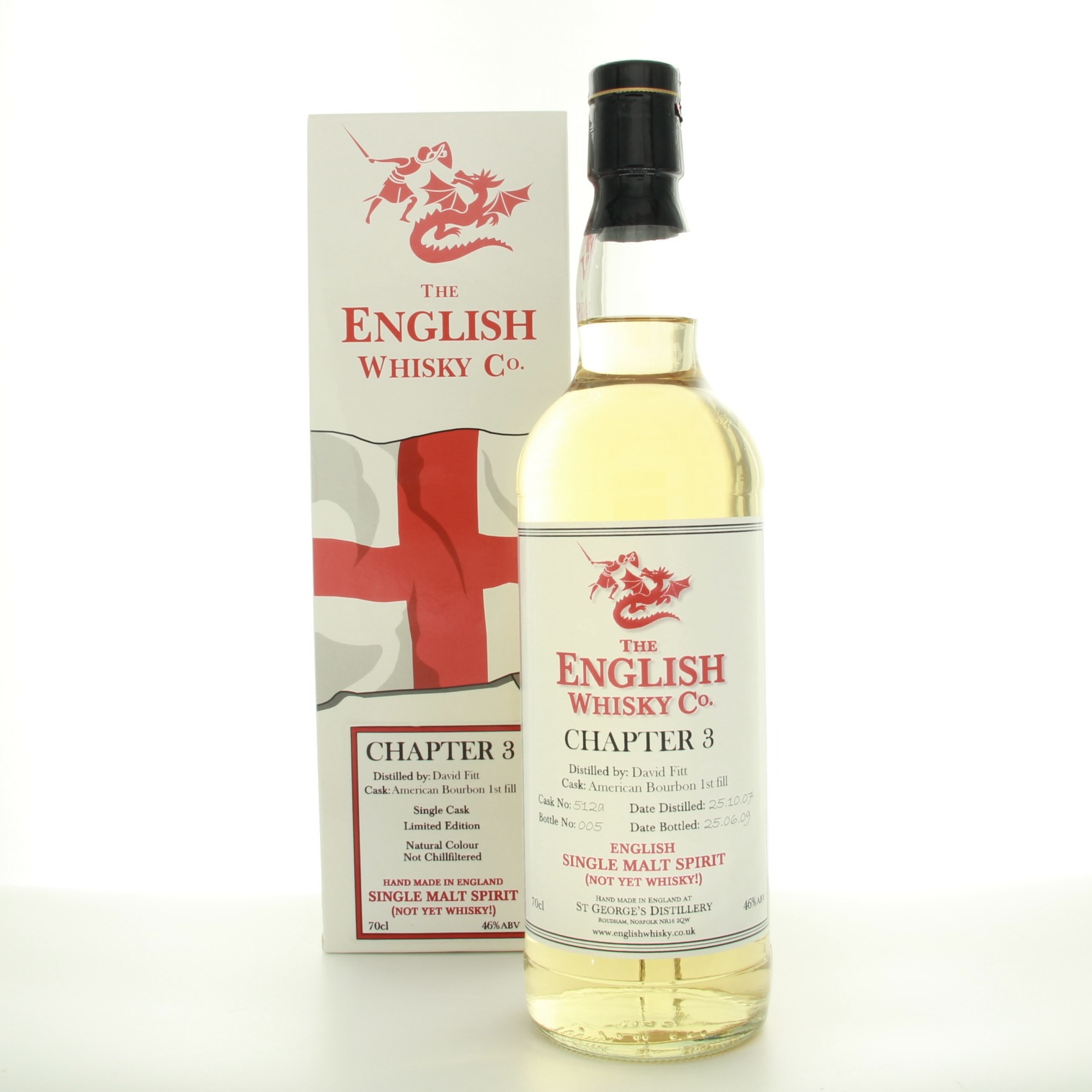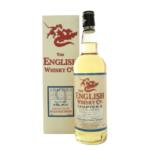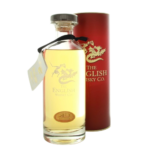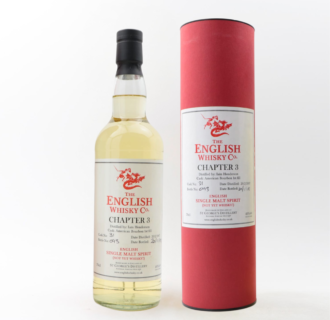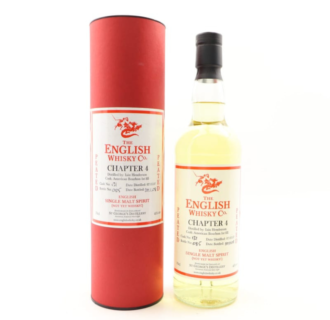
English Whisky Co. Chapter 3 2007
70cl / 46%

£86.00
- Cask type: Bourbon
- Malt type: New Make
- Region: England
- Chilfiltered: No
- Coloring: No
If you like this whisky, you will also like these
A pivotal, three-year-old release confirming the legitimacy and quality of England’s pioneering modern whisky production era.
At-a-Glance
| Field | Details |
| Distillery / Bottler / Country & Region | The English Whisky Co. (St George’s Distillery) / England, Norfolk |
| Category | Single Malt English Whisky |
| Age / Vintage / Bottled | 3.25 Years Old / Distilled 12/2007 / Bottled 03/2011 |
| ABV & Size(s) | 46% ABV / 70cl (700ml) |
| Cask / Treatment | American Oak, finished in small 40-litre Oloroso/PX casks |
| Natural Colour | Yes, stated |
| Non-Chill-Filtered | Yes, stated |
| Cask Strength | No (bottled at 46%) |
| Bottle count / Outturn | 1,000 bottles |
| Intended channel | Distillery and specialist UK retail |
| Packaging | Standard glass bottle, presentation tube/box |
| Notes on discrepancies | None stated; specifications are confirmed by the producer. |
Historical Context
The English Whisky Co. (EWC), operating from St George’s Distillery in Norfolk, holds the distinction of spearheading the modern revival of English single malt production, having commenced operations in 2006 ``. The Chapter Series (releases 1 through 5) serves as a vital historical record of the distillery's foundational years and its initial explorations into cask management.
Chapter 3, distilled in late 2007 and bottled in March 2011, is one of the earliest official releases to satisfy the minimum three-year maturation requirement for single malt, reaching 3.25 years of age at bottling. The high demand confirms that the collector base prioritizes demonstrable historical provenance over traditional measures of maturity.
The technical specifications of this release are a direct result of the distillery's early operational needs. As a fledgling operation aiming to rapidly establish market legitimacy and perceived quality, EWC required a production method that could quickly develop a complex flavour profile. This need dictated an accelerated maturation strategy.
Technical Specification & Variant Map
The Chapter 3 expression was released at a conservative 46% ABV and a standard volume of 70cl, with a strictly limited outturn of 1,000 individually numbered bottles ``. This intentional scarcity cemented its collectible status immediately upon release.
The technical solution to the challenge of youth was innovative cask management. While the spirit began its life in American Oak, it received a critical finishing period in small, 40-litre Oloroso and Pedro Ximénez (PX) casks. This successful technical maneuver was essential in establishing immediate consumer confidence in the quality of the new English single malt category.
The distribution strategy for this critical early bottling was focused heavily on the UK domestic market through the distillery and specialist retailers ``. This focused approach was designed to solidify initial brand credibility and secure a loyal collector base within England before considering wider international distribution.
Documented variants
The Chapter 3 release maintains highly consistent specifications across the entire outturn: 46% ABV, 70cl, and 1,000 fixed bottles ``. No significant packaging or ABV variants exist for this specific batch.
Variant Matrix
| ABV | Volume | Market | Era cues | Relative desirability | |
| Chapter 3 (Standard) | 46% | 70cl | UK Specialist Retail | Early Chapter Series, Small Cask Finish | High (Due to historical significance) |
Packaging & authenticity checklist
The packaging is straightforward: a standard glass bottle generally accompanied by a presentation tube or box. Authentication verification requires confirmation of the "Chapter 3" labelling, the corresponding bottling date (March 2011), and the stated 46% ABV.
While counterfeiting risk is lower than for established high-age Scotch, buyers must confirm the integrity of the original seal and the documentation related to the low outturn of 1,000 bottles ``. The presence and condition of the original presentation tube significantly elevates the collector grade and value of the acquisition.
Regulatory-terminology notes
The whisky fully complies with the UK minimum three-year maturation requirement for Single Malt Whisky.
Furthermore, EWC established a technical commitment to transparency from its earliest releases. The spirit is explicitly stated as Non-Chill-Filtered (NCF) and featuring Natural Colour ``. These premium specifications reinforce the unadulterated nature of the liquid, ensuring that the concentrated flavour derived from the small sherry casks is presented exactly as it emerged from maturation.
Liquid Profile (from verifiable notes)
The flavour profile is fundamentally defined by the strategic sherry finish, providing a depth of character rarely found in three-year-old expressions.
Nose: Rich red fruits are prominent, exhibiting significant sherry depth from the PX and Oloroso treatment, accompanied by a subtle, warming spice ``.
Palate: The initial sweetness of the cereal base quickly gives way to intense dried fruit complexity, combined with distinct nutty characteristics. The body is medium, effectively carrying the concentrated flavours.
Finish: The conclusion is lengthy, dominated by persistent nuttiness and integrated spice notes.
With water: The producer has not detailed the effect of water. Given the 46% ABV, the spirit is already at an optimal strength, and dilution is generally deemed unnecessary, as it might risk diminishing the intensity of the critical sherry influence.
Pricing & Market Dynamics (GBP)
The Chapter 3 bottling has shown robust secondary market appreciation since its 2011 release at an Original RRP of £45 ``.
The bottle is now exclusively sourced via secondary channels. Current UK retail estimates place the price range at £250–£350 (incl. VAT). Recent UK and EU auction results confirm a hammer price range typically spanning £200 to £280 as of 2023 ``.
Pricing stratification remains low. The value is fixed primarily by the historical significance and the definitive, low outturn of 1,000 bottles. Price differences are mostly attributable to minor variations in packaging condition or the specific sales channel used.
Price Snapshot
| Channel | Date | Bottle spec | Price (GBP) | Notes |
| RRP | 2011 | 70cl, 46% | £45 | Original Producer Price `` |
| Auction (Low) | 2023 | 70cl, 46% | £200 | Recent hammer price `` |
| Auction (High) | 2023 | 70cl, 46% | £280 | Recent hammer price `` |
Liquidity is strong for this expression, driven by sustained collector interest in pioneering English whisky. Sourcing, however, is significantly constrained by the low initial production run.
Distillery-Bottler Snapshot
St George’s Distillery (EWC) is universally recognized as the foundational entity of the modern English whisky movement. The early Chapter releases defined the brand’s house style—fruit-driven, rich, and technically pure (NCF/NC)—securing its position as a globally collectible pioneer.
Sourcing
Target formats-eras: The specific target is the original 2011 bottling of Chapter 3 (70cl, 46% ABV).
Red flags to avoid: Procurement should reject examples with damaged or missing presentation packaging, or those showing evidence of improper storage that has impacted the liquid fill level.
Condition thresholds: The original tube is highly valued. The liquid fill level must meet the minimum standard of high shoulder or better for collector valuation.
Margin-velocity expectations: High appreciation yields strong margin potential. However, acquisition velocity is moderate due to the inherent scarcity of the original 1,000-bottle run.