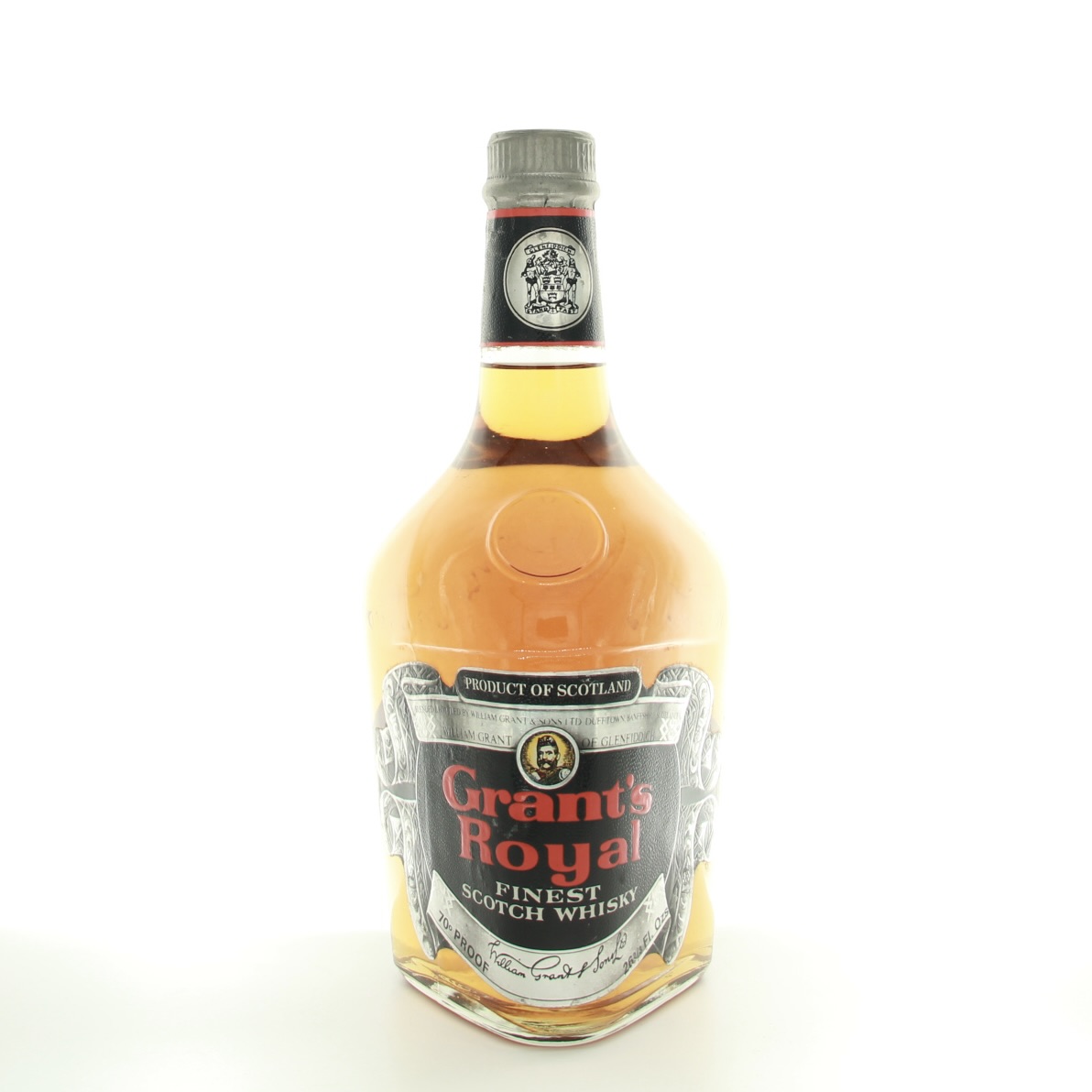
Grant’s Royal (1970s Edition)
75.7cl / 70 Proof%
£99.00

- Malt type: Blended
- Region: Speyside
If you like this whisky, you will also like these
A high-specification vintage blend, bottled at 43% and underpinned by exceptional malt stocks from Glenfiddich and The Balvenie.
At-a-Glance
| Field | Details |
| Distillery / Bottler / Country & Region | William Grant & Sons (WGS). Bottled by William Grant & Sons Ltd., Glasgow. Scotland. |
| Category | Premium Blended Scotch Whisky |
| Age / Vintage / Bottled | No Age Statement (NAS). Bottled circa 1970–1979. |
| ABV & Size(s) | 43% ABV. 75 cl. |
| Cask / Treatment | Not stated by the producer. Components underpinned by Sherry and Refill American Oak maturation from WGS stocks. |
| Natural Colour | Not stated by the producer (likely E150a added). |
| Non-Chill-Filtered | Not stated by the producer (likely chill-filtered). |
| Cask Strength | No. Standard bottling strength (43%). |
| Bottle count / Outturn | High Volume release; specific count unknown. |
| Intended channel | Premium domestic retail and high-end export markets. |
| Packaging | Distinctive flat, rectangular bottle shape. Metallic/elaborate labelling. |
| Notes on discrepancies | The 43% ABV is essential for verification; some later markets may have seen 40% versions. |
Historical Context
Grant’s Royal was strategically developed by William Grant & Sons (WGS) during the 1970s to occupy a prestige niche above their already highly successful flagship product, Grant’s Stand Fast. This commercial imperative demanded a higher malt content and superior presentation, evidenced by the unique flat, rectangular bottle shape.
The quality of this blend is intrinsically linked to its corporate provenance. As a product of the WGS family, the blend’s malt components were drawn from their substantial stocks, specifically those held at Glenfiddich and The Balvenie distilleries. These foundational malts contribute a characteristic richness, fruitiness, and robust profile to the blend, frequently incorporating heavier sherry notes than those found in competitor blends of the era. This quality assurance, backed by verifiable malt sources, is a major driver of current collectible value.
Furthermore, the bottling strength decision is significant. The choice to bottle at 43% ABV reinforced its premium positioning, particularly as the industry trend toward 40% ABV was accelerating. The higher strength preserves greater flavour integrity and enhances the mouthfeel, making the 1970s 43% edition highly sought after for consumption.
Technical Specification & Variant Map
The distinct flat, rectangular bottle shape (often featuring textured glass or embossing) serves as the primary visual confirmation of the 1970s premium status. The label frequently employs elaborate metallic inks or foiling consistent with the era’s luxury presentation.
The defining technical factor is the 75cl volume explicitly paired with the 43% ABV, which definitively anchors this expression to the more desirable 1970s premium export and domestic markets.
Documented variants
The primary target is the 43% ABV, 75 cl version. Variants include a 40% ABV, 75 cl version (representing a late 1970s or early 1980s transition in strength) and sporadic 43% ABV, 1 Litre releases intended for duty-free channels.
Variant Matrix
| ABV | Volume | Market | Era cues | Relative desirability |
| 43% | 75 cl | Domestic / Export | Rectangular bottle, 1970s metallic label | High (Target bottling) |
| 40% | 75 cl | Domestic / Export | Similar bottle shape, later label formats | Medium |
| 43% | 1 Litre | Duty Free | Rectangular bottle, 100 cl size stamp | Medium-High |
Packaging & authenticity checklist
Integrity of the closure and capsule is vital for this bottle. The unique rectangular bottle shape and older closure methods employed mean that liquid integrity relies heavily on a perfectly executed seal. Any indication of damage or compromise to the capsule must be considered a serious defect that dramatically impacts value. Buyers should verify the bottler information, confirming William Grant & Sons Ltd., and check for typical 1970s duty seals if appropriate for the sourcing region.
The liquid should not be confused with later "Grant’s Royal" releases that either abandoned the distinctive rectangular bottle format or reduced the ABV to 40%. Achieving premium pricing requires pristine label condition and, if originally supplied, the inclusion of the original box.
Regulatory/terminology notes
The inclusion of the term "Royal" is used as a brand descriptor signifying premium positioning and does not inherently denote a Royal Warrant.
Liquid Profile (from verifiable notes)
The liquid profile is significantly richer and more robust than most competitor blends from the same era.
Nose: Rich and deep, displaying notable malt density. Characterized by notes of dried fruits, dark honey, sweet spice, and a subtle, balanced whiff of smoke.
Palate: Full-bodied and viscous, the 43% ABV provides substantial weight. Flavours include pronounced sherry characteristics, notes of Christmas cake, toffee, and dark chocolate, all layered over a solid core of sweet grain whisky.
Finish: Medium to long, warming, concluding with notes of oak, gentle leather, and residual dried fruit sweetness.
With water: Not applicable or recommended due to the optimal bottling strength.
Distillery/Bottler Snapshot
William Grant & Sons (WGS) is regarded as one of Scotland's most respected family-owned distillers. Their ownership and control over premium malt resources, notably Glenfiddich and Balvenie, meant that their proprietary blends, including Grant’s Royal, possessed an inherent quality and consistency that differentiated them from many competitor blends during this era. This pedigree ensures high reliability concerning vintage quality.
Sourcing
The sourcing imperative is to focus entirely on the 43% ABV, 75cl version, identifiable by the distinctive rectangular bottle. Red flags primarily revolve around physical integrity: compromised capsules or torn seals. Significant variations in liquid colour between bottles may indicate environmental damage or potential refilling and must be investigated. Condition thresholds require capsule and seal integrity to be the highest priority. Fill level must be High Shoulder (HS) or better. Box inclusion, while rare, acts as a significant multiplier for premium pricing. Velocity is expected to be medium, but the target margin is high (60–100% possible) due to the strong brand pedigree and the technical quality differentiation provided by the 43% proofing.