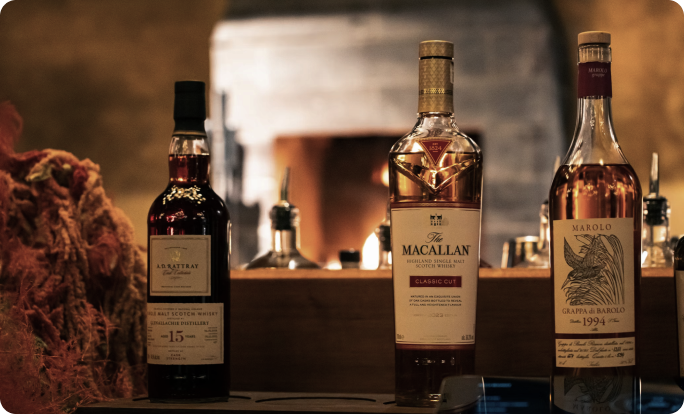
Haig Gold Label 1960s
75.7cl / 43%
£159.00

- Malt type: Blended
- Region: Scotland
If you like this whisky, you will also like these
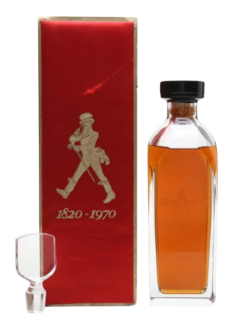
A discontinued 1960s bottling of the historic Haig blend, featuring the desirable spring cap and 43% export strength.
At-a-Glance
| Field | Details |
| Distillery / Bottler / Country & Region | John Haig & Co. (Cameronbridge Grain core) / Scotland |
| Category | Blended Scotch Whisky (NAS) |
| Age / Vintage / Bottled | No Age Statement (NAS) / Bottled 1960s |
| ABV & Size(s) | 43% ABV (or 75 Proof) / 75cl (Also 40% ABV variant) |
| Cask / Treatment | Mixed (Malts, including Glenkinchie and Linkwood; Grain, centred on Cameronbridge) |
| Natural Colour | Not stated by the producer. (Likely coloured) |
| Non-Chill-Filtered | Not stated by the producer. (Assumed chill-filtered) |
| Cask Strength | No |
| Bottle count / Outturn | Not stated by the producer (Historically high volume) |
| Intended channel | Mass-market retail (Standard blend of the era) |
| Packaging | Tall glass bottle, often featuring a spring cap and branded foil seal |
| Notes on discrepancies | Vintage Gold Label exhibits two common strengths in this era: 40% ABV and the preferred 43% ABV. This bottling sometimes lacks explicit capacity statement but is generally 75cl. |
Historical Context
Haig Gold Label is one of the most historically significant blended Scotch whiskies, tracing its origins back to John Haig, who founded the Cameronbridge grain distillery in 1824. The Haig family's association with distilling runs even deeper, extending back to the early 18th century. Gold Label established itself as a popular, approachable blend of malt and grain whiskies, maintaining its high market visibility well into the 1970s.
This 1960s bottling originates from an era of packaging innovation and strong domestic dominance for the brand. The use of the distinctive spring cap, often combined with a branded foil seal, is a key stylistic marker for bottles from the late 1950s and 1960s, prior to the adoption of the metal twist caps in the 1960s and later plastic caps in the 1970s.
Crucially, the blend relies on malt whiskies such as Glenkinchie, Linkwood, and Teaninich. However, its backbone is the single grain whisky produced at Cameronbridge. As the largest grain distillery in Scotland, Cameronbridge provided the Haig blends with a distinctive smooth, light-bodied grain character that features notes of toffee, caramel, and vanilla.
The technical distinction of the 43% ABV variant (often labelled 75 Proof in the UK or export markets of the time) positions it as the more desirable liquid profile compared to the standard 40% bottling of the time. Despite its eventual discontinuation and high historical volume, this vintage bottle remains a valuable historical sample of a seminal blended Scotch.
Technical Specification & Variant Map
Haig Gold Label is a Non-Age-Statement blend, although during this vintage era, the consistency and depth of the aged stock available contributed significantly to its reliable quality. The composition is centred on the grain whisky from Cameronbridge, balanced by malt whiskies sourced from across the Scottish Lowlands and Highlands. The higher 43% ABV version (often in the 75cl format) is the preferred specification for drinking due to its superior flavour retention compared to the 40% ABV standard.
2.1 Documented variants
| ABV | Volume | Market | Era cues | Relative desirability |
| 43% (75 Proof) | 75cl | Specialist Export / Vintage Collector | Spring cap, branded foil seal, 1960s bottling era | High (Higher strength, pre-rationalisation blend) |
| 40% (70 Proof) | 75cl | UK Domestic / Mass Market | Spring cap, various cap types (twist cap later in 60s) | Medium-Low (Common, lower strength, lower auction floor) |
Packaging & authenticity checklist
Authentication of a 1960s Haig Gold Label focuses heavily on the closure: the classic spring cap is a definitive marker of this era. Collectors should verify the bottle’s size (typically 75cl, or 26 2/3 fl. ozs. at the time) and its specific proof, aiming for the 43% (75 Proof) or 40% (70 Proof) ABV notations. Due to the age of the closure, careful inspection of the fill level is essential; while some ullage is expected, bottles with severe liquid loss or compromised corks carry high risk and decreased value. Minor label damage, such as rips or staining, is common on bottles of this vintage.
Regulatory/terminology notes
As an NAS blend, Haig Gold Label meets the basic Scotch Whisky maturation requirements. The ABV of 40% (or 70 Proof) was the standard domestic strength for blends in the mid-20th century. The key technical feature of the blend is the Cameronbridge grain, the largest grain distillery in Scotland, which forms the smooth, light core of the whisky.
Liquid Profile (from verifiable notes)
The historical profile of Haig Gold Label is noted for its approachability, smoothness, and light balance of malt and spice, contrasting with heavier blends of the time.
Nose: Smooth and light, characterised by a subtle freshness of grass and lemon. The aroma carries hints of honey, vanilla, and caramel, derived from the American oak-matured grain component.
Palate: Very mild and smooth. It offers a delicate balance of honey, vanilla, caramel, and nut flavours. A faint hint of spice or pepper from the malt is noted as it develops on the palate.
Finish: The finish is smooth, with the initial spice fading to a faint smokiness.