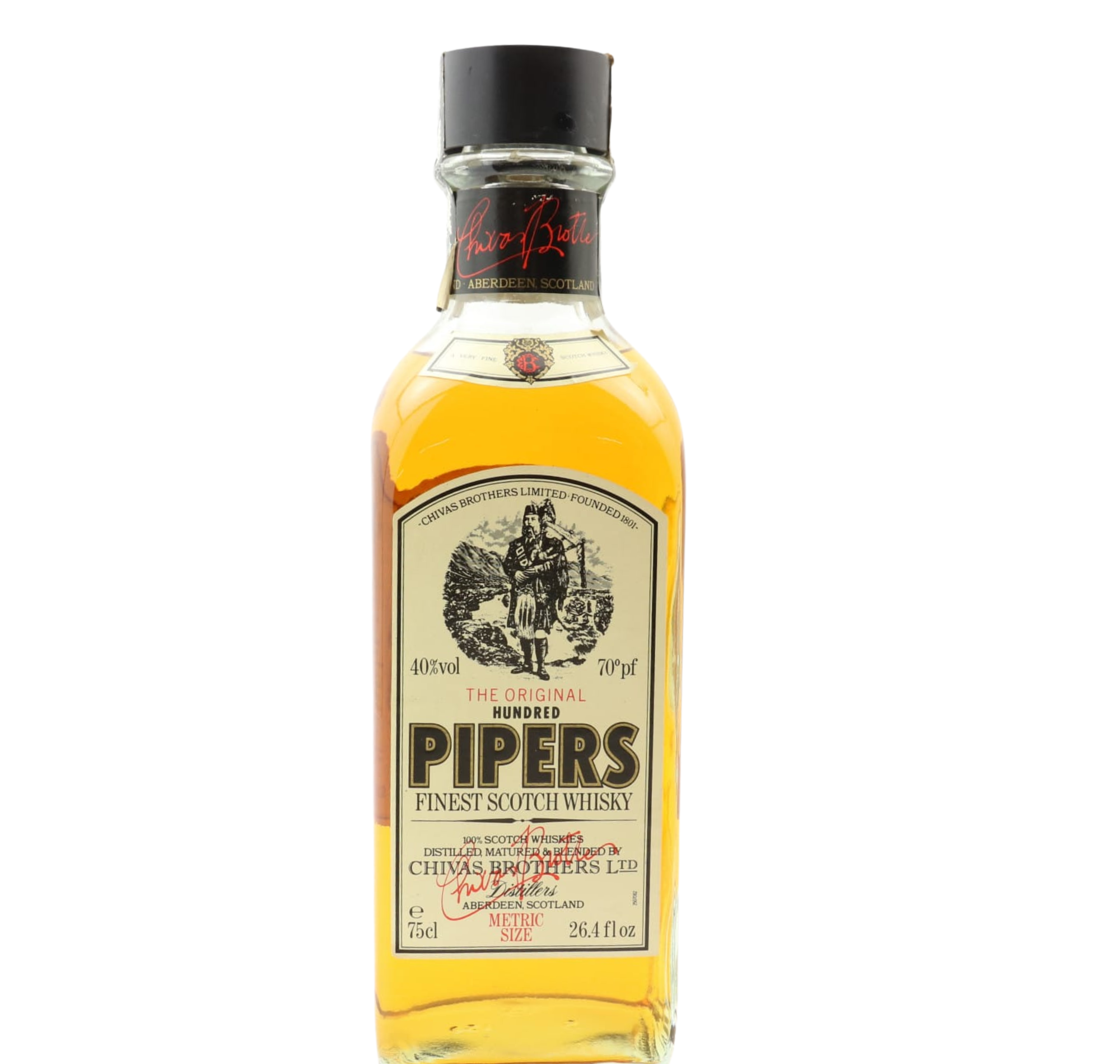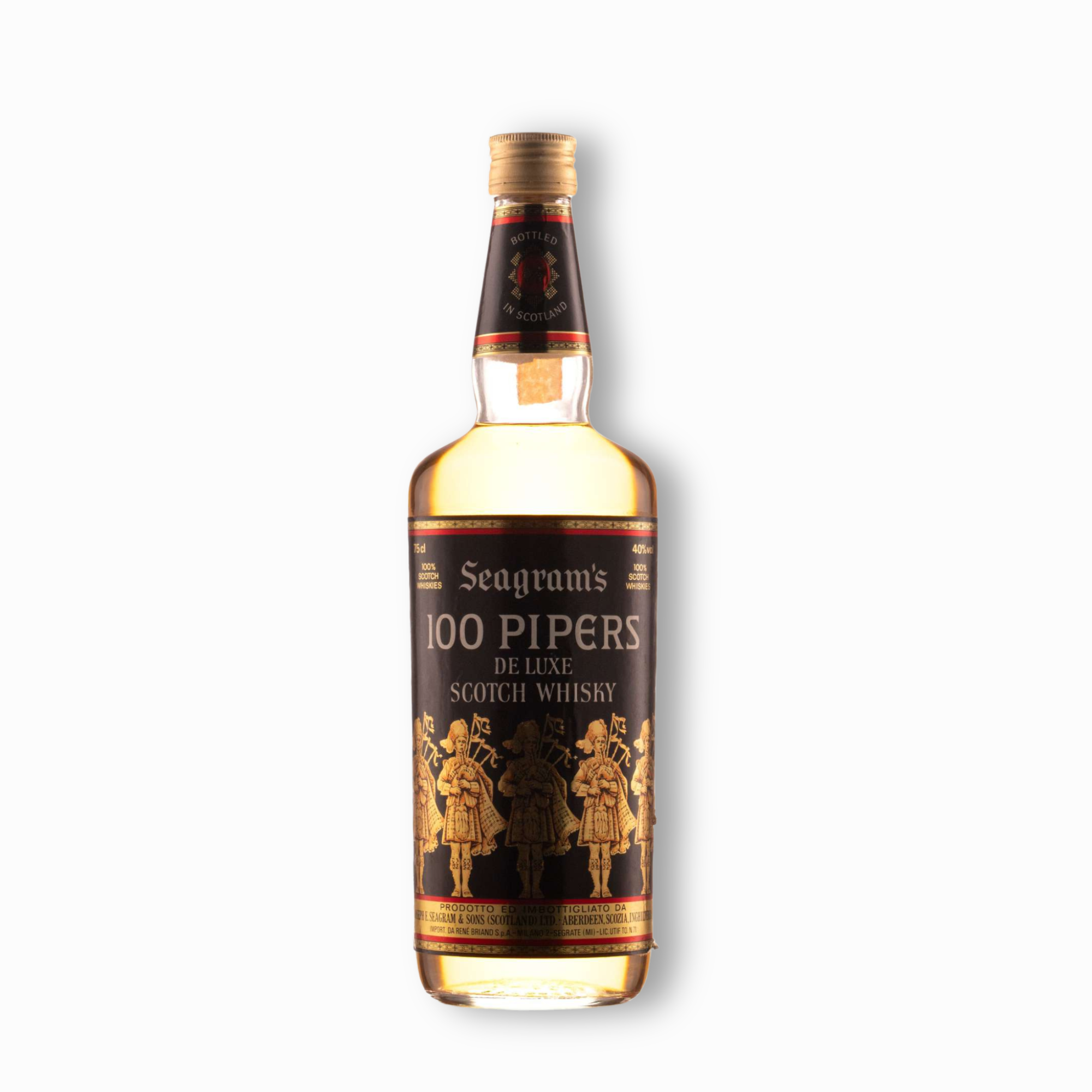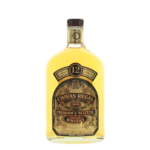
Hundred Pipers The Original (1970s Edition)
75cl / 40%70 Proof%

£99.00
- Malt type: Blended
- Region: Scotland
Tasting Notes
Oak, Spices, Ripe Fruits
Honey, Caramle, Dried Fruits,
Medium Finish, Honey, Oak
If you like this whisky, you will also like these
A genuine 1970s Seagram's bottling, capturing the historical profile of a key global standard Scotch blend.
At-a-Glance
| Field | Details |
| Distillery / Bottler / Country & Region | Seagram Distillers (Chivas Bros) / Scotland (Blended & Bottled) |
| Category | Blended Scotch Whisky (De Luxe Standard) |
| Age / Vintage / Bottled | NAS / Estimated 1970s / 1970s |
| ABV & Size(s) | 40% / 75cl or 75.7cl |
| Cask / Treatment | Aged in oak barrels (Specifics Not Stated by the producer) |
| Natural Colour | Not stated by the producer |
| Non-Chill-Filtered | No (Inferred commercial practice) |
| Cask Strength | No |
| Bottle count / Outturn | High Volume Production (Not numbered) |
| Intended channel | Global mass market, pivotal in Asian markets |
| Packaging | Standard glass bottle, screw cap/simple closure, Seagram's labeling |
| Notes on discrepancies | Volume variation (75cl vs 75.7cl) reflects transitional imperial/metric bottling standards of the era. |
Historical Context
The Hundred Pipers brand was launched in 1965 by Seagram Distillers. This 1970s bottling represents the whisky during its period of rapid global expansion under the ownership of the powerful Bronfman family, which controlled Seagram's operations. The brand positioned itself utilizing the romantic Celtic imagery derived from the historical ballad of "The Hundred Pipers".
This vintage liquid's importance is found in its historical market role rather than its premium liquid status. It was strategically positioned as a "De Luxe Blended Scotch Whisky", designed for high-volume sales. It successfully established market dominance in crucial Asian territories, including India and Thailand, where it remains a leading brand today. The 1970s bottle provides a genuine reference point for the flavour profile that achieved this level of commercial success under Seagram's methodology.
Technical Specification & Variant Map
Hundred Pipers is a blend composed of an assembly of between 25 and 30 source whiskies, incorporating both malt and grain spirits. The blending structure was designed to achieve a consistent, smooth, and approachable profile necessary for a global standard blend. A substantial portion of the malt component was derived from the Allt a'Bhainne distillery.
The bottling strength is 40% ABV, which is the standard minimum for blended Scotch.1 Crucially for dating, the volumes recorded (75cl or 75.7cl) are indicative of bottlings from the 1970s, a period when the industry was transitioning away from imperial measures toward the metric 70cl standard.
Documented variants
Variants from this era relate mostly to minor label changes based on the specific year and the intended export market, but the core 40% ABV, 75cl/75.7cl ‘De Luxe’ format remains consistent.
Variant Matrix
| ABV | Volume | Market | Era cues | Relative desirability |
| 40% | 75cl/75.7cl | Global/Vintage | Simple 1970s label, Seagram's ownership stamp 7 | Historical Reference (Low Liquid Value) |
Packaging & authenticity checklist
For vintage bottles over five decades old, inspection for integrity is essential. The fill level (ullage) is the primary concern, as a low level (e.g., below the high shoulder) can indicate long-term cork failure and evaporation, compromising the liquid. The capsule seal must be inspected closely. If the capsule spins freely or appears compromised, it suggests the bottle may have been opened and refilled with modern spirit. Although a low-cost blend initially, refilling risks exist due to the scarcity of the vintage packaging. The presence of sediment at the base, which is common in vintage whiskies, can be a positive, albeit non-definitive, indicator of an undisturbed bottling. The label should clearly reference the 'De Luxe' designation and Seagram’s.
Regulatory/terminology notes
As a blended Scotch, the components meet the minimum three-year maturation requirement in oak in Scotland. Standard production practices of the 1970s confirm this blend is likely chill-filtered and contains caramel colouring (E150a), as these were industry norms for high-volume products.
Liquid Profile (from verifiable notes)
The profile is simple, smooth, and straightforward, characteristic of a 1970s standard blended Scotch.
Nose: Presents a basic framework of oak, sweet spices, and ripe fruits. There is a presence of honey and caramel.
Palate: Exhibits a medium-to-full body. The taste is defined by dominant notes of creamy vanilla, raw cereal notes, caramel, and simple dried fruits. It is consistently described as being straightforward in delivery.
Finish: The conclusion is of medium length, echoing characteristics of honey and soft oak.
Pricing & Market Dynamics (GBP)
The Original RRP for this blend was low, commensurate with its positioning as a global commodity. In the contemporary secondary market, the pricing is highly volatile, driven primarily by bottle condition and historical interest. Auction results show low hammer prices, documented at £25.00 in 2021. However, specialized vintage retailers may demand significantly higher prices for bottles in pristine condition, such as the £145.00 quoted for a 75.7cl example. This price stratification indicates that the market value is tied to condition and historical relevance, not intrinsic liquid performance or investment growth. Liquidity is low, restricted to niche collector auctions.
Price Snapshot
| Channel | Date | Bottle spec | Price (GBP) | Notes |
| Auction (Hammer) | 27/06/2021 | 75cl, 40% | £25.00 | Confirmed low secondary market hammer price 15 |
| Retail (Vintage) | Current | 75.7cl, 40% | £145.00 | Example of high-end vintage retail pricing 6 |
Distillery/Bottler Snapshot
This bottling reflects the high-volume production standards of Seagram's during their peak global influence. It represents commercial blending expertise rather than small-batch artisan craft.
Sourcing
Target formats/eras
Focus on 1970s 75cl or 75.7cl bottles explicitly bearing the Seagram's 'De Luxe' stamp.
Red flags to avoid
Avoid bottles with low fill levels (mid-shoulder or below). Reject bottles where the capsule seal integrity is compromised.
Condition thresholds
A high shoulder fill level or better is necessary. Pristine label condition is highly valued for collectors focused on historical memorabilia.
Margin/velocity expectations
Low sales velocity is expected. Margins are achieved primarily by marketing to niche collectors of vintage blended Scotch.