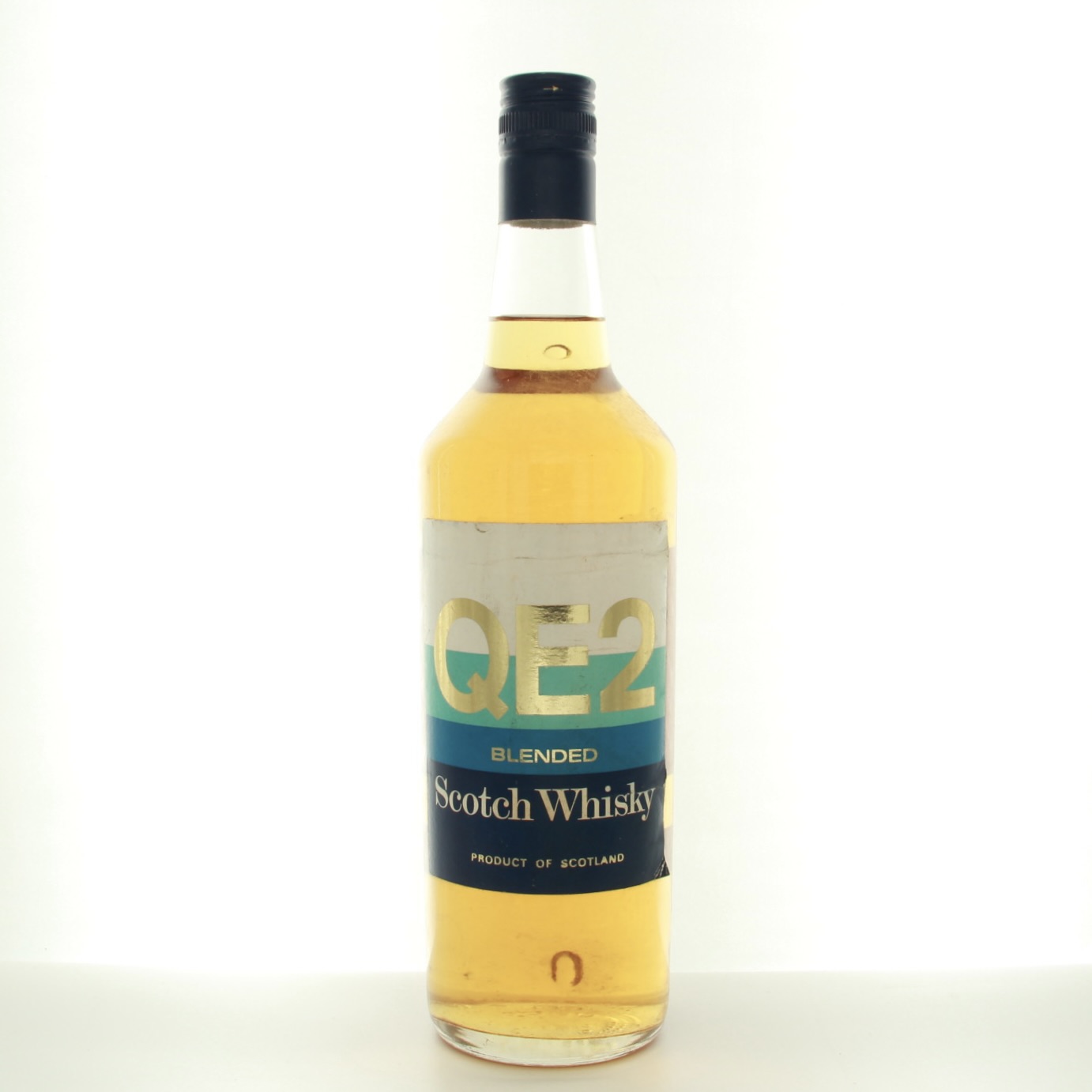
James Buchanan QE2 1970s
75cl / 70 Proof%
£149.00

- Malt type: Blended
- Region: Scotland
If you like this whisky, you will also like these
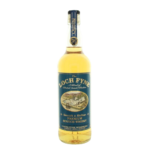
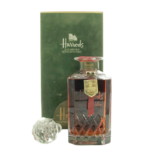
A classic 1970s era blend, representing the golden age of DCL bottling standards.
At-a-Glance
| Field | Details |
| Distillery / Bottler / Country & Region | Multiple DCL Sources / James Buchanan & Co. Ltd. / Scotland |
| Category | Blended Scotch Whisky |
| Age / Vintage / Bottled | No age statement / Circa 1970s / Varies (specific label iteration) |
| ABV & Size(s) | 43% ABV / 75cl (Most desirable collector format) |
| Cask / Treatment | Not stated by the producer |
| Natural Colour | Not stated by the producer |
| Non-Chill-Filtered | Presumed Non-Chill-Filtered (Standard for era) |
| Cask Strength | No |
| Bottle count / Outturn | Commercial Blend |
| Intended channel | Luxury Travel Retail / Export Market |
| Packaging | Standard glass bottle, often with specific QE2 labelling/promotional material |
| Notes on discrepancies | 43% ABV, 75cl is preferred over the later 40% ABV, 70cl version. |
Historical Context
The James Buchanan QE2 blend is intrinsically tied to the operational dominance of the Distillers Company Limited (DCL), the conglomerate that eventually became Diageo. During the 1960s and 1970s, DCL maintained immense reserves of aged malt and grain whiskies, which provided blenders, including those at James Buchanan & Co. Ltd., with access to deeply mature stocks.
This era, often termed the "golden age" of blending, is historically significant because the standard commercial blends of the 1970s are widely accepted to have contained a substantial proportion of mature components compared to many modern counterparts. This factor is the primary driver of collector interest in these vintage blends.
The specific "QE2" designation utilized for this bottling serves a dual purpose: it establishes a strong historical association with the luxury travel and duty-free market segments of the 1970s.
Analysis of the secondary market demonstrates that the physical condition of this historical blend is the overriding factor in its valuation, acting as a crucial proxy for quality preservation. The auction data reveals a marked difference in hammer price between bottles with a high-shoulder (HS) fill and those showing mid-shoulder (MS) fill. A higher fill level signifies better preservation of the liquid over the decades, indicating less evaporation and reduced oxidation. This valuation mechanism confirms that collectors prioritize liquid integrity above the bottle's inherent rarity, making the condition threshold the most important metric.
Technical Specification & Variant Map
Documented variants
For collectors, the most desirable iteration of the James Buchanan QE2 bottling is the earlier 1970s release, characterized by its 43% ABV and 75cl volume. This specification is crucial because later versions, reflecting the regulatory and blending shifts of the post-1980s, standardized to 40% ABV and 70cl. These later, lower-strength variants are consistently perceived as less desirable. The labelling should also carry the identification of "James Buchanan & Co. Ltd." as the distributor.
Variant Matrix
| ABV | Volume | Market | Era cues | Relative desirability |
| 43% | 75cl | Export / Duty-Free | Pre-1980s distribution name | High (Collector Grade) |
| 40% | 70cl | UK / Later Export | Post-1980s distribution/regulation | Moderate/Lower |
Packaging & authenticity checklist
Authenticity checks must focus on several period-specific markers. The presence of appropriate historical duty stamps or importer stickers provides strong provenance. Furthermore, the explicit identification of the distributor as "James Buchanan & Co. Ltd." confirms the desired era. A crucial technical pitfall is the degradation of the cork and capsule, leading to ullage. Collectors must scrutinize the fill level: a level falling below the high shoulder (HS) will severely impact market value, as confirmed by auction results.
Regulatory/terminology notes
The bottling strength of 43% ABV serves as a key implicit indicator of the product’s vintage. This strength was commonly adopted for premium blends destined for specific international markets prior to widespread regulatory standardisation.
Liquid Profile (from verifiable notes)
The expected profile is inferred from the known quality of DCL's aged stock during the 1970s, suggesting a high ratio of mature malt components.
Nose: Not stated by the producer. The profile is anticipated to be rich and complex, potentially exhibiting notes of old wax, dried dark fruits (such as figs and raisins), leather, and a subdued, warming layer of peat smoke or earthiness.
Palate: Not stated by the producer. Should present a heavier, slightly viscous mouthfeel than contemporary blends. Expected flavour components include butterscotch, rich caramel, notable sherry influence, and a robust, lengthy presence of malt components.
Finish: Not stated by the producer. Expected to be lengthy and satisfying, concluding with balanced oak spice and a hint of residual dark sweetness.
With water: Not applicable.
Distillery/Bottler Snapshot
James Buchanan & Co. played a fundamental role in globalizing premium blended Scotch. The QE2 bottling exemplifies the production standards of the 1970s DCL era, where widespread access to highly mature component whiskies allowed commercial blends to achieve a depth and complexity rarely replicated in standard current-day products.
Sourcing
Target formats/eras: The 43% ABV, 75cl format, with a minimum fill level of High Shoulder (HS).
Red flags to avoid: Bottles displaying obvious ullage or evidence of cork degradation; the later, less desirable 40% ABV versions.
Condition thresholds (fill/box/labels): High Shoulder (HS) fill minimum is non-negotiable for premium valuation; capsule and label integrity must be robust.
Margin/velocity expectations — qualitative: High velocity for bottles in excellent condition (HS fill); margins are reflective of this stringent condition requirement.