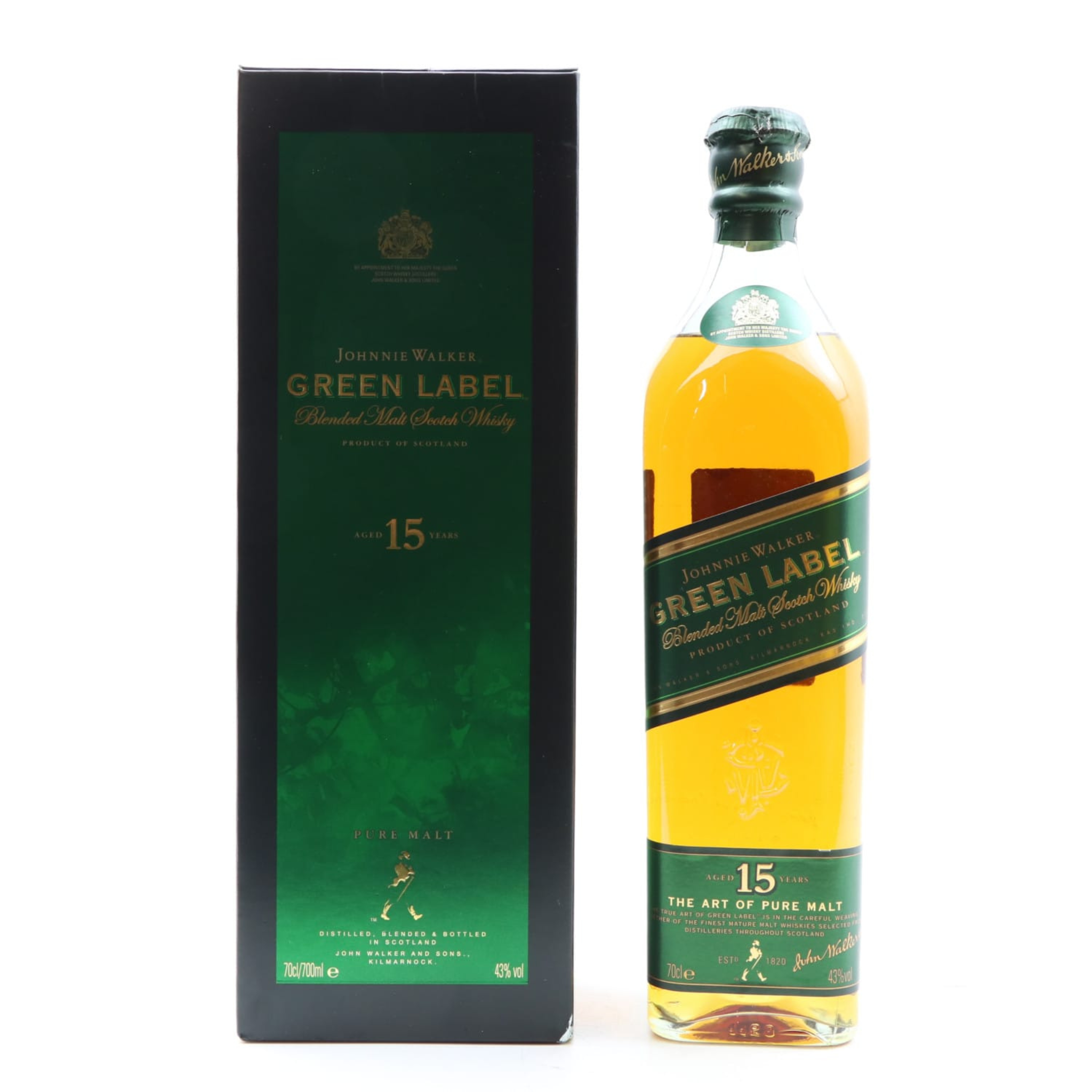
Johnnie Walker Green Label 15 Years Old (2000s Edition)
70cl / 43%
£99.00

- Malt type: Blended Malt
- Region: Scotland
- Coloring: Yes
Tasting Notes

Herbal and rich with hints of fresh-cut grass, smoke, and deep wood spice.

Full-bodied with layered notes of malt, dark chocolate, dried fruit, and peat warmth.

Lingering and complex, with an earthy, slightly smoky conclusion.
If you like this whisky, you will also like these


Classic 15-year-old blended malt built on Talisker, Linkwood, Cragganmore and Caol Ila, in the original 2000s presentation.
At-a-Glance
| Field | Details |
|---|---|
| Distillery / Bottler / Country & Region | John Walker & Sons (Diageo), Scotland |
| Category | Blended (vatted/pure) malt Scotch whisky |
| Age / Vintage / Bottled | 15 Years Old / Early-to-mid 2000s packaging |
| ABV & Size(s) | 43% ABV, 70cl common; 1L for travel retail |
| Cask / Treatment | Malt blend built around four key malts (Talisker, Caol Ila, Cragganmore, Linkwood); individual casks not stated by the producer |
| Natural Colour | Not stated by the producer |
| Non-Chill-Filtered | Not stated by the producer (assume chill-filtered for global release) |
| Cask Strength | No |
| Bottle count / Outturn | Ongoing line in the 2000s, not numbered |
| Intended channel | Global retail and travel retail, premium JW tier |
| Packaging | Green bottle label with gold accents, square JW bottle, carton box in matching colours |
| Notes on discrepancies | Some 2000s bottles still say “Pure Malt” or use slightly different carton shades; confirm 15 Years Old, 43%, and “Green Label” for listing accuracy |
Historical Context
Green Label was the permanent, age-stated malt-only expression in the Johnnie Walker range during the 2000s. It evolved out of the earlier 15-year-old pure malt concept and formalised the idea that JW could sell a whisky with no grain component while keeping the brand’s house balance. It used Diageo’s deep stocks of coastal, smoky and Speyside malts to create something unmistakably “Walker” but more malt-driven than Black Label. The four malts that were always talked about for Green Label in this era were Talisker (peppery, maritime), Caol Ila (clean smoke), Cragganmore (structured, fruity, slightly herbal) and Linkwood (elegant, floral). That combination gave Green Label its very recognisable profile: sweet-and-smoky, but not as forceful as an Islay single malt and not as caramel-heavy as a blended Scotch. In some markets the line paused or was reduced later, which is why 2000s bottles are sought after: they represent the “original recipe” era and, for many drinkers, the benchmark version.
Technical Specification & Variant Map
2.1 Documented variants
-
70cl, 43%, boxed, 2000s UK/EU release (most common collector target).
-
1L, 43%, travel retail, 2000s, same liquid and design but larger format.
-
Transitional labels that still lean on “vatted/pure malt” wording but are recognisably the same 15-year-old product.
-
Later 2010s reintroductions exist, but for this entry we keep to the 2000s style.
Variant Matrix
| ABV | Volume | Market | Era cues | Relative desirability |
|---|---|---|---|---|
| 43% | 70cl | UK/EU retail | Green carton, 2000s fonts, 15 Years Old | Highest for standard collectors |
| 43% | 1L | Travel retail | Same livery, taller bottle | Very good, value-led for drinkers |
| 43% | 70cl | Transitional “pure/vatted malt” text | Early 2000s, pre-standardised wording | Niche/interesting, case-by-case |
2.2 Packaging & authenticity checklist
-
Bottle: classic JW square bottle, green main label, age statement 15 clearly printed.
-
Carton: dark-to-mid green with gold edging; age statement and “blended malt” (or earlier term) must match bottle.
-
Closure: factory seal/capsule must be intact; 2000s stock sometimes shows carton shelfwear.
-
Back label: should describe the balance of key malts; minor wording differences by market are normal.
-
Common pitfalls: 2010s-and-later Green Label shown with 2000s description; 1L travel bottle described as 70cl; missing box on a listing that uses box photos.
2.3 Regulatory/terminology notes
-
In the 2000s the term “vatted malt” or “pure malt” was still commonly used; today the legal term is “blended malt Scotch whisky”. When listing, use the modern term but note older wording if it appears on the bottle.
-
Age statement 15 years means the youngest malt in the blend is 15 years old.
-
No declarations on colour or chill-filtration, so none should be claimed.
Liquid Profile (from verifiable style notes)
Nose: Malty and rounded with honey, toffee and soft oak, then gentle smoke and a maritime lift. A light floral note consistent with Linkwood/Cragganmore.
Palate: Medium-bodied, very well integrated. Sweet malt up front, then pepper, a wisp of peat smoke, some citrus, and herbal/fruit notes from the Speyside components. The 43% bottling strength keeps it lively.
Finish: Medium to long, with lingering malt sweetness, light smoke and a soft, slightly drying oak spice.
With water: A small splash will push the fruity/herbal side forward and make it even easier to drink; too much water will flatten the smoke.
-
Original RRP (GBP): Not stated by the producer.
-
Current UK retail/collector asking range (GBP): typically 90–140 GBP for a clean 2000s 70cl with box; 1L travel bottles can sit in a similar band or a touch lower, depending on condition.
-
Observed secondary-market working band (GBP): often 70–110 GBP for sealed bottles without notable provenance; high-condition, fully boxed 2000s examples can go to the top of the band.
-
Pricing stratification: boxed 70cl 2000s edition at the top; unboxed or slightly scuffed to the middle; 1L travel retail to the value side.
-
Liquidity & sourcing note: very liquid because the name is well known and many drinkers remember this recipe; easy to replenish when priced in the mid band.
Distillery/Bottler Snapshot
John Walker & Sons, now under Diageo, controls a large portfolio of malt distilleries. Green Label was the showcase for that advantage: a whisky made entirely of malt yet built in the Walker house style. The four malts most closely associated with it make sense from a blending perspective: Talisker for pepper and coastal character, Caol Ila for clean smoke, Cragganmore for structure and complexity, and Linkwood for elegant sweetness. The 15-year age statement gave it credibility above everyday blended Scotch and made it a connoisseur’s “house” JW.
Sourcing
-
Target formats/eras to prefer: 2000s 70cl, 43%, with original green carton, clean fill, clean closure.
-
Red flags to avoid: modern-era Green Label being sold as 2000s; heavy carton wear misaligned with a “collectors” price; bottles with stained labels from poor storage.
-
Condition thresholds: fill into neck, label intact, carton acceptable for retail photography.
-
Margin/velocity expectations: if sourced in the 70–90 GBP zone, there is room to retail toward 120–140 GBP to collectors who want the 2000s presentation.