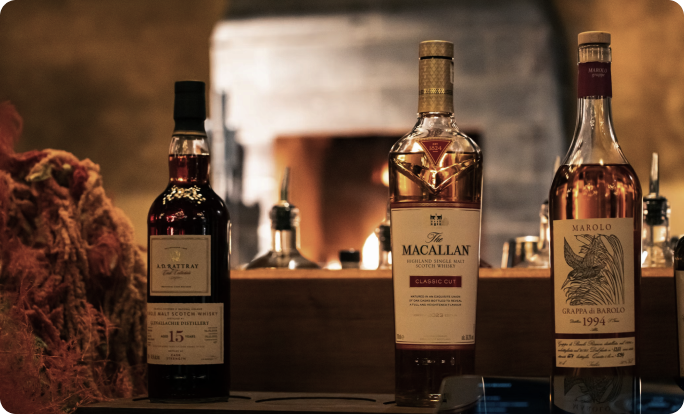
Johnnie Walker Red Label (1970s Edition)
75cl / 40%
£99.00
- Malt type: Blended
- Region: Scotland
Tasting Notes

Fruity citrus aroma

Black pepper and sweet cinnamon flavours

Long lingering smoky finish
If you like this whisky, you will also like these
A highly coveted vintage bottling reflecting the richer, peatier character of the world’s most famous blend prior to modern supply adjustments.
At-a-Glance
| Field | Details |
| Distillery / Bottler / Country & Region | John Walker & Sons (DCL) / Scotland, Blended Scotch |
| Category | Blended Scotch Whisky (Vintage Standard Grade) |
| Age / Vintage / Bottled | No Age Statement (NAS) / Bottled 1970s |
| ABV & Size(s) | 40% ABV, 70cl (Common UK/EU metric bottling) |
| Cask / Treatment | Oak maturation (Not stated by the producer) |
| Natural Colour | Not stated by the producer (Assumed E150a used) |
| Non-Chill-Filtered | No |
| Cask Strength | No |
| Bottle count / Outturn | High volume retail (Specific bottling volume unknown) |
| Intended channel | Global Standard Retail |
| Packaging | Square glass bottle, iconic 24° slanted label. |
| Notes on discrepancies | 40% ABV 70cl represents the late 70s/early 80s UK shift. Export versions were often 43.4% ABV (86.8 Proof). |
Historical Context
Johnnie Walker Red Label, first introduced in 1909, is globally recognised for its consistency. However, bottlings from the 1970s are viewed fundamentally differently from contemporary production. This era preceded the widespread production boom often referred to as the ‘Whisky Loch’. Consequently, the component malts used in standard blends during the 1970s were often older and possessed a greater complexity than those used in subsequent decades.
During this period, the brand was managed by Distillers Company Limited (DCL), the direct precursor to Diageo. The blend benefited from the extensive inventories of key DCL distilleries, including Cardhu, and utilized critical Island malts like Caol Ila and Talisker, which historically lent a richer, more characterful smoky dimension to the standard Red Label expression.
Technical Specification & Variant Map
Accurate dating and authentication of a 1970s bottling requires a rigorous examination of the regulatory markers, as the decade encompassed a major transition from imperial to metric systems. Key markers for dating include the presence or absence of a tax strip (generally discontinued in 1985), the listing of volume in avoirdupois (pints and quarts, prior to 1980) versus metric, and the use of Universal Product Codes (UPC), which became common in the late 1970s.
While the 70cl, 40% ABV bottling is a standard UK/EU metric format, collectors often prefer export versions bottled at 43% ABV (or 86/86.8 Proof). The higher alcohol content is understood to have provided better protection against chemical degradation and oxidation (commonly known as the Old Bottle Effect) over the decades. The liquid quality is the definitive metric for valuation; experienced collectors confirm that the vintage profile, particularly the 43% ABV expression, often exhibits superior complexity, justifying a market premium comparable to certain aged single malts.
Documented variants
The difference between UK domestic and US/Export bottling strengths constitutes the most significant variance in collector desirability.
Variant Matrix
| ABV | Volume | Market | Era cues | Relative desirability |
| 40% | 70cl | UK/EU | Metric volume, 70º proof equivalent (Late 70s/Early 80s) | Moderate (Standard ABV, good liquid quality) |
| 43% (86 Proof) | 75cl or 4/5 Quart | US/Export | Higher ABV, imperial/US volume or early metric (Mid-Late 70s) | High (Superior liquid concentration and preservation) |
Packaging & authenticity checklist
The bottle must conform to the signature Johnnie Walker design, featuring the square glass shape and the iconic 24° slanted label. For vintage blends, the fill level is critically important: a high shoulder (HS) or higher fill level is vital. Low ullage (excessive evaporation) suggests oxidation may have occurred, a risk particularly pronounced in the 40% ABV version. Buyers should seek confirmation regarding the absence of a UPC code if dating the bottle to the mid-1970s or earlier.
Regulatory/terminology notes
Red Label is a No Age Statement (NAS) blend. Its elevated valuation on the secondary market is based entirely on the qualitative characteristics of the historical component whiskies used, which offered a demonstrably richer and deeper profile than subsequent, younger iterations.
Liquid Profile (from verifiable notes)
The vintage Red Label is highly regarded for its unexpected depth and complexity.
Nose: The aroma is richly expressive, reminiscent of older single malts like Glenfarclas 15. It features a genuine note of old sherried oak, interwoven with a powerful and appealing hit of toffee.
Palate: The mouthfeel is creamy, delivering pronounced spiciness and a subtle influence of bourbon wood. The overall flavour is highly rewarding and is considered by experts to compete favourably with premium expressions, including the modern Johnnie Walker Blue Label.
Finish: Not explicitly detailed, but implied to be complex and prolonged, supported by the rich, sherried structural components.
With water: Not stated by the producer.
Distillery/Bottler Snapshot
John Walker & Sons, operating under DCL management, commanded access to enormous resources and aged malt stocks. The exceptional quality noted in the 1970s Red Label vintage reflects the vast inventory reserves and blending skill prevalent during this era of DCL’s history.
Sourcing
Target formats/eras: The priority in sourcing should be placed on 4/5 Quart or 86.8 Proof (43.4% ABV) variants due to their superior flavour retention.
Red flags to avoid: Bottles exhibiting low fill levels (below High Shoulder). Bottles bearing UPC codes or definitive modern metric markings should be viewed cautiously if they are being sold under the claim of being mid-1970s vintage.
Condition thresholds (fill/box/labels): High Shoulder (HS) fill level is paramount for valuation.
Margin/velocity expectations—qualitative: Well-preserved, high-proof bottles offer strong margin potential and maintain consistent velocity among serious vintage collectors.