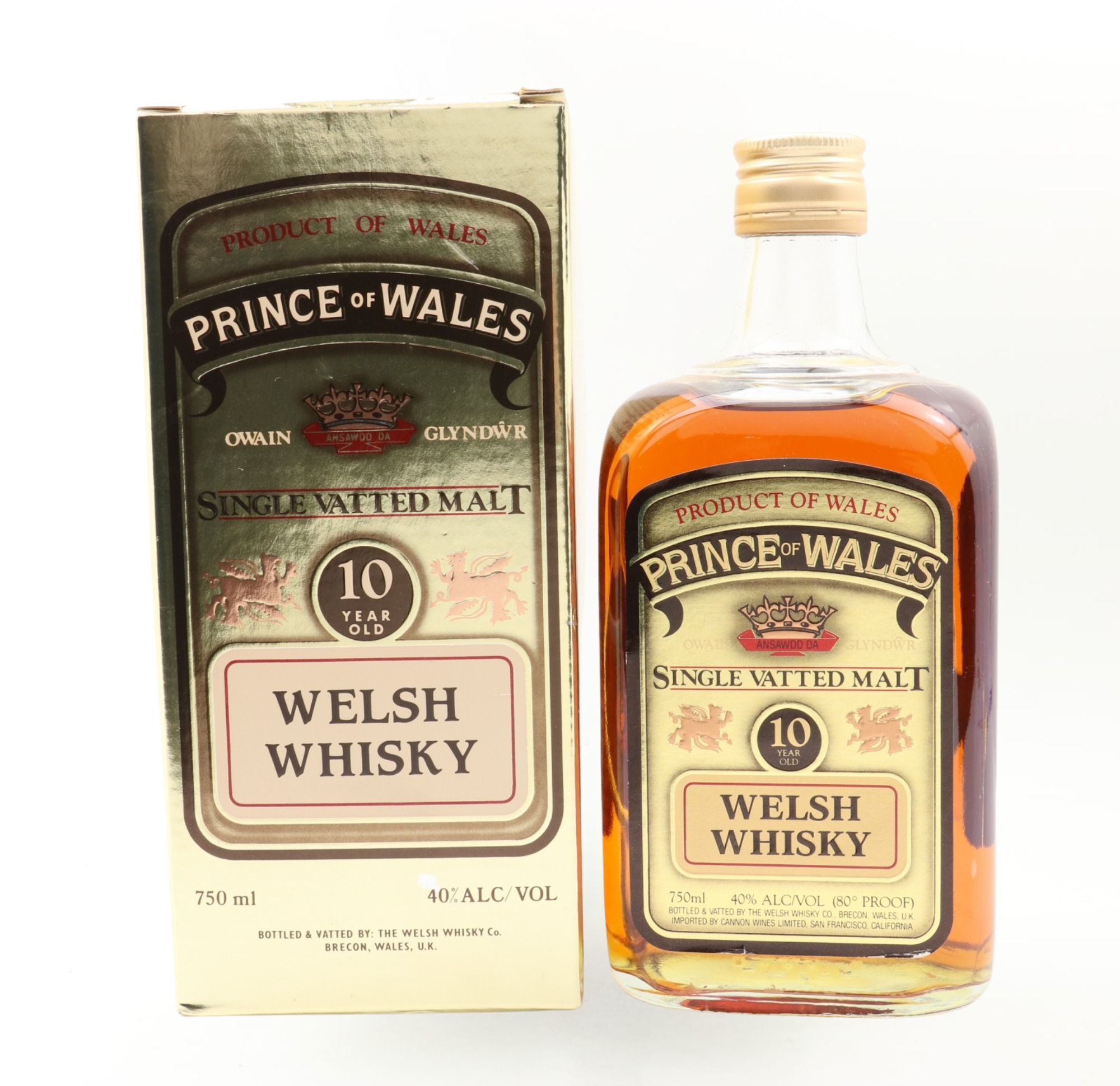
Prince Of Wales 10 Year Old Welsh Malt Whisky (1980’s Edition)
75cl / 40%
£179.00

- Region: Wales
If you like this whisky, you will also like these
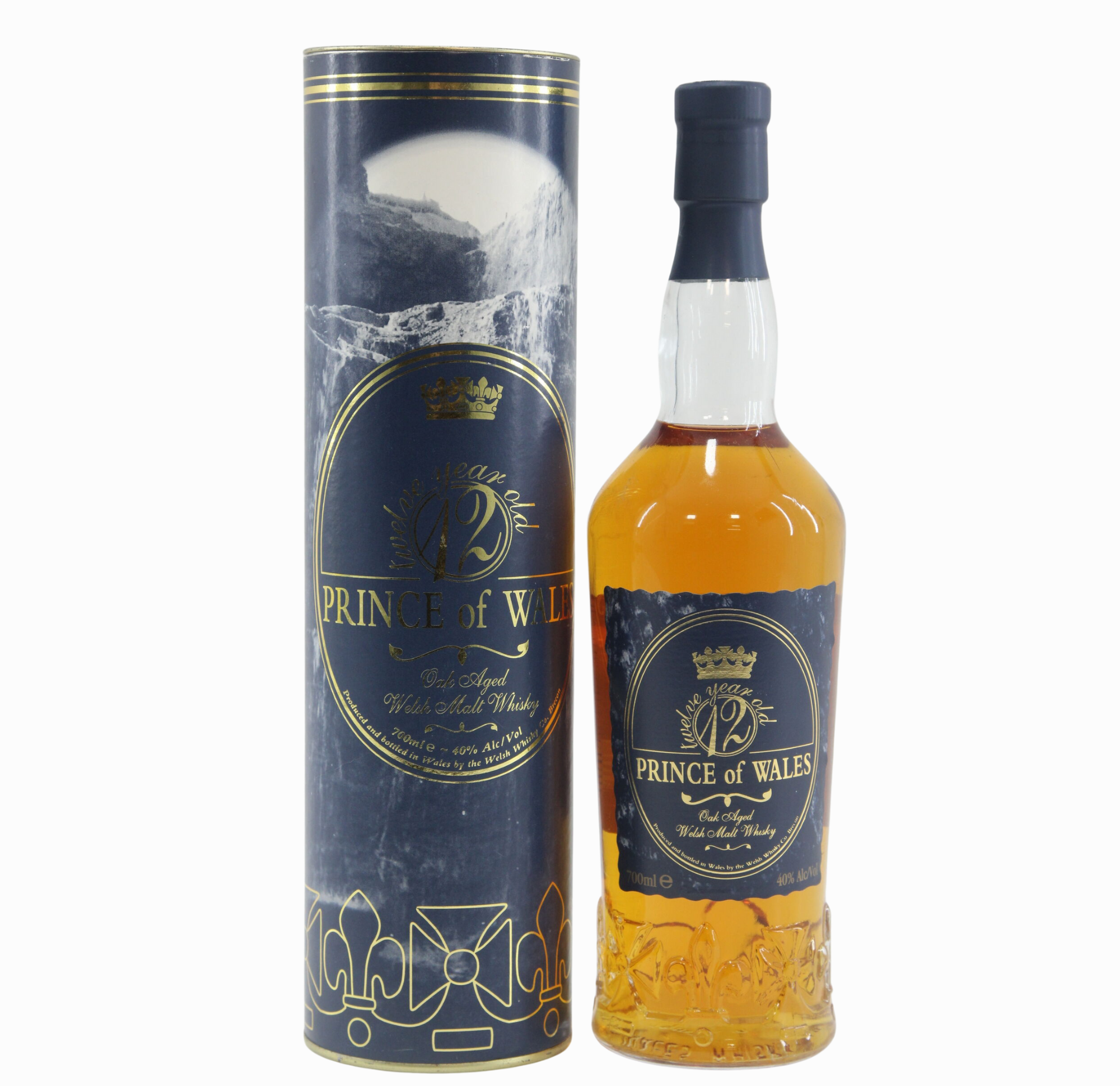


A pivotal, yet contentious, pre-revival Welsh bottling, representing the historical foundation of modern Welsh whisky.
At-a-Glance
| Field | Details |
| Distillery / Bottler / Country & Region | Unstated Scotch Distillery / The Welsh Whisky Co. / Wales (Sourced Scotch) |
| Category | Single Vatted Malt (Sourced Scotch Malt Spirit) |
| Age / Vintage / Bottled | 10 Year Old / Not stated by the producer / Bottled 1980s |
| ABV & Size(s) | 40% ABV (80° Proof) / 75cl |
| Cask / Treatment | Oak maturation (Scottish) / Rumoured herb filtering in Wales |
| Natural Colour | Not stated by the producer (Inferred Yes) |
| Non-Chill-Filtered | Not stated by the producer (Inferred No) |
| Cask Strength | No |
| Bottle count / Outturn | Not stated by the producer |
| Intended channel | Domestic UK and historical curiosity market |
| Packaging | Clear glass bottle, screw cap, original box often included |
| Notes on discrepancies | This liquid is demonstrably sourced Scottish whisky, bottled in Wales during a period when no legal commercial distillation occurred in the country. |
Historical Context
The Prince of Wales 10 Year Old is significant not for its liquid quality, but for its role as a precursor to the modern Welsh whisky industry. Commercial distillation in Wales had ceased completely by 1910. When The Welsh Whisky Co. began bottling in the 1980s, they sought to revive a national spirit identity without possessing a functional distillery.
The approach involved sourcing aged Scotch malt whisky, importing it, and bottling and "vatting" it in Wales. This process allowed them to apply the name "Single Vatted Malt Welsh Whisky" to the label, exploiting regulatory loopholes that existed prior to modern Geographic Indication (GI) protection. Crucially, the company avoided explicitly stating that the spirit was distilled in Wales. The most controversial component of the company's process was the rumour that the sourced Scotch malt whisky was filtered through a layer of herbs, purportedly mirroring ancient Welsh distilling traditions.
The ultimate significance of The Welsh Whisky Co. rests in its transition. Although the Prince of Wales product was controversial and based on sourced Scotch, the company later provided the foundation and impetus for the highly successful and legitimate revival of Welsh whisky with the establishment of Penderyn Distillery in the early 2000s. This 1980s bottling is therefore understood as a necessary, if rudimentary, step in establishing the business and market presence required to launch the genuine distillation revival.
Technical Specification & Variant Map
The key technical specifications reflect the 1980s bottling era. The age statement is ten years old, and the spirit is bottled at 80° Proof, which equates to 40% ABV. The bottle size is a distinct 75cl, a volume standard commonly used before the UK's shift to the 70cl EU standard.
The classification of this product as a "Single Vatted Malt" denotes a blend of single malt whiskies, excluding grain whisky, all originating from Scotland. The fact that the entire commercial industry was absent from Wales during this period confirms that this product is fundamentally Scottish, regardless of where the vatting, filtering, or bottling occurred. Its value today is entirely divorced from modern production standards and is rooted in its historical positioning.
Variant Matrix
| ABV | Volume | Market | Era cues | Relative desirability |
| 40% (80 Proof) | 75cl | UK / Historical Niche | 1980s, Screw Cap, Pre-Penderyn | High (Historical), Low (Drinker) |
Packaging & authenticity checklist
As a vintage bottle dating from the 1980s, condition is paramount and often compromised. Buyers should be acutely aware of several risks associated with older bottles of this type. The bottle is sealed with a simple screw cap, which offers poor protection against oxygen ingress over decades. Consequently, low fill levels (ullage) are extremely common, a factor which greatly diminishes value, although mid-to-low shoulder levels are often tolerated given the age.
The original presentation box is an important factor for collectors, as it verifies the provenance and completeness of the historical artifact. The tags on the packaging may confusingly include references like "vintage scotch," further confirming the true origin of the liquid. It is imperative to check for general condition, as damage to the box and label is frequently noted by auction houses. For this specific bottling, the valuation is heavily weighted toward its provenance as an artefact of the pre-revival Welsh industry, meaning packaging integrity often outweighs the quality of the potentially degraded liquid within.
Regulatory/terminology notes
The 1980s context dictates the terminology and controversy surrounding this bottling. The name "Welsh Whisky" was used during a period when the legal definition of whisky, particularly in terms of geographic origin, was less stringently applied than today. The current UK GI status for Welsh Whisky, which protects against imitation or misuse, was introduced much later, largely in response to the historical ambiguity exemplified by bottlings such as this.
The fact that the spirit was sourced from Scotland and merely finished or bottled in Wales meant that while it was technically a 'Malt Whisky' (distilled from malted barley), its geographic claim was tenuous. Independent commentary suggests the flavour profile was heavily influenced by any post-production treatment in Wales, such as the rumoured herb filtering. The regulatory complexity of this era is a major aspect of the bottle's appeal to historical collectors.
Liquid Profile
The Welsh Whisky Co. did not publish detailed descriptive tasting notes for the Prince of Wales 10 Year Old. Therefore, no verifiable, producer-stated notes for the nose, palate, or finish are available.
Nose: Not stated by the producer.
Palate: Not stated by the producer. Independent commentary, reflecting modern tasting standards, has been highly critical, suggesting the liquid is of poor quality.
Finish: Not stated by the producer.
With water: Not stated by the producer.
The consistent lack of positive consumption-focused notes across reliable sources redirects the narrative toward the bottle’s historical and cultural value, as opposed to its sensory merit.
Distillery/Bottler Snapshot
The Welsh Whisky Co. functioned solely as a bottler and vatter, driven by the goal of establishing a Welsh spirits brand. They established a visitor centre in Brecon in 1991, building necessary infrastructure and domestic enthusiasm. This groundwork was crucial, providing the business acumen that would eventually lead to the successful establishment of Penderyn Distillery. Therefore, this bottler’s significance is that of a key corporate lineage, bridging the gap between historical cessation and modern revival. The company’s efforts, even with sourced stock, ensured continuity of the ‘Welsh whisky’ concept until genuine distillation could recommence.
Sourcing
Target formats/eras to prefer: Bottles should be sought primarily for historical collection completeness, particularly by those documenting the history of Penderyn or international whisky anomalies. The 75cl volume and presence of the original box are essential for maximising collectible value.
Red flags to avoid: Bottles with severely low fill levels (below mid-shoulder), or bottles where the screw cap appears tampered with or replaced. Buyers should understand the poor liquid reputation and value the bottle solely as a historical artefact.
Condition thresholds (fill/box/labels): As a vintage item, some degradation is inevitable, but clear labels and an intact presentation box are important condition thresholds.
Margin/velocity expectations — qualitative: Velocity is extremely low, limited to a small, niche collector base. Prices are low, reflecting the poor liquid quality and general scarcity rather than high appreciation potential.