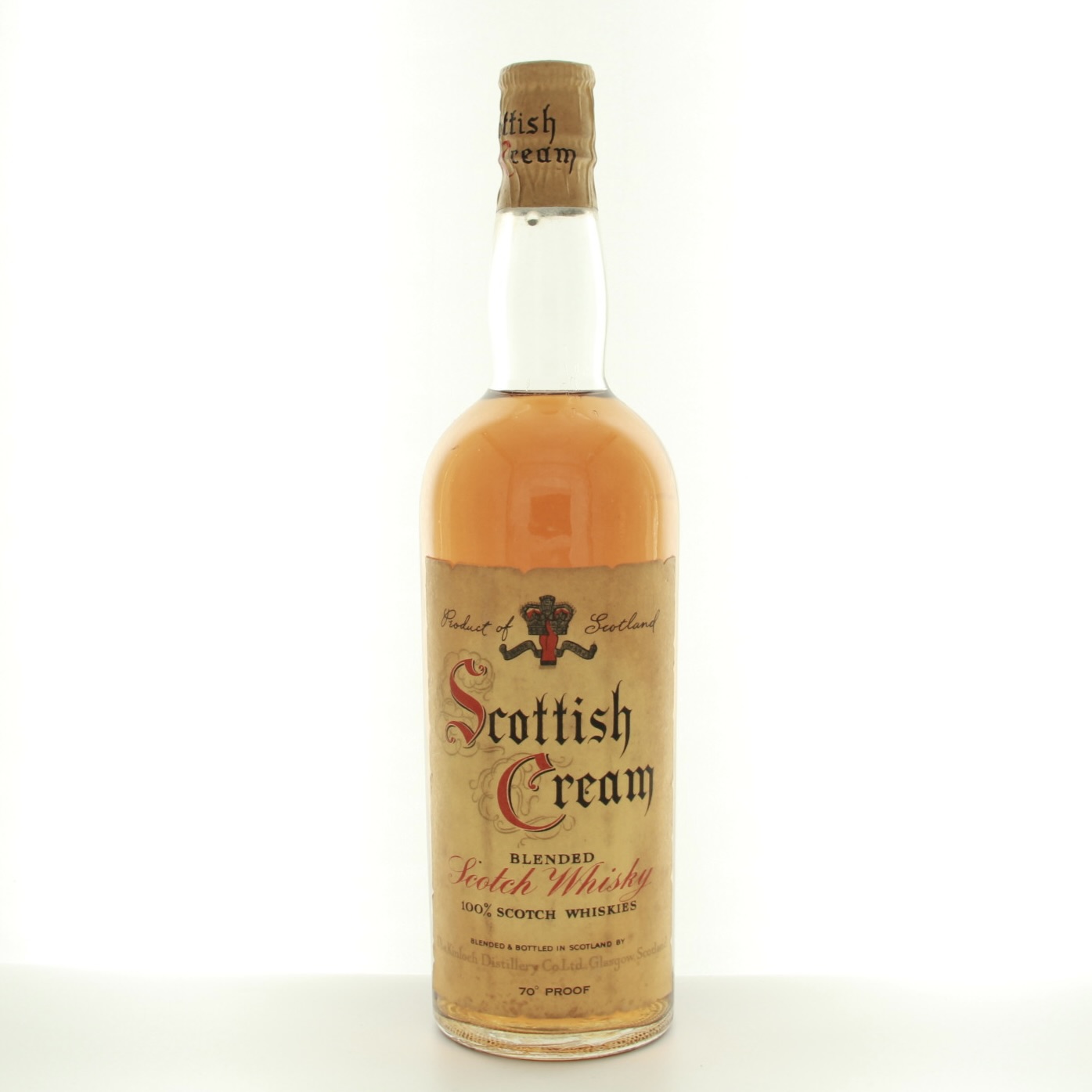
Scottish Cream 1940s
75.7cl / 70 Proof%
£119.00

- Malt type: Blended
- Region: Scotland
If you like this whisky, you will also like these
A highly scarce blended Scotch representing a liquid time capsule of severe post-WWII rationing and production constraints.
At-a-Glance
| Field | Details |
| Distillery / Bottler / Country & Region | The Kinloch Distillery Co. Ltd. (Bottler, Blend Creator) / Scotland, Unknown Region (Historically Campbeltown affiliation) |
| Category | Blended Scotch Whisky (sometimes labelled Liqueur Scotch Whisky) |
| Age / Vintage / Bottled | Not Stated (NAS) / Distillation Pre-1940s / Bottled 1940s |
| ABV & Size(s) | 40% ABV (80 Proof) / 75cl or 750ml |
| Cask / Treatment | Not stated by the producer. |
| Natural Colour | Not stated by the producer. (Likely Natural) |
| Non-Chill-Filtered | Not stated by the producer. (Likely standard filtration for the era) |
| Cask Strength | No (Bottled at 40% ABV) |
| Bottle count / Outturn | Extremely limited; bottling runs unknown. |
| Intended channel | Domestic UK and Export trade, likely grocers/dram shops. |
| Packaging | Clear/dark glass, foil/paper seal, potentially screw cap closure. |
| Notes on discrepancies | Must be clearly distinguished from 'Teacher's Highland Cream', another major blend of the era sometimes confused with this label. |
Historical Context
The existence of the Scottish Cream blend from the 1940s, bottled by The Kinloch Distillery Co. Ltd., is a direct reflection of the extraordinary circumstances defining the Scotch whisky industry during and immediately following World War II.
Kinloch Distillery Co. Ltd. had ceased its primary operational function—distilling in Campbeltown—in the decade prior to this bottling. This closure dictates that the entire blend relied exclusively on accumulated, pre-existing mature stocks. The consequence for blending houses like Kinloch was profound. Following wartime production halts and severe rationing (1939–1944), blenders were compelled to maintain product quality by utilizing older, more mature grain and malt components from existing reserves.
Thus, regardless of the lack of an age statement, a 1940s blend intrinsically contains components of maturity far surpassing most standard post-war or modern blends. The bottling strength of 40% ABV was the commercial standard adopted to maximize the volume of saleable liquid from finite, dwindling aged resources.
Technical Specification & Variant Map
The Scottish Cream blend is primarily documented in a standard 75cl or 750ml bottle format. A historical detail emerges in the documentation of a miniature bottle (estimated 5cl) which was explicitly labelled as "Scottish Cream Liqueur Scotch Whisky".
A critical point for due diligence is ensuring differentiation from highly similar contemporary labels. The collectability of this specific bottle stems from its Kinloch Distillery Co. Ltd. bottling, an entity operating solely on legacy stock post-distillery closure.
Kinloch Blends - Variant Matrix (1940s Era)
| ABV | Volume | Market | Era cues | Relative desirability |
| 40% (80 Proof) | 75cl / 750ml | UK / Export (Pre-metric) | Full paper label, possible screw cap, potentially original wooden crate remnants | High (Historical Significance & Volume) |
| Not stated (Likely 40%) | Miniature (5cl est.) | UK/Domestic Sample | "Liqueur Scotch Whisky" label variation, cork/seal uncertainty | Medium (Condition Risk, Rare Format) |
Packaging & authenticity checklist
Authenticity checks for spirits dating back eight decades must focus heavily on closure technology and condition. The broader market trend for externally threaded bottles sealed with screw caps gained dominance for liquor bottles post-1920s and continued throughout the 1940s. Verifying authenticity involves inspecting the bottle neck finish for the characteristic tooling marks or seams indicative of the mass-produced screw-cap closures common in that period.
The glass itself is typically a dark olive green or olive amber, colours frequently used during the 1930s and 1940s. Labels should clearly feature The Kinloch Distillery Co. Ltd. designation.
The most critical condition threshold is the fill level. Given the standard 40% ABV—a strength prone to evaporation—and the inherent risk of cork degradation over eighty years, any bottle must maintain a fill level at or above the shoulder or base of the neck. Lower fills below this threshold suggest increased oxidation.
Regulatory/terminology notes
The absence of an age statement ("NAS") is standard for this era. During times of severe stock constraint, blenders prioritized resource management and market supply over age declarations. This characteristic should be viewed not as a deficiency in maturity, but as a typical attribute of surviving stocks from a period when liquid resources were critically finite.
Liquid Profile (from verifiable notes)
Direct, specific tasting notes for the Kinloch Scottish Cream 1940s bottling are not stated by the producer. However, an analysis of the blend’s historical composition allows for informed inference.
The necessity of using significantly older malt and grain stocks due to wartime production halts suggests the malt component would be both more mature and potentially represent a higher ratio within the blend than is common today. Comparable high-quality 1940s blends were noted for exhibiting a firm, powerful palate with a well-balanced attack encompassing aromas of peat, smoke, and spices. The finish would typically be very smooth and flavourful. It is highly probable that the Scottish Cream would share these core characteristics of complexity derived from high-quality, aged components.
| Component | Description |
| Nose: | Not stated by the producer. (Inferred: complex, possibly smoke/spice) |
| Palate: | Not stated by the producer. (Inferred: firm, powerful, well-balanced with peat/smoke notes) |
| Finish: | Not stated by the producer. (Inferred: very smooth and flavorful) |
With water: Not stated by the producer.
Pricing & Market Dynamics (GBP)
The market valuation of this bottling is exceptionally volatile, driven almost entirely by provenance, format, and condition. A full 75cl bottle has achieved a hammer price of GBP 370.00 at online auction. This result should be interpreted as a foundational price floor; given the profound historical scarcity of verified wartime-era stock, this bottle is often considered undervalued relative to the intrinsic age of its components.
Original RRP (GBP): Not stated by the producer.
Current UK retail range (GBP, incl. VAT): Extremely limited, market supply is N/A.
Recent UK/EU auction range (GBP, hammer): GBP 35.00 – GBP 370.00.
Price Snapshot (Kinloch Scottish Cream 1940s)
| Channel | Date | Bottle spec | Price (GBP) | Notes |
| Auction (Online) | Historical | 75cl Full Bottle | 370.00 | Winning bid recorded; represents a low floor for this vintage |
| Auction (Online) | Historical | 5cl Miniature | 5.00 | Illustrates significant depreciation for poor fill level/small format |
| UK Retail | Not applicable | N/A | Not stated by the producer. | No modern retail pathway |
Pricing stratification: Size and condition dramatically impact value. The hammer price recorded for a low-fill miniature was only GBP 5.00. This stratification underscores that historical value translates into collector price only when condition thresholds are strictly met.
Liquidity & sourcing note: Liquidity is very low. Sourcing relies almost exclusively on the dismantling of established private collections.
Distillery/Bottler Snapshot
The Kinloch Distillery Co. Ltd. is best understood in this context as a historical blending house, not an active producer. Its operational whisky distillery in Campbeltown was silent prior to this bottling era. Therefore, the value of this liquid resides in its status as a historical artifact, preserving high-quality malt and grain components from a previous generation of Scotch stockholding.
Sourcing
Target formats must prioritize 75cl/750ml bottles with verifiable 1940s label designs. It is essential to confirm the bottling is indeed attributed to The Kinloch Distillery Co. Ltd.
Red flags to avoid include any bottle exhibiting a low fill level (below shoulder) or damaged original seals, which indicate severe risk of oxidation and subsequent flavour compromise.
Condition thresholds demand an intact seal and high fill level, reflecting careful storage over eight decades.
Velocity is extremely low; this is a highly niche collector item. Margin expectations should reflect the significant sourcing premium required for such a scarce, historical liquid.