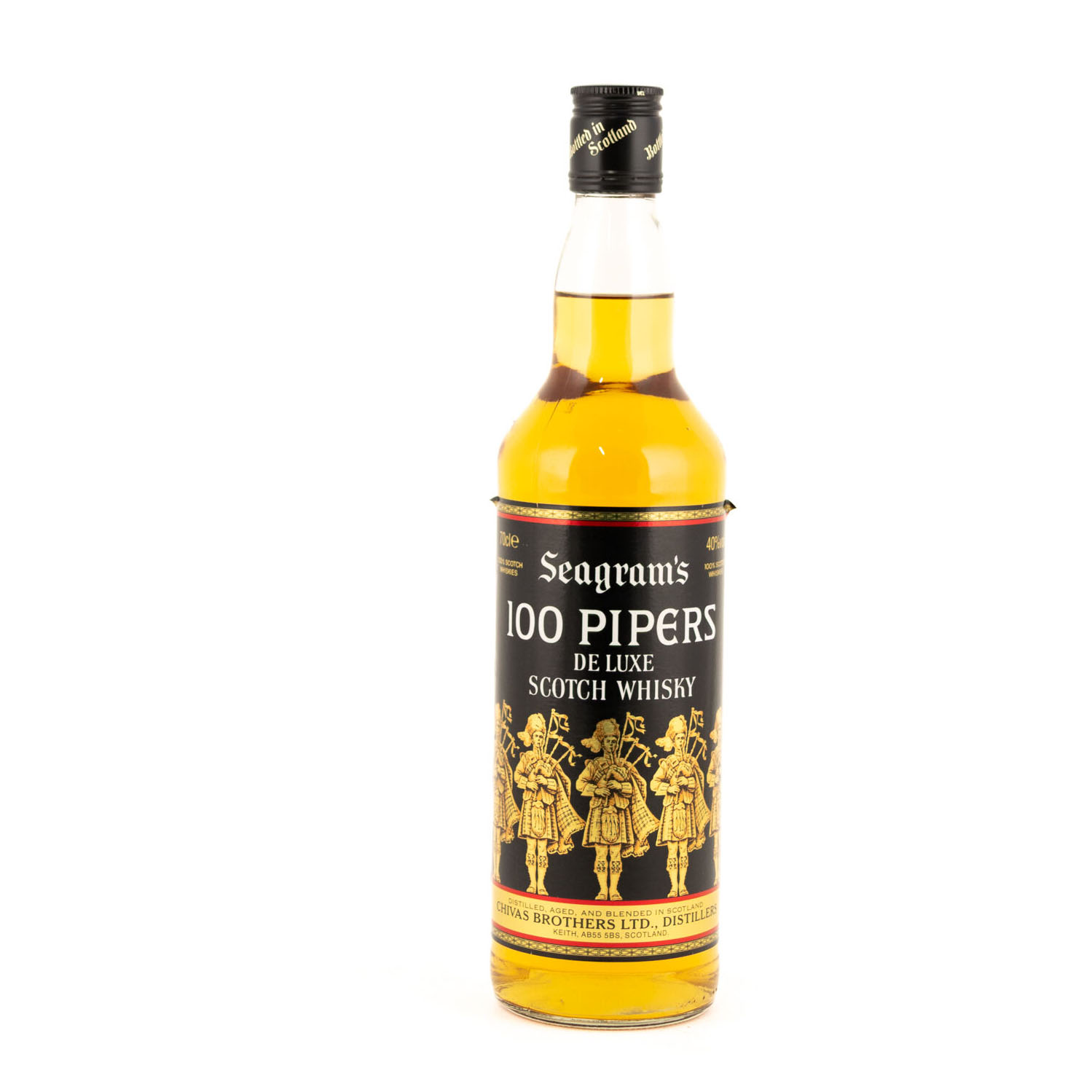
Seagram’s 100 Pipers Deluxe 1990s Edition
70cl / 40%
£99.00

- Malt type: Blended
- Region: Scotland
Tasting Notes

Mango, Kiwi, Melon, Shoe Polish and Caramel

Caramel, Cream, and Orange

Medium Finish, Toffee, Citrus, and Oak.
If you like this whisky, you will also like these
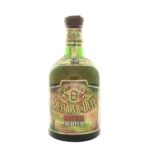
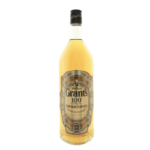
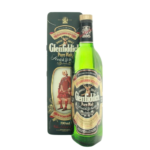

A vintage 'Deluxe' edition blend, representing the superior stock quality guaranteed by the vast 1990s Seagram’s corporate portfolio.
At-a-Glance
| Field | Details |
| Distillery / Bottler / Country & Region | Seagram Distillers plc (Owner) / Bottled in Scotland |
| Category | Blended Scotch Whisky (Deluxe) |
| Age / Vintage / Bottled | NAS / Bottled 1990s |
| ABV & Size(s) | 40% or 43% ABV / 70cl or 75cl |
| Cask / Treatment | Not stated (Refill oak) |
| Natural Colour | Yes (Likely E150a) |
| Non-Chill-Filtered | No |
| Cask Strength | No |
| Bottle count / Outturn | Very High Volume (Global market) |
| Intended channel | Export markets (Asia/Global Travel Retail) |
| Packaging | Standard proprietary bottle shape, ‘Deluxe’ designation |
| Notes on discrepancies | ABV often varied between 40% (UK/EU) and 43% (Export/US). |
Historical Context
This 1990s edition of 100 Pipers Deluxe was produced during the peak operational era of the Seagram corporate giant. Seagram’s, at that time, possessed an unparalleled, vertically integrated supply chain encompassing some of Speyside’s most important malt distilleries, including Glen Grant and Strathisla.
The corporate provenance under Seagram’s is the critical factor driving the secondary market premium. The 'Deluxe' version was assured continuous access to high-quality, aged proprietary single malts—Strathisla is historically considered the core malt of the blend. This specific composition is viewed as qualitatively superior to subsequent versions produced after the dramatic break-up and sale of Seagram’s assets post-2001.
Historically, 100 Pipers was positioned as a major international brand, specifically targeting high-volume Asian markets where the 'Deluxe' marker was essential for premium market differentiation. The intrinsic value of this bottle is deeply linked to the stability and quality assurance provided by the Seagram’s conglomerate. This 1990s bottling contains malts that matured during an era before the industry-wide rationalisation, justifying the market revaluation observed today.
Technical Specification & Variant Map
The 'Deluxe' designation is a commercial marker that historically implied the inclusion of older components or a higher malt-to-grain ratio. While the minimum age is not stated, the components likely included well-aged whiskies.
A key variant distinction is the bottling strength. The 43% ABV export version is consistently favoured by collectors over the 40% domestic bottling, as the higher strength is widely perceived to have preserved the flavour and body of the 1990s liquid more effectively.
Variants are primarily tracked through changes in packaging within the 1990s, especially variations in the stated ABV and the presence of specific duty or import stamps.
Variant Matrix
| ABV | Volume | Market | Era cues | Relative desirability |
| 40% | 70cl | UK/EU | Standard 1990s label, clear 70cl size | Medium |
| 43% | 75cl (or 4/5 Quart) | Asia/US | Prominent 43% ABV, export duty stamps | High (Higher strength vintage blend) |
Packaging & authenticity checklist
Authentication relies on verifying the explicit link to the original ownership. The label must clearly feature text such as "Seagram Distillers plc" or similar pre-2001 ownership references. Seal integrity is the principal verification point, as damage can lead to oxidation.
The presence of specific 1990s-era import or duty stickers is a valuable authentication cue. A high fill level (into the neck) is fully expected and required to achieve top valuation. Buyers must actively avoid bottles labelled under subsequent ownership, such as Pernod Ricard.
Regulatory/terminology notes
The category is standard Blended Scotch Whisky. The 'Deluxe' term is purely commercial but signals adherence to a higher, internal quality specification governed by the Seagram portfolio standards of the time.
Liquid Profile (from verifiable notes)
The profile is generally defined by its smoothness and malty sweetness, reflecting the quality of the component malts.
Nose: Soft, highly refined, and malty sweet, exhibiting the signature characteristics of Glen Grant and Strathisla—floral sweetness, light honey, and subtle orchard fruit notes.
Palate: Exceptionally smooth and balanced, with a medium body. Dominant flavours include vanilla, light butterscotch, and a clean cereal sweetness. The malt backbone is distinct and provides greater depth.
Finish: Medium duration, clean, and mildly spicy.
With water: Not stated by the producer.
Distillery/Bottler Snapshot
The 100 Pipers blend, specifically in this 1990s Deluxe iteration, benefited directly from the stability and quality of Seagram’s supply chain, particularly the access to premium malts from key Speyside sites. This edition serves as a chronological marker of that specific corporate era in blending history.
Sourcing
Target formats/eras: Verification of Seagram Distillers ownership (pre-2001) is paramount. Prioritisation should be given to 43% ABV export formats due to superior collector demand.
Red flags to avoid: Bottles labelled under subsequent corporate ownership.
Condition thresholds: Good closure integrity and clear, legible 1990s-style labelling are essential.
Margin/velocity expectations: Moderate velocity; reliable margin uplift based on the historical component quality.