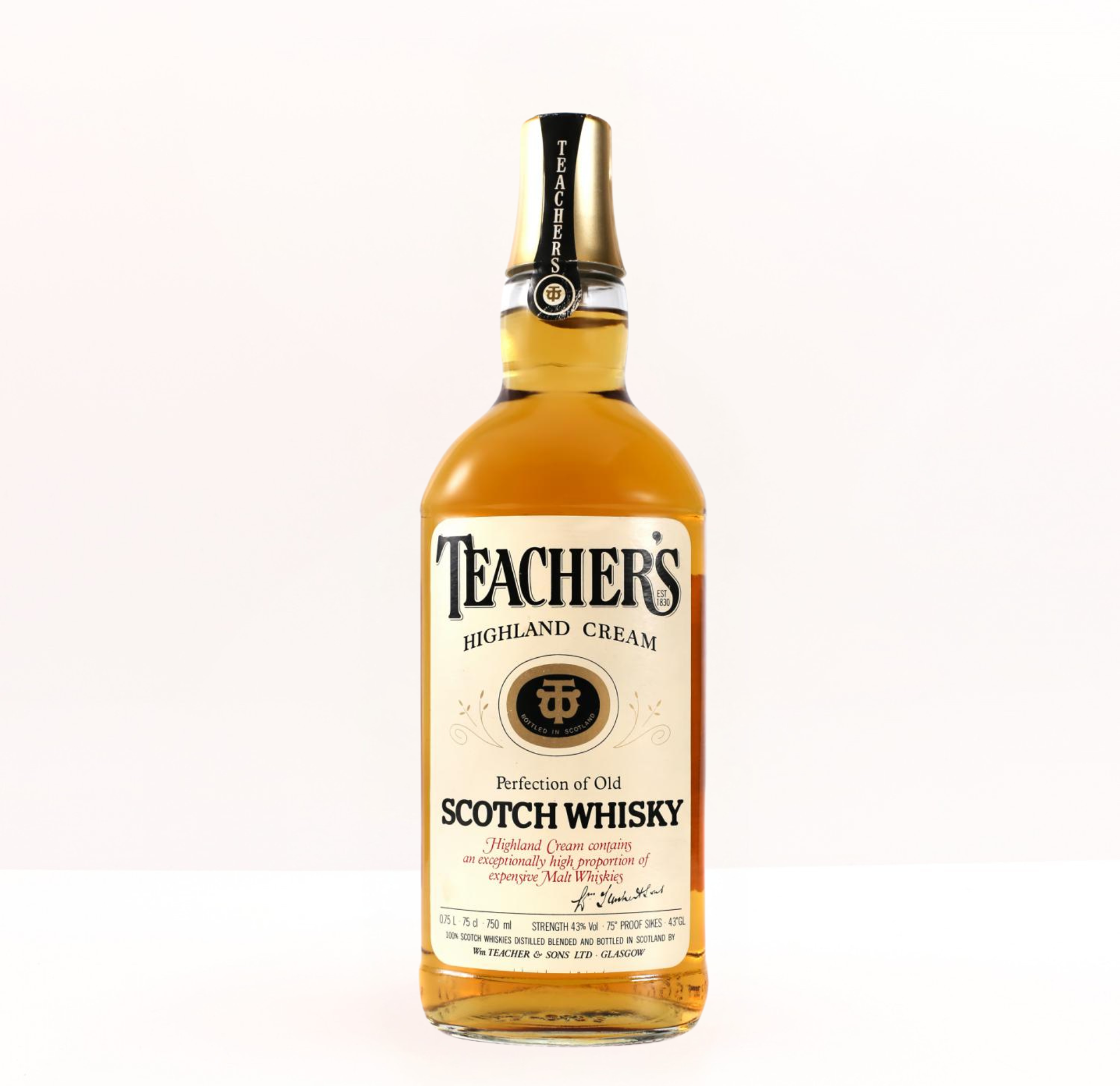
Teacher’s Highland Cream (1970s Edition)
75cl / 43%
£139.00

- Malt type: Blended
- Region: Scotland
- Chilfiltered: Yes
If you like this whisky, you will also like these
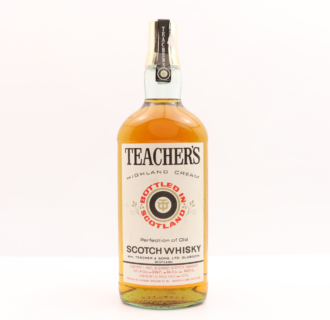
A highly sought-after vintage blended whisky defined by its exceptional 45% malt content and the unmistakable, rich smoke of Ardmore single malt.
At-a-Glance
| Field | Details |
| Distillery / Bottler | Wm Teacher & Sons Ltd. / Scotland |
| Category | Blended Scotch Whisky |
| Age / Vintage | Non Age Statement; Bottled circa 1970–1976 (Pre-Allied Breweries) |
| ABV & Size(s) | 40% or 43% ABV (70 Proof or 86 Proof); 75cl, 1 Litre, or 26 2/3 Fl Oz |
| Cask / Treatment | Oak casks (components include ex-Bourbon and likely Sherry) |
| Natural Colour | Not stated by the producer |
| Non-Chill-Filtered | Chill-Filtered (Standard commercial practice for the era) |
| Cask Strength | No |
| Bottle Count | Standard commercial blend of the era |
| Intended Channel | Domestic UK and General Export |
| Packaging | Traditional rounded glass bottle, paper label, screw cap or cork stopper |
Historical Context
Teacher’s Highland Cream was first introduced in 1884, quickly establishing a reputation for quality based on a technical commitment to a high proportion of single malt whisky in its composition. The 1970s bottlings hold particular historical significance for collectors as they represent the final period of production under the independent ownership of Wm Teacher & Sons Ltd. This era predates the critical 1976 acquisition of the company by Allied Breweries.
The appeal of pre-1976 vintage bottlings lies in the widespread assumption that the high-quality stock and traditional blending costs were strictly maintained prior to corporate ownership. The defining feature of this period’s blend is the inclusion of 45% single malt whisky. This ratio is notably high for a commercial blend, ensuring the resulting liquid possessed exceptional body and flavour complexity. The crucial malt component that gives the blend its character is the smoky Highland malt sourced from Ardmore Distillery, supplemented by malts from other facilities, including Glendronach, resulting in a combination of over 30 different whiskies.
Technical Specification & Variant Map
The blend's foundation is the high volume of malt, with Ardmore serving as the central flavour driver. Ardmore is known for employing peat in the malting process, delivering a rich, earthy smoke that provides depth without the medicinal, iodine-rich character often found in Islay malts.
The specific ABV for 1970s Teacher's Highland Cream varies depending on the destination market. While 40% ABV (70 Proof) was common for standard UK domestic and some EU releases, many export and 1 Litre formats were bottled at 43% ABV (86 Proof). This higher strength is typically preferred by connoisseurs as it better preserves the volatile aromatic compounds and provides a more robust texture over decades of bottle aging.
Variant Matrix
| ABV | Volume | Market | Era Cues | Desirability |
| 43% (86 Proof) | 1 Litre | Export/Duty-Free | Wm Teacher & Sons, 45% Malt statement | Very High |
| 40% (70 Proof) | 75cl | UK Domestic/EU | Wm Teacher & Sons, standard label | Moderate |
| 70 Proof | 26 2/3 Fl Oz | US/Commonwealth | Obsolete Fl Oz volume | Historical Interest |
Packaging & Authenticity Checklist
-
Bottler Name: To verify an authentic pre-1976 bottling, the key information is the name of the bottler on the label: "Wm Teacher & Sons Ltd.". Post-1976 labels typically reflect subsequent corporate ownership.
-
Measurement: The labels often feature the Proof designation (e.g., 86 Proof), consistent with the pre-metric regulatory environment.
-
Closure: Closure integrity should be inspected carefully, as screw caps were common. Collectors should look for intact seals and minimal label deterioration.
-
Liquid Condition: High fill levels (Into Neck or High Shoulder) are mandatory, as low fill or signs of oxidation (turbidity or darkening of the liquid) drastically reduce value.
Regulatory & Terminology Notes
The use of Proof measurements is a clear indicator of the bottling era. Although the exact Natural Colour status is Not stated by the producer, the process of chill filtration was standard commercial practice for blended whiskies of this volume during the 1970s. This technique ensured visual clarity and stability regardless of temperature fluctuations in the market.
Liquid Profile
-
Nose: Characterised by a strong malt presence, combined with notes of sweet vanilla, golden syrup, and freshly baked malty biscuits. Hints of salt and fresh sea air are also noted, suggesting the coastal influence of the Ardmore component.
-
Palate: The high malt content delivers a notably warm, robust, and malty profile. The flavour develops with notes of spice, particularly cinnamon, and a distinct, underlying peatiness. The texture is exceptionally smooth and full-bodied.
-
Finish: Robust and lengthy. The smoke and ashy dryness intensify as the sweeter notes fade, providing a sophisticated, peppery conclusion.
Distillery/Bottler Snapshot
The blending expertise of Wm Teacher & Sons Ltd. was anchored by the Ardmore Distillery, which consistently supplied the unique, smoky Highland malt essential to the blend's distinct identity. During the 1970s, the company was focused on preserving legacy quality through the high 45% malt richness, maintaining a premium position in the global market relative to competitive standard blends.
Sourcing
-
Target formats/eras: Bottles confirmed to be from the pre-1976 period (Wm Teacher & Sons Ltd.) and those bottled at the higher 43% ABV (86 Proof).
-
Red flags: Low fill levels (below High Shoulder). Auction lots where the ABV is not clearly legible.
-
Condition thresholds: Fill level must be IN or HS. Boxed examples are rare and highly sought after.
-
Market Expectations: Velocity is moderate, sustained by collectors seeking the qualitative difference of vintage blends.
Sources & References
- Industry standards for chill filtration in 20th-century commercial blending.
- Historical records of the founding of Teacher’s (1884) and the Allied Breweries acquisition (1976).
- Technical specifications for Teacher's Highland Cream malt-to-grain ratios (45% malt).
- Archive of Wm Teacher & Sons Ltd. independent bottling labels.
- Ardmore Distillery heritage and peat profile documentation.
- UK Customs and Excise records for 70 Proof domestic spirits.
- Commonwealth and US volumetric conversion tables for 26 2/3 Fl Oz.
- Historical closure technology database (Screw caps vs. Cork).
- Tasting notes from independent vintage whisky reviewers and spirit historians.