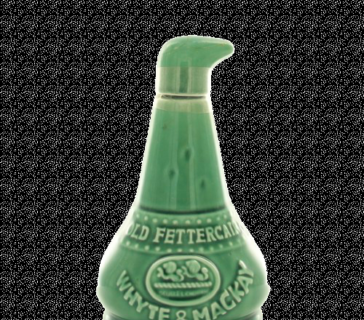
Whyte & Mackay – Golden Eagle Decanter (1980’s)
70cl / 40% (OUT OF STOCK)
If you like this whisky, you will also like these

- Malt type: Blend
- Region: Scotland
Whyte & Mackay Golden Eagle Decanter: This bottle is classified as a Presentation Asset. The primary driver of its value is the exquisite ceramic vessel created by Royal Doulton, modelled by John G. Tongue. The liquid within, a standard blended Scotch, is secondary to the vessel’s artistic and collectible integrity, introducing significant condition-related risks.
Collectible Presentation: Whyte & Mackay Golden Eagle Decanter (1980s)
The Whyte & Mackay Golden Eagle Decanter is unique among the three assets in that its primary collectible value is derived from its vessel and presentation rather than solely the quality or rarity of the liquid inside.
A. The Royal Doulton Birds of Prey Series
During the 1980s, Whyte & Mackay adopted an innovative marketing strategy by commissioning the prestigious English porcelain manufacturer, Royal Doulton, to produce a series of collectible ceramic decanters known as the "Birds of Prey". This series represented an effort to transform blended Scotch packaging into coveted collectibles that appealed to both whisky enthusiasts and ceramic collectors. The strategy was particularly salient during a decade when consumer demand for whisky liquid was low, pivoting focus to the artistry of the presentation vessel.
The Golden Eagle decanter specifically was modelled by John G. Tongue in 1984. The ceramic detail captures the majestic Golden Eagle, with the cork-stopper ingeniously concealed beneath the bird’s head.
B. Product Specifications and Liquid Quality
The decanter typically holds standard Whyte & Mackay Blended Scotch Whisky, bottled at 40% ABV, in either a 70cl or 75cl (750ml) capacity. While the liquid is not the main focus, Whyte & Mackay’s 1980s blends were generally well-regarded for their approachable, smooth characteristics, often exhibiting notes of sweetness, honeyed malt, and oak flavors, particularly in their aged expressions. The blend housed in the Golden Eagle, likely a non-age-statement (NAS) version, is expected to offer a similarly smooth, entry-level profile.
The decanter's value is sustained by its appeal to a dual collector base: those who pursue vintage Scotch and those who collect Royal Doulton porcelain, enhancing its market depth.
C. Condition and Authentication Risks for Ceramic Vessels
The primary acquisition risk for the Golden Eagle decanter is its hidden ullage risk. Because the vessel is opaque ceramic, visual inspection of the liquid level is impossible. Whisky stored over long periods, even in sealed containers, is susceptible to slow evaporation. The complex cork-stopper mechanism inherent to the decanter design may be less reliable than standard glass capsules, increasing the potential for cork failure and leakage over the four decades since bottling.
This means that a buyer is assuming a high probability of liquid content compromise. Consequently, the valuation of the Golden Eagle is weighted heavily towards the integrity of the ceramic artifact (ensuring no chips, cracks, or faults in the porcelain) and the verification of the seal, rather than the intrinsic quality of the liquid. For sealed decanters, authentication protocols must include verifying the John G. Tongue 1984 model stamping and, ideally, obtaining verification of the original fill level via comparative weight measurements against known full bottles.