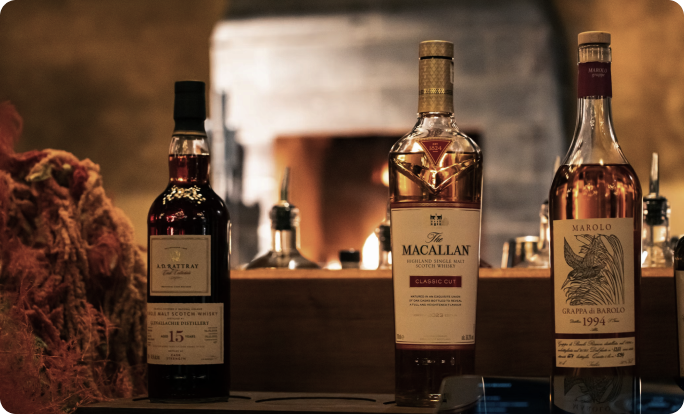
Whisky is water, grain, and time. But what makes a Scotch legally Scotch, a bourbon genuinely bourbon, or a Japanese whisky distinctly Japanese is a matter of law, tradition, and — increasingly — competitive market pressure.
Despite dramatically different regulations and traditions, all whisky follows the same fundamental process. Understanding this foundation makes the variations between national styles much easier to grasp.
The core process in six steps:
Every national style involves all six steps. What varies is: which grains, how they’re processed, what type of still is used, what kind of cask, how long the spirit must mature, and what legal minimum standards apply.
Malted barley is the foundational ingredient of most Scotch, Irish, and Japanese whisky. The germination process converts starch into fermentable sugars — and malted barley contains the enzymes necessary to also convert other, unmalted grains. This is why malted barley appears even in grain whiskies and blends.
Other grains used in whisky production:
| Grain | Typical Use | Flavour Contribution |
|---|---|---|
| Malted barley | All single malts; mash bill in grain whisky | Biscuit, malt, dried fruit, complexity |
| Corn (maize) | US bourbon (minimum 51%), American grain whisky | Sweet, full, creamy, vanilla |
| Rye | US rye whisky; added to many bourbon mash bills | Spice, dry, pepper, complexity |
| Wheat | Some bourbon mash bills (wheated bourbons); some Canadian | Soft, creamy, mild sweetness |
| Unmalted barley | Irish pot still whisky (required by regulation) | Grain spice, oil, richness |
The grain selection determines the foundational character of the spirit before distillation or cask influence. A barley-forward Scotch single malt will have a fundamentally different raw material compared to a high-corn bourbon.
Malting (for malted barley):
Barley is soaked in water and allowed to germinate — a controlled sprouting that activates enzymes (amylases) which convert starches to fermentable sugars. Once germination reaches the right point, it’s halted by drying with hot air. The method of drying dramatically affects flavour: drying over peat fires infuses the malt with phenolic compounds, creating the smoky character associated with Islay whisky and other peated styles.
Traditionally, malting was done on the distillery’s own malting floor — a large flat space where germinating barley was turned regularly to control temperature. Today, most distilleries source industrially malted barley and only a handful maintain traditional floor maltings.
Key exception: For Irish Single Pot Still Whisky, both malted and unmalted barley are used in the mash, creating a distinctive creamy, oily, spicy character unique to Ireland.
Mashing:
The malted grain (and any other grains) is ground into grist and mixed with hot water in the mash tun. The hot water dissolves the sugars released during malting, creating a sweet liquid called wort. This is then drained off, leaving the spent grain (draff), which is typically used as animal feed.
The wort is cooled and transferred to fermentation vessels — called washbacks in Scotland, though the name varies internationally. Yeast is added.
Yeast converts the dissolved sugars into alcohol and CO₂ over 48–96 hours. The result is a liquid called wash (or beer in American production) — essentially a beer-strength (6–9% ABV) fermented liquid with significant flavour compounds alongside the alcohol.
Why fermentation matters for flavour:
The yeast strain, fermentation temperature, and duration all contribute to the final spirit’s character. Longer fermentations typically produce more fruity, complex spirit as bacteria break down some yeast cells. Many distilleries closely guard their yeast strains.
For bourbon, corn’s high starch content produces sweeter, fuller-bodied wash. For Scotch single malt, the all-barley wash tends toward more complex, cereal-forward character.
Distillation concentrates the alcohol and selects which flavour compounds pass through into the final spirit. This is where the distillery’s most important technical and artistic decisions are made.
Pot stills are large copper vessels — typically onion or pear-shaped — heated from below. The wash is boiled; alcohol and aromatic compounds vaporise, travel up the neck and through a condenser (lyne arm), where they cool back into liquid.
Pot stills are batch distillation. The liquid must be redistilled to achieve acceptable strength. Most Scotch single malt undergoes distillation twice (some three times for lighter Lowland styles).
The cut: The distiller controls which portion of the distillate becomes the spirit. The earliest distillate (“foreshots” or “heads”) contains harsh compounds and is discarded. The later distillate (“feints” or “tails”) is also rejected. Only the middle portion (“the heart”) becomes new make spirit. Where the distiller makes these cuts profoundly affects flavour.
The still shape matters: Tall, narrow stills with steep lyne arms produce lighter, more delicate spirit. Short, squat stills with shallow lyne arms produce heavier, more robust character. This is why Glenmorangie (extremely tall stills) tastes different from Macallan (traditionally lower-shaped stills).
Column stills (also called Coffey stills or patent stills) produce spirit continuously rather than in batches. They are more efficient and typically produce a lighter, higher-ABV spirit. Used for:
Column distillation tends toward cleaner, lighter spirit with less of the heavy congeners that pot stills retain. This is why grain whisky is typically lighter and more neutral in character than pot still single malt.
New make spirit — clear, often harsh and raw — becomes whisky in the cask. Time in oak is the transformation.
What the cask does:
The “angel’s share”: Each year, approximately 1–2% of the spirit evaporates through the cask. This is called the angel’s share. A 20-year-old whisky has lost roughly 20–30% of its original volume — which is part of why aged whisky is more expensive.
Cask size matters: Smaller casks have a higher surface-area-to-volume ratio, accelerating interaction with wood. This is why some producers use smaller casks to produce “matured” spirit more quickly — though critics argue it doesn’t replicate the true depth of slow barrel ageing.
Before bottling, the distillery (or independent bottler) makes several decisions:
Strength: Most bottling is done at reduced strength — water is added to bring the spirit to typically 40%, 43%, or 46% ABV. “Cask strength” means no water is added — the spirit is bottled at whatever strength it came out of the barrel.
Filtration: Most whisky is chill-filtered to remove fatty acids that cause cloudiness when the spirit is cold or diluted. This process removes some flavour compounds and is controversial among enthusiasts. “Non chill-filtered” is increasingly marketed as a premium attribute.
Colouring: Caramel colouring (E150a) may be added to standardise colour across batches. This is legal and widely practiced. “Natural colour” or “no artificial colouring” on a label means the colour is entirely from cask maturation.
Scotland has the most detailed and strictly enforced whisky regulations in the world. The Scotch Whisky Regulations 2009 (amended) define five legally distinct categories:
Scottish Geographical Indications (GIs): Scotland’s five protected regions are Speyside, Highlands, Lowlands, Campbeltown, and Islay. A distillery claiming a regional GI must be located in that region. The flavour profiles associated with each region are traditional conventions, not legally mandated characteristics.
Age statements: Any age statement on a Scotch whisky must reflect the age of the youngest whisky in the bottle. “No age statement” (NAS) whiskies may contain very young spirit blended with older material.
American whiskey is regulated by the US Standards of Identity for Distilled Spirits (27 CFR Part 5).
Kentucky Straight Bourbon: Must meet all straight bourbon requirements and be produced in Kentucky.
Irish whiskey is regulated by the Irish Whiskey Technical File (2014, updated) and the Geographical Indication under EU law.
Irish Single Malt: 100% malted barley, single distillery, pot stills.
Irish Single Pot Still Whiskey: The uniquely Irish category. Made from a mash of both malted and unmalted barley (minimum 30% each), distilled in pot stills at a single distillery. This produces the characteristic creamy, spicy, full-bodied style that was the dominant Irish style before the 20th century and has been revived since. Key producers: Redbreast, Green Spot, Powers.
Irish Single Grain: Made from cereals other than (or in addition to) malted barley, distilled in column stills at a single distillery.
Irish Blended Whiskey: A blend of two or more of the above categories.
Irish Geographical Indications: The island of Ireland is the GI. There are no sub-regional GIs with legal standing as of this writing.
Japanese whisky has historically operated with notably relaxed regulation — and this has created significant controversy in the collector market.
Until 2021, there were no mandatory regulations for labelling something as “Japanese Whisky.” This allowed producers to import bulk Scotch or Canadian whisky, bottle it in Japan, and sell it as Japanese whisky — or blend imported spirit with a small amount of domestically produced whisky.
The JSLA, a voluntary industry body, introduced standards that apply to member companies:
Critical limitation: These are voluntary standards. Not all producers are JSLA members and enforcement relies on industry self-regulation. Legal mandatory standards for Japanese whisky do not exist at national level as of this writing (though regulatory discussions continue).
For collectors: The most established Japanese whisky houses (Nikka, Suntory/Beam Suntory, Mars, Chichibu, Hakushu, Yamazaki, Yoichi) all produce authentic domestically-made whisky. The collector market is sophisticated enough to distinguish between these genuine producers and budget bottlings of uncertain provenance.
Canadian whisky is regulated under the Food and Drug Regulations of Canada.
Key distinguishing feature: Canadian regulations allow the addition of up to 9.09% of other beverage alcohol (including wine, sherry, rum, and bourbon) without affecting the “Canadian Whisky” designation. This is the source of the Canadian whisky tradition of “flavouring whiskies” blended with base column still grain whisky.
Permitted additions: Unlike Scotch, bourbon, or Irish whiskey, Canadian whisky may contain added colouring and flavouring agents. This is unusual among major whisky nations and has historically limited the category’s prestige in the collector market, though premium single-distillery Canadian whiskies are increasingly respected.
The past two decades have seen whisky production expand dramatically beyond the traditional producing countries.
India is one of the world’s largest whisky markets by volume, though most Indian whisky is technically a blend of grain spirit with a small amount of Scotch malt whisky — not whisky by international standards. Authentic Indian single malt has emerged from producers like Amrut and Paul John, receiving strong critical reception. Amrut (established 1948, with serious single malt production since 2004) and Paul John are the most internationally recognised.
Kavalan Distillery (established 2005) has become one of the most critically acclaimed whisky producers in the world. Taiwan’s warm climate produces exceptionally fast maturation — angels’ share can exceed 10% per year. Kavalan’s Solist series, in particular, has won international competitions and commands strong secondary market prices.
A growing craft whisky scene, particularly in Tasmania (Sullivans Cove, Lark, Hellyers Road). Sullivans Cove’s French Oak expressions have won international awards. Australian regulations align broadly with the Scotch model.
The English whisky scene has developed since The English Whisky Company established the first English whisky distillery in over 100 years in 2006. The category is small but growing, with producers like Bimber (London), The Lakes Distillery, and Penderyn (Wales).
Penderyn has produced well-regarded Welsh single malt since 2004 using a unique single-pass Faraday still design. Their expressions have won international competitions and command a growing secondary market.
Regulatory frameworks are not just legal documents — they directly affect secondary market value for collectors and sellers.
Strict regulations create scarcity and trust:
Scotch whisky’s rigorous regulation means a bottle labelled as a 20-year-old Speyside single malt actually is exactly that. This certainty underpins secondary market confidence. Collectors and investors buying Scotch are purchasing a product with legally verifiable characteristics.
The Japanese provenance challenge:
The pre-2021 regulatory gap in Japan created secondary market uncertainty. For older Japanese whisky (pre-2000 bottlings), provenance questions can arise. Most serious collectors focus on recognised distilleries with known production histories.
Minimum age statements as value anchors:
The 3-year minimum for Scotch means any age statement above this is a genuine differentiator. A 25-year-old Scotch represents 22 years of production commitment beyond the minimum. This is reflected in prices.
Cask restrictions as quality signals:
Bourbon’s “new charred oak” requirement means every bourbon cask is used once and then sold to Scotch, Irish, or other producers. This creates the global supply chain of ex-bourbon casks that underlies much of the world’s whisky maturation. The regulatory requirement that seems burdensome for bourbon actually benefits the entire global whisky ecosystem.
For collectors evaluating bottles for their collection or for sale, understanding which regulations apply — and whether the bottle was produced when those regulations were in force — is an important part of provenance assessment.
If you have rare whisky to value or sell, Glenbotal’s team can help
The minimum maturation period for Scotch whisky is 3 years in oak casks in Scotland. Any Scotch whisky with an age statement (e.g., “12 Year Old”) must reflect the age of the youngest whisky in the bottle.
No. Bourbon can legally be made anywhere in the United States. Kentucky’s association with bourbon is historical and commercially important — Kentucky produces the vast majority of bourbon — but there is no legal requirement for bourbon to be made in Kentucky. “Kentucky Straight Bourbon” is a specific designation requiring Kentucky production.
Irish Single Pot Still Whiskey is unique in being made from a mash of both malted and unmalted barley (minimum 30% each), distilled in traditional pot stills. The unmalted barley creates a distinctive oily, spicy, creamy character that is found nowhere else in the whisky world. This style almost died out in the 20th century and has been significantly revived since the 2000s.
Until 2021, there were no legal requirements for labelling a product as “Japanese Whisky” in Japan. This allowed some producers to import bulk spirit (usually from Scotland or Canada), blend it with minimal domestic Japanese whisky, and sell it under Japanese branding. The JSLA voluntary standards introduced in 2021 address this, but they are not legally mandated.
The angel’s share is the portion of whisky that evaporates through the cask walls during maturation — approximately 1–2% per year in Scotland. A 20-year-old whisky will have lost roughly 20–30% of its original volume. This loss of volume is part of why aged whisky costs more — there is simply less of it left.
Cask strength (also called barrel proof) means the whisky was bottled at the strength it came out of the cask, without dilution. Typical cask strength is 55–65% ABV. Adding a few drops of water to cask strength whisky before tasting releases aromatic compounds and often reveals the most interesting character.
Single malt whisky is made from 100% malted barley at a single distillery and distilled in pot stills. Blended whisky combines single malt(s) with grain whisky from column stills. Blended Scotch (like Johnnie Walker or Chivas) is typically lighter and more accessible than single malts. Blended malt (like Monkey Shoulder) is a blend of single malts with no grain whisky.
Regional character reflects historical conventions more than legal requirements. Islay’s climate, its water (running over peat), the local peat composition, and the island’s small number of distilleries all contribute to the region’s coastal, smoky style. Speyside’s sheltered inland geography and water from the River Spey contributed to a tradition of lighter, more fruit-forward whiskies. These are tendencies, not rules — distilleries within regions vary significantly.
Peat is partially decomposed organic matter, primarily heather and grasses, found widely in Scotland. When burned to dry malted barley, peat smoke infuses the grain with phenolic compounds — guaiacol, syringol, and others — that create the characteristic smoky, medicinal, antiseptic character of peated whisky. The level of peat influence is measured in phenol parts per million (ppm) — from barely perceptible (single digits) to intensely peated (over 100ppm for some Bruichladdich expressions).
Independent bottlers are companies that purchase casks from distilleries and bottle them under their own label, often at cask strength and without chill filtration. They allow access to distillery expressions that the distillery itself may not release commercially. Notable independent bottlers include Gordon & MacPhail, Cadenhead’s, and Berry Bros. & Rudd. Independent bottlings can represent exceptional value and quality for collectors.
| Country | Main Spirit | Minimum Grain | Still Type | Minimum Age | New vs. Used Cask | Added Colour/Flavour |
|---|---|---|---|---|---|---|
| Scotland | Scotch Single Malt | 100% malted barley | Pot still | 3 years | Used casks typical | E150a only |
| Scotland | Blended Scotch | Mixed (malt + grain) | Pot + Column | 3 years | Mixed | E150a only |
| USA | Bourbon | 51% corn | Column or Pot | None (2 yrs for Straight) | New charred oak only | None |
| USA | Rye | 51% rye | Column or Pot | None (2 yrs for Straight) | New charred oak only | None |
| Ireland | Irish Single Malt | 100% malted barley | Pot still | 3 years | Used casks | None |
| Ireland | Irish Pot Still | 30%+ malted + 30%+ unmalted barley | Pot still | 3 years | Used casks | None |
| Japan | Japanese Whisky (JSLA) | Malted grain + other cereal | Pot or Column | 3 years | Used or new | None |
| Canada | Canadian Whisky | Cereal grain | Column (typical) | 3 years | Small wood | Colouring + flavouring permitted |
Understanding how these regulations work — and how they shape the character, rarity, and value of the whisky you collect or sell — is fundamental to navigating the rare whisky market with confidence.
For rare whisky valuations and sales, Glenbotal’s expert team applies this knowledge to ensure your bottles are accurately assessed and correctly positioned for sale.
Get a free whisky valuation at Glenbotal