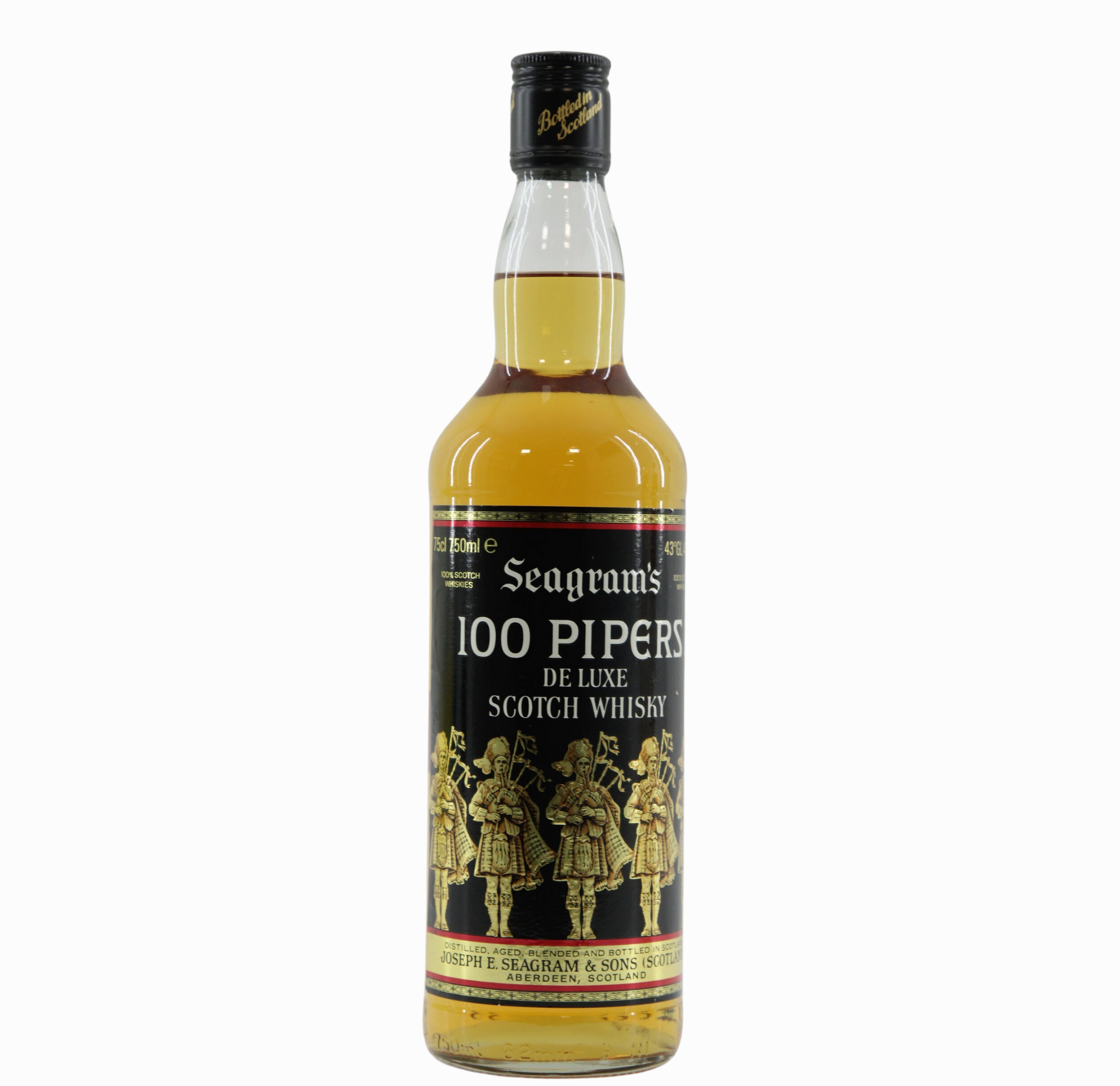
Seagram’s 100 Pipers Deluxe 75cl
75cl / 40%
£99.00

- Malt type: Blended
- Region: Scotland
Tasting Notes

Mango, Kiwi, Melon, Shoe Polish and Caramel

Caramel, Cream, and Orange

Medium Finish, Toffee, Citrus, and Oak.
If you like this whisky, you will also like these

A significant vintage remnant of the Seagram empire, this Deluxe blend encapsulates the light, Speyside-centric style marketed heavily across the globe in the 1970s and 1980s.
| Field | Details |
| Distillery / Bottler / Country & Region | Joseph E Seagram & Sons (Historical) / Scotland, Blended Scotch |
| Category | Blended Scotch Whisky (De Luxe grade) |
| Age / Vintage / Bottled | No Age Statement (NAS) / 1970s/1980s bottling. / Not stated by the producer |
| ABV & Size(s) | 40% ABV / 75cl (0.75 Litre). |
| Cask / Treatment | Matured in oak casks. Core malt component sourced primarily from Allt-a-Bhainne. |
| Natural Colour | Not stated by the producer. (Likely E150a added). |
| Non-Chill-Filtered | Not stated by the producer. (Likely Chill-Filtered). |
| Cask Strength | No |
| Bottle count / Outturn | High volume international blend. |
| Intended channel | Global export, US, Asia, and South America. |
| Packaging | Typically brown-labelled bottle, often with a round cylindrical box. |
| Notes on discrepancies | This is a vintage Seagram-era bottling (pre-2001 acquisition by Pernod Ricard). |
Historical Context
Seagram’s 100 Pipers Blended Scotch Whisky was introduced to the US market in 1965 by the vast Joseph E Seagram & Sons corporate entity. The blend draws its identity from Scottish legend, taking its name from the traditional ballad, "The Hundred Pipers," which recounts the tale of the pipers who accompanied Bonnie Prince Charlie during the 1745 Jacobite rebellion. This romantic historical connection was leveraged to market the brand internationally.
The critical phase in the blend's development occurred in 1975 when Seagram invested in building the Allt-a-Bhainne distillery in Speyside. The purpose of this strategic acquisition was to secure a consistent supply of light, Speyside malt whisky, which was established as the core component of the 100 Pipers blend. The inclusion of Allt-a-Bhainne malt positioned 100 Pipers as an easy-drinking, vanilla-scented blend with notes of dried fruit, differentiating it from heavier, older blends.
This specific 75cl "De Luxe" bottling originates from the period of Seagram’s direct management, primarily spanning the 1970s and 1980s. This time frame is significant because it predates the brand's major commercial surge in Asia and its subsequent acquisition by Pernod Ricard in 2001. The 75cl format itself is a strong indicator of a Scottish-bottled, international export product from that specific era, before the global standardisation of 70cl in many markets. By originating from the historical Seagram ownership and being bottled in Scotland, this specific vintage is expected to offer the precise quality control and consistency of the original formulation, differentiating it from later, high-volume local bottlings in markets like India and Thailand, which sometimes carry different ABVs (e.g., 42.8% ABV) or production specifications.
Technical Specification & Variant Map
100 Pipers is fundamentally an NAS blended Scotch composed of between 25 and 30 whiskies. The spirit is triple-vatted, meaning the malt and grain components are married three times before bottling, aiming for maximum harmony. The flavour architecture is built upon the light, fragrant malt from the Allt-a-Bhainne distillery.
The specific 75cl De Luxe version is defined by its 40% ABV and its designation as an early international export format from the Seagram ownership era. This vintage version is primarily sought after for its provenance rather than complex technical specification, as it represents a historical marker of the brand's early success before its transformation into a high-volume Asian market leader.
Documented variants
- Seagram’s Deluxe (1970s/1980s): This specific, archival target is defined by the 75cl volume and 40% ABV, carrying the Joseph E Seagram & Sons name.
- Modern/Regional Variants: Subsequent bottlings under Pernod Ricard are generally 70cl and include specific regional variants, such as a 12-year-old Deluxe and bottlings at different ABVs, notably 42.8% in markets where local bottling occurs, such as India.
| ABV | Volume | Market | Era cues | Relative desirability |
| 40% | 75cl | US/International Export | Brown label, Seagram’s bottler name, 1970s-1980s | Medium (Historical artifact value, guaranteed Scottish bottling) |
| 40% | 70cl | Modern Global | Pernod Ricard ownership, standard modern label | Low (Standard current blend) |
| 42.8% | Varies | India/Regional Asia | Local bottling marker, specific regional ABV | Low (Niche interest only, often locally produced) |
Packaging & authenticity checklist
Collectors should verify the presence of the 75cl volume designation on the bottle, which strongly indicates a vintage bottling. The label should clearly reference Joseph E Seagram & Sons as the bottler, differentiating it from current releases marketed under Pernod Ricard/Chivas Brothers. These bottles often featured a distinctive brown label design. For archival value, the inclusion of the original cylindrical box is highly valued, despite it often being slightly damaged. Given the low intrinsic liquid value, only bottles with excellent fill levels (Into Neck) and minimal label damage should be considered for collection.
Regulatory/terminology notes
The "De Luxe" terminology designates this as a slightly higher-grade offering compared to a standard blend, although it remains an NAS product. Its primary regulatory requirement is adherence to the Scotch Whisky Regulations concerning minimum maturation time and geographical origin. Although the use of caramel colouring (E150a) is not explicitly stated, it is assumed given the blend's commercial nature and relatively young age.
Liquid Profile (from verifiable notes)
The flavour profile of 100 Pipers Deluxe is consistently described as light, approachable, and mild, maintaining an uncomplicated, harmonious character.
- Nose: The aroma is mild and slightly sweet, with pleasant and balanced notes of vanilla, malt, and honey. There are also floral accents and a subtle, restrained smoky trace in the background, typical of an entry-level classic blended Scotch. Reviews occasionally note a spirity sharpness indicative of young components, combined with caramel and woody European oak influences.
- Palate: The taste is smooth and balanced, dominated by a malty base note. The experience is light and sweet, featuring light sweetness married with fine oak spice, toffee, dark fruits, and subtle smokiness. It is consistently described as ideal for beginners or as a base for mixed drinks due to its uncomplicated nature.
- Finish: The conclusion is medium-long and smooth. A light warmth and a hint of caramel and oak persist, contributing to a round and very approachable conclusion.
- With water: Not stated by the producer. Due to its 40% ABV and already light, easy-drinking character, dilution is generally not necessary to subdue the spirit, although it may soften some of the younger, sharper notes.
Distillery/Bottler Snapshot
The 100 Pipers brand was a pillar of the Seagram empire's global blending strategy, focused on providing mass-market, consistent Scotch whisky accessible to a vast international audience. Although ownership transitioned to Pernod Ricard, the blend maintains its core identity tied to the light, Speyside character primarily supplied by Allt-a-Bhainne. The historical importance of this specific bottling lies in its representation of the blend’s quality standard prior to its evolution into a massive, regionally bottled international volume driver.
Sourcing
- Target formats/eras to prefer: Acquisition should prioritize bottles that are unequivocally marked 75cl and feature "Seagram’s" on the label as the bottler, placing them accurately in the desired 1970s-1980s vintage window.
- Red flags to avoid: Avoid modern 70cl bottles and any regional Asian bottlings, as these liquids may differ and carry minimal archival value for a European collector. Be wary of listings where the fill level is not clearly visible or guaranteed Into Neck.
- Condition thresholds (fill/box/labels): As a historical curiosity, optimal value hinges on immaculate presentation. An Into Neck fill level is necessary, and the inclusion of the original cylindrical box is paramount to achieving the higher end of the pricing spectrum.
- Margin/velocity expectations - qualitative: Margin is dependent on securing the bottle at auction (low hammer price) and selling it to a specialist collector (high retail price). Velocity is very slow, as the market is highly niche.