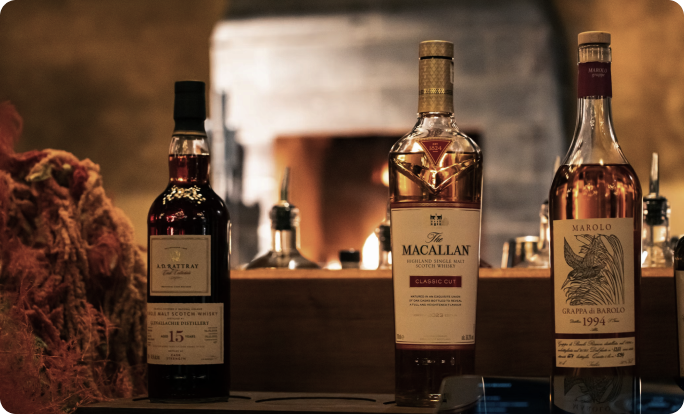
The Macallan 64 Years Old in Lalique Cire Perdue — a single, one-of-a-kind crystal decanter — sold at auction in 2010 for $460,000, setting a world record for a single bottle of Scotch whisky at that time.
This guide covers every major Macallan crystal decanter collaboration with Lalique: the Six Pillars series, The M Decanter and its Black and Red editions, the Genesis Decanter, the Cire Perdue, and the Masters of Photography releases. You’ll understand what makes each bottle remarkable, what the whisky inside actually is, and how these pieces perform on the secondary market.
Whether you are building a collection or evaluating a specific acquisition, this is the resource you need before making a decision of this magnitude.
The Macallan and Lalique were always going to find each other. Both were born in the nineteenth century, both spent decades building reputations no money could shortcut, and both understood that the vessel shapes the perception of what it contains.
The Macallan distillery was founded in 1824 on the banks of the Spey in Craigellachie, Moray. Lalique was established in 1888 in Paris, when René Lalique — then a jewellery apprentice working under Louis Aucoc and later in London — began developing the signature approach to decorative glasswork that would define Art Nouveau. By the 1920s and 1930s, Lalique crystal was the dominant force in European luxury glassmaking. Hood ornaments for Rolls-Royce and Bentley. Perfume bottles for Coty and Nina Ricci. Architectural glass panels for ocean liners including the Normandie.
When René Lalique died in 1945, his son Marc continued the company’s evolution toward lead crystal. The house passed through several ownership changes over subsequent decades, eventually being acquired by Art & Fragrance SA in 2010, which continued the collaborations with prestige partners across automotive, perfume, and spirits.
The formal Macallan–Lalique partnership launched in 2005 with the first instalment of the Six Pillars series, as documented in specialist whisky press coverage of the release. The conceptual fit was deliberate: Macallan’s marketing had long centred on six defining characteristics of the distillery — the pillars of its house philosophy, if you will — and Lalique was commissioned to create a unique crystal decanter to embody each one. The result was a decade-long collaboration producing some of the most sought-after collectibles ever released in the spirits world.
Several crystal houses have worked with spirits brands, but Lalique brought something competitors could not easily replicate. First, the design language: Lalique’s signature motifs — botanical forms, wildlife, flowing organic geometry — carry an immediately recognisable aesthetic weight that reads as art, not packaging. Second, the manufacturing quality: full lead crystal cut and polished by hand, with the kind of provenance documentation collectors expect at this price tier. Third, prestige alignment: being associated with a house that had decorated ocean liners and Royal residences elevated the Macallan bottles from premium gifting into genuine investment-grade collectibles.
For Macallan, the message was clear: these are not simply whiskies in nice bottles. They are dual-medium art objects, where the crystal and the liquid are equally the point.
René Lalique (1860–1945) trained as a jewellery apprentice from the age of sixteen. His early work blended precious stones with unconventional materials — glass, horn, enamel — at a time when fine jewellery was strictly precious metals and gems. He opened his first dedicated glassworks in 1909 and spent the following three decades building a body of work that bridged decorative craft and mass-luxury manufacturing. His ability to produce limited runs of genuinely extraordinary objects at scale — not one-offs for a single patron, but editions of hundreds — became the model for every prestige spirits collaboration that followed. The Lalique company history records that during the 1920s and 1930s, Lalique was among the world’s most renowned glassmakers.
The partnership with Macallan honours that tradition directly. Each Six Pillars decanter was a numbered, limited edition: scarce enough to be collectible, abundant enough to reach serious buyers globally.
The Six Pillars collection is the backbone of the Macallan–Lalique story: six releases over eleven years, each celebrating one of the distillery’s founding principles, each containing some of the oldest Macallan ever bottled, each available in editions of 400–450 pieces worldwide.
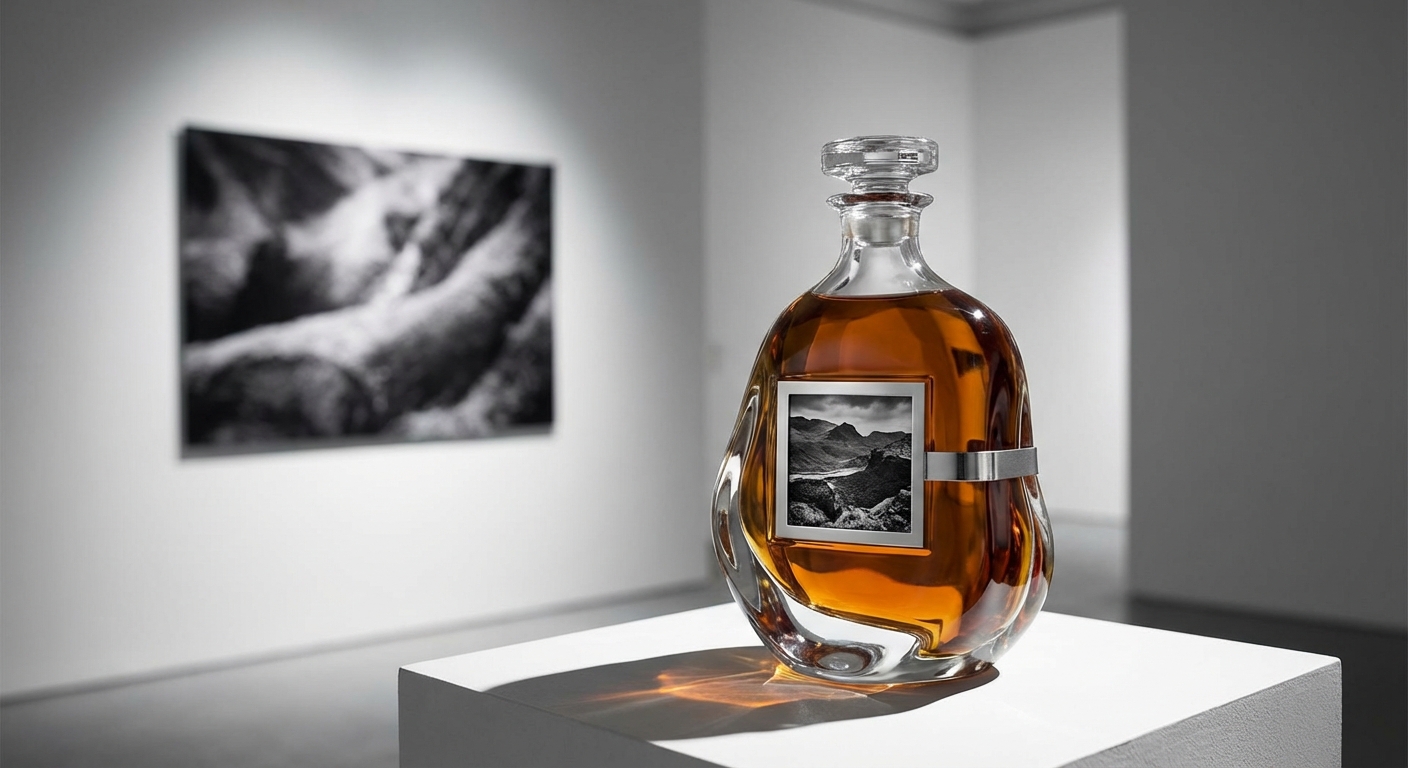
Together, the complete set represents one of the most coherent long-form releases in Scotch whisky history. Assembled in full, a complete set of all six pillars is an extraordinary piece of rare whisky history.
Here is every release in sequence:
The opening chapter of the series celebrated Macallan’s commitment to hand-selected sherry oak casks from Jerez, Spain. The whisky was a 50 Years Old, distilled in the 1950s and matured exclusively in sherry-seasoned Spanish oak.
The Lalique crystal decanter for the First Pillar features hand-engraved oak leaf and acorn motifs — a direct visual reference to the pillar it celebrates. Edition size: 470 decanters globally, each numbered. Launch price at release was approximately £4,000–£5,000 per decanter.
This was the release that established the format and the ambition of the entire series. For collectors, it also has the distinction of being first — and first editions of series consistently command premiums above subsequent chapters.
The second release focused on Macallan’s practice of drawing colour entirely from cask maturation, with no added caramel colouring — still unusual among major distilleries at scale. The whisky was a 55 Years Old.
The Lalique crystal for the Second Pillar celebrates colour itself: the decanter is crafted in a warm amber crystal, echoing the deep natural gold of the whisky within. Edition: 420 decanters. Launch pricing was around £7,000–£10,000.
The Finest Cut pillar refers to Macallan’s practice of distilling to a tight spirit cut — using a smaller proportion of the run than most distilleries, prioritising character over volume. The whisky was a 57 Years Old.
The crystal for the Third Pillar features geometric precision cuts that reflect the stillhouse philosophy: discipline and exactness applied to form. Edition: 420 decanters. Launch price approximately £10,000–£13,000.
Macallan’s pot stills are famously small, forcing the spirit to spend more time in contact with copper and developing the house’s characteristic richness and weight. This pillar celebrated that distinctive piece of equipment with a 60 Years Old expression.
The Lalique crystal echoes the lantern shape of the stills themselves, with a distinctive copper-tinged accent. Edition: 425 decanters. By this point the series was commanding sustained collector interest at auction, and launch pricing reflected it at approximately £14,000–£18,000.
The fifth release shifted focus to the Easter Elchies House, the Victorian manor at the centre of the Macallan estate that appears on every bottle and has been the distillery’s visual identity since the brand’s modern reinvention. The whisky inside was a 62 Years Old.
The Lalique crystal for the Fifth Pillar incorporated architectural elements referencing the manor’s façade, with columns and fenestration motifs rendered in the glass. Edition: 450 decanters. Launch price approximately £20,000–£25,000.
The final chapter of the series — and arguably the most sought-after — celebrated the whisky itself: the distillery’s relationship with time, wood, and spirit. The whisky was a 65 Years Old, making it one of the oldest single malt Scotch expressions ever commercially released.
The Lalique crystal for the Sixth Pillar is the most elaborate of the series: a full-bodied decanter incorporating botanical and abstract motifs that synthesise all five prior design languages into a single coherent piece. Edition: 450 decanters. Launch price approximately £30,000–£35,000.
Now here’s the deal: post-launch, all six pillars appreciated significantly. Individual chapters of the series regularly appear at Scotch whisky auctions with hammer prices two to four times their original retail. Complete sets of all six in original packaging are exceptional rarities — and priced accordingly.
If the Six Pillars series is Macallan’s love letter to its own heritage, The M Decanter is its statement of intent for what luxury whisky can be.
First released in 2013, The M Decanter marked a shift in approach. Rather than celebrating heritage through aged expression, it presented a masterfully blended vatting of exceptional casks — some aged up to 74 years — selected for quality above all, then presented in a crystal decanter that stood apart from anything the spirits world had previously produced.
The whisky inside the original M is a marriage of exceptional sherried Macallan casks spanning multiple decades. The exact vatting was composed of selected casks including parcels aged 25, 30, 35, and older, chosen for colour, complexity, and cohesion rather than adherence to a single age statement.
The Lalique crystal decanter for The M was a significant departure from the Six Pillars’ more decorative aesthetic. It is large — approximately 5.25 litres in the magnum format — and architecturally bold: a faceted, hand-cut structure that catches and refracts light dramatically. The design language references Macallan’s curiously small stills through its silhouette, while the crystal craftsmanship is Lalique at its most technically ambitious.
Edition: 1,750 decanters in 70cl, plus 168 magnums (1.5 litre) and 2 imperials (6 litre). Launch price for the standard decanter was approximately £3,900; magnums at approximately £11,000.[^macallan-m-release]
The M immediately became the accessible entry point into the Macallan–Lalique collector category — accessible being relative. It also demonstrated a commercial intelligence in the collaboration: by releasing a larger edition without an age statement, Macallan could make the The M available to a much wider audience without compromising the rarity narrative.
The M Red introduced a second colourway of the crystal decanter — a deep crimson Lalique crystal — alongside a new whisky composition. The red crystal itself was a technically demanding production: achieving consistent colour at this depth of saturation in lead crystal requires extended development at the furnace, and the rejection rate for imperfect pieces is high.
The whisky inside The M Red draws from exceptional sherry casks, with a deeper, more intensely fruited character than the original M. Edition: 2,000 decanters in 70cl. Launch price approximately £4,700.
The red colourway became a significant collector marker — the visual distinctiveness makes the M Red immediately identifiable on a shelf, which matters at secondary market level. Auction results for the M Red have consistently tracked above original retail.
Released simultaneously with the M Red, the Black edition presented an entirely contrasting aesthetic: a smoked obsidian black Lalique crystal that is striking in its restraint. Where the Red commands attention through colour, the Black achieves distinction through absence — its near-total absorption of light giving it the quality of a sculptural object rather than a vessel.
The whisky inside The M Black is drawn from a selection of Macallan’s oldest resting casks, with a more mineral, complex profile that reflects extended maturation. Edition: 1,000 decanters, making it the more limited of the two simultaneous releases. Launch price approximately £6,000.
The Black’s smaller edition size has made it the more sought-after of the two 2018 releases at auction. When both appear in the same sale, the Black typically achieves a 15–25% premium over the Red.
Two releases stand apart from the systematic series format: the Genesis Decanter of 2018 and the extraordinary one-of-a-kind Cire Perdue from 2010.
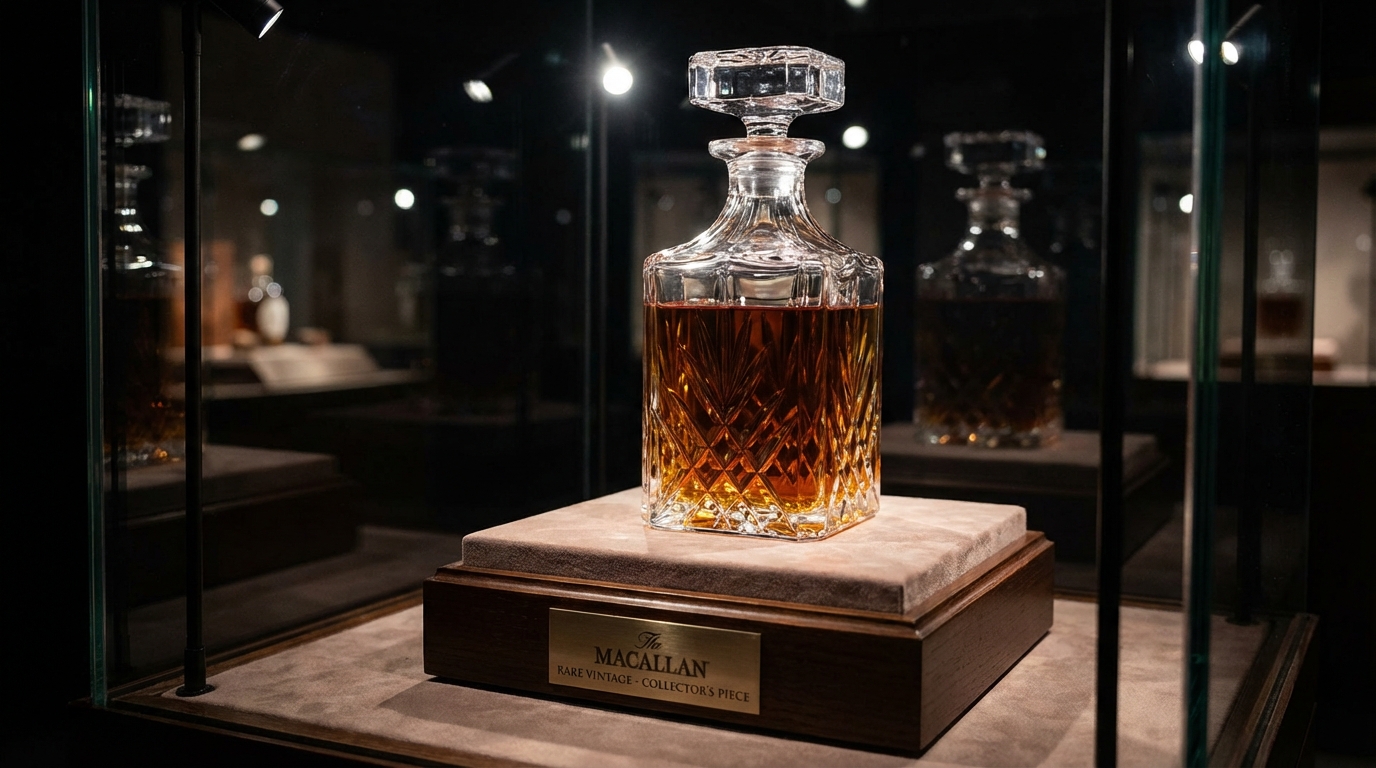
To mark the opening of the new Macallan distillery and visitor experience at Easter Elchies — designed by Rogers Stirk Harbour + Partners, the firm behind the Lloyd’s building and Terminal 5 at Heathrow — Macallan commissioned Lalique to create the Genesis Decanter.
The whisky inside is a 72 Years Old, making it one of the oldest Macallan expressions ever released. Distilled in the mid-1940s, it sat in exceptional sherry oak casks through the entirety of the post-war period, the birth of modern whisky collecting, and the rise and partial cooling of the whisky investment market. By the time it was bottled in 2018, it was a genuinely historic liquid.
The Lalique crystal for the Genesis Decanter is arguably the house’s most architecturally ambitious piece for Macallan. The design references the new distillery building directly: the undulating, organic roofline of the Rogers Stirk Harbour structure is reflected in the decanter’s form, with a barrel-wave pattern pressed into the crystal that echoes both the distillery’s aesthetic and the cask-shaped maturation vessels that produced the whisky.
Edition: 600 decanters globally. Launch price: approximately £30,000–£35,000 per decanter. It sold out rapidly — the combination of historic age, architectural significance, and edition size made it among the most desirable releases in the series’ history.
There is only one.
The Macallan 64 Years Old in Lalique Cire Perdue is a singular object: a single, unique crystal decanter designed using the ancient lost-wax casting process — cire perdue in French — that produces a mould that is destroyed in the making of the piece, meaning the form cannot be replicated.
The crystal was designed by Lalique and took an unprecedented amount of development time. The whisky inside — a 64 Years Old Macallan, distilled in 1946 — is equally unique; the decanter holds the equivalent of only a small number of bottles.
In October 2010, the Cire Perdue was auctioned by Sotheby’s in New York to raise funds for charity. It sold for $460,000 (approximately £295,000 at that time’s exchange rate), setting a world record for a single bottle of Scotch whisky at that time.
That record has since been eclipsed by other exceptional expressions, but the Cire Perdue remains one of the defining moments in the history of whisky as a collectible. It established, definitively, that a whisky bottle could be treated as a work of art — and priced accordingly.
The Macallan–Lalique collaboration was not the distillery’s only foray into prestige crystal packaging, and it ran alongside other high-profile creative partnerships that together defined Macallan’s collector proposition.
Running from 2008 to 2014, the Masters of Photography series paired Macallan expressions with the work of some of the twentieth century’s most important photographers. Individual series featured Rankin, Albert Watson, Annie Leibovitz, Juergen Teller, Elliott Erwitt, and Mario Testino — each photographer creating original work for the packaging and campaign.
While the Masters of Photography series used standard glass bottles rather than Lalique crystal, it established the pattern of treating the physical object as a cultural artefact. Limited edition prints were included with certain releases, turning the bottles into complete artistic packages. These expressions — particularly the Rankin and Leibovitz editions — are now sought-after collectibles in their own right, often appearing alongside the crystal decanters in specialist whisky auctions.
The synergy between the two series is notable. Both ran concurrently through most of the Six Pillars period, reinforcing Macallan’s positioning at the intersection of art, craft, and time.
Beyond the main Lalique collaboration, Macallan has released several other expressions in crystal or premium glass packaging worth noting for collectors:
The Macallan Reflexion — Released in 2015, Reflexion is presented in a hand-blown Lalique crystal decanter of more modest scale. The whisky itself, while lacking an age statement, draws from heavily sherried casks for an intensely rich character. Edition size was larger than the Six Pillars, making it a more accessible entry point into Lalique Macallan ownership.
The Macallan M Copper — A limited edition companion to the M series, presented in a copper-tinted crystal decanter that references the pot still heritage. Released in smaller quantities than the standard M, the Copper edition is relatively rarely seen at auction, which naturally affects market values.
The Macallan No. 6 in Lalique Crystal — Another decanter expression, No. 6 takes its name from the Easter Elchies estate and references the six-pillared portico of the manor house. The whisky inside is a sherry oak expression drawn from traditional seasoned casks, bottled at natural colour and non-chill-filtered.
Each of these expressions reinforces the same collector logic: Lalique crystal plus Macallan liquid equals an object that commands a premium both at launch and on the secondary market.
The Macallan–Lalique decanters sit at the very top of the whisky collectibles market — and the auction record backs that up consistently.
The secondary market for premium whisky has matured significantly over the past two decades. Specialist whisky auction houses including Whisky Auctioneer, Scotch Whisky Auctions, and Hart Davis Hart operate regular sales where expressions like the Six Pillars and The M Decanter are standard lots. At the upper end of the market, Sotheby’s, Christie’s, and Bonhams handle single-owner collections and exceptional individual pieces.
Three factors determine where a specific piece lands in the auction room:
Age statement and edition size. The oldest, rarest expressions within the series command the strongest premiums. The Sixth Pillar (65 Years Old, 450 decanters) and the Genesis Decanter (72 Years Old, 600 decanters) are consistently the highest-achieving lots when they appear.
Condition. Crystal decanters are fragile. Any chips, scratches to the stopper, or blemishes to the crystal reduce value significantly. Original wooden presentation case in excellent condition is expected — a box in poor condition or a missing box will reduce the hammer price by 15–30% in a specialist auction setting.
Completeness. Original documentation — certificates of authenticity, distillery letters, tasting notes — matter to sophisticated buyers. A complete set of all six pillars in original cases, with documentation, represents a different category of lot from individual bottles.
Below are indicative auction ranges based on market activity. These figures reflect typical results in the specialist whisky secondary market and should be treated as directional rather than precise:
| Release | Original RRP | Typical Auction Range (2024–25) |
|---|---|---|
| First Pillar (50 YO) | £4,000–£5,000 | £18,000–£32,000 |
| Second Pillar (55 YO) | £7,000–£10,000 | £22,000–£40,000 |
| Third Pillar (57 YO) | £10,000–£13,000 | £28,000–£48,000 |
| Fourth Pillar (60 YO) | £14,000–£18,000 | £40,000–£65,000 |
| Fifth Pillar (62 YO) | £20,000–£25,000 | £55,000–£90,000 |
| Sixth Pillar (65 YO) | £30,000–£35,000 | £70,000–£120,000 |
| The M Decanter (original) | £3,900 | £7,000–£14,000 |
| The M Decanter Red | £4,700 | £8,000–£15,000 |
| The M Decanter Black | £6,000 | £10,000–£20,000 |
| Genesis Decanter (72 YO) | £30,000–£35,000 | £65,000–£110,000 |
Now: these ranges reflect general market conditions and can move significantly based on macroeconomic factors, the quality of a specific lot, and the appetite of buyers at a particular sale.
Whisky values can go down as well as up. Past auction results are not a guarantee of future performance. Individual results may vary. Always verify current market values with a specialist before buying or selling.
A complete set of all six pillars, in original cases with full documentation, is an exceptionally rare offering. When complete sets have appeared at auction, they have tended to exceed the sum of individual bottles by a meaningful premium — collectors and institutions pay for completion. If you hold a partial set, the strategic question is always whether acquiring the missing chapters brings you closer to the premium that completion commands.
If you need help understanding the current market value of a bottle in your collection, Glenbotal offers free bottle valuations — a straightforward way to get a real-world price without commitment.
The most expensive mistake in this category is not paying too much. It is not knowing what you have — or what condition it needs to be in to command the price you expect.
The whisky inside a Lalique decanter ages in the bottle at a negligible rate. The crystal does not age gracefully if mistreated. Light chips to the stopper or base — often acquired in transit or through careless storage — are immediately visible to auction specialists and reduce hammer prices significantly. When acquiring a Macallan–Lalique piece, inspect the crystal in good natural light and from every angle before purchase. A small chip that looks minor can cost thousands at auction.
Store these decanters away from direct sunlight and temperature fluctuations. UV exposure over years can affect both the crystal clarity and, eventually, the condition of any wooden case. A purpose-built wine and spirits storage cabinet with UV-filtering glass is the appropriate environment for pieces of this value.
The Macallan–Lalique decanters have appreciated, and the performance data supports their collector value. But they are not bonds. Liquidity in this market is episodic — you need a specialist auction, the right buyer, and timing. Anyone who needs to sell quickly may not achieve the price a patient, well-positioned sale would command.
The right approach: acquire pieces you would be proud to own regardless of price trajectory. The market has historically rewarded patience. Urgency is the collector’s worst enemy.
Macallan issued certificates of authenticity, original paperwork, and tasting notes with every Lalique decanter release. These are not decorative — they are provenance documentation that any serious buyer at auction or private sale will expect to see. Missing documentation is manageable but reduces value.
If you acquire a piece without documentation, contact a specialist dealer who can advise on what records may still be traceable through distillery or auction house records. Provenance gaps can sometimes be partially filled; they should not be left unaddressed.
The M Decanter has been released in multiple editions — original, Red, and Black — and variations in crystal colour and whisky composition mean they trade at different price points. At the lower end of the secondary market, condition reports and auction descriptions are not always as precise as they should be. If you are purchasing a specific edition, verify the crystal colour, the batch number, and the documentation before buying.
The Black edition in particular is significantly rarer than the Red, and acquiring one listed simply as “The M Decanter” without clear identification of the colourway is a risk. For this reason, always engage a specialist. The difference between the Black and a standard edition can be several thousand pounds.
The formal Macallan–Lalique collaboration launched in 2005 with the release of the First Pillar, a 50 Years Old expression presented in a hand-cut Lalique crystal decanter celebrating Macallan’s exceptional oak casks. The partnership continued for over a decade, producing the complete Six Pillars series (2005–2016) and several further releases including The M Decanter family and the Genesis Decanter.
Each chapter of the Six Pillars was released in a limited edition of approximately 400–470 decanters worldwide. The exact figures are: First Pillar — 470 decanters; Second Pillar — 420; Third Pillar — 420; Fourth Pillar — 425; Fifth Pillar — 450; Sixth Pillar — 450. Total across the full series: approximately 2,635 decanters.
The M Decanter contains a specially composed vatting of exceptional Macallan casks rather than a single age statement. The original M draws from casks spanning multiple decades of maturation, with some parcels exceeding 70 years of age, blended for balance and character. The Red and Black editions feature distinct vatting compositions with different cask profiles — the Black drawing from older, more complex parcels.
The Macallan 64 Years Old in Lalique Cire Perdue is unique — there is literally only one in the world, created using the lost-wax casting process which destroys the mould. It sold at Sotheby’s New York in 2010 for $460,000. Among the production series, the M Decanter Black (1,000 decanters) and the Fourth Pillar (425 decanters) are among the most limited by edition size.
Lalique decanters are hand-crafted from full lead crystal and involve significant manual production stages including hand-cutting, polishing, and in some cases hand-engraving. Each piece is individually inspected for quality before release. The rejection rate for imperfect crystal in series of this prestige level is high, which means the actual number of completed decanters that reach collectors is often below the stated edition size for flawed production runs.
Yes — the crystal is fully inert and has no effect on the whisky. However, crystal decanters are not designed for indefinite long-term storage. Lead crystal can, over very extended periods, leach trace amounts of lead into the liquid. For collector pieces kept as investment objects, this is rarely a consideration as they are not opened. For pieces acquired for drinking, the whisky should be consumed within a reasonable timeframe rather than stored for decades in crystal.
Store the decanter upright in its original presentation case, away from direct sunlight and fluorescent UV light. Temperature fluctuations should be minimised — a consistent cool-to-room temperature environment is ideal. Humidity affects wooden cases; very dry environments can cause the wood to crack or the felt lining to deteriorate. A dedicated wine and spirits cabinet with UV-filtered glass is the appropriate storage solution for pieces of this value.
Genuine pieces come with original Macallan documentation including a certificate of authenticity, batch and bottle number, and original wooden presentation case with branded Lalique and Macallan detailing. The crystal itself carries Lalique’s signature etched on the base. For high-value pieces, engage a specialist whisky dealer or auction specialist to inspect the piece before purchase. Forgeries in this category are rare but not unknown at lower-tier auction venues.
The Six Pillars series has been closed since 2016, and the individual series releases are no longer available through retail channels. The M Decanter continues to be produced periodically, and individual releases appear at specialist retailers and auction houses. For private collector sales and sourced pieces, specialist retailers who work directly with private collections — like Glenbotal — are often the most reliable route to finding specific editions.
The Six Pillars have historically outperformed most standard rare Macallan expressions on a percentage basis, primarily because their edition sizes are significantly smaller than even the most limited of the distillery’s age statement releases, and because they represent a complete, coherent series with strong collector appeal. Buyers who hold the full set benefit from the completeness premium. That said, all alternative investments carry risk, and whisky values are not guaranteed to appreciate.
The original M Decanter from 2013 currently trades in the £7,000–£14,000 range at specialist auction, depending on condition and lot presentation. The M Black commands a premium over the M Red due to its smaller edition size. All M variants have appreciated from their original retail prices over time, though the appreciation trajectory is less steep than the age-statement Six Pillars pieces, reflecting the larger edition sizes and ongoing production.
Yes, meaningfully so. A complete, matched set of all six pillars in original cases with full documentation trades at a premium to the sum of individual lots when it appears at a specialist whisky auction. The premium reflects both the rarity of finding all six in equivalent condition and the appeal to institutional collectors and serious private buyers who want the complete series. If you are assembling a set, the marginal cost of acquiring the final piece in a complete run is typically above market rate for that individual lot on a standalone basis.
The Macallan–Lalique collaboration produced a body of work that will be studied, collected, and contested in auction rooms for generations.
The Six Pillars represent the most coherent long-form rare whisky release in the history of Scotch. The M Decanter brought the Lalique aesthetic to a wider audience. The Genesis Decanter marked a distillery’s renewal with one of the oldest whiskies ever commercially released. The Cire Perdue stands alone as one of the most extraordinary single objects in whisky history.
For the collector approaching this market, the sequence is clear: understand the editions, verify condition, secure documentation, and buy for permanence rather than quick return. These are pieces that reward patience and proper care.
If you are looking to buy into this series, to value a piece already in your collection, or to understand where a specific decanter sits in the current market, the team at Glenbotal works directly with private collectors across the UK and Europe. See How Glenbotal sources rare Macallan or get a free valuation on a bottle in your possession.
[^lalique-history]: Wikipedia. “Lalique.” Wikipedia: The Free Encyclopedia. https://en.wikipedia.org/wiki/Lalique
[^macallan-m-release]: Macallan Distillery. “The M Decanter.” Product release documentation, 2013. Referenced via specialist retailer records.
[^cire-perdue-record]: Sotheby’s New York. “The Macallan in Lalique: Cire Perdue.” Auction result, October 2010. $460,000 hammer price, proceeds to charity.
Explore the full collection at Glenbotal — rare whisky sourced from private collectors across the UK and Europe.