
Glenfiddich is the world’s most sold single malt Scotch whisky. That fact alone stops some collectors in their tracks — surely the most popular dram in the world can’t also be one of the most collectable?
Here’s the deal: volume and rarity are entirely different things. While tens of millions of bottles of 12 Year Old move through supermarkets and duty-free stores every year, the distillery’s limited releases — single casks, 30, 40, and 50 year old expressions, and acclaimed Grand Series bottlings — are produced in genuinely tiny quantities. Secondary market demand for these consistently outpaces supply.
In this guide you’ll find everything a serious Glenfiddich collector needs: a breakdown of the core range, an overview of every major series, investment-grade expressions to prioritise, and a quick-reference table of key collectibles. Each section links to deeper resources where you can go further.
“Glenfiddich has been the world’s best-selling single malt Scotch whisky for over five decades — yet its rarest expressions remain among the least accessible bottles in the secondary market.”
The Glenfiddich story begins in 1887, when William Grant and his sons built the distillery by hand in the Speyside valley near Dufftown. Grant’s gamble paid off. By the 1960s, Glenfiddich was one of the first single malts to be marketed internationally, and it has held the global sales crown ever since.
That heritage matters to collectors for two reasons.
First, it means Glenfiddich’s older warehoused stocks are exceptionally deep. The distillery has been maturing whisky continuously for nearly 140 years — a foundation that makes expressions like the 40 Year Old and 50 Year Old possible in a way that isn’t feasible for newer distilleries.
Second, global brand recognition drives secondary market liquidity. When you eventually sell a rare Glenfiddich, you are selling into a worldwide pool of potential buyers who already know and trust the name. That is a structural advantage most distilleries simply cannot match.
The key insight for collectors: Glenfiddich’s mass-market reputation is a ceiling for everyday bottles and a floor for limited editions. The 12 Year Old will never trade above retail. But a 1973 vintage single cask or a Grand Yozakura can realise multiples of its issue price at auction — because the brand is credible at every price point, from £30 to £30,000.
For a broader view of which Scottish distilleries offer the strongest collecting fundamentals, see The Best Whisky Distilleries for Collectors.
No serious Glenfiddich collection ignores the core range entirely. These bottles establish the distillery’s house style, provide reference points for understanding older expressions, and — in the case of the 18, 21, 26, and 30 Year Old — sit at price points where secondary market premiums occasionally appear.
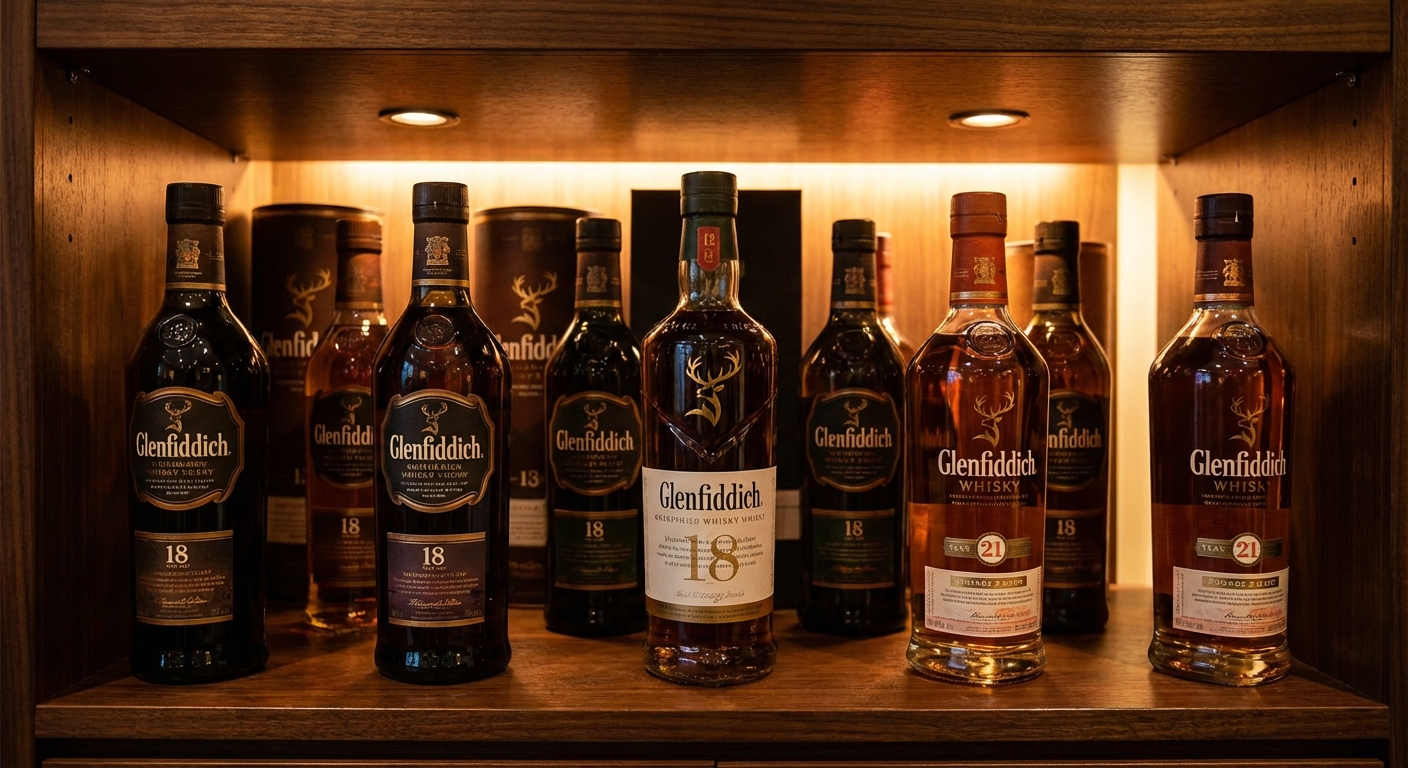
The 12 Year Old is the entry point and the world’s most recognisable single malt. Matured in American oak ex-bourbon and European oak ex-sherry casks, it delivers fresh pear, vanilla, and a gentle cereal note. Collect it? Not typically. Understand it? Absolutely. Every older Glenfiddich builds on this DNA.
The 15 Year Old uses Glenfiddich’s unique Solera Vat — a large married cask that is never fully emptied, ensuring continuity of character across batches. Richer than the 12, with honey, spice, and toasted oak. Limited regional editions of the 15 occasionally attract collector interest.
Matured in American and European oak, then finished in Oloroso sherry casks, the 18 Year Old is the point where the core range becomes genuinely interesting for light collecting. Batch variation exists, and certain travel retail exclusives command modest premiums.
The 21 Year Old Gran Reserva is where the core range crosses into collector territory. Finished in Caribbean rum casks — a bold and distinctive choice — it delivers exotic fruit, spice, and a long, warming finish. Demand routinely exceeds supply in specialist retailers. This expression anchors the Glenfiddich Grand Series discussed below.
The 26 Year Old Excellence is a prestige core-range release finished in rare Virgin Oak casks. Production numbers are limited, and it trades consistently above retail on auction platforms. If you are building a core-range collection, the 26 deserves a position.
The 30 Year Old sits at the apex of the routinely available Glenfiddich range. Presented in a distinctive bottle with a wooden case, it blends casks from different decades to achieve extraordinary depth: dried fruit, sandalwood, leather, and dark chocolate. Issue price is typically £500–£800 in the UK market. Secondary market sales regularly exceed that.
The 40 Year Old is released in small batches and draws on the distillery’s oldest warehoused stocks. Each release is distinct from the last. Bottle counts are typically in the low hundreds globally. These are genuine collector items that require patience to acquire at or near retail.
Glenfiddich organises its premium and experimental releases into named series. Understanding which series an expression belongs to is the fastest way to assess its collecting potential.
The Grand Series represents Glenfiddich’s prestige finishing programme — expressions where the base whisky is completed in an exceptional secondary cask that adds a distinctive final chapter to the flavour profile.
Gran Reserva (21 Year Old) — Caribbean rum cask finish. The most accessible Grand Series entry and the most liquid on the secondary market.
Grand Cru (23 Year Old) — French cuvée wine cask finish. Named for the classification system of the finest French wine regions, this expression is finished in hand-selected casks that previously held Grand Cru wine. Elegant, refined, and harder to find than the Gran Reserva.
Grand Yozakura (29 Year Old) — Finished in Japanese Awamori casks, with a release that coincided with the cherry blossom (yozakura) season. This is one of Glenfiddich’s most culturally distinctive bottlings and has performed strongly at auction since launch.
Grand Château (26 Year Old) — Finished in First Growth Bordeaux wine casks. The wine finishing is pronounced and deliberate, producing an expression that sits at the intersection of whisky and wine collecting. A natural choice for buyers who collect both categories.
For detailed tasting notes, release histories, and secondary market data for every Grand Series expression, visit Glenfiddich Grand Series: Gran Cru, Grand Yozakura and Beyond.
Launched in 2017, the Experimental Series was Glenfiddich’s statement of intent: the distillery was prepared to challenge conventions and take genuine creative risk.
IPA Cask Experiment — Finished in craft IPA beer casks, introducing hoppy and citrus notes entirely alien to the traditional Speyside profile. The first release generated significant media attention and secondary market trades above retail almost immediately.
Project XX — Blended by 20 Glenfiddich brand ambassadors, each of whom selected a favourite cask. The resulting whisky is a study in collaborative curation. Multiple editions have been released; early batches are the most sought after.
Winter Storm (21 Year Old) — Finished in ice wine casks from Canada. Intensely sweet, rich, and distinctive. Limited to under 1,000 bottles on initial UK release. This is among the most collectable Experimental Series expressions.
Fire & Cane — Peated Glenfiddich matured in Latin rum casks. Peat and sweetness in deliberate tension. Accessible pricing on release, with secondary trades typically modest — but it demonstrates the range’s willingness to experiment.
A full breakdown of every Experimental Series release, batch history, and which expressions still appear at auction is available in Glenfiddich Experimental Series: IPA Cask, Project XX and More.
Time Re:Imagined is Glenfiddich’s contemporary art collaboration series, pairing rare whisky with commissioned artwork to produce limited collectibles that appeal equally to whisky collectors and art collectors. Each release is numbered and presented with provenance documentation. The dual-market appeal means demand can be unpredictable — and sometimes extraordinary.
Beyond the named series, Glenfiddich releases individual single cask bottlings through its Rare Collection programme and occasionally through third-party bottlers who have held stocks for decades.
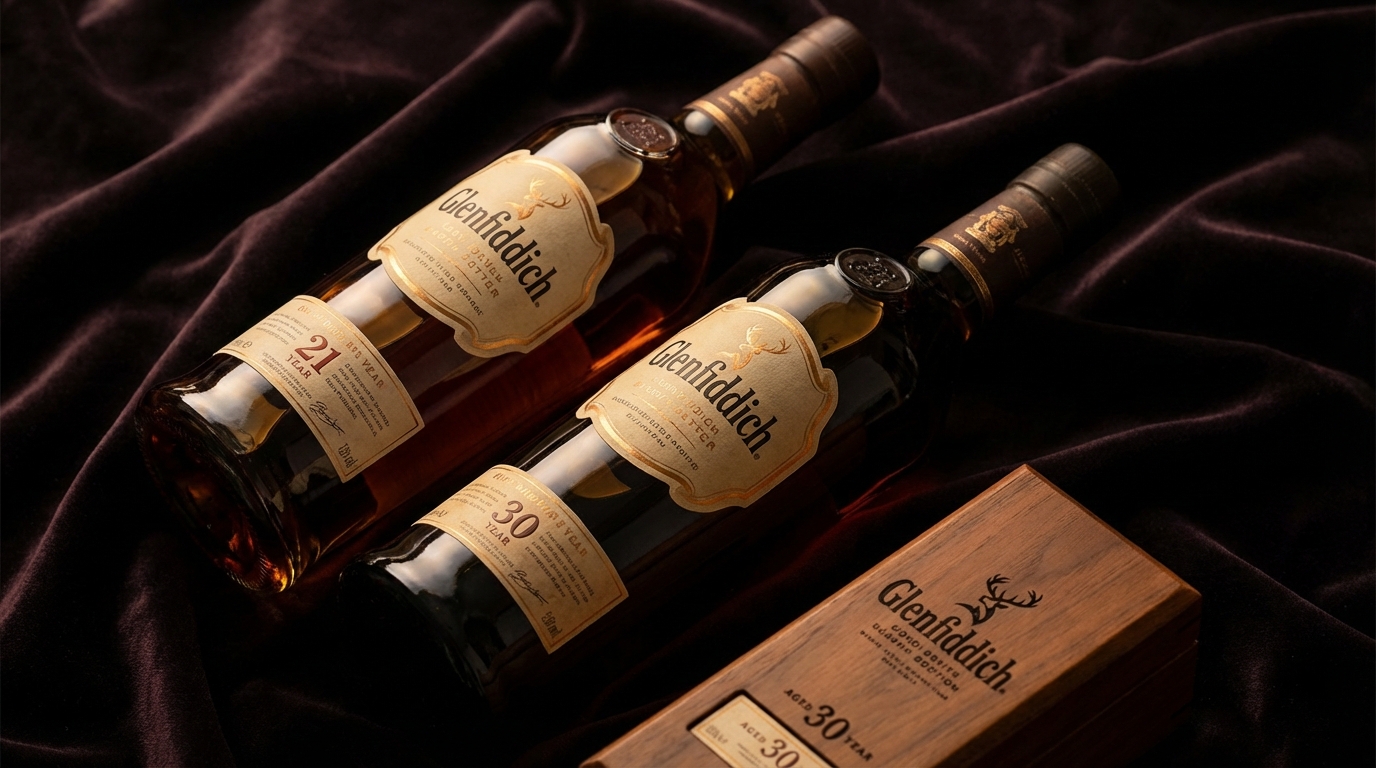
Single casks are by definition unrepeatable. Each one represents a unique interaction between spirit, wood, and time. Distillery-bottled single casks carry full provenance documentation — distillation date, cask number, strength, and yield — and attract a premium over equivalent independent bottlings.
Key categories to watch:
According to data from Rare Whisky 101, vintage single cask Scotch malt prices have appreciated significantly over the past decade, with Speyside expressions — including Glenfiddich — among the most consistently traded categories.[^1]
No survey of Glenfiddich collecting is complete without the 50 Year Old.
Released in extremely limited batches — typically fewer than 50 decanters globally per release — the 50 Year Old represents the oldest and most precious stocks in the distillery’s warehouses. Each release is individually numbered, presented in a hand-blown crystal decanter crafted by Scottish glassmakers, and accompanied by full provenance documentation.
This is not a bottle you discover at retail. The 50 Year Old is allocated through specialist retailers, private client programmes, and auction houses. Issue prices typically start above £25,000. Secondary market realisations have exceeded £50,000 for certain releases.
For context on how expressions at this level are valued and what drives the gap between issue price and auction price, see What Makes a Whisky Bottle Valuable? 7 Key Factors and Macallan vs Glenfiddich: Which Is the Better Collector’s Whisky?.
Disclaimer: Whisky collecting involves financial risk. Past price performance does not guarantee future returns. The information below is educational and reflects historical secondary market trends, not investment advice. Always conduct independent research before purchasing with investment intent.
Now:
Not every Glenfiddich bottle is a store of value, and serious collectors are clear-eyed about the distinction. Here is a framework for evaluating investment-grade expressions.
Prioritise age and scarcity over series branding. A 40 Year Old from any programme will typically hold value better than a well-branded 12 Year Old. Age statements represent finite stocks that cannot be replenished.
Earlier batches outperform later batches in the same series. The first release of the IPA Cask Experiment trades above subsequent releases because it carried novelty value at launch. This pattern holds across most Experimental Series expressions.
Provenance documentation matters enormously. Full original packaging — box, inner packaging, any printed collateral — is increasingly expected by auction house buyers. An incomplete set can reduce realised price by 10–20%.
Single casks from pre-1990 distillation years are structurally scarce. There is no mechanism for creating more 1978 Glenfiddich. As these stocks are consumed or auctioned, the remaining pool of bottles shrinks permanently.
The Scotch Whisky Association’s industry data confirms that Scotch whisky exports have remained robust even through economic volatility, with the premium and super-premium segments consistently outperforming volume categories.[^2]
For a practical valuation methodology, including how to interpret auction records and assess condition, visit How Much Is My Whisky Worth? A Complete Valuation Guide.
| Expression | Age | Series | Approx. Issue Price | Collector Interest |
|---|---|---|---|---|
| 21 Year Old Gran Reserva | 21 yr | Grand Series | £150–£200 | Moderate — liquid market |
| 23 Year Old Grand Cru | 23 yr | Grand Series | £250–£350 | High — limited allocation |
| 26 Year Old Grand Château | 26 yr | Grand Series | £500–£700 | High — dual wine/whisky appeal |
| 29 Year Old Grand Yozakura | 29 yr | Grand Series | £700–£1,000 | Very High — cultural crossover |
| 30 Year Old | 30 yr | Core Range | £500–£800 | High — consistent demand |
| 40 Year Old | 40 yr | Core Range | £3,000–£5,000 | Very High — batch limited |
| 50 Year Old | 50 yr | Rare Collection | £25,000+ | Ultra-rare — private allocation |
| Winter Storm (21 yr) | 21 yr | Experimental | £200–£300 | High — under 1,000 bottles UK |
| IPA Cask (Batch 1) | NAS | Experimental | £50–£80 | Moderate — early batch premium |
| Vintage Single Cask (pre-1990) | 30–50 yr | Rare Collection | £5,000–£50,000+ | Ultra-rare — auction only |
Issue prices are indicative and reflect approximate UK retail at time of release. Secondary market prices vary significantly. Always verify current auction data before purchasing.
Understand the full range of expressions within each Glenfiddich series — including which batches are most sought-after, what secondary market data shows, and where gaps in your collection might be filled.
2 Resources
Before committing to a bottle, serious collectors weigh Glenfiddich against the wider market. Discover how the distillery stacks up against its most formidable rival, learn what drives secondary-market value, and get a clear method for valuing what you already own.
3 Resources
Glenfiddich sits within a broader world of rare and elusive single malts. These resources place your collection in that wider context.
1 Resource
Certain Glenfiddich expressions have a strong track record on the secondary market — particularly the 40 Year Old, the 50 Year Old, and limited Grand Series releases like Grand Yozakura. However, whisky collecting carries financial risk, and past price appreciation does not guarantee future returns. Only the rarest, best-documented expressions tend to appreciate materially. The everyday core range is not investment grade.
The 50 Year Old is the rarest expression Glenfiddich produces, with batch sizes typically under 50 decanters globally. Beyond that, pre-1990 vintage single casks, the Grand Yozakura, and early-batch Experimental Series releases are among the hardest to source.
The Grand Series focuses on prestigious finishing casks — rum, wine, and Japanese spirit casks — applied to older, long-matured whisky. The Experimental Series explores radical departures from convention, such as IPA beer cask finishes and collaborative blending projects. Grand Series bottles are generally older and more expensive; Experimental Series bottles are more accessible but often more boldly flavoured.
Full, original packaging is essential. This means the outer box, inner packaging, any certificate of authenticity, and any accompanying material such as booklets or droppers. The bottle should be undamaged and the label clean and unaffected by moisture. Fill level matters for very old expressions — any ullage (evaporation below the shoulder) should be disclosed.
Specialist rare whisky retailers, reputable UK auction houses (including Whisky Auctioneer, Scotch Whisky Auctions, and Bonhams), and select independent whisky shops. Be cautious of private sellers without established reputation or provenance documentation.
Check the distillery’s own records where possible, verify batch numbers and cask references against known release lists, and inspect capsule, label, and bottle typography for consistency with known authentic examples. For very high-value bottles, independent authentication services exist. Glenfiddich has also introduced digital authentication features on certain limited releases.[^3]
A single malt is produced entirely at one distillery but may blend multiple casks together to achieve a consistent house style. A single cask Glenfiddich is drawn from one individual barrel — it will not be exactly replicated — and is typically bottled at cask strength without chill-filtration.
Significantly. Unopened bottles with original seal intact command a substantial premium over opened bottles. Once opened, the whisky begins to oxidise and the secondary market treats it as a different category of item — suitable for consumption rather than collection.
The Grand Series is the most accessible entry point for serious collecting. The 21 Year Old Gran Reserva offers a strong introduction at a price point that remains under £200 in most markets, while expressions like Grand Cru and Grand Yozakura provide the scarcity and prestige characteristics that underpin secondary market performance.
Upright (not on their sides — unlike wine, whisky cork contact with liquid can cause off-flavours and label damage), in a dark environment, at consistent temperature (ideally 12–16°C), away from direct light and strong odours. Humidity between 60–70% prevents cork desiccation. Do not store near heating sources or in attic spaces subject to temperature swings.
Yes, though it requires access to specialist allocation channels. The 50 Year Old is not available through general retail. Specialist retailers with direct distillery relationships — including private client programmes — are the most reliable route. Auction houses occasionally offer bottles from previous releases.
Both distilleries dominate the upper end of the Scottish single malt secondary market. Macallan has historically achieved higher price records for its rarest expressions, but Glenfiddich offers stronger mid-market liquidity and a broader range of entry points. A detailed comparison is available in Macallan vs Glenfiddich: Which Is the Better Collector’s Whisky?.
Glenfiddich is both the most accessible and — at the upper end — one of the most exclusive distilleries in Scotland. The core range establishes its character; the Grand Series, Experimental Series, and Rare Collection define its ceiling.
For collectors, the practical takeaway is straightforward: the everyday bottles are for drinking, and the distillery’s limited releases are genuinely scarce. Pre-1990 single casks, the 40 and 50 Year Old expressions, and Grand Series bottlings with strong auction histories represent the most defensible positions in a serious collection.
Start with the expressions you understand, build provenance documentation from the first purchase, and use the resources linked throughout this guide to deepen your knowledge of each series before committing capital.
Glenfiddich’s 140-year history of continuous production is its strongest credential. The stocks that underpin its rarest bottles took decades to accumulate — and they cannot be replaced.
Start Collecting — Browse Rare Glenfiddich at Glenbotal
[^1]: Rare Whisky 101 — Rare Whisky Market Report (annual tracking of secondary market transactions across UK auction platforms). rarerwhisky101.com
[^2]: Scotch Whisky Association — Scotch Whisky Industry Review (annual export statistics and premium segment analysis). scotch-whisky.org.uk
[^3]: William Grant & Sons — Glenfiddich Limited Editions product pages and authentication guidance. glenfiddich.com
Start Collecting — Browse Rare Glenfiddich Bottles at Glenbotal
Explore the full collection at Glenbotal — rare whisky sourced from private collectors across the UK and Europe.