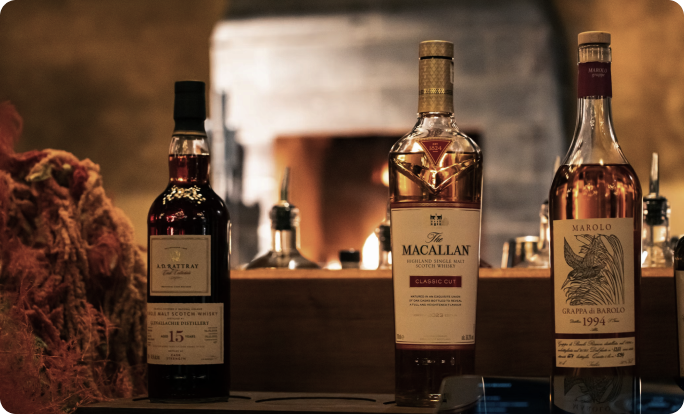
Scotland is home to over 140 malt and grain distilleries — the greatest concentration of whisky production anywhere in the world — exporting 43 bottles every second to markets across the globe.
Where a whisky comes from is not a postcode. It is a fingerprint. Scotland’s regions each carry distinct geology, climate, and craft traditions that shape everything from flavour and character to collector demand and long-term value. Whether you are building your first serious collection or refining a private cellar that already spans decades, understanding the regional map is the single most important step you can take.
The five officially recognised Scotch whisky regions — Speyside, Highlands, Islay, Campbeltown, and Lowlands — are defined under the Scotch Whisky Regulations 2009. The Islands are widely treated as a sixth, unofficial region by collectors, retailers, and the industry alike, even though they technically fall within the Highland classification. Each region carries legal weight: a distillery’s regional identity appears on labels, in auction listings, and in the provenance documentation that serious buyers demand.
For a collector, region matters in three interconnected ways: flavour predictability, production scarcity, and market behaviour. Knowing that a distillery sits in Campbeltown, for example, immediately signals a rare and sought-after category — one with only three active producers, a storied history, and a collector community that treats its bottles as true rarities. Speyside, by contrast, offers depth and variety across dozens of distilleries, with flagship names trading in the upper echelons of the global auction market.
Region also affects how a collection tells a story. A rack that spans all six regions demonstrates both breadth of knowledge and strategic intent. A tightly focused single-region collection — say, every independent bottling from a closed Islay distillery — signals connoisseurship of the highest order. Understanding the regions is not background knowledge. It is the foundation of intelligent collecting. For a deeper look at how geography shapes value, see our guide to distilleries worth collecting.

Speyside occupies a relatively compact area of northeast Scotland, centred on the River Spey and its tributaries as they cut through Moray and the Cairngorms. Despite its modest geography, the region holds the greatest number of distilleries of any single area in Scotland — approximately 50 active producers — and accounts for roughly half of all Scotch malt whisky production by volume. The town of Dufftown alone operates six working distilleries with a combined annual capacity exceeding 40 million litres of spirit.
The character that defines Speyside is elegance. Water drawn from rivers and springs with exceptionally low mineral content, combined with a tradition of using lightly peated malt and high-quality ex-sherry and ex-bourbon casks, produces whiskies that are consistently fruity, complex, and refined. Expect notes of orchard fruit, dried vine fruits, vanilla, honey, and warm baking spice. The phenolic hit of a heavily peated malt is largely absent here; Speyside whisky is built for contemplation rather than confrontation.
Skim Stopper: Speyside produces approximately 50% of all Scotch malt whisky by volume from fewer than 50 distilleries — a density of production found nowhere else on earth.
The Macallan is the region’s most coveted name for collectors, with aged expressions, private cask releases, and limited editions commanding five- and six-figure sums at auction. Glenfiddich, the world’s best-selling single malt, offers collectible tier expressions including the 30, 40, and 50 Year Old Grand Series that represent serious long-term holdings. The Glenlivet, the world’s second best-selling single malt, carries rare vintage bottlings from independent bottlers that regularly surface in private collections. Aberlour and Glenfarclas are celebrated for their sherried expressions — Glenfarclas Family Casks in particular, spanning vintages from the 1950s to the present, are regarded as one of the most complete collector series in Scotch whisky. Craigellachie, a more obscure name to casual buyers, has developed a strong cult following for its waxy, sulphury, distinctly old-fashioned character that stands apart from the region’s sweeter mainstream. Among closed distilleries, Convalmore and Caperdonich bottles command serious premiums wherever they appear. For a full deep-dive into collecting the region’s most prestigious name, read our guide to collecting Macallan whisky.
Speyside’s combination of volume and prestige makes it both the most accessible entry point and the deepest rabbit hole in Scotch collecting. A collector can begin with widely available age-statement expressions and progress toward rare independent bottlings, discontinued vintages, and limited distillery releases. The region rewards patience: bottles held for five to ten years have consistently demonstrated strong appreciation, particularly for sherried expressions from distilleries with constrained output. See our ultimate whisky collecting guide for a framework on building Speyside holdings strategically.
The Highlands is by far the largest of the five official regions, stretching from Perthshire in the south to the far north of Scotland at Wick and beyond. The sheer geographic scale — encompassing mountains, glens, coastal cliffs, and everything between — makes flavour generalisation almost impossible. The Highlands is less a unified style statement and more a collection of micro-environments, each producing whisky shaped by its immediate surroundings.
If any broad flavour thread connects Highland whiskies, it is a full-bodied richness combined with regional variation. Northern distilleries like Clynelish and Balblair tend toward waxy, coastal expressions with a bracing herbal quality. Eastern Highland producers, including Old Pulteney in Wick, lean maritime. Central and southern Highland whiskies, exemplified by Aberfeldy and Blair Athol, tend toward honeyed, heather-honey sweetness. The diversity is the point.
Dalmore has built one of the most recognisable collector profiles in the Highlands, with its multi-decadal expressions — the 25, 40, and the Constellation Collection — traded as trophies among serious buyers. Glenmorangie is celebrated for its 18-year core expression and the Private Edition series, which showcases experimental cask finishing at its most thoughtful. Balblair, which switched to vintage dating rather than age statements in 2019, offers a compelling back-catalogue of single vintage expressions that have become increasingly scarce. Clynelish holds particular collector appeal because its waxy, complex character is under-recognised relative to its quality — prices remain relatively accessible for now, making it one of the more intelligent long-term bets. Oban produces small volumes of a coastal malt widely regarded as one of the best expressions of the western Highland style, with its 18 Year Old a consistent auction performer.
Among closed Highland distilleries, Brora — mothballed in 1983 and periodically reopened for single cask releases — generates extraordinary auction interest. Dallas Dhu, closed in 1983 and now a visitor museum, produces bottles that fetch multiples of their original retail prices wherever they appear.
The Highland region rewards collectors who specialise by sub-region or by distillery rather than treating it as a single category. Picking three or four Highland distilleries with distinct flavour profiles and building verticals — consecutive age statements or annual releases from the same producer — creates a collection that is both intellectually coherent and financially defensible. Compare Highland and Speyside approaches in depth with our article on Highland vs Speyside whisky.
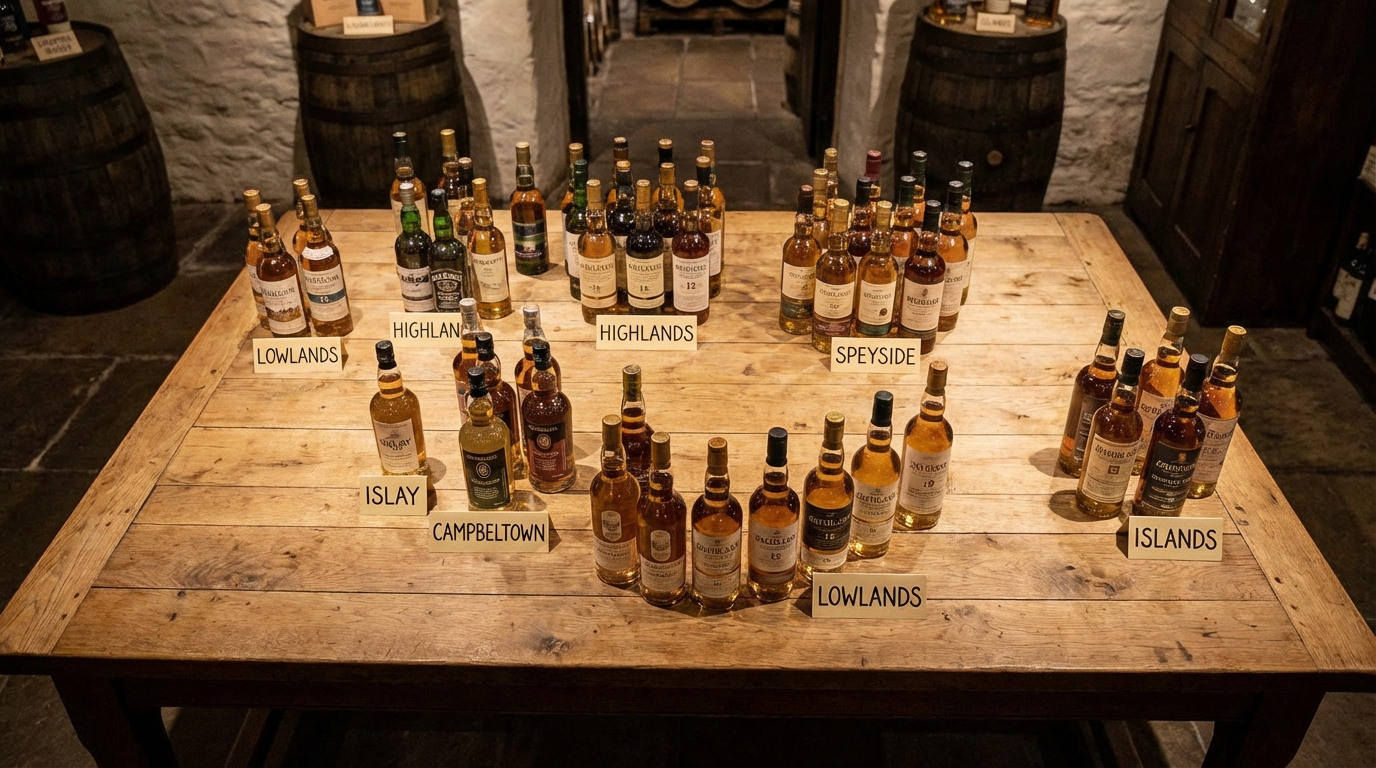
Islay (pronounced “Eye-luh”) is a small island off the southwest coast of Scotland, roughly 25 miles long and 20 miles wide, accessible by ferry from Kennacraig or by a short flight from Glasgow. Its physical smallness belies its outsized cultural weight: Islay is the most mythologised whisky region in the world, its name synonymous with peat smoke, Atlantic salt, and a character that provokes strong responses in even casual drinkers. The island currently has nine active distilleries — Ardbeg, Bowmore, Bruichladdich, Bunnahabhain, Caol Ila, Kilchoman, Lagavulin, Laphroaig, and the newer Ardnahoe — making it one of the most productive islands per square mile in whisky history.
Skim Stopper: Islay has nine active distilleries on an island of roughly 3,200 residents — more distilleries per capita than any other whisky-producing area in Scotland.
Islay’s signature is peat, but peat is not the whole story. The island’s whiskies range from the heavily medicinal and iodine-driven expressions of Laphroaig and Ardbeg to the unpeated Bruichladdich Classic Laddie, the gentle maritime notes of Bunnahabhain, and the rich, complex mid-peated character of Lagavulin. The commonality is the sea: almost every Islay malt carries some trace of coastal salinity, ozone, and brine that is a function of geography rather than production choice.
Laphroaig is the defining Islay collector’s distillery — its annual Càirdeas bottling, released for Fèis Ìle (the island’s whisky festival) each May, is one of the most sought-after limited releases in Scotch whisky. Our detailed guide to the Laphroaig Càirdeas series covers which vintages are most prized and what prices to expect. Ardbeg produces some of the most heavily collected limited editions in any region, with Day and Committee releases trading at significant premiums on secondary markets. Lagavulin 16 Year Old is one of the landmark Scotch whiskies of any era; Distillers Edition releases and rare independent bottlings of 25+ year expressions are genuine trophies. Bruichladdich‘s Black Art series — unpeated, matured in undisclosed cask combinations, with recipes kept secret by the distillery — occupies a unique position as a prestige collector series that defies easy comparison. We cover it in detail in our Bruichladdich Black Art series guide. Among closed Islay distilleries, Port Ellen (closed 1983, with annual Diageo special releases resuming in the 2000s) stands as perhaps the single most coveted closed distillery in all of Scotch whisky — bottles regularly achieve five-figure sums at auction.
Islay bottles are among the most internationally recognisable Scotch whiskies, which creates a floor of strong global demand. Collector-focused limited releases from Ardbeg, Laphroaig, and Bruichladdich have historically appreciated strongly. Port Ellen remains the ultimate Islay trophy. Even mid-range Islay expressions from independent bottlers — particularly older vintages of Caol Ila — have shown excellent long-term value retention.
At the tip of the Kintyre peninsula, separated from the rest of Scotland by miles of moorland and accessible only by a long drive or a small ferry from Ballycastle in Northern Ireland, sits Campbeltown — once the undisputed whisky capital of Scotland and now one of its most compelling collector stories. At the industry’s Victorian peak in the 1880s, the town operated over 30 distilleries, producing a style of whisky that was shipped in bulk to blenders across Scotland. The style fell from favour in the early 20th century, and one by one the distilleries closed. By the mid-20th century, the region was down to a handful of producers.
Today, only three distilleries operate in Campbeltown: Springbank, Glen Scotia, and Glengyle. The Scotch Whisky Regulations require a minimum of three distilleries for a region to retain its classification — Campbeltown meets that threshold, but only barely. That precariousness is part of its collector mystique.
Campbeltown whiskies are unlike anything produced elsewhere in Scotland. The style is typically described as briny, oily, and slightly maritime — a punchy, full-bodied character with a distinctive coastal earthiness that sits between the salinity of the west coast Highlands and the peat of Islay, but belongs fully to neither. There is often a slight sulphury note in younger expressions that resolves with age into something complex and deeply satisfying.
Springbank is the jewel of the region and one of the most important distilleries in all of Scotch whisky. It is the only distillery in Scotland that malts all of its own barley on-site and handles the entire production process from malting to bottling, without chill filtration or colouring. Its output is small and its releases are intensely sought-after — annual bottings of the 10, 12, 15, and 18 Year Old, along with limited releases under the Longrow (heavily peated) and Hazelburn (unpeated, triple distilled) labels, are collected seriously worldwide. Glen Scotia produces an underrated, good-value range that punches above its recognition level. Glengyle, which reopened in 2004 after decades of silence, produces the Kilkerran range — a critically acclaimed malt whose annual Work in Progress series has built a devoted collector following.
Skim Stopper: At Campbeltown’s Victorian peak there were over 30 distilleries in the town. Today there are three. Every bottle from this region carries the weight of that near-extinction.
Campbeltown’s scarcity is structural, not cyclical. With only one major distillery (Springbank) producing at meaningful scale, and that distillery choosing to remain deliberately small, supply will never keep pace with global collector demand. Vintage Springbank — particularly expressions from the 1960s and 1970s released under original labels — trades at auction alongside the most prestigious Speyside bottles. The newer Kilkerran Work in Progress series, by contrast, offers collector-grade bottles at relatively accessible prices. Campbeltown is a region where entry now, before global recognition catches up with quality, represents a compelling strategic position.
The Lowlands region covers Scotland south of an imaginary line running roughly from Greenock on the west coast to Dundee on the east — a broad swath of rolling farmland and industrial heritage that includes Edinburgh, Glasgow, and the agricultural heartlands of Ayrshire and Dumfries and Galloway. Historically the most productive region in Scotland by volume, the Lowlands was dominated by large grain distilleries supplying the blended Scotch trade. The malt distillery count collapsed dramatically through the 20th century, and for a period the region was down to just a handful of producers.
The defining characteristic of Lowland single malt is lightness. The region has a tradition of triple distillation — passing the spirit through the still three times rather than the standard two, which strips away heavier flavours and produces an exceptionally smooth, delicate whisky. Lowland malts are typically grassy, floral, and gentle, with soft cereal notes, light citrus, and a dry, clean finish. They are often described as aperitif whiskies — something to begin an evening with rather than end it.
Auchentoshan near Glasgow is the most visible Lowland brand, with its Three Wood expression — matured in bourbon, Oloroso sherry, and Pedro Ximénez casks — offering a showcase of the region’s ability to carry complex cask influence on a lighter spirit base. Glenkinchie near Edinburgh, long considered Edinburgh’s own malt, produces the benchmark light and floral Lowland style. Bladnoch in Dumfries and Galloway is the southernmost distillery in Scotland, recently under new ownership and producing increasingly impressive releases that have attracted collector attention. Daftmill in Fife is the region’s most compelling collector story: a farm distillery producing tiny quantities of whisky from its own barley, releasing it in very limited annual batches that sell out almost instantly. Its 2020 and subsequent releases represent some of the hardest-to-source bottles in the entire Lowlands category.
Among closed Lowland distilleries, Rosebank (closed 1993, with a full restart announced and underway) and St Magdalene/Linlithgow (closed 1983) produce bottles that command strong premiums at auction. Rosebank’s lightly peated, triple-distilled character was considered by many to be the archetype of the Lowland style.
The Lowlands is the most overlooked region among serious collectors — which creates opportunity. Daftmill releases are already trading well above retail. As Rosebank completes its reboot and releases its first new-make bottlings to a waiting market, collector interest in historic Rosebank stock will likely intensify. The region also benefits from close proximity to Edinburgh’s auction houses and the growing Scotch whisky tourism infrastructure. For collectors building a regionally diversified portfolio, Lowlands offers the clearest gap between current prices and likely future appreciation.
The Islands are not a legal region under the Scotch Whisky Regulations 2009 — legally, the island distilleries fall within the Highland designation. But in practice, the whisky community, auction houses, retailers, and collectors treat the Islands as a distinct category, and with good reason. The distilleries scattered across Scotland’s island archipelago share a common maritime context and produce whiskies that sit apart from mainland Highland styles in character, identity, and collector appeal.
The Islands category is united by salt air, sea spray, and the influence of an oceanic climate on both maturation and spirit character. Beyond those shared environmental factors, the distilleries diverge significantly — from the heavily peated expressions of Highland Park and Talisker to the lighter, more approachable styles of Arran and Tobermory.
Highland Park on Orkney is the northernmost whisky distillery in Scotland and one of the most complete single malts in the world. Its use of Orcadian peat — which imparts a distinctive heather-smoke note different from the phenolic peat of Islay — combined with extended sherry cask maturation produces a whisky of extraordinary balance. The 18 Year Old is widely regarded as a benchmark expression; older releases and limited editions command serious collector interest. Talisker on Skye is Diageo’s island jewel — a fierce, volcanic, black-peppery malt with a warming finish that is one of the most immediately recognisable flavour profiles in all of Scotch whisky. The 18 and 25 Year Old expressions are consistent auction performers.
Isle of Arran Distillers produces both peated and unpeated expressions that have built a loyal following, with vintage releases and independent bottlings gaining traction in collector markets. Jura — one of Scotland’s most prolific island producers by volume — has shifted toward a more premium positioning in recent years, with older expressions and the Casks of Distinction range attracting collector attention. Tobermory on Mull produces both an unpeated expression (Tobermory) and a heavily peated one (Ledaig), with older Ledaig bottlings having developed a particular cult following among peat enthusiasts. Abhainn Dearg on Lewis is Scotland’s most westerly distillery and produces a tiny amount of whisky each year — its bottles are among the hardest to source in the entire Islands category, making them genuine rarities for a private collection.
The Islands offer something no other region can replicate: the combination of dramatic provenance stories, maritime character, and genuine scarcity. Highland Park’s aged expressions have shown some of the most consistent long-term appreciation of any island category. Talisker limited releases, particularly annual Distillers Edition expressions, are consistently absorbed by collectors on release. Abhainn Dearg, for the most committed collectors, represents a bottle that simply cannot be restocked once it is gone.
The most straightforward region-based approach is to assemble one or two definitive expressions from each of the six regions, creating a collection that tells the complete story of Scottish whisky geography. A well-chosen six-bottle regional collection — say, a sherried Speyside, a coastal Highland, a peated Islay, a Springbank from Campbeltown, a Daftmill from the Lowlands, and a Highland Park from Orkney — gives any serious collector a foundation that is immediately coherent to any buyer, auction house, or appraiser.
The regional spectrum approach is particularly effective as the beginning of a collection, or as the connecting thread between deeper specialist holdings. It signals seriousness without overspending, and it creates natural anchor points around which further acquisitions can cluster.
For collectors with a clear flavour preference or a particular affinity for a region’s history, the single-region deep-dive is the most intellectually rewarding approach. A Campbeltown-only collection built around Springbank annual releases, closed distillery bottlings (Rieclachan, Benmore, Scotia from the 1970s), and independent expressions of Glen Scotia and Kilkerran creates something that is not only financially interesting but historically significant. Similarly, a comprehensive Islay collection — covering all nine active distilleries plus independent bottlings of Port Ellen — represents one of the most coveted collector categories in the global market.
Single-region collections command respect from knowledgeable buyers and tend to attract more focused bidding at auction. They also require more research, more patience, and more willingness to source through specialist networks rather than open retail.
A more financial approach treats regions as asset classes: spreading holdings across Speyside (high liquidity, strong global demand), Islay (strong limited-edition premiums), Campbeltown (structural scarcity), and Islands (provenance premium) creates a collection that is resilient to shifts in any one region’s market standing. This mirrors the logic of portfolio diversification in any asset class.
Skim Stopper: The most valuable single malt collection sold at auction in recent years was built around a single-region focus — not breadth, but depth. Regional specialisation creates differentiated collector value that breadth alone cannot match.
Building a serious regional collection requires access to bottles that never reach open retail. At Glenbotal, we have spent six years building a private collector network spanning the UK and Europe, sourcing rare, hard-to-find expressions — from single-cask independent bottlings to closed-distillery stock — that simply do not appear in mainstream retail channels. Our free valuation service allows collectors to understand what they hold before making any buying or selling decision. Explore the full collection at Glenbotal or read our ultimate whisky collecting guide for a complete framework.
Scotland has five officially recognised Scotch whisky regions under the Scotch Whisky Regulations 2009: Speyside, Highlands, Islay, Campbeltown, and Lowlands. The Islands are widely treated as a sixth region by the industry and collector community, even though they are technically classified as part of the Highland region under the regulations.
Speyside is the most popular region by both production volume and global retail sales. The world’s two best-selling single malts — Glenfiddich and The Glenlivet — are both Speyside distilleries, and the region accounts for approximately 50% of all Scotch malt whisky production. In collector markets, Islay and Campbeltown generate disproportionate interest relative to their size due to the scarcity and cult status of their key distilleries.
Speyside produces the most single malt Scotch whisky, accounting for roughly half of Scotland’s total malt whisky output across its approximately 50 active distilleries. For grain whisky — the bulk production base of blended Scotch — the Lowlands historically dominated, and its large grain distilleries (Cameronbridge, Strathclyde) continue to produce enormous volumes for the blending industry.
Speyside is geographically situated within the Highlands but was granted its own regional classification due to its unique concentration of distilleries and its distinctive production style. Highland whiskies are typically fuller-bodied and more diverse in character, with flavour profiles ranging from heathery and herbal in the north to honeyed and rich in the south. Speyside whiskies tend toward elegance, fruitiness, and refinement — particularly around the use of sherry casks — with less of the robust earthiness found in many Highland expressions. Read our full comparison in our Highland vs Speyside whisky guide.
Peat is historically the practical answer: Islay has relatively little woodland but abundant peat bogs, so the island’s distillers traditionally dried their malted barley over peat fires, which imparts the phenolic compounds (chiefly guaiacol and syringol) responsible for smoky, medicinal, and iodine flavours. Over centuries this became a defining stylistic choice rather than simply a practical one. Some Islay distilleries — notably Bunnahabhain and Bruichladdich’s classic expression — now produce unpeated or lightly peated whisky, demonstrating that the peat character is a tradition rather than an absolute rule.
Yes — Campbeltown retains its official regional status under the Scotch Whisky Regulations 2009, though it meets the minimum threshold of three active distilleries (Springbank, Glen Scotia, and Glengyle) with no room to spare. Its retention as a recognised region is significant: Campbeltown expressions carry a provenance designation that is unique to a historically important but now extremely scarce production area, which directly supports their collector value.
The Lowlands produces the lightest style of Scotch single malt, primarily because of the region’s tradition of triple distillation — passing spirit through the still three times to create a smoother, more delicate new make that carries lighter cereal and floral notes. Auchentoshan is the most widely available example of this style. Unpeated expressions from Bruichladdich (Islay) and Bunnahabhain are also lighter than typical Islay style, but Lowland whisky remains the benchmark for delicacy and subtlety in the Scotch world.
Islay and Campbeltown consistently generate the highest premiums relative to production volume in the collector market. Port Ellen (closed 1983) remains the single most coveted closed distillery in Scotch whisky, and active Islay producers like Ardbeg, Laphroaig, and Bruichladdich release annual limited editions that trade well above retail on secondary markets. Campbeltown’s Springbank, given its tiny output and the near-total scarcity of its older vintages, is arguably the most valuable distillery per bottle in the entire market.
Region influences price in several important ways. Campbeltown commands a structural premium due to scarcity — only three producers exist. Islay’s limited festival releases and closed distillery bottles (Port Ellen) are priced as trophies. Speyside’s top distilleries (Macallan, Glenfiddich aged expressions) dominate the upper auction bands by volume. The Lowlands, despite producing exceptional quality, remains relatively underpriced — which many collectors regard as the region’s key opportunity right now. Region is not the only driver of price, but it consistently shapes the ceiling and floor of what collectors expect to pay.
Speyside offers the most logical entry point: deep variety, widely available age-statement expressions, a clear hierarchy of distilleries from accessible to trophy-level, and a global secondary market that provides reliable price discovery. A beginner building a Speyside foundation — perhaps starting with Glenfarclas Family Casks, Aberlour a’bunadh, and a single Macallan limited edition — acquires both drinkable pleasure and genuine collector assets from day one. The Highlands and Islands also offer excellent entry-level collector value at lower price points than top-tier Speyside, with Clynelish and Highland Park both representing strong quality-to-price positions.
Several closed distilleries produce highly sought-after bottles. Port Ellen (Islay, closed 1983) is the most prestigious. Brora (Highlands, closed 1983) produces bottles at the five-figure level. Rosebank (Lowlands, closed 1993) is undergoing revival but historic bottles remain scarce. Convalmore and Caperdonich (both Speyside, closed) appear in independent bottlings that command significant premiums. In the Islands, the original Ardbeg expressions from before its 1996 closure are collector trophies.
Scotland’s whisky regions are not just a geographic taxonomy — they are a collector’s framework. Each region brings a distinct combination of flavour identity, production history, scarcity dynamics, and market behaviour that shapes how bottles are valued today and how they are likely to perform tomorrow. Speyside offers depth and liquidity. The Highlands offer diversity and discovery. Islay offers prestige and passion. Campbeltown offers rarity that money alone cannot easily solve. The Lowlands offer an undervalued opportunity. The Islands offer drama and provenance unlike anywhere else in the world.
Building a collection without understanding the regions is like building a library without understanding genres. The regional map is the key that unlocks intelligent, confident, and rewarding collecting. Whether you are starting your first collection or deepening one that already spans decades, the team at Glenbotal — with six years of experience, thousands of bottles sourced from private collectors across the UK and Europe, and a four-star-plus rated reputation on Trustpilot — is here to help you navigate it. We offer free valuations, access to rare and hard-to-find expressions that never reach open retail, and a private collector network that has been built over years rather than months.
Explore the full collection at Glenbotal →
Explore the full collection at Glenbotal — rare whisky sourced from private collectors across the UK and Europe.