
No recipe. No cask declaration. No repeat. Just one of the most coveted limited-release series in all of Scotch whisky — a new batch every year or two, each one gone forever once it’s gone.
There are limited editions, and then there is Black Art. Since 2009, Bruichladdich has released a series of aged Islay single malts with no disclosed recipe, no repeated formula, and a philosophy rooted in the idea that the best whisky you will ever make cannot — and should not — be made twice. Each numbered edition is a private experiment from the mind of one person, locked in cask for decades, and released to a world that has learned to pay close attention when the next batch arrives.
Black Art is a series of limited-release single malt Scotch whiskies produced by Bruichladdich Distillery on the Isle of Islay. Each release draws on aged spirit distilled before the distillery’s closure in 1994 — whisky that spent decades quietly maturing in undisclosed cask combinations, selected and blended by the master distiller alone.
What distinguishes Black Art from every other Bruichladdich expression is the deliberate withholding of information. The cask types, the vatting ratios, the finishing details — none of it is disclosed. Only the master distiller knows what went into the bottle. That secrecy is not a marketing quirk; it is fundamental to the series’ identity.
Each edition carries a numbered designation: 1.1, 2.1, 3.1, and so on. The number before the decimal indicates the edition; the number after indicates a sub-batch. Every release is strictly limited, unpeated, non-chill-filtered, and released at cask strength. Once a batch is gone, it is gone permanently — the formula will never be repeated.
The whisky industry has no shortage of “limited editions.” Many are limited by design rather than by nature. Black Art is genuinely unrepeatable in the most literal sense: the combination of aged stocks from a specific era, the particular casks chosen, and the judgment calls made at the vatting table in that moment cannot be recreated.
The pre-1994 spirit used in the series represents a finite, diminishing resource. As each edition is released, those old casks become smaller in volume — and eventually, the era of whisky from before Bruichladdich’s closure will run out entirely. The series is, in a very real sense, a race against time.
Bruichladdich sits on the western shore of Loch Indaal on Islay, Scotland’s most whisky-dense island. Built in 1881 by three brothers — William, John, and Robert Harvey — the distillery was designed from the outset to be modern and efficient. John designed it, Robert engineered it, and William financed it. It was constructed from local shore stone and laid out around a central courtyard in a manner considered state-of-the-art for its era.
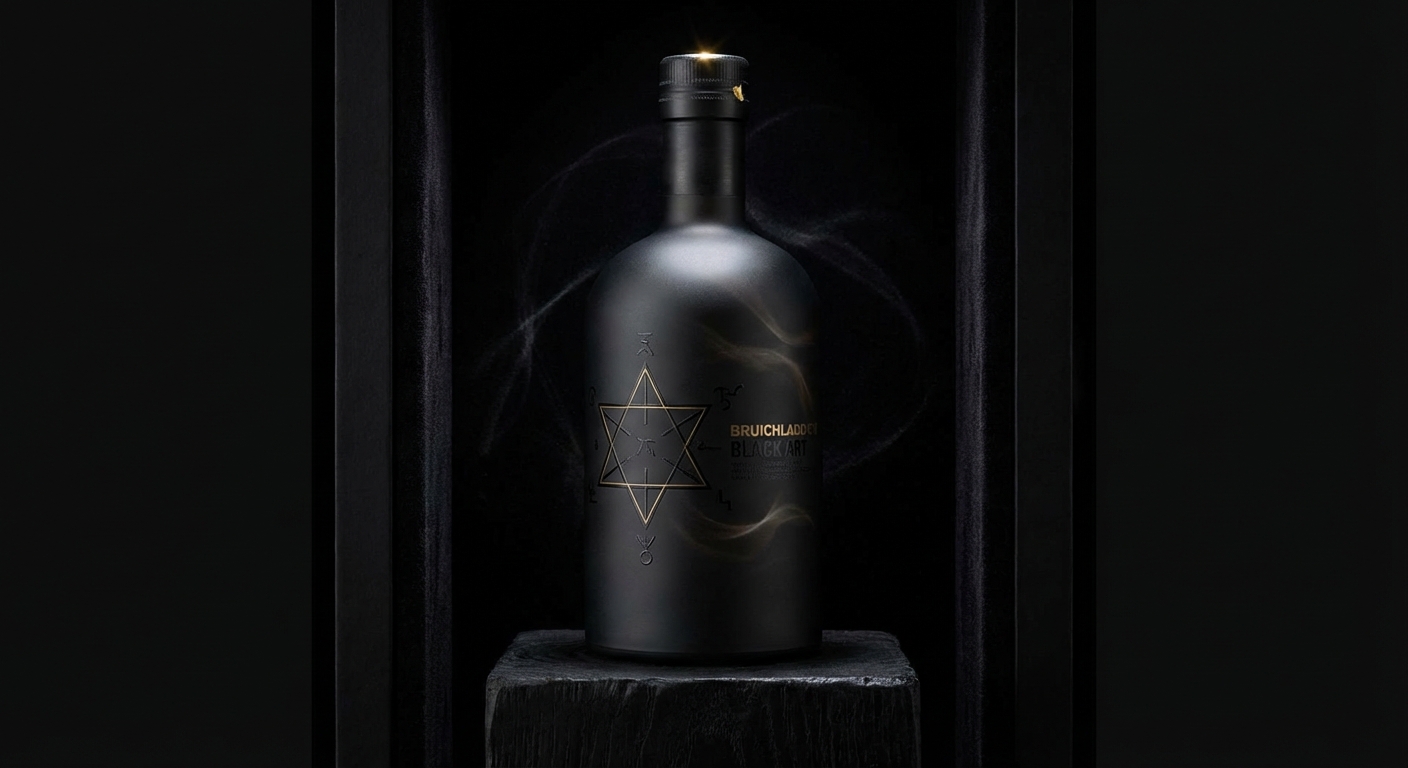
The distillery passed through several ownerships across the twentieth century, experiencing closures in 1907–1918, 1929–1935, 1941–1945, and most significantly in 1994–2001. It was the last of these closures — under Whyte and Mackay — that created the silent years from which much of the Black Art stock originates.
On December 19, 2000, a group of private investors led by Mark Reynier purchased the distillery. Between January and May 2001, the entire operation was dismantled and reassembled, with the original Victorian décor and equipment retained throughout. The decision to preserve rather than modernise was a deliberate philosophical statement: Bruichladdich would stand apart from the industrialised end of the Scotch whisky industry.
The distillery remains one of the few in Scotland where all production processes are controlled by skilled artisans rather than computer automation. That hands-on ethos runs through everything Bruichladdich produces — and it is inseparable from the Black Art series.
In July 2012, French cognac house Rémy Cointreau acquired Bruichladdich for £58 million. The acquisition raised concerns among fans about whether the distillery’s famously independent character would survive under a large corporate owner. Those fears have largely not materialised. Bruichladdich has retained its Islay production base, its unpeated house style, and the continuation of experimental releases including Black Art.
The distillery now produces three distinct spirit styles: the unpeated Bruichladdich, the heavily peated Port Charlotte, and the super-heavily peated Octomore — the most heavily peated whisky commercially produced anywhere in the world. Black Art sits within the Bruichladdich line, drawing exclusively on unpeated spirit.
The Black Art series was conceived by Jim McEwan, one of the most decorated figures in Scottish whisky. McEwan joined Bowmore Distillery as a young man and spent decades building an unmatched reputation for craft, creativity, and an almost preternatural ability to read a cask. When he joined Bruichladdich after the 2001 revival as master distiller and production director, he brought with him decades of expertise and an intimate understanding of Islay’s particular style of spirit.
McEwan created the first Black Art release in 2009. His central idea was deceptively simple: take aged spirit from some of the oldest casks at the distillery — stock laid down before the 1994 closure — and blend it in a way that reflected nothing more than his own instinct and judgment. No recipe would be written down. No process would be documented for reproduction. The result would be entirely personal, entirely unscientific, and entirely unrepeatable.
When collectors and journalists pressed McEwan on the cask composition, he was consistently untroubled by the question. The secrecy, he explained, was not about protecting proprietary information. It was about freedom. Once you commit a recipe to paper, you create an expectation of consistency. You create a standard to which future releases will be compared. Black Art was designed to exist outside that framework entirely.
Each release is a snapshot of a moment — the stocks available, the master distiller’s instincts on that particular day, the particular interplay of casks that seemed most interesting at the time. To document and repeat it would be to misunderstand what the series is.
“Black Art is what happens when you give a master distiller complete freedom, a cellar full of aged spirit, and no obligation to explain himself to anyone.”
Jim McEwan retired in 2015, having created the first four or five editions of the series. His successor as head distiller, Adam Hannett, inherited not just the distillery but the responsibility of continuing Black Art on McEwan’s terms — which is to say, on terms entirely his own.
Hannett has carried the philosophy forward faithfully. He has never disclosed the cask composition of his editions, and each of his releases has been met with the same critical enthusiasm as those of his predecessor. The transition from McEwan to Hannett represents one of the more intriguing continuity questions in collector whisky: can the spirit of a series survive the departure of its originator? In Black Art’s case, the answer appears to be yes.
By 2022, Hannett’s sixth release (Edition 10.1) had been bottled. The series shows no sign of a philosophy shift — only a different pair of hands working with fewer and fewer bottles of that irreplaceable pre-1994 spirit.
The following is a complete guide to every edition in the Bruichladdich Black Art series, compiled from distillery release information and specialist whisky reporting.
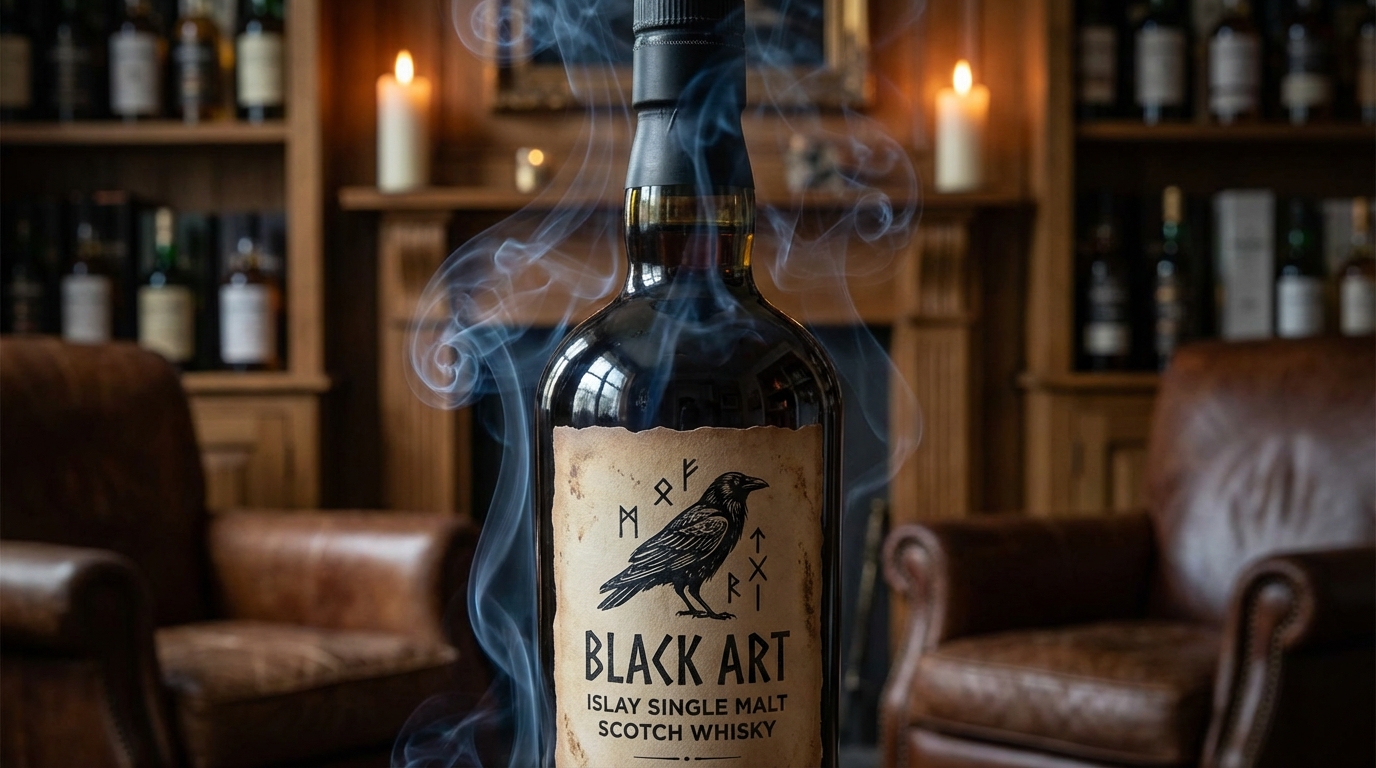
The first Black Art release arrived in 2009, distilled from spirit produced in 1989 — making it a 19-year-old at the time of release. Jim McEwan released approximately 6,000 individually numbered bottles at a robust 51.1% ABV, making it the highest-strength release in the series to date.
Edition 1.1 set the template for everything that followed: pre-closure spirit, undisclosed cask selection, cask strength, and a deliberately small allocation that rewarded collectors who were paying attention. At auction today, early bottles from this release command prices significantly above their original retail value, with collectors drawn to the provenance of being the first in a series that would prove consistently outstanding.
The 1989 spirit was distilled during a period when Bruichladdich was operating under its previous ownership — a very different era from the post-2001 revival. That historical dimension adds a layer of interest that goes beyond the liquid itself.
Edition 2.1 returned to the same 1989 vintage but aged two further years in cask before release, making it a 21-year-old. The increase in maturation time brought additional complexity to the base spirit, and the release helped establish the pattern of revisiting strong vintage years from different angles.
The series notation — the “.1” suffix — indicates that each numbered edition could theoretically produce multiple sub-batches. So far, each edition has produced only a single batch, suggesting the available stocks from any given year and cask combination are finite enough to exhaust in one release.
Edition 3.1 continued the exploration of 1989-distilled spirit, now approaching its mid-twenties in cask. By this point, the Black Art series had developed a small but intensely engaged following within the collector community. Whisky forums discussed each release with the kind of forensic attention usually reserved for Bordeaux vintages.
McEwan’s selection for Edition 3.1 drew considerable praise, with tasters noting the characteristic Bruichladdich profile of orchard fruit, maritime minerality, and oak integration — all amplified by the age and the undisclosed cask maturation. The meta-critic score for this release across specialist review aggregators sits among the highest in the series.
With Edition 4.1, the focus shifted to the 1990 vintage — stock distilled in the final years before the distillery’s impending closure. The spirit was bottled at 23 years of age, marking a natural transition point in the Black Art narrative: the distillery had now moved beyond the single vintage year of 1989 into a broader canvas of pre-closure stocks.
This edition is particularly significant for collectors with an interest in the pre-closure era. The 1990 spirit was produced when Bruichladdich was still operating under its previous ownership structure, and the cask stock from that period represents exactly the kind of irreplaceable raw material that gives the series its rarity value.
Edition 5.1 marked a significant transition: this was the first Black Art release to carry Adam Hannett’s name as master distiller rather than Jim McEwan’s. Distilled in 1992 and released in 2017 at 24 years of age, this release was bottled at 48.4% ABV with 12,000 individually numbered bottles produced.
The release was offered at £255 per bottle through UK retailers at the time, establishing a pricing benchmark for the mid-series editions. Hannett’s first Black Art was scrutinised closely by collectors wondering whether the change in distiller would alter the series’ character. The general consensus was reassuring: the philosophy held, the quality held, and the secrecy held.
The 1992 vintage spirit was distilled just two years before the distillery’s closure, making it among the last stocks produced before the seven-year silence. That proximity to the closure gives Edition 5.1 a particular narrative weight.
Edition 6.1 represented another shift in vintage year, drawing on spirit distilled in 1994 — the very year of the distillery’s closure. This spirit was laid down just before the lights went out, spending its entire maturation life waiting for a distillery that had temporarily ceased to exist.
Released at approximately 26 years of age, Edition 6.1 was made available in a limited allocation of 12,000 bottles. With a release price of approximately £395 per bottle, this edition marked the point at which Black Art pricing moved decisively into the upper range of collectible Scotch. The critical reception was strong, with the extra maturation time evident in the additional depth and complexity of the release.
The seventh edition returned to the 1994 vintage for another expression, this time at 25 years of age and 48.4% ABV, with 12,000 bottles produced. The release in 2019 continued Hannett’s run of critically well-received editions, reinforcing the view that the transition from McEwan had not diminished the series in any meaningful way.
Edition 7.1 drew considerable attention from collectors for its striking packaging — the Black Art box design has evolved subtly across editions — and for the particular quality of the 1994 vintage, which many specialists consider among the strongest source material in the series.
Edition 8.1 revisited the 1994 vintage at 26 years of age, releasing 12,000 bottles at 45.1% ABV in 2020. The Whisky Advocate awarded it 92 points, describing a profile of bright citrus notes — lemon, mandarin — with deeper spice and oak complexity underlying the fresh aromatic character.
This edition is particularly noteworthy as one of the more accessible entry points into the series on the secondary market — more recent than the early editions but carrying the full weight of the Bruichladdich pre-closure pedigree. Retail pricing at launch sat at approximately £400, with secondary market values moving above that figure as stock depleted.
Edition 9.1 represented a high-water mark for the series at its time of release. At 29 years of age, it was the oldest single malt Bruichladdich had ever sent to market — drawing on 1992-distilled spirit that had been in cask for nearly three decades. Released in December 2021 at 44.1% ABV, 12,000 bottles were allocated globally, with a retail price of approximately $600 in the US market.
The release was described as carrying “opulent, layered aromatics and flavors” with exceptional depth and viscosity. The fact that this spirit was produced before the distillery’s closure and had matured entirely through the distillery’s revival years without interruption gives it an almost documentary quality — a bottle of history as much as whisky.
Demand significantly outpaced supply. Bottles sold out quickly at retail, and secondary market prices climbed rapidly in the months following release.
Edition 10.1 marked Hannett’s sixth Black Art release and the tenth edition in the series. Distilled in 1992 and released in November 2022 at 29 years of age, it was bottled at 45.1% ABV. US retail pricing was approximately $650, reflecting the trajectory of the series toward premium price points.
The release confirmed that the 1992 vintage, revisited across multiple editions, continues to deliver depth and quality. Non-chill-filtered and with no added colour, Edition 10.1 maintains the production standards established at the series’ outset. Matured entirely on Islay, this release also underscores Bruichladdich’s commitment to island maturation.
Edition 11.1, released in 2024, marked a departure from the very old ages of the preceding editions. Bottled at 24 years of age and 44.2% ABV, this release drew on younger stock while maintaining the Black Art philosophy of undisclosed cask composition and limited availability.
The return to a younger age statement reflects the natural evolution of the series’ source material: the oldest pre-closure stocks have been progressively allocated across previous editions, and the series must now work with different parcels as the very oldest reserves diminish. This edition remains firmly within the Black Art tradition — the secrecy, the limited run, the unpeated Islay character — even as the age dynamics of the series shift.
The Bruichladdich Black Art series occupies a well-defined position in the collectible whisky market: it is sought-after, reliably high quality, and genuinely limited. That combination creates a secondary market with consistent upward price pressure on older editions.
Early editions — particularly 1.1, 2.1, and 3.1 — rarely appear at auction, and when they do, prices reflect both their age and their scarcity. Bottles from these editions in good condition with intact packaging routinely attract bids well above original retail. Edition 4.1, also from the McEwan era, commands similar premiums among collectors who distinguish between the two distillers’ eras.
Mid-series editions (5.1 through 7.1) have established themselves as the most active portion of the secondary market, with enough supply to maintain liquidity but tight enough allocation to sustain prices above retail. Editions 8.1 through 10.1, being more recent releases, are more commonly available but have shown consistent appreciation as stocks at retail depleted.
As a general principle: any Black Art edition in original packaging, with an intact box and the original certificate or leaflet where applicable, commands a premium over loose bottles. Condition matters significantly in the collectible whisky market.
To get an accurate current valuation for a Black Art bottle you already own, Glenbotal offers free bottle valuations based on live secondary market data and private collector network pricing. It is one of the few services of this kind available to UK collectors without any sales obligation attached.
New releases, when they arrive, are allocated through specialist whisky retailers. The series is not stocked in supermarkets or standard off-licences — it requires a retailer with direct access to Bruichladdich’s allocation, or a specialist secondary market dealer with established collector connections.
For older editions, the secondary market is the primary route. Specialist auction houses, including those focused exclusively on whisky, carry Black Art editions periodically. Private collector networks — such as the one operated by Glenbotal — are often the fastest route to specific editions, particularly from the McEwan era, since these bottles rarely appear in public auctions and tend to move through private sale.
Bruichladdich Black Art bottles carry individual serial numbers on the label. Verify that the serial number on the bottle corresponds to the edition number claimed — the first digit(s) before the decimal point indicate the edition, and each bottle within a 12,000-bottle run will have a unique number. If a seller cannot provide a clear photograph of the label and its serial number, treat the transaction with caution.
Packaging condition is also informative. Genuine Black Art boxes are high quality, with a consistent finish. Replica packaging tends to show inconsistencies in printing and material quality. When in doubt, consult a specialist. Understanding what makes a whisky bottle valuable can help you assess whether a Black Art bottle’s condition warrants the asking price.
To appreciate what makes Black Art exceptional, it helps to understand where it sits within Bruichladdich’s wider portfolio.
The Classic Laddie is the distillery’s flagship expression: unpeated, no age statement, and designed for everyday drinking rather than collecting. It is an excellent introduction to Bruichladdich’s house style — gentle, floral, fruit-driven — but it sits at the opposite end of the complexity spectrum from Black Art. Think of it as the distillery’s handshake; Black Art is its signature.
Port Charlotte is Bruichladdich’s heavily peated expression, produced at the same distillery but from a very different malt specification. At 40–50 ppm phenol, it delivers the smoky, coastal character associated with Islay whisky more broadly. Black Art is definitionally unpeated, so the two expressions serve entirely different collector profiles. If you are drawn to peated Islay whisky, the Bruichladdich Octomore series is the more natural comparison point.
Octomore is one of the most discussed whisky series in the world — ultra-heavily peated, typically young, and released in annual batches with phenol figures that regularly exceed 100 ppm. Its rarity and critical acclaim place it firmly in the collector category. The contrast with Black Art is instructive: Octomore is young spirit driven to extremes; Black Art is aged spirit driven to elegance. Both are essential Bruichladdich, but they appeal to different instincts.
Black Art is the apex of the Bruichladdich collection — the expression that most clearly represents what the distillery can achieve when it removes all commercial constraints and gives a single person complete creative control over the best aged stocks available. It is not the entry point to Bruichladdich collecting; it is the destination.
For collectors building a broader whisky portfolio, Black Art pairs naturally with other long-running limited series. The commitment to annual or biennial releases with consistent philosophy but evolving character is a pattern also found in the Glenfarclas Family Casks series and, in a different register, the Macallan Edition Series. Understanding what drives value in these series helps calibrate expectations for Black Art’s long-term trajectory. If you are asking yourself how much your whisky is worth, the comparison with other premium limited series is a useful starting point.
As of 2024, there have been eleven main editions in the Black Art series: 1.1 through 11.1. The series launched in 2009 with Edition 1.1 and has produced roughly one new release every one to two years since. The first five editions were created under Jim McEwan; the subsequent editions have been created by his successor, Adam Hannett.
The secrecy is intentional and philosophical rather than commercial. Both Jim McEwan (who created the series) and Adam Hannett (who has continued it) have stated that the point of Black Art is to produce a whisky that is entirely personal and unrepeatable. Writing down the recipe would create a template — and a template would undermine the series’ core identity. The secret is the point.
Black Art is unpeated. Bruichladdich produces three spirit styles: the unpeated Bruichladdich, the heavily peated Port Charlotte, and the super-heavily peated Octomore. Black Art draws exclusively from the unpeated Bruichladdich spirit, matured in undisclosed cask combinations. If you are looking for an Islay peated collectible, the Octomore series is the relevant alternative.
ABV has varied across editions, reflecting the natural variation of cask-strength bottling from different parcels: Edition 1.1 was bottled at 51.1%, Edition 5.1 and 7.1 at 48.4%, Editions 8.1 and 10.1 at 45.1%, Edition 9.1 at 44.1%, and Edition 11.1 at 44.2%. All editions are released at cask strength and without dilution, colour addition, or chill-filtration.
Edition 1.1, as the first in the series, commands the highest secondary market prices when it appears. Editions 2.1 and 3.1 are similarly elusive. For collectors seeking strong value-to-availability ratios, the mid-series editions (5.1–7.1) represent the most actively traded portion of the market. Current values fluctuate with market conditions; for live pricing guidance, Glenbotal’s free valuation service provides assessments based on current secondary market data.
New releases are allocated through specialist whisky retailers at the time of launch. Once retail allocation is exhausted, bottles move to the secondary market — specialist auction houses and private dealer networks. Glenbotal sources rare bottles including Black Art editions through its private collector network, spanning the UK and Europe. The ultimate whisky collecting guide covers the broader landscape of where and how to acquire limited editions.
Genuine Bruichladdich Black Art bottles carry an individually printed serial number on the label corresponding to their position within a numbered batch. The packaging is high quality with consistent printing and finish. Warning signs include blurred or inconsistent label printing, missing or non-sequential serial numbers, unusually low asking prices, and sellers unable to provide clear photographs of the label. When in doubt, consult a specialist before purchasing.
For collectors interested in aged, pre-closure Islay spirit with strong critical scores, demonstrable secondary market demand, and a genuinely limited supply trajectory, Black Art represents compelling value. It is not cheap, and it should not be evaluated on the same terms as everyday drinking whisky. As a collectible with a finite source material base and a decade-plus track record of consistent quality, it occupies a distinct and defensible position in a well-constructed rare whisky collection.
For a first purchase, Editions 8.1, 9.1, or 10.1 offer the best combination of quality, relative availability, and accessible price points compared to the earliest editions. Edition 8.1 is the easiest to find at a realistic price and the most frequently reviewed — making it easier to calibrate expectations before committing to a more elusive edition. Collectors who find Edition 8.1 to their taste typically pursue the rest of the series with considerable enthusiasm.
This is genuinely subjective, and opinion is divided within the collector community. McEwan’s editions — 1.1 through approximately 4.1 — benefit from the mystique of the originator and the novelty of a series that had not yet established its reputation. His early releases were made when fewer collectors were watching. Hannett’s editions have been technically polished, critically acclaimed, and produced with full knowledge of the high expectations the series has generated. The honest answer is that both eras have produced exceptional whisky, and the most sophisticated collectors pursue the full series rather than treating it as a competition between two distillers.
Editions from the mid-series onward have been produced in batches of 12,000 individually numbered bottles. The original Edition 1.1 was limited to approximately 6,000 bottles. The allocation is split globally across markets, meaning that any individual retailer or region receives a very small portion of the total.
Historical pricing data from specialist whisky auctions shows that Black Art editions consistently appreciate after retail release, with the rate of appreciation increasing once retail stock is exhausted. Early editions have appreciated substantially over their original retail prices. More recent editions are at an earlier stage of their appreciation curve. As with all collectible whisky, condition, provenance, and the completeness of original packaging are significant factors in secondary market value.
The Bruichladdich Black Art series is, by any measure, one of the most thoughtfully constructed limited-release programmes in Scotch whisky. It has a coherent philosophy — unrepeatable, secret, personal — that has been maintained consistently across more than a decade and two master distillers. It draws on a genuinely finite source of aged, pre-closure spirit. It is produced in small quantities, reviewed with consistent admiration, and collected with genuine passion.
For those building a serious rare whisky collection, Black Art is not optional. It is a benchmark. It is what the best of a distillery’s craft looks like when commercial pressures are removed and a single expert is trusted to make something that will only ever exist once.
If you are looking to add a Black Art edition to your collection, or if you already own a bottle and want to understand its current market value, Glenbotal can help. With six years of specialist rare whisky expertise, a private collector network spanning the UK and Europe, and free valuations for any bottle in your collection, we exist precisely for moments like this one.
See How to Find Your Black Art Edition at Glenbotal — and find the edition that belongs with you.
Secondary market prices fluctuate with demand and availability. Always verify current pricing before purchasing — values shown are indicative based on historical auction data and may vary.
Explore the full collection at Glenbotal — rare whisky sourced from private collectors across the UK and Europe.