
Some Octomore expressions have reached 407 PPM — more than ten times the phenol level of a typical Islay single malt.
Bruichladdich Octomore is unlike anything else in Scotch whisky. Released in numbered editions since 2008, each bottling deliberately pushes the boundaries of peating intensity — yet the liquid in the bottle consistently defies what those extreme numbers suggest. This is the complete guide to understanding, appreciating, and collecting the Octomore series.
Octomore is Bruichladdich’s experimental peated single malt — an ongoing project to discover what happens when you take Islay peat to its absolute limit.
Named after a farm on the south side of Islay, Octomore was first released as a commercial expression in 2008. From the very beginning, the philosophy was explicit: this was not peat for peat’s sake, but a genuine inquiry into the relationship between phenolic intensity and flavour. The question Bruichladdich’s team kept asking was whether extraordinarily heavy peating could produce something complex, layered, and even elegant — rather than simply punishing.
The answer, across more than fifteen numbered editions, has been an emphatic yes. Octomore has repeatedly demonstrated that extreme PPM and nuanced whisky are not mutually exclusive.
Bruichladdich has always positioned itself as the most experimental distillery on Islay. While neighbours like Laphroaig and Ardbeg produce heavily peated expressions as their core range, Bruichladdich historically made unpeated spirit — the Classic Laddie — and treated peat as a deliberate choice rather than a default.
Octomore took that philosophy to its logical extreme. Each release is a named experiment: a question posed, then answered in the glass. The distillery publishes the PPM figures, the barley provenance, the cask type, and the maturation details for every expression — treating whisky lovers as intelligent adults who want to know exactly what they’re drinking.
Octomore attracts a specific kind of whisky enthusiast. They tend to be experienced drinkers who have already explored the conventional Islay canon — Laphroaig, Ardbeg, Lagavulin — and are looking for something that operates at a different level entirely. They are curious about process, not just outcome. And they are often, as it turns out, collectors: because Octomore’s limited releases and annual evolution make it one of the most sought-after series in rare whisky.
PPM — parts per million of phenolic compounds — is the standard measure of peat intensity in whisky malt. But the number on the bottle tells you less than you might think.
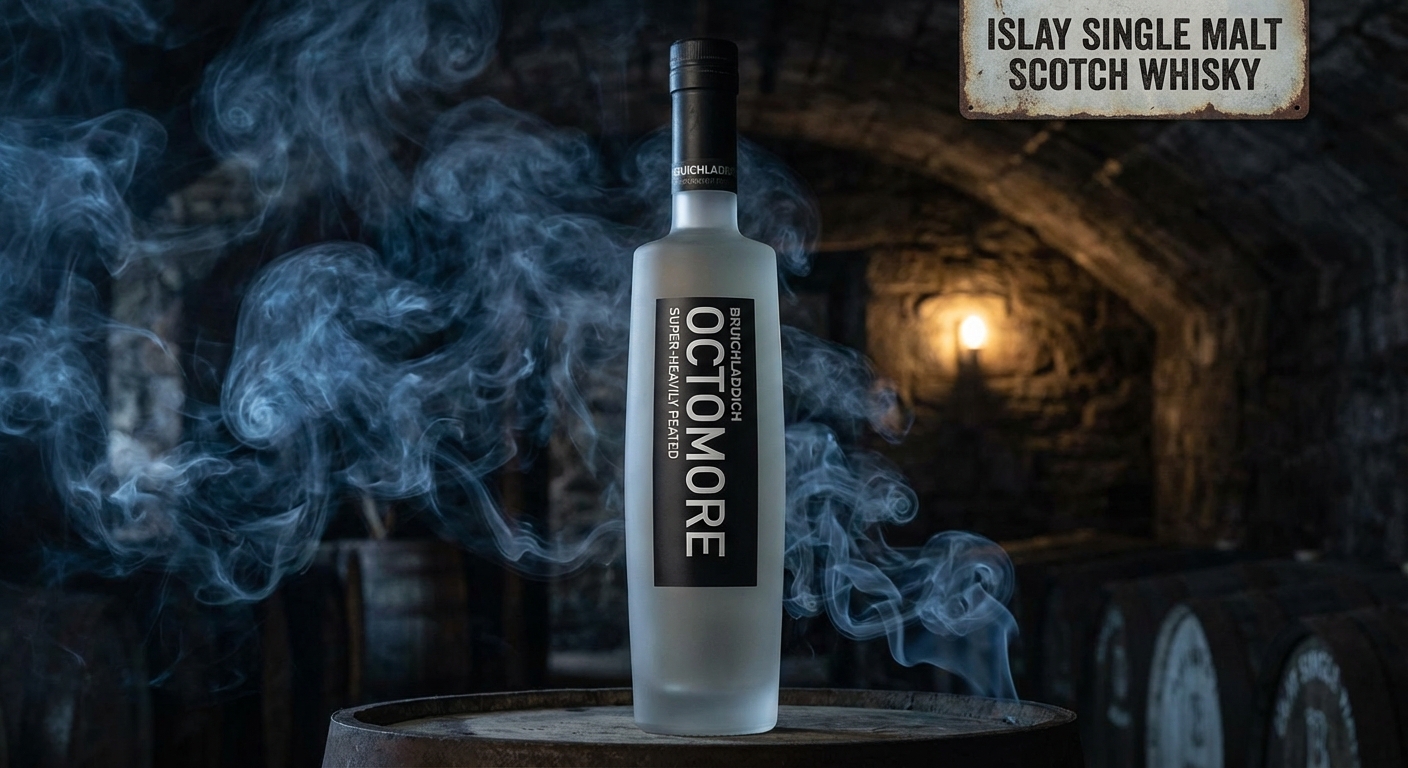
Phenols are the aromatic compounds that transfer from burning peat into malt during the kilning process. They’re what give heavily peated whiskies their characteristic medicinal, smoky, and earthy character. The higher the PPM in the malted barley, the more phenols were absorbed during drying.
The critical distinction, however, is between PPM in the malt and PPM in the spirit. A significant proportion of phenols are lost during fermentation and distillation. A barley malted at 300 PPM does not produce a spirit at 300 PPM — the final whisky will typically contain a fraction of that figure. Octomore’s stated PPM refers to the malt, not the finished liquid.
This is where Octomore consistently surprises first-time drinkers. The expectation from a 167 PPM or 258 PPM whisky is something overwhelming — a wall of smoke that obliterates any other character. The reality is more interesting.
Bruichladdich’s distillation is notably slow and careful. The wash stills at the distillery are among the tallest on Islay, and the cut points during distillation are taken conservatively. This results in a spirit that carries the phenols with surprising grace. The smoke is present — often dramatically so — but it shares the glass with coastal minerality, tropical fruit, vanilla from oak, and the briny, maritime character that defines Islay whisky.
Here’s the deal: the phenol compounds in heavily peated spirit behave differently depending on maturation. Time in cask transforms aggressive smoke into something more complex — leather, tar, cold ash, dried herbs — and this is precisely what makes aged Octomore so compelling.
To understand what Octomore’s numbers actually mean, it helps to benchmark them:
| Whisky | Approximate PPM (Malt) |
|---|---|
| Glenlivet 12 | ~1-2 PPM |
| Glenfiddich 12 | ~2-3 PPM |
| Highland Park 12 | ~20 PPM |
| Bowmore 12 | ~25 PPM |
| Ardbeg 10 | ~55 PPM |
| Laphroaig 10 | ~40-45 PPM |
| Octomore (typical) | 130–300+ PPM |
| Octomore 10.4 (record) | 407 PPM |
The gap between Laphroaig and even a modest Octomore edition is not incremental — it is categorical.
Bruichladdich is one of the most unconventional distilleries in Scotland — and its entire modern identity is built on conscious rebellion against the industry norm.
The distillery was founded in 1881 by the Harvey brothers on the western shore of Islay, overlooking Loch Indaal. It was built using a radical design for its time: a raised floor for better ventilation and exceptional natural light in the still room. For much of the twentieth century, it operated as a conventional Islay malt producer, changing hands several times before closing in 1994 as whisky industry consolidation swept away smaller independent operations.
The closure lasted seven years. In December 2000, a group of private investors led by wine merchant Mark Reynier purchased Bruichladdich for a reported £6.5 million. Reynier brought a different philosophy: transparency over mystique, provenance over polish, and a genuine commitment to doing things the way they had always been done — long fermentations, slow distillation, minimal intervention. He reopened the distillery in May 2001.
Reynier’s team gave the distillery a new operating identity: the Progressive Hebridean Distillers. The name captured everything they stood for. Hebridean because the landscape, peat, and barley of these islands were central to everything they made. Progressive because they refused to stand still. Under this identity, Bruichladdich became the first distillery to bottle all three Islay style expressions — unpeated (Classic Laddie), heavily peated (Port Charlotte), and ultra-peated (Octomore) — as distinct, named ranges.
In July 2012, the French spirits group Rémy Cointreau acquired Bruichladdich for £58 million — a dramatic return on the original £6.5 million investment just eleven years earlier. The acquisition raised questions about whether the distillery’s independent, experimental character would survive corporate ownership. A decade on, the answer appears to be largely yes. Octomore has continued to evolve, grow in ambition, and command the premium pricing it deserves. The distillery still operates from Islay, still uses long fermentations, and still publishes the kind of transparent production data that most large producers would never dream of releasing.
The extreme PPM in Octomore is not an accident of terroir — it is an act of deliberate, controlled engineering at every stage of production.
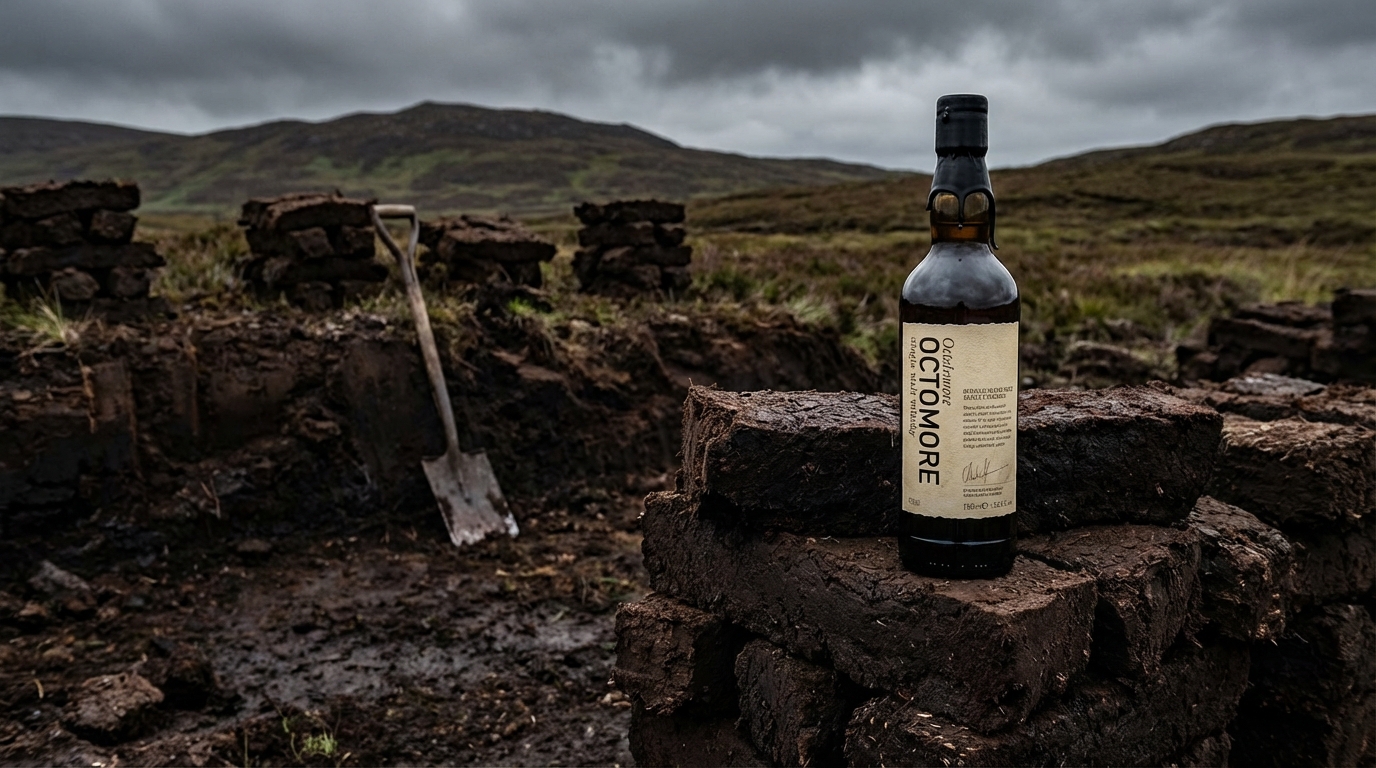
Most Islay distilleries achieve their characteristic peat character by malting barley over fires fuelled with local peat. The heat and smoke from the peat permeates the wet barley as it dries, depositing phenolic compounds into the grain. The duration of peat smoking, the moisture level of the barley, and the temperature all affect how many phenols are absorbed. For Octomore, every variable is pushed to its maximum.
Bruichladdich does not malt its own barley on-site — most Scottish distilleries don’t. Octomore’s malt is typically produced at Port Ellen Maltings on Islay or at specialist mainland maltsters, using extended peat smoking times that are significantly longer than those used for standard peated expressions. Where a Laphroaig malt might be smoked for several hours to achieve ~40 PPM, an Octomore malt destined for 200+ PPM requires sustained smoking over a far longer period.
The barley used matters enormously. The .1 and .2 suffix editions (explained in the next chapter) represent different barley provenances — Scottish mainland and Islay-grown respectively — and each expresses the same peat smoke differently because of the grain’s distinct characteristics.
Bruichladdich runs a longer fermentation than most distilleries — up to 70-90 hours — which develops additional fruity esters that provide an important counterpoint to the phenols in the final spirit. The wash stills are relatively tall for Islay, encouraging reflux: the heavier, oilier compounds fall back down the still rather than making it into the spirit. The result is a surprisingly clean, well-defined new-make spirit that carries its peat gracefully rather than clumsily.
The cut points — the windows during distillation when the distiller chooses to collect the “heart” of the spirit — are taken conservatively at Bruichladdich. This means a smaller volume of spirit is collected, but with better clarity and definition. It’s a quality-first decision that costs volume and rewards character.
Most Octomore expressions are matured in American oak ex-bourbon barrels, typically for five years. Five years is a relatively short maturation for Scotch whisky — the legal minimum is three years — but it suits the Octomore style. Shorter maturation preserves the raw, intense peating character rather than allowing oak to dominate. The .3 expressions introduce European wine casks into the equation, and the resulting interplay between heavy smoke and red fruit from ex-wine wood is one of the most interesting recurring experiments in the series.
The Octomore numbering system is both logical and, until you understand it, entirely opaque. Here is exactly what every number and suffix means.
Each Octomore release carries a two-part designation: a whole number representing the edition (01, 02, 03, and so on), and a decimal suffix (.1, .2, .3, .4) indicating the style of that particular expression within the edition. Edition numbers have incremented roughly annually since the first commercial release in 2008.
The suffixes have remained broadly consistent across the series, though Bruichladdich has occasionally experimented with the .4 position:
The series began with Octomore 01.1 in 2008, a whisky that arrived like a provocation — 131 PPM at a time when industry consensus held that anything above 60 PPM was approaching undrinkable. Editions 02 through 06 established the series’ credentials through the early 2010s, with PPM figures escalating steadily. Editions 07 through 09 saw Bruichladdich explore the .3 wine cask territory more ambitiously. The 10 series, released in 2019-2020, produced the record-breaking 10.4 at 407 PPM. The current editions — running through to edition 15 as of 2024 — have settled into a rhythm of annual release across three or four expressions per edition, each numbered, documented, and fiercely anticipated.
Across fifteen-plus editions and dozens of individual expressions, certain Octomores stand apart — either for their record-breaking numbers, their exceptional flavour, or their status in the collector market.
The first commercial Octomore release. At 131 PPM, it was already more than three times the phenol level of Laphroaig at the time. What made 01.1 remarkable was not just the PPM but the quality: it was genuinely drinkable, genuinely complex, and genuinely different from anything else in Scotch whisky. Original bottles from this release now command significant premiums on the secondary market — they are pieces of whisky history. See our guide on what makes a whisky bottle valuable for more on the factors that drive prices for landmark first releases.
The 06.3, matured in Sauternes wine casks at 258 PPM malt, is widely regarded as one of the finest Octomores ever released. The sweet, honeyed character of Sauternes oak created an extraordinary dialogue with the heavy smoke — neither element dominated, and the result was a whisky of real complexity. It remains one of the most sought-after expressions in the entire back catalogue.
At 407 PPM malt, Octomore 10.4 holds the record for the most heavily peated commercial whisky ever produced. Released as part of the 10 series in 2020, this expression was matured in virgin American oak — a cask type that contributes intense vanilla and coconut character. The combination of record peat and assertive oak produced something polarising and extraordinary in equal measure. It is the whisky that whisky journalists reach for when writing about the outer limits of the peated style, and it has become a landmark bottle for collectors.
The best part? Despite its record-breaking PPM, many tasters describe Octomore 10.4 as less aggressively smoky than you’d expect — a testament to how distillation technique and cask influence can transform raw phenolic intensity into something more structured.
The 11.3 combined Islay-grown barley with maturation in Burgundy Pinot Noir casks, resulting in a whisky that offered red berry, dark chocolate, and earthy peat in an unusually elegant combination. For collectors focused on the provenance dimension of Octomore — particularly the Islay barley story — the 11.3 series expressions are the ones to target.
Editions 12 through 15 have demonstrated Bruichladdich’s continued ambition with the series. PPM figures have remained extreme across the .1 expressions (typically 130–200 PPM), with the .3 expressions continuing to explore interesting wine cask territory. Annual releases have kept secondary market prices active without making the series so abundant that collector interest fades. Each new edition creates urgency among dedicated followers: Octomore is a series where anticipation is always part of the experience.
Octomore is one of the most consistently interesting series for the serious whisky collector — but approaching the secondary market intelligently requires understanding what drives value in this particular range.
Unlike some collectible whisky series where every release appreciates simply by virtue of the brand name, Octomore has a more nuanced secondary market. Not every expression commands a premium over retail. The collector who succeeds with Octomore is the one who understands which expressions have lasting significance and which were produced in quantities that keep prices near retail for years.
Early editions are the strongest performers. Octomore 01.1, 02.1, and 03.1 are historical artefacts as much as whiskies — they represent the founding of one of the most important series in contemporary Scotch. Condition, original packaging, and fill level all affect value here, as they do with any aged rare bottle. Our guide to how much your whisky is worth covers these factors in detail.
Record-breaking expressions attract collector attention. Octomore 10.4 — the 407 PPM world record — has established a floor that continues to hold. When a whisky claims a superlative that is genuinely verifiable and well-documented, collectors take notice. The same logic applies to the record-holding expression of any future edition.
Wine cask expressions (.3) with distinctive origins — particularly Sauternes, Burgundy, and STR casks — have shown strong collector interest. The 06.3 is the standout historical example, but well-reviewed .3 expressions from later editions have also performed above retail on secondary platforms.
Pricing on the secondary market for current editions of Octomore typically runs from £80 to £200 for most expressions, with older editions and record-holders ranging from £200 to several hundred pounds depending on condition and provenance. Original release boxes, intact tax strips, and well-preserved fill levels all support higher prices. If you’re considering a significant purchase and want an independent view, Glenbotal offers free bottle valuations — a resource worth using before committing to a price you’re unsure about.
Disclaimer: Secondary market prices for rare whisky fluctuate and are not guaranteed. Values quoted here are illustrative ranges based on market observations and may not reflect current auction or retail prices. Always verify current pricing through multiple sources before buying or selling.
Octomore is not widely faked — the market for counterfeit Islay whisky is much smaller than for premium single malts from Speyside — but due diligence still matters for high-value older expressions. Check label printing quality, cork condition, and fill level against documented examples. For the very earliest editions, reference images from reputable auction records provide the most reliable comparison material. Our ultimate whisky collecting guide covers authentication across the broader rare whisky market.
Current editions are available through specialist UK retailers at or near recommended retail price. Older and sold-out expressions require the secondary market: whisky auction houses, specialist collectors’ platforms, or retailers — like Glenbotal — who source from private collections. The advantage of a specialist retailer with a private collector network is access to expressions that haven’t been available at retail for years.
Bruichladdich produces three distinct single malt ranges, each with a completely different flavour profile. Understanding where Octomore sits in the Bruichladdich lineup clarifies exactly what you’re choosing when you reach for it.
The Classic Laddie (formerly Scottish Barley) is Bruichladdich’s flagship unpeated expression. It is matured in a combination of American and European oak, bottled at 50% ABV without chill filtration or added colour, and represents Islay terroir expressed entirely through unpeated barley. If Octomore is a statement about the outer limits of peat, Classic Laddie is a statement about what Islay tastes like without it — and the answer is coastal, grassy, and genuinely distinctive.
Port Charlotte sits between Classic Laddie and Octomore on the peating spectrum, typically malted at around 40 PPM — closer to Laphroaig territory than to Octomore’s extreme end. Named after a village on Islay’s western coast, Port Charlotte is Bruichladdich’s heavily peated but approachable expression: the right entry point for drinkers who want serious smoke but are not yet ready for Octomore’s intensity. The PC (Port Charlotte) series also includes limited and special editions that attract collector interest. See our guide to Bruichladdich Black Art for another angle on Bruichladdich’s limited-release philosophy.
Black Art is Bruichladdich’s most secretive release: an unpeated whisky matured in an undisclosed combination of casks, with no information given about cask types beyond the age statement. Released periodically — currently in its ninth edition — Black Art is the antithesis of Octomore’s full-disclosure approach. Where Octomore tells you everything, Black Art tells you nothing. Both approaches have created devoted collector followings. Read the full guide to Bruichladdich Black Art for a deep dive into this fascinating counterpart series.
Within the Bruichladdich range, Octomore occupies the most extreme position: the most peated, the most documented, the most experimental. It is the range that makes the biggest statement about what the distillery is willing to attempt. But it exists within a coherent philosophy: all three main ranges are bottled without chill filtration, without added colour, and with full provenance transparency. Octomore is not separate from Bruichladdich’s identity — it is its most concentrated expression.
For whisky drinkers considering their first heavily peated bottle, the Octomore vs. Laphroaig Cairdeas question comes up frequently. Here’s how they compare:
| Factor | Octomore (typical) | Laphroaig 10 |
|---|---|---|
| PPM (Malt) | 130–300+ PPM | ~40-45 PPM |
| Age | Typically 5 years | 10 years |
| Style | Experimental, evolving by edition | Consistent classic |
| Flavour | Smoke + fruit/maritime, highly varied | Medicinal, seaweed, iodine, peat |
| Availability | Limited annual release | Year-round standard |
| Price range | £70–£200+ | £40–£60 standard |
The key difference is consistency versus evolution. Laphroaig is a benchmark: you know what you’re getting. Octomore is a moving target — every edition is genuinely different, and part of the appeal is following that evolution over time.
The Octomore series regularly reaches 130–300 PPM in the malt, with most standard .1 expressions in the 130–170 PPM range and .3 wine cask expressions often higher. The extreme end is represented by exceptional releases that push above 300 PPM, demonstrating the distillery’s ongoing ambition with the format.
Octomore 10.4, released in 2020, holds the record for the most heavily peated commercial whisky ever produced at 407 PPM of phenols in the malt. This expression was matured in virgin American oak casks and was part of the 10 series alongside the standard 10.1, 10.2, and 10.3 expressions.
No — and this is the question that surprises first-time Octomore drinkers most. Despite extreme PPM figures at the malt stage, the finished whisky is significantly less aggressive than the numbers imply. A substantial proportion of phenols are lost during fermentation and distillation, and careful cut points at Bruichladdich mean the spirit retains its peat with structure rather than aggression. Most drinkers find Octomore intense and complex rather than punishing.
Each Octomore release carries a whole number (the edition, which increments annually) and a decimal suffix (.1, .2, .3, .4) indicating the expression style. The .1 is the core expression using Scottish mainland barley; .2 uses Islay-grown barley; .3 uses European wine cask maturation; .4 is an experimental slot used for special cask types or record-breaking expressions. Not every edition includes all four suffix expressions.
Most Octomore expressions are malted using Scottish peat, which may include Islay peat depending on the malting facility used. The .2 expressions specifically use Islay-grown barley, linking the expression to Islay terroir at the grain level. The peat used for smoking is typically sourced from the island as well, though Bruichladdich is transparent about variations between releases.
Laphroaig is typically malted at around 40-45 PPM — already among the most heavily peated whiskies in the standard market. Even a relatively modest Octomore .1 expression at 130+ PPM is more than three times the phenol level of Laphroaig. The flavour profiles are also quite different: Laphroaig is defined by medicinal iodine and seaweed alongside its peat, while Octomore tends toward tropical fruit, coastal brine, and a drier, ashier smoke character. They are both Islay whiskies, but they operate in different registers. See our guide to the Laphroaig Cairdeas series for a closer look at Laphroaig’s most collectable expressions.
For a first encounter with the series, the current edition .1 expression is the recommended starting point. The .1 is Bruichladdich’s benchmark for each release — Scottish mainland barley, American oak maturation, the clearest statement of the series’ character. It is the most approachable expression within the extreme PPM context, and it provides the reference point against which the .2 and .3 variants of the same edition can be compared. Starting with the .3 wine cask expressions, while often extraordinary, can make it harder to understand what the core series actually tastes like.
From a secondary market perspective, Octomore 01.1 as a founding expression, 06.3 as a benchmark wine cask release, and 10.4 as the world-record holder are the three expressions most consistently cited as priority targets for serious collectors. Among later editions, .3 expressions from years where the wine cask choice was particularly distinctive — and where critical reception was strong — have shown the best secondary market performance. Condition and original packaging are always significant factors. Learn more about the key drivers of rare whisky value in our guide to what makes a whisky bottle valuable.
Current editions of Octomore are available through UK whisky specialists at or near the recommended retail price. Older, sold-out, and back-catalogue expressions require the secondary market — whisky auction houses, private sales, or specialist retailers who source from private collectors. Glenbotal stocks rare and hard-to-find Octomore expressions sourced from private collections across the UK and Europe. Browse the current collection or use the free valuation service if you’re looking to sell.
Yes — all Octomore expressions carry an age statement, which is unusual for heavily peated whiskies at this intensity level. The standard age for most expressions is five years, which is deliberately kept short to preserve the intensity of the peating rather than allowing extended oak influence to soften or mask it. Some special editions and later releases carry slightly longer age statements, and the .2 Islay barley expressions sometimes reflect longer maturation times due to the crop yield cycles involved in farming barley on Islay.
Like most limited-release single malts, Octomore’s secondary market performance is edition-dependent. Early releases (01–03), record-holding expressions (10.4), and highly-rated wine cask editions have shown consistent appreciation. Later editions at or near retail release dates tend to track close to RRP until sold out, after which supply-demand dynamics drive prices upward. If you are considering Octomore as part of a broader whisky collecting strategy, our ultimate whisky collecting guide covers the fundamentals of building a collection that holds and grows in value.
Bruichladdich Octomore is the most compelling long-running experiment in Scotch whisky — and after more than fifteen editions, it still has the ability to surprise.
Every new release is a genuine event. The PPM figures are extreme, the edition system rewards followers who engage with the series over time, and the quality of the whisky — consistently excellent despite the experimental nature of the project — means that Octomore appeals both to drinkers who want to push their palates and collectors who recognise a series with sustained cultural and market significance.
Whether you are building a complete Octomore collection, searching for a specific edition, or simply looking for your first bottle from the series, the starting point is the same: find a specialist who knows the market.
Glenbotal has been sourcing rare and elusive whisky for six years, working with a private collector network across the UK and Europe to find bottles that mainstream retailers simply don’t stock. If you’re looking for a specific Octomore expression — a particular edition, a .3 wine cask variant, or one of the early releases — browse the current collection or get in touch for a free consultation.
Start Exploring Octomore at Glenbotal →
Explore the full collection at Glenbotal — rare whisky sourced from private collectors across the UK and Europe.