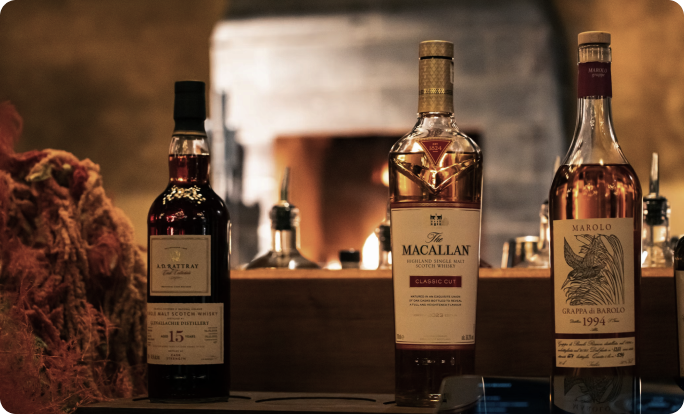
The rare whisky market saw record global auction sales exceeding $100 million in 2023, yet some of the most rewarding bottles in any serious collection were bought at retail for under £100.
In this guide I’m going to show you exactly how to build a rare Scotch whisky collection at any budget — whether you’re starting with £500 in total or spending that on a single bottle.
The rare whisky market is one of the few places where genuine knowledge still beats deep pockets. Collectors who understand distillery production cycles, independent bottlers, and release timing consistently acquire bottles that outperform far costlier purchases made by those simply buying names. We’ve seen clients build extraordinary collections across all three price tiers described in this guide — and the most impressive collections often start at the bottom.
Here’s exactly what we’re going to cover: the right bottles, the right strategies, and the right mindset for each budget level, plus the cross-cutting tactics that apply regardless of how much you spend per bottle.
Most aspiring collectors make the same mistake: they look at headline auction prices — £5,000 for a Macallan 1963, £80,000 for a Port Ellen — and conclude that genuine rare whisky collecting is simply out of reach.
Here’s why that logic is flawed.
Those headline prices represent the top fraction of one percent of the collectable whisky universe. The far larger, far more accessible world of genuinely rare whisky includes annual limited releases bought on release day for £65, single-cask independent bottlings acquired directly from the bottler for £80, and focused distillery collections built bottle by bottle for well under £200 per piece.
The collectors who succeed at every budget level share one trait: they buy on knowledge, not on hype.
Rarity, in whisky terms, is not simply about price. A bottle is rare if it comes from a limited run that won’t be repeated — whether that run cost £60 to produce or £600. A heavily peated single cask from Cadenhead’s, bottled at cask strength from a closed distillery, is rare in every meaningful sense, and it might have a price tag that fits comfortably within most monthly discretionary budgets.
The Scotch Whisky Association reports that Scotland exports over 50 million cases of Scotch per year — but the portion of that production that ends up in genuinely limited, collectible releases is a tiny fraction. Understanding where that fraction lives, across every price tier, is the foundation of this guide.
Before diving into specific tiers, it pays to understand the underlying mechanics. Because once you grasp what drives collectible status, every purchase decision becomes clearer.
A bottle becomes collectible when demand will permanently exceed supply.
That sounds obvious. The practical application is less so. Supply and demand in whisky aren’t fixed at the point of purchase — they evolve over years. A batch of 6,000 bottles might seem plentiful in October when it releases. Three years later, after most of those bottles have been opened and enjoyed, the remaining sealed examples become genuinely scarce. The collector who bought on release and held patiently benefits from that natural attrition.
The key drivers of collectible status are:
Production limit. Was this a finite run that cannot be repeated? Single-cask releases have a hard ceiling defined by the cask’s yield — typically 200 to 600 bottles. Annual limited releases are gated by the distillery’s commitment to a specific recipe for that year. Both qualify; open-ended core range expressions generally do not.
Distillery reputation. Bottles from distilleries with genuine cult followings — Springbank, Bruichladdich, Port Ellen, Brora — carry a floor of demand that standard releases simply don’t have. This is not snobbery; it’s market mechanics.
Cask quality and provenance. Whisky aged in exceptional casks — first-fill sherry butts, rare wine casks, specific cooperages — commands sustained interest that standard bourbon-cask maturation typically does not.
Independent bottler selection. A bottle selected by Gordon & MacPhail, Cadenhead’s, or Berry Bros & Rudd from an exceptional cask carries the imprimatur of experienced tasters with reputations built over decades. That endorsement matters to the market.
For a deeper look at this, see our guide to what makes a whisky bottle valuable.
This is where most great collections begin — and where many experienced collectors continue to operate even after their budgets expand. The under-£100 tier contains some of the most genuine value in the entire market.
Now:
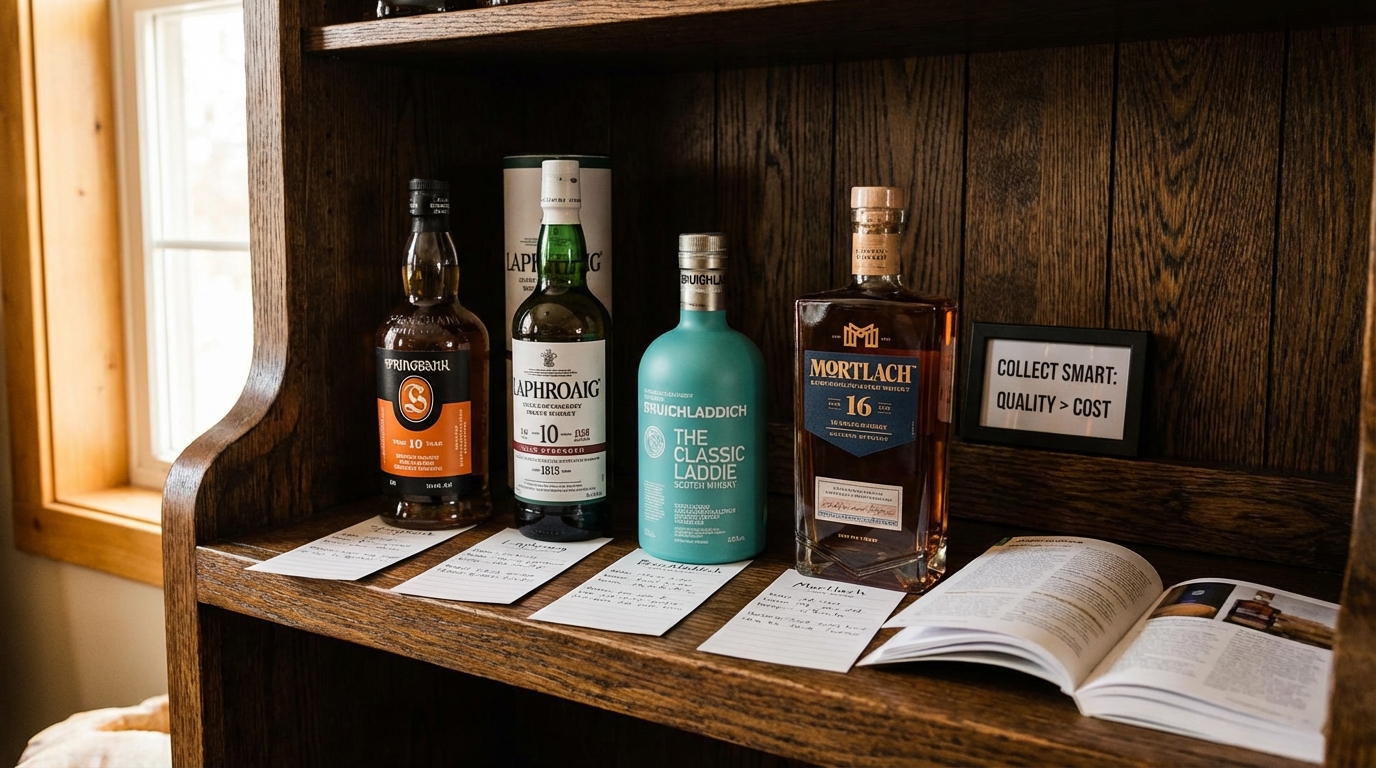
The key to this tier is understanding that “under £100” does not mean settling. It means being selective and informed.
Some of Scotland’s most respected distilleries produce annual or batch limited releases that sit firmly in this tier on release day. The opportunity is real, but it is time-limited — retail prices reflect release-day allocation; secondary market prices often do not.
Aberlour A’bunadh. Released in numbered batches, A’bunadh is a cask-strength sherry bomb from one of Speyside’s most consistent producers. Individual batches vary meaningfully in profile — some are richer, some drier, some more heavily sherried — and collectors track batch numbers with genuine interest. At roughly £65–£80 at retail depending on the batch, it sits at the upper edge of this tier. The key move: buy multiples of a batch you consider exceptional, because batches are finite and they don’t come back. Batches 60 through 80 have become increasingly difficult to source at retail pricing.
Glenfarclas 105. This cask-strength Speyside stalwart is one of the most reliable quality anchors in any collection. At approximately £55–£70 for a standard release, it represents a distillery with genuine family-owned heritage and a decades-long track record of consistency. The 105 has also produced some excellent vintage expressions and cask bottlings at higher price points for collectors who want to graduate within the same distillery.
Diageo Special Releases (entry-level). Diageo’s annual Special Releases programme includes expressions that stretch across all three tiers in this guide, but the programme reliably includes at least a few bottles in the £70–£100 range. These releases are genuinely limited — when they’re gone, they’re gone — and they come from distilleries (including some that are now silent) with serious collector followings.
Here’s the deal: the discipline required at this tier is buying on release, not browsing secondary listings six months later. We’ll cover the mechanics of that in the strategies section.
Gordon & MacPhail is arguably the world’s most important independent bottler, with a history dating to 1895 and a warehouse full of maturing casks from distilleries that have since closed. Their Connoisseurs Choice and Distillery Labels ranges regularly produce bottles under £100 that offer access to distilleries — Linkwood, Caperdonich, Glenburgie, Benrinnes — that would otherwise require five-figure spends. Watch for bottlings in the 10–15 year age range from Speyside distilleries; these represent some of the clearest examples of knowledge-over-budget in the market.
Cadenhead’s operates one of the most respected cask selection programmes in Scotland, with a direct-to-customer shop in Campbeltown. Their Authentic Collection bottlings, typically released at natural cask strength without colouring or chill filtration, regularly fall in the £60–£90 range. The appeal here is provenance and transparency: you know exactly what you’re getting, and the bottles are finite by the nature of single-cask release.
Berry Bros & Rudd brings the same rigour they apply to wine to their spirits selections. Their own-label and selected cask releases often fall in the £60–£90 range and represent genuinely considered purchases from one of the UK’s most trusted merchants. The “BBR” stamp on a bottle serves as a meaningful quality signal to buyers on the secondary market.
Buy on allocation when possible. Sign up directly to distillery and retailer mailing lists (more on this in the strategies section). The window between a release going live and selling out at retail can be measured in hours for the most sought-after bottles. Purchase multiple bottles of any expression you consider genuinely excellent — not for speculative resale, but because you won’t be able to buy more at the same price.
This is where collections develop a genuine personality. At this tier, you’re making meaningful decisions about focus — which distilleries, which styles, which producers represent your collecting thesis.
The collectors who thrive at this tier almost always have a focus. Generalist collections at the £100–£500 level tend to be pleasant without being exceptional. Focused collections — built around a single distillery, a specific style, or a defined era — are the ones that other collectors notice.
Springbank is the most compelling focused distillery thesis in modern whisky collecting. Family-owned, independently operated in Campbeltown, using traditional methods including direct-fired stills and on-site floor malting, Springbank produces at a scale that makes genuine scarcity plausible. The 10-year-old core expression retails around £60–£70, but the distillery’s limited editions — the annual Local Barley releases, the Springbank Society bottlings, the occasional aged expressions — sit firmly in this tier.
The Springbank model rewards patience and mailing list membership. Limited editions sell out at the distillery shop within hours of release. Collectors who engage with the distillery directly, visit Campbeltown, and join the Friends of Springbank programme have materially better access than those who rely on secondary sourcing.
Bruichladdich Black Art. Now in its tenth edition, Black Art is perhaps the clearest example of a mid-range bottle with genuine mystique. Distillery director Adam Hannett has never publicly revealed the full recipe or cask composition — that opacity is central to the appeal, and it’s commercially intelligent. Each edition is different, each is limited, and each carries the full weight of Bruichladdich’s reputation for progressive thinking and quality obsession. Prices typically sit between £130 and £180 at retail depending on the edition; the secondary market for older editions reflects consistent collector interest. Starting a Black Art series collection now — holding one of each edition — is a coherent long-term strategy.
Diageo Special Releases (upper tier). The Diageo Special Releases programme includes expressions in the £150–£400 range that represent some of the most serious distillery bottlings available at this price point. Releases from Lagavulin, Caol Ila, Dalwhinnie, and periodically from silent distilleries command attention far beyond their retail price. Buying on release is the only sensible strategy; chasing secondary market prices typically means paying a 30–50% premium.
At this level, you can afford to be more specific. Look for:
At this tier, the independent bottler proposition becomes even more compelling. A 20-year-old single cask from an Islay distillery, bottled at cask strength by Gordon & MacPhail with a named distillation year, at £150–£250, represents a fundamentally different proposition from the same distillery’s £100 core expression. You are buying documented history in a bottle, and the market understands that.
Watch Gordon & MacPhail’s Private Collection range in particular. These casks have been maturing in the company’s own warehouse for decades — sometimes from distilleries that have now closed — and they represent some of the most direct access to a specific place and time that whisky collecting offers.
“The most sophisticated collectors I know spend a disproportionate share of their budget at the £150–£250 tier. It’s where genuine knowledge pays the highest dividends.”
At £500 and above per bottle, you are making high-conviction purchases. The dynamics shift: individual bottles represent meaningful sums, the secondary market is more liquid and more closely tracked, and the gap between informed and uninformed purchasing is at its widest.
This tier rewards specialists above all others.
Vintage-dated Scotch whisky — where the distillation year is named on the bottle — is the clearest expression of the collector proposition. When you buy a bottle distilled in 1973 or 1985, you are buying something that cannot, by definition, ever be replicated. The casks of that era are finite; many have already been bottled or lost to the angel’s share. What remains carries a scarcity that only deepens with time.
Gordon & MacPhail’s Generations range — releasing casks from the 1940s through the 1970s — has produced some of the most extraordinary vintage expressions available at any price. These bottles routinely sit at £500–£3,000 depending on distillery and age, and they represent a genuine long-term proposition for collectors with confidence in their palate and their provenance knowledge.
This is where some of the most compelling long-term collecting logic lives. When a distillery closes, its remaining stock becomes permanently finite. No future production can dilute the scarcity. Every bottle opened, broken, or lost makes the remainder rarer.
Brora, closed in 1983 and briefly reopened under Diageo in 2021, remains one of the most sought-after names in the market. The original pre-reopening releases carry prices from £500 into the tens of thousands depending on age and bottler. Port Ellen, closed in 1983 and the subject of Diageo’s annual limited release programme, has produced some of the most iconic bottles in whisky collecting history — and prices reflect that status.
For collectors entering this space, the key discipline is provenance verification. Bottles at this price level require authentication. See our guide on how to authenticate vintage whisky for a full walkthrough of what to check.
Macallan’s position in the collector market is unique: simultaneously the world’s most recognisable whisky brand and the producer of some of the most genuinely scarce bottles in circulation. The limited series — The Macallan Edition series, the M series, the single-cask releases — command consistent collector interest because Macallan’s reputation for sherry-wood quality is backed by decades of production consistency.
The Edition series (now concluded) offered a coherent collecting thesis at accessible price points — £150–£300 per bottle — that rewarded early adopters who built the complete set. Individual expressions from the series now trade meaningfully above retail on secondary markets.
At the £500+ level, the Macallan Fine and Rare range and the distillery’s 25- and 30-year-old releases represent the most serious collector propositions. These are bottles with documented provenance, exceptional wood quality, and a global collector base that provides genuine secondary market liquidity.
For context on which distilleries carry the strongest long-term collector propositions, see our guide to distilleries worth collecting.
These tactics apply at every tier. They are the mechanics of successful collecting regardless of budget.
This is the single highest-leverage habit in whisky collecting. Retail prices on release day are almost always the lowest prices those bottles will ever be available for from a trusted source. Secondary market premiums of 30%, 50%, or 100%+ are common for sought-after releases within months of launch.
The practical requirement: mailing lists. Join the direct mailing lists for:
Set up notifications. Act immediately when allocation emails arrive. The window for many sought-after releases is genuinely short.
The Scotch Malt Whisky Society deserves serious consideration at any budget level. Membership grants access to single-cask releases bottled exclusively for members, from distilleries across Scotland. The bottles are numbered but not named by distillery — a system that protects distillery relationships while maintaining transparency for initiated members who know the code. SMWS releases are frequently among the most interesting single-cask bottlings available at any given moment, and membership pricing reflects the buying power of a large, committed collector community.
The Independent Bottlers Association and various regional whisky clubs offer similar benefits at smaller scale — early access, member allocations, and the collective knowledge of committed fellow collectors.
The whisky auction market has matured considerably over the past decade. Platforms including Scotch Whisky Auctions, Whisky Hammer, and McTear’s now provide regular structured auctions with transparent recent price history. This matters for two reasons:
First, it gives you reliable comparables. Before paying retail or secondary market prices for any bottle, check recent auction results for that expression. You may find that the secondary market has moved significantly from the retail price in either direction.
Second, auction timing affects results. Sales in the weeks before Christmas and around Father’s Day see elevated buyer competition. Sales in January and February typically see lower hammer prices across the board. Patient buyers with a list of specific targets can find meaningful differences in the same bottle depending purely on timing.
A collection built on sound purchasing decisions can be significantly undermined by poor storage. Whisky bottles require:
For a full guide to this, see how to store whisky bottles.
Every era of whisky collecting has had bottles that were overlooked at release and became sought-after later. Identifying them in advance is partly skill and partly luck — but there are structural indicators worth watching.
Independent bottler releases from underappreciated distilleries. Markets have enthusiasms and blind spots. Some distilleries — Benrinnes, Linkwood, Caperdonich, Glen Keith — have genuine quality credentials but lack the mainstream recognition that Springbank or Ardbeg carry. Independent bottlings from these distilleries at natural cask strength, from respected bottlers, at £60–£100, represent the clearest current example of the sleeper pattern. The whisky is excellent; the market hasn’t fully priced in that quality yet.
Early releases from restarted distilleries. Distilleries that have recently reopened after closures — Port Ellen, Brora, Rosebank — produce releases that carry the weight of that story. Early official releases from the reopened era are likely to be collectable precisely because they document a moment of return. They are also typically priced at retail in ways that the secondary market subsequently adjusts.
Single sherry cask releases from Tier 2 distilleries. The secondary market is well-aware of first-fill sherry expressions from Macallan and Glenfarclas. It is less efficient in pricing similar quality from distilleries like Benromach, GlenDronach, or Glendullan. A well-sourced first-fill sherry butt single cask from one of these producers at £80–£120 represents a genuine opportunity for the knowledgeable buyer.
Here’s the deal: sleeper identification requires genuine engagement with the market — tasting, reading, participating in the community. There is no shortcut. But the payoff is acquiring bottles that the broader market will later recognise as significant, at prices that reflect today’s incomplete information rather than tomorrow’s consensus.
It gets better: sleeper bottles are often genuinely excellent to drink. The collecting and the appreciation are not separate activities.
Whisky values can go down as well as up. This article is for informational purposes only and is not financial advice.
The most experienced collectors in any community have learned from errors. These are the ones worth avoiding.
Chasing hype without knowledge. When a whisky influencer or publication declares a bottle unmissable, secondary market prices often spike within 48 hours. Buying at the peak of that cycle — paying a 60% premium on secondary for a bottle you could have bought at retail with better information — is one of the most common and most avoidable errors in collecting.
Neglecting condition. A bottle with label damage, fill level loss, or missing original packaging may be worth significantly less than a pristine example of the same expression. At the entry level this matters modestly; at the £500+ tier it can represent hundreds of pounds of value difference.
Overpaying for age statements. “Older is better” is the most persistent myth in whisky collecting. A 25-year-old expression from a mediocre cask matured in a mediocre warehouse is an inferior whisky and an inferior investment compared to a 12-year-old from an exceptional first-fill sherry butt. The age statement is a proxy at best. The actual quality drivers — cask quality, distillation character, warehouse conditions — matter more.
Building a collection without a thesis. Collections built on impulse tend to become expensive and incoherent. Collections built around a clear focus — a distillery, a style, an era, a bottler — are more interesting, more legible to the market, and easier to manage over time.
Ignoring authentication at the high end. At £500+, counterfeiting and re-sealing are real risks. The how to authenticate vintage whisky framework is not optional at this tier — it is essential.
For a comprehensive rundown of avoidable errors, see our article on whisky collecting mistakes.
You can begin building a genuinely rare whisky collection for under £200 total — two or three well-chosen independent bottler releases or annual limited editions represent a meaningful start. The important discipline is buying the right bottles, not spending more.
Absolutely. Some of the most significant collector bottles of the past twenty years were retail-priced under £100 on release day. Aberlour A’bunadh batches, early Cadenhead’s single casks, and certain Diageo Special Releases all sit or have sat in this tier and demonstrated meaningful secondary market appreciation. Price at purchase and collectible quality are not the same thing.
The most satisfying approach is to do both — buy enough bottles of your most valued expressions to hold some and drink some. The collectors who never open anything miss the point of whisky; those who open everything miss the opportunity to hold bottles through the period of natural scarcity attrition that drives secondary market value.
Gordon & MacPhail, Cadenhead’s, and Berry Bros & Rudd are the three most consistently respected names for UK collectors. Each has decades of track record, transparent provenance practices, and a market following that translates to better secondary liquidity. Signatory Vintage and Càrn Mòr are also well regarded, particularly for their older stock releases.
Go directly to the distillery website and create an account or newsletter subscription. For distilleries with high demand (Springbank, Bruichladdich, Glenfarclas), also register at their official retail partners. Being an established customer with a purchase history improves your allocation chances at some distilleries.
Check recent completed auction results on platforms like Scotch Whisky Auctions, Whisky Hammer, or Sotheby’s Wine & Spirits for the specific expression and batch. Current listings (bottles for sale) are less reliable than completed sales. Glenbotal also offers a free whisky valuation service for collectors who want an expert opinion.
Whisky can appreciate meaningfully over time — particularly limited, discontinued, or vintage expressions. However, it is not a liquid asset, storage and condition requirements are real, and values can decline as well as increase. Do not allocate funds you may need in the short term to whisky collecting. Whisky values can go down as well as up. This article is for informational purposes only and is not financial advice.
Springbank’s collector appeal combines genuine scarcity (small-scale, family-owned, single-site production), exceptional quality consistency, stylistic distinctiveness (notably the lightly-peated house style and the range of expressions including Longrow and Hazelburn), and an unusually loyal community following. The distillery’s refusal to over-produce for commercial convenience gives its releases a genuine scarcity that collectors rightly prize.
Auction prices for identical bottles can vary by 10–20% or more depending on the timing of the sale. Pre-Christmas auctions see elevated competition and higher hammer prices. January and February auctions typically see lower prices as discretionary spending recovers from the holiday period. Patient collectors with specific target bottles can exploit this seasonality meaningfully over time.
Verify the fill level (the spirit level within the bottle), label condition, the integrity of the seal, the presence of original packaging (box, tube, case), and, for pre-2000 bottlings, the consistency of the capsule with the era’s known production. Cross-reference the specific expression against documented auction results and reference databases. At £500 and above, do not skip this process. Our guide on how to start a whisky collection covers authentication basics as part of the collecting fundamentals.
Yes — and it is arguably the most coherent strategy for many collectors. A complete Springbank Local Barley series, a full run of Bruichladdich Black Art editions, or a complete Macallan Edition series tells a story and has a coherent market identity that ad-hoc collections do not. Single-distillery focus also concentrates your research and network, which tends to improve access and purchasing decisions over time.
A specialist retailer can source bottles from private collectors and estates across the UK and Europe, often including expressions that don’t appear at auction — either because owners prefer private sale or because the bottle is not yet widely known to the auction market. Buying from a reputable specialist also gives you provenance assurance and condition verification that can be harder to obtain at auction. See our ultimate whisky collecting guide for more on sourcing strategies.
The rare whisky collector who succeeds is not defined by budget. They are defined by the quality of their knowledge, the patience of their buying discipline, and the coherence of their collecting thesis.
Start with the tier that fits your current situation. If that means three bottles of Cadenhead’s authentic collection and a batch of A’bunadh, that is a genuine beginning. If it means a focused run of Springbank limited editions or a Black Art series, that is equally valid. If it means high-conviction vintage purchases at the top tier, the foundations described throughout this guide still apply.
The steps are the same regardless of where you start: understand what makes a bottle collectible, buy on release when possible, build relationships with distilleries and specialist retailers, and let knowledge do the work that money alone cannot.
See how Glenbotal’s private collector sourcing can help you access bottles that never reach the open market — browse the current collection at glenbotal.co.uk.
Whisky values can go down as well as up. This article is for informational purposes only and is not financial advice.
Explore the full collection at Glenbotal — rare whisky sourced from private collectors across the UK and Europe.