Six cask types. One whisky. The result is one of the most layered and sought-after non-age-statement expressions ever released by a Highland distillery.
The Dalmore King Alexander III is not a whisky you encounter by accident — you seek it out. Finished simultaneously in six distinct cask types, it represents the pinnacle of blended maturation technique, and it bears the name of a Scottish king whose life was saved by the very clan that shaped Dalmore’s identity. Whether you are a collector, a serious gifter, or someone who simply wants to understand why this bottle commands the attention it does, this guide covers everything.
The Dalmore King Alexander III is Dalmore’s flagship non-age-statement expression — a Highland single malt Scotch whisky matured and finished across six different cask types at the same time.
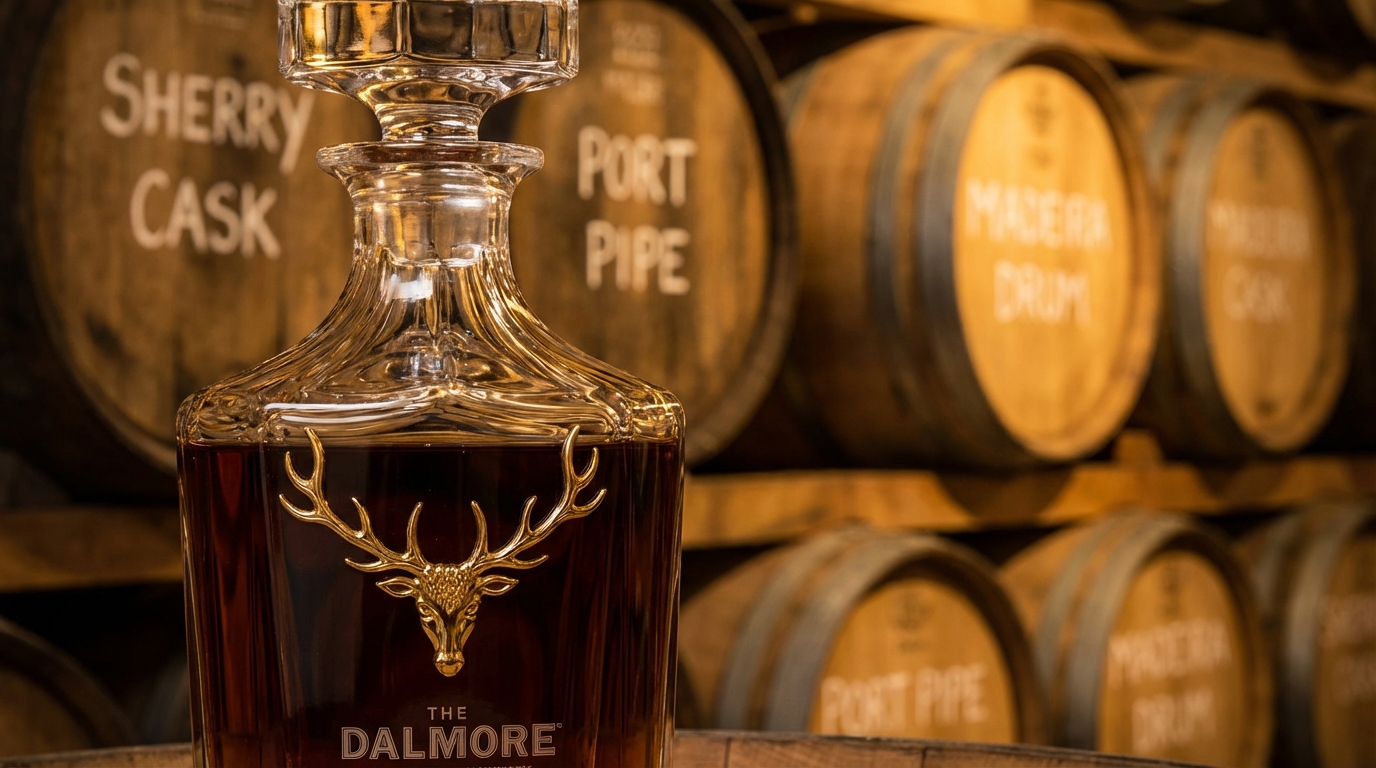
Most whiskies finish in one cask after spending years in another. The King Alexander III takes a different approach entirely: the spirit rests in a combination of American white oak ex-bourbon barrels, Matusalem oloroso sherry butts, Madeira drums, Marsala barrels, port pipes, and Cabernet Sauvignon wine casks — all simultaneously, not sequentially. The result is a whisky of exceptional complexity, where no single wood note dominates. Every flavour you detect has been contributed by one of six different vessels, each lending its own character to the final spirit.
The expression carries an ABV of 40% and is bottled at an approachable strength that belies the intricacy of what went into making it. It is non-age-statement (NAS), meaning Dalmore declines to put a year on the label — a deliberate choice that gives master distiller Richard Paterson the freedom to blend parcels of spirit from different maturation periods to maintain a consistent flavour profile.
For collectors used to the prestige hierarchy of age statements, NAS expressions can feel like an unknown quantity. The King Alexander III reframes that entirely. The question is not how old the whisky is — the question is how many layers of flavour a single expression can carry. The answer, in this case, is considerable. Dalmore positions this not as an entry-level release but as the full expression of their multi-cask philosophy.
The King Alexander III occupies the upper tier of the Dalmore accessible range — priced above the core 12-year but below the ultra-premium age-stated expressions like the 25-year and the Constellation series. It is sold in specialist retailers, independent whisky shops, and through dedicated rare whisky sources like Glenbotal. If you are exploring the distilleries worth building a collection around, Dalmore — and this expression in particular — belongs in that conversation.
Dalmore distillery sits on the southern shore of the Cromarty Firth in Alness, Ross-shire — a Highland location that has shaped the character of its whisky since 1839.
The distillery was founded by entrepreneur Alexander Matheson, who recognised the potential of the site’s access to the Firth’s water and the agricultural lands of the Black Isle beyond. It was established as a serious commercial operation from the outset — not a farm distillery, but an industrial-scale producer with ambitions. The Cromarty Firth location matters: the waters draw in cooling air off the firth, the local barley was historically prized, and the warehouses sit close enough to the shoreline that the influence of a maritime climate on the maturing spirit is real.
In 1867, Alexander Matheson sold the distillery to Andrew and Charles Mackenzie. The Mackenzies were not merely new owners — they transformed the distillery’s identity. They introduced the twelve-pointed royal stag emblem that has defined Dalmore’s branding ever since, a symbol with deep roots in Scottish royal history (more on this in Chapter 4). The Mackenzie family retained ownership and operational control until 1960, when Whyte & Mackay — a long-standing customer — acquired the distillery. Today, Dalmore is owned by Alliance Global, the Philippines-based conglomerate that holds Whyte & Mackay.
No account of Dalmore is complete without Richard Paterson, the master distiller who has shaped the modern identity of the brand over decades of work. Paterson is known throughout the Scotch whisky industry for his exceptional nose and for his commitment to sourcing exceptional casks — he personally selects aged sherry casks from Gonzalez Byass, the renowned Jerez producer, for use in Dalmore’s maturation programme. The King Alexander III is a direct expression of that philosophy: Paterson’s belief that the finest whisky is a marriage of the best casks available, not a slave to a single maturation path.
Paterson’s relationship with sherry wood is central to Dalmore’s identity, but the King Alexander III shows the full breadth of his ambition — six different cask types, each chosen for what they bring to the blend.
The defining characteristic of the Dalmore King Alexander III is its simultaneous six-cask maturation — a technical achievement that separates it from virtually every other whisky in its price range.
This is not a sequential finish, where a whisky spends time in one cask and then moves to another to add a final layer. Instead, parcels of Dalmore spirit are matured in six different wood types simultaneously, and those parcels are then married together to create the final expression. Each cask type contributes distinct flavour compounds; the skill lies in balancing those contributions so none overwhelms the others.
Here is what each cask brings to the King Alexander III:
The foundation of the whisky. Bourbon casks, by law made from new American white oak and previously used to mature Kentucky bourbon, are the dominant maturation vessel for almost all Scotch whisky. They contribute vanilla, coconut, toffee, and lighter citrus notes. In the King Alexander III, the bourbon component provides structural sweetness and a clean, approachable base that allows the more characterful casks to express themselves without the whole becoming chaotic.
Matusalem is a specific style of oloroso sherry from Gonzalez Byass — one of the most celebrated sherry producers in Jerez, Spain. Oloroso sherries are aged oxidatively, developing rich, dark flavours of dried fruits, walnuts, dark chocolate, and molasses. The Matusalem designation refers to an exceptionally old oloroso, and the butts used by Dalmore have themselves been aged for an extended period. This is where the King Alexander III gets its depth: dark fruit, Christmas cake richness, and a warmth that persists through the finish.
Madeira is a Portuguese fortified wine from the island of the same name, produced using a distinctive heating and oxidation process that gives it remarkable longevity and a distinctive combination of sweetness, acidity, and nuttiness. Madeira casks contribute bright stone fruit — apricots, peaches — alongside a refreshing acidity that lifts the heavier sherry and port notes. They bring elegance to what could otherwise be an overwhelmingly rich flavour profile.
Marsala is a Sicilian fortified wine, ranging from dry to sweet, that has been used in whisky maturation with increasing frequency in recent years. In the King Alexander III, the Marsala casks contribute fig, date, and caramel notes alongside a distinctive earthy sweetness that differs subtly from the sherry and port influences. Marsala maturation is relatively uncommon in Scotch whisky, and its presence here is part of what makes this expression difficult to replicate.
Port pipes — large casks from the port wine cellars of the Douro Valley in Portugal — are a well-established cask type in the Scottish whisky industry. They contribute vibrant red fruit: raspberry, strawberry, cherry. Port casks tend to produce a distinctive ruby hue in spirit and a juicy, bright fruit quality that contrasts pleasingly with the darker, richer sherry and Marsala influences. In the King Alexander III, port adds freshness and lift.
The most unusual of the six. Cabernet Sauvignon is the world’s most planted red wine grape variety, and the casks that previously held Cabernet Sauvignon wines bring blackcurrant, blackberry, cedar, and a dry tannic quality that adds structure and complexity. Wine casks in Scotch maturation remain relatively rare, and the Cabernet Sauvignon influence in the King Alexander III is one of the elements that most surprises first-time drinkers — a subtle but unmistakable dark fruit and grape note that no other cask type produces.
The Skim Stopper: Six cask types is not a marketing claim — it is an engineering challenge. Balancing six distinct wood influences so that each contributes without overwhelming requires years of tasting, blending, and adjustment. The King Alexander III is the result of that ongoing process.
The name King Alexander III connects Dalmore’s modern identity to one of the defining moments in thirteenth-century Scottish history — a royal rescue that tied the Mackenzie clan to the Crown.
Alexander III ruled Scotland from 1249 to 1286 and is remembered as one of the most capable medieval Scottish kings. Under his reign, Scotland concluded the Treaty of Perth in 1266, through which the Western Isles and the Isle of Man were formally incorporated into Scottish territory following centuries of Norse control. His reign was prosperous, his kingdom was stable, and his legacy was sufficiently significant that a twentieth-century whisky brand chose to name its flagship expression after him.
The story most relevant to Dalmore concerns a hunting incident. According to the legend that Dalmore has carried forward through their branding, King Alexander III was on a stag hunt when he was charged by a wounded stag. A member of the Mackenzie clan — the family that would later own Dalmore distillery — stepped in front of the charging animal and saved the King’s life, sacrificing his own safety to protect the Crown.
In gratitude, Alexander III granted the Mackenzie clan the right to bear a royal stag’s head in their heraldry. That stag’s head — twelve-pointed, to represent the twelve-point antlers of a mature royal stag — became the symbol that the Mackenzie family introduced to Dalmore when they took ownership in 1867. It remains the emblem on every bottle of Dalmore produced today, from the entry-level 12-year to the King Alexander III itself.
This is not merely brand mythology for its own sake. The twelve-pointed stag on every Dalmore bottle is a physical trace of that medieval story — a reminder that the distillery’s identity is tied to a specific clan, a specific rescue, and a specific act of loyalty to the Scottish Crown. When Dalmore chose to name their most complex, multi-layered expression after King Alexander III, they were drawing a direct line from the thirteenth-century origins of the clan’s emblem to the contemporary pinnacle of their craft.
For collectors, that provenance adds a dimension of narrative that purely flavour-focused whiskies cannot match. The King Alexander III is not just a six-cask expression — it is the embodiment of a 750-year connection between a distillery, a clan, and Scottish royalty.
The Dalmore King Alexander III delivers a flavour profile that is rich, layered, and unmistakably Highland — with the multi-cask complexity evident from the first pour.
The whisky pours a deep, rich amber — deeper than most expressions at 40% ABV, which reflects the concentration of colour from the sherry, port, and wine casks used in its maturation.
The nose opens with immediate warmth and richness. Dark fruits come first — plum, black cherry, and dried fig — contributed primarily by the oloroso sherry and port casks. Beneath that is a bed of vanilla and toffee from the bourbon wood. Madeira’s influence shows up as a subtle stone fruit lift — fresh apricot and a faint floral quality. Given time in the glass, the Cabernet Sauvignon contribution emerges: a hint of blackcurrant leaf and a faintly tannic, almost cedar-like note. The overall impression is generous and inviting, complex without being impenetrable.
The palate delivers exactly what the nose promises. There is a richness — dark chocolate, orange peel, warming spice — that feels substantial despite the 40% ABV. Christmas cake, coffee, and almond from the oloroso sherry sit alongside brighter notes of red berry and dried cherry from the port casks. The Marsala contribution shows as a faintly caramel-sweet earthiness. The Madeira’s acidity lifts the mid-palate, preventing the richness from becoming cloying. The wine cask influence — blackcurrant, cedar — adds structure and a dry backbone.
The finish is long and warming, with the sherry and port influences carrying through. Spiced dark fruits, a hint of smoke from the spirit’s Highland character, and a final flourish of vanilla and oak. The Madeira’s acidity ensures the finish feels clean rather than heavy, and the overall impression is of a whisky that rewards slow, attentive drinking.
The Skim Stopper: At 40% ABV, the King Alexander III is deliberately approachable — but the complexity is entirely genuine. The ABV choice reflects a philosophy that the best whisky should be drinkable, not merely impressive. Six cask types at cask strength would be overwhelming; at 40%, they find balance.
Understanding where the King Alexander III sits in the Dalmore range helps collectors and buyers make informed decisions about what they are investing in.
Dalmore produces one of the most coherent and clearly structured ranges in Highland whisky. Each expression has a defined role, a defined price point, and a defined flavour ambition. The King Alexander III is not the entry point to Dalmore — but it is the most distinctive expression within the accessible range.
The Dalmore 12-year is the entry point: a 40% ABV single malt that uses a combination of American white oak and Matusalem oloroso sherry casks. It is polished and reliable — the classic Dalmore profile in its most accessible form. The King Alexander III takes that sherry influence and adds five more cask types, producing a whisky of significantly greater complexity at a commensurately higher price. If you know the 12-year and want to understand what Dalmore is truly capable of, the King Alexander III is the logical step.
The Cigar Malt Reserve is a fascinating counterpoint. It uses a combination of American white oak, Matusalem oloroso sherry, port pipes, and Amoroso sherry casks — designed specifically to complement the flavours of a cigar. The King Alexander III adds Madeira, Marsala, and Cabernet Sauvignon to the equation, making it more complex but also less specifically focused. The Cigar Malt is a specialist pairing expression; the King Alexander III is the full-spectrum showcase. Both are excellent — the choice depends on what you are looking for.
The 15-year and 18-year expressions are age-stated releases that use similar sherry cask combinations to the 12-year, but with extended maturation producing greater depth, integration, and complexity. They represent the traditional route through the Dalmore range. The King Alexander III takes a different path — prioritising cask variety over age statement. Collectors who prefer provenance and age will gravitate to the 15 and 18; collectors who want to explore the possibilities of multi-cask maturation will find the King Alexander III more compelling.
The Constellation series sits at the top of the Dalmore hierarchy — single-cask, vintage expressions from specific years, bottled at cask strength, available in extremely limited numbers and commanding prices that place them firmly in the investment-grade whisky category. If the King Alexander III is Dalmore’s flagship accessible expression, the Constellation is the collection ceiling. Serious collectors who have explored the King Alexander III will often look towards Constellation releases as the natural next step — and what makes a whisky bottle valuable is precisely the kind of scarcity and provenance the Constellation series embodies.
What no other expression in the Dalmore range offers is the combination of six cask types at an accessible price point. The King Alexander III does not ask you to choose between sherry richness and port vibrancy, or to sacrifice the lift of Madeira for the depth of Marsala. It includes all of them, simultaneously, in a single bottle. That is its particular distinction — and the reason it holds a unique position not just within the Dalmore range, but within Highland whisky more broadly.
The Dalmore King Alexander III occupies an interesting position in the rare whisky market: widely recognised, consistently regarded, and present in serious collections across the UK.
Understanding its value proposition requires separating two questions: is it a good purchase as a whisky to drink, and is it a sound addition to a whisky collection? The answers are different, and both are worth exploring. For a deeper grounding in the fundamentals, our ultimate whisky collecting guide covers the full framework.
The King Alexander III retails in the region of £80–£120 in the UK, depending on the retailer. Older bottlings — those produced before recent reformulations or from earlier batches — can attract premiums on the secondary market, particularly among collectors who have noticed subtle differences between release batches. It is not a bottle that disappears from the market entirely, but specific batch iterations can become hard to find. At Glenbotal, we source bottles from private collectors across the UK and Europe, which means we can sometimes locate expressions that have become scarce through conventional retail channels.
Three buyer types gravitate towards this expression:
The serious gifter. The King Alexander III is the kind of bottle that signals genuine knowledge. It is not the default Scotch whisky gift — it requires research to find and awareness to appreciate. For a whisky lover who already has the standard age-stated Dalmore expressions, receiving the King Alexander III as a gift is recognition that the giver really paid attention. For gifting at a meaningful price point, it is a strong choice.
The distillery collector. Anyone building a focused Dalmore collection needs the King Alexander III. It represents a distinct philosophy within the range — multi-cask complexity rather than age-stated progression — and without it, the collection tells an incomplete story.
The flavour-led buyer. Some collectors are not primarily interested in investment value or brand hierarchy — they are interested in outstanding whisky. The King Alexander III delivers genuine flavour complexity at a price point well below what comparable complexity commands in the age-stated upper range.
The King Alexander III is not currently among the most aggressively traded bottles on the secondary market — it occupies a different tier from bottles like the Macallan Edition series, which have seen significant secondary market activity. Its value is more stable than speculative. That said, older expressions and specific release batches do attract collector attention, and the broader Dalmore portfolio — including the Constellation series — is well established in serious collections. If you are considering the secondary market value of bottles in your collection, our free whisky valuation service at Glenbotal can provide a current assessment. You can also find guidance in our guide to how much your whisky is worth.
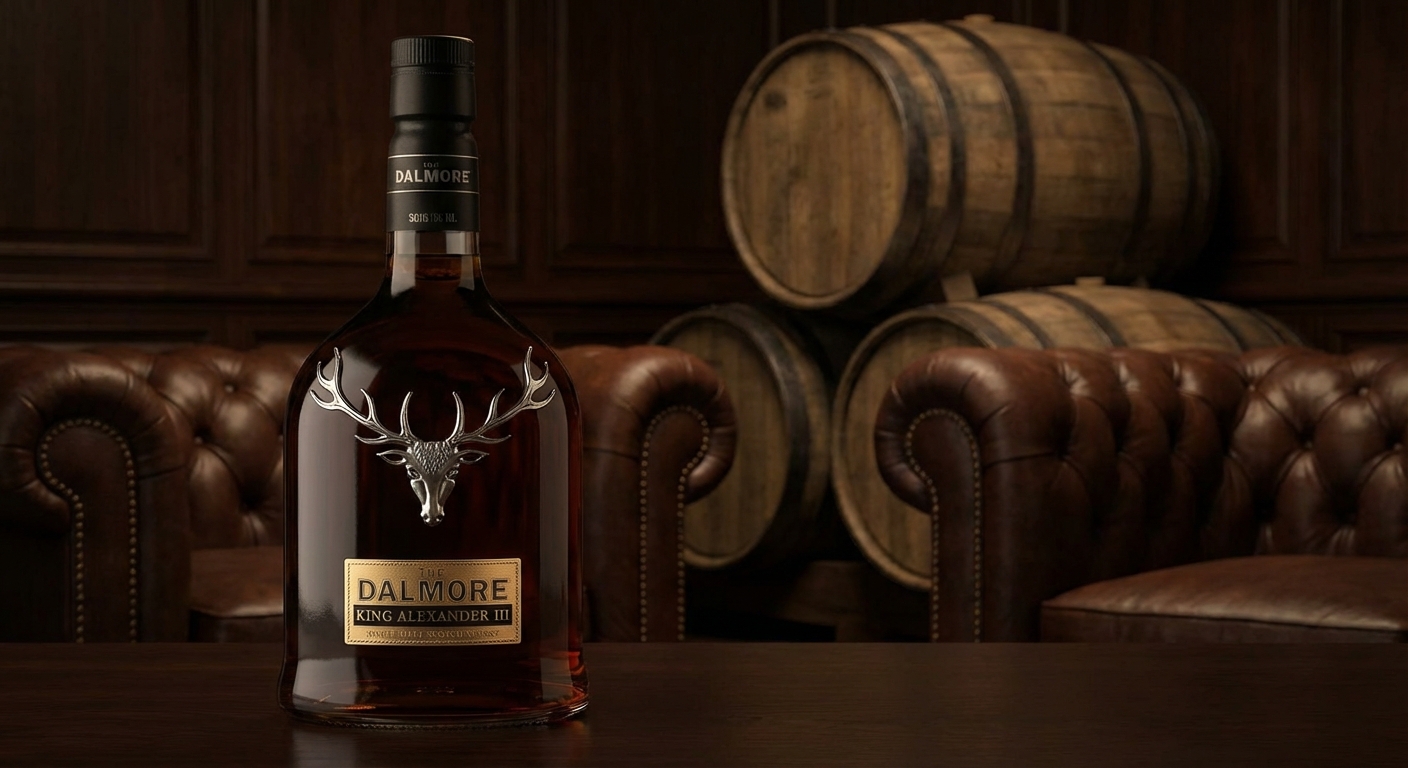
The King Alexander III is presented in Dalmore’s characteristic packaging — a tall, dark, and weighty box bearing the twelve-pointed stag emblem. The bottle itself is distinctive, the embossed stag prominent on the label. For gifting, the presentation adds significant perceived value — this is a bottle that communicates seriousness before it is even opened.
The Skim Stopper: Rare whisky value is not solely a function of price — it is a function of scarcity, narrative, and distinctiveness. The King Alexander III scores highly on all three. The six-cask methodology is genuinely uncommon at its price point, the historical story behind the name adds narrative weight, and the Dalmore brand carries the kind of collector credibility that supports long-term interest.
The King Alexander III offers a rich, layered flavour profile driven by dark fruits — plum, black cherry, dried fig — from the oloroso sherry and port cask influence, balanced by vanilla and toffee from the bourbon wood. Brighter Madeira-influenced notes of stone fruit and a faint acidity lift the mid-palate, while the Cabernet Sauvignon casks contribute blackcurrant and cedar. The finish is long and warming, with spiced dark fruit and a clean, satisfying conclusion.
The Dalmore King Alexander III is matured simultaneously in six distinct cask types: American white oak ex-bourbon barrels, Matusalem oloroso sherry butts (from Gonzalez Byass), Madeira drums, Marsala barrels, port pipes, and Cabernet Sauvignon wine casks. Each cask type contributes different flavour compounds — the skill lies in balancing all six so that the result is complex without being incoherent.
No. The Dalmore King Alexander III is a non-age-statement (NAS) expression. Dalmore does not disclose the age of the spirit within the bottle, which gives master distiller Richard Paterson the flexibility to blend parcels of spirit from different maturation periods in order to maintain a consistent flavour profile across batches.
In the UK, the Dalmore King Alexander III typically retails between £80 and £120, depending on the retailer and whether you are sourcing a current release or an older batch. Specialist retailers and rare whisky sources may carry older expressions at different price points. For current availability and pricing, browse the collection at Glenbotal.
It is an excellent gift for any serious whisky drinker. The distinctive six-cask methodology, the rich historical narrative behind the name, the quality of the presentation packaging, and the genuine complexity of the flavour profile all combine to make this a bottle that signals genuine knowledge and thoughtfulness. It is particularly well suited to Dalmore collectors, Highland single malt enthusiasts, and anyone who appreciates multi-cask expressions.
Yes, though its collectibility operates differently from purely speculative bottles. It is a mainstay of serious Dalmore collections and holds consistent secondary market interest, particularly for older batch releases. Within the broader context of rare whisky collecting, it occupies a stable and well-regarded position. Collectors building focused Dalmore portfolios regard it as an essential expression.
King Alexander III ruled Scotland from 1249 to 1286. According to the legend that underpins Dalmore’s brand identity, a member of the Mackenzie clan saved Alexander III’s life during a stag hunt, stepping in front of a charging stag to protect the King. In gratitude, Alexander III granted the Mackenzie clan the right to bear a royal stag’s head in their heraldry. When the Mackenzie family acquired Dalmore distillery in 1867, they introduced that twelve-pointed royal stag as the distillery’s emblem — where it has remained on every Dalmore bottle ever since.
The King Alexander III sits above the core 12-year and 15-year expressions in terms of complexity and price, but approaches the flavour brief differently from the age-stated range. Where the 12, 15, and 18-year expressions use extended maturation in a smaller number of cask types to build depth, the King Alexander III uses six simultaneous cask types to achieve multi-layered complexity at a non-age-stated price point. It is neither better nor worse than the age-stated range — it is a different kind of excellence.
The King Alexander III is available through specialist whisky retailers, independent whisky shops, and rare whisky sources. Glenbotal sources bottles from private collectors across the UK and Europe, with thousands of bottles in stock across the full Dalmore range and beyond. If you are looking for a specific batch or an older expression, contact us directly — our free valuation service also extends to sourcing enquiries.
Dalmore maintains a consistent flavour profile for the King Alexander III through careful batch blending — the six cask types used remain the same. As with all NAS expressions, the precise composition of each batch may vary slightly to maintain that consistency as the character of individual cask vintages fluctuates. The core expression and its defining characteristics are unchanged.
No. The Dalmore King Alexander III is an unpeated Highland single malt. Dalmore does not use heavily peated barley in its production, and the King Alexander III’s flavour profile is dominated by the influence of the six cask types rather than any peat or smoke character. The faintly warming, spiced quality in the finish reflects the Highland spirit character and the wood influence rather than peat.
Neat, in a tulip-shaped whisky glass, at room temperature. The complexity of the six cask finish reveals itself slowly — give it ten minutes in the glass and return to it as it opens up. A few drops of still, room-temperature water can further open the nose and mid-palate without diluting the experience. Ice is not recommended — the cold suppresses the aromatics that make this expression distinctive.
The Dalmore King Alexander III is a masterclass in multi-cask maturation — a whisky that earns its place at the top of Dalmore’s accessible range through genuine complexity rather than marketing ambition.
Six cask types, a 750-year historical narrative, and Richard Paterson’s decades of cask selection expertise combine in a bottle that rewards both the casual drinker and the serious collector. The flavour profile is rich, layered, and unmistakably Highland; the presentation is worthy of the price; and the story behind the name adds a dimension of provenance that purely technical expressions cannot match.
If you are starting to explore the Dalmore range seriously, the King Alexander III is the bottle that shows you what the distillery is genuinely capable of. If you are an established collector, it is the expression that most clearly demonstrates why Dalmore belongs in any collection focused on distilleries worth collecting. And if you are buying it as a gift, you can be confident that whoever receives it will understand immediately that thought went into the choice.
Browse the full Dalmore range — and thousands of other rare and sought-after bottles — at Glenbotal. Our team has six years of experience sourcing rare whisky from private collectors across the UK and Europe, and our free valuation service means you can always understand what a bottle is worth before you buy or sell. See How Our Free Valuation Works — no obligation, no commitment.
Prices quoted in this guide are indicative of current retail rates. Whisky prices change frequently in line with secondary market conditions — always verify current pricing directly with the retailer before making a purchase decision.
Explore the full collection at Glenbotal — rare whisky sourced from private collectors across the UK and Europe.