When the 2005 Inaugural Release reached the market in June 2018, it comprised exactly 629 bottles — the entire output of Fife’s first new distillery in over a century, distilled in a converted farmyard barn by two brothers who grow their own barley.
Daftmill is not a marketing exercise in scarcity. It is scarcity itself. The distillery operates on one of Scotland’s most productive agricultural farms, produces only when the harvest allows, and bottles only what it genuinely has. When the inaugural 2005 vintage appeared after twelve years of patient maturation, there were 629 bottles. No more were coming. The world took notice, and prices followed. This is the complete guide to what Daftmill is, how it works, why those first 629 bottles matter, and how collectors continue to pursue every release that has followed.
Daftmill is a farm distillery situated in the Howe of Fife, near Cupar, in the Kingdom of Fife — a region better known for cereals and soft fruit than for Scotch whisky. It was founded in 2003 by brothers Francis and Ian Cuthbert, who run Daftmill Farm as a working agricultural enterprise producing barley and other crops. The distillery was licensed by HMRC and produced its first spirit on 16 December 2005, making it Fife’s first new distillery in more than a hundred years.
The Cuthberts are farmers first. Distilling was a considered extension of what they already did — grow grain — rather than an ambition imported from outside the industry. The barley that goes into every bottle of Daftmill is grown on the farm itself, harvested from named fields on the estate and malted locally. The water comes from an artesian well beneath the property. From soil to spirit, the supply chain at Daftmill is as short and controlled as it gets anywhere in Scotch whisky.
The distillery sits inside a converted meal mill and barn on the farm. It is emphatically not a visitor attraction. The website is direct about this: Daftmill is a working farm and does not generally receive visitors. There are no tours, no tasting rooms, no gift shop. The experience of Daftmill whisky begins and ends in the bottle — which, for collectors, makes every release feel more like a private communication than a commercial product.
The farm distillery model is one of the oldest forms of whisky production in Scotland, but Daftmill is one of very few modern distilleries to practise it in its truest sense. At most distilleries, production runs year-round, with grain sourced externally from large commercial maltsters and spirit produced to a consistent industrial schedule. At Daftmill, production stops when the farm needs to.
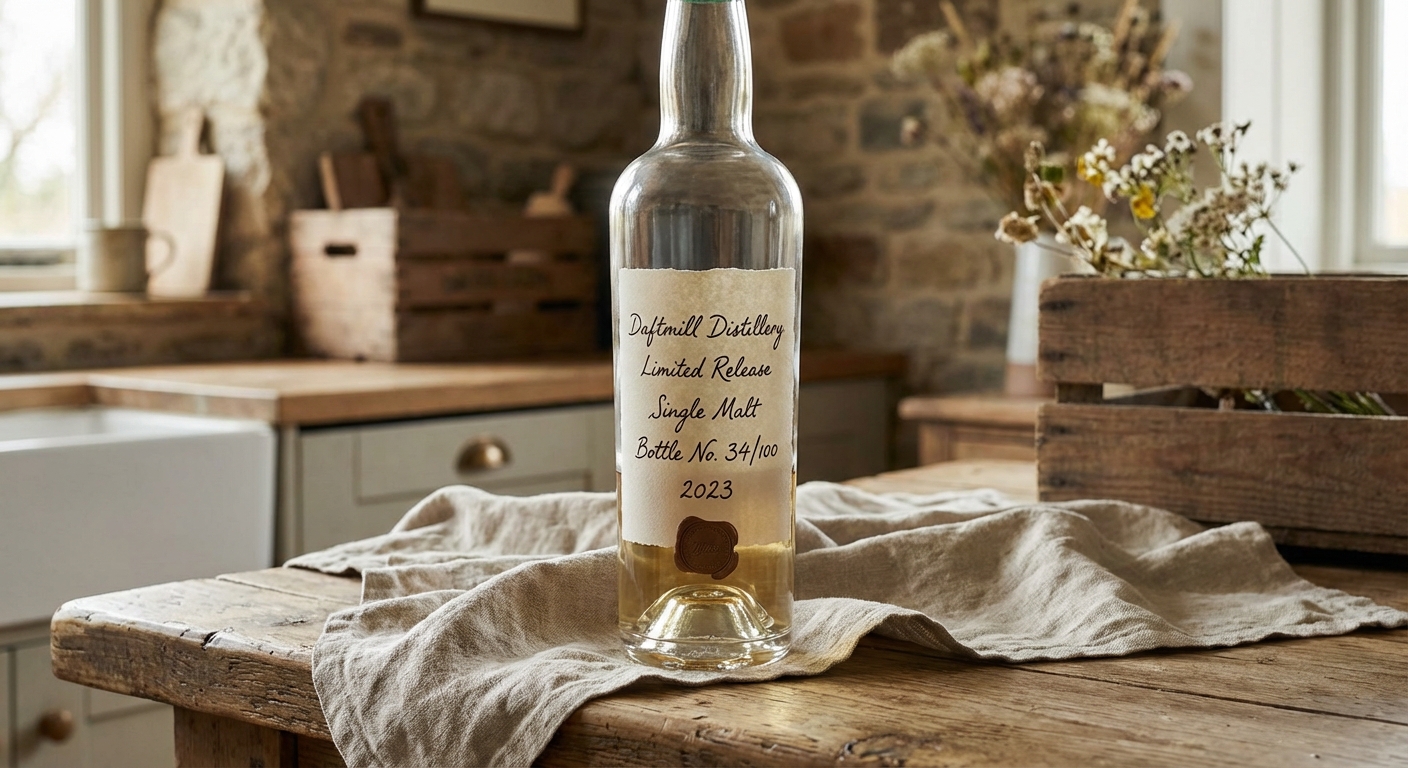
Distilling takes place in two seasonal windows: mid-summer and winter, during the quieter periods between agricultural activity. This is not a nod to tradition for its own sake — it is a practical constraint of running a farm. The stills, a 2,500-litre wash still and a 1,500-litre spirit still, are modest by any industry standard. Annual production sits at a maximum of around 20,000 litres of pure alcohol, though actual output in any given year may be considerably lower. On a lean year, Daftmill might fill as few as 100 casks.
One hundred casks. By comparison, a large Speyside distillery might fill 50,000 in the same period. The mathematics of scarcity at Daftmill are not complicated — they are simply unforgiving.
The two-still setup means the distillery’s character is set by a small, consistent team and a fixed set of parameters. Un-peated malt. First-fill ex-bourbon barrels sourced primarily from Heaven Hill in Kentucky. Maturation in Warehouse No. 1 on the farm estate. The result is a clean, fruit-forward Lowland style — delicate, complex, and entirely unlike the heavily sherried or smoky expressions that dominate collector markets. Daftmill’s flavour is its own: agricultural and precise, shaped by Fife’s cool climate and the specific terroir of one farm’s grain.
The grain-to-glass approach also means total accountability. Francis Cuthbert can tell you which field the barley for any given cask came from and when it was harvested. The 2005 inaugural release used barley harvested on 31 August 2004 from Dam Park and Curling Pond — two named fields on the estate. That barley was malted by Robert Kilgour & Co, one of Fife’s last traditional maltsters, in one of that company’s final batches before it closed. Every bottle carries that provenance invisibly.
In June 2018, after twelve years of silence, Daftmill released its first whisky to the public. The 2005 Inaugural Release was a 12-year-old single malt bottled at 55.8% ABV from three first-fill bourbon casks — numbers 05/02, 05/03, and 05/07. Total bottles produced: 629.
The number is not an accident of marketing. It is an accurate count of every bottle that could be filled from those three casks. There was no production decision to limit the run for effect. The casks held what they held, and when the filling was done, the release was complete. Daftmill’s own description of the inaugural bottling was characteristically unemotional: it called the whisky “rarer than rocking horse shit.” That line, appearing on the official product page, tells you everything about the distillery’s relationship with hype. They are not playing a game. They are simply making whisky and being honest about what’s available.
The release landed at a moment when the collector market for rare Scotch whisky was accelerating sharply. Secondary market prices for limited releases from small, credentialed producers had been climbing since the early 2010s, and the Daftmill 2005 Inaugural entered that environment with near-perfect credentials: ultra-low production, an impeccable farm provenance story, twelve years of patient maturation, and a cask-strength ABV that signalled the distillery had bottled the whisky on its own terms. The original retail price through Berry Bros. & Rudd — Daftmill’s exclusive UK distributor — was in the region of £85–£95 for a 70cl bottle.
That original price was not where the whisky stayed. Within months of release, bottles were appearing on secondary markets at multiples of retail. Today, the 2005 Inaugural trades at prices substantially above its release point — when bottles surface at all. At auction, confirmed sales have regularly reached the £300–£600 range depending on condition and platform, with exceptional examples commanding more. For a debut release of only 629 bottles, every single one is now a collector’s item. The fact that it drinks exceptionally well — structured, orchard-fruited, with the warm vanilla and baked apple character of well-selected first-fill bourbon — makes it doubly sought after.
The 629 bottles were not just a debut. They were a statement of intent. Daftmill would not make more than it had. It would not compromise on the 12-year minimum maturation. It would not release a whisky that wasn’t ready. In an era of NAS releases and rapid-turnaround distilleries built for volume, that stance was remarkable — and the market recognised it immediately.
Following the inaugural release, Daftmill established the pattern that now defines its annual release calendar: a Summer bottling and a Winter bottling, each drawn from spirit distilled in the corresponding seasonal window. These releases represent the core of the Daftmill range and are the expressions most collectors focus on.
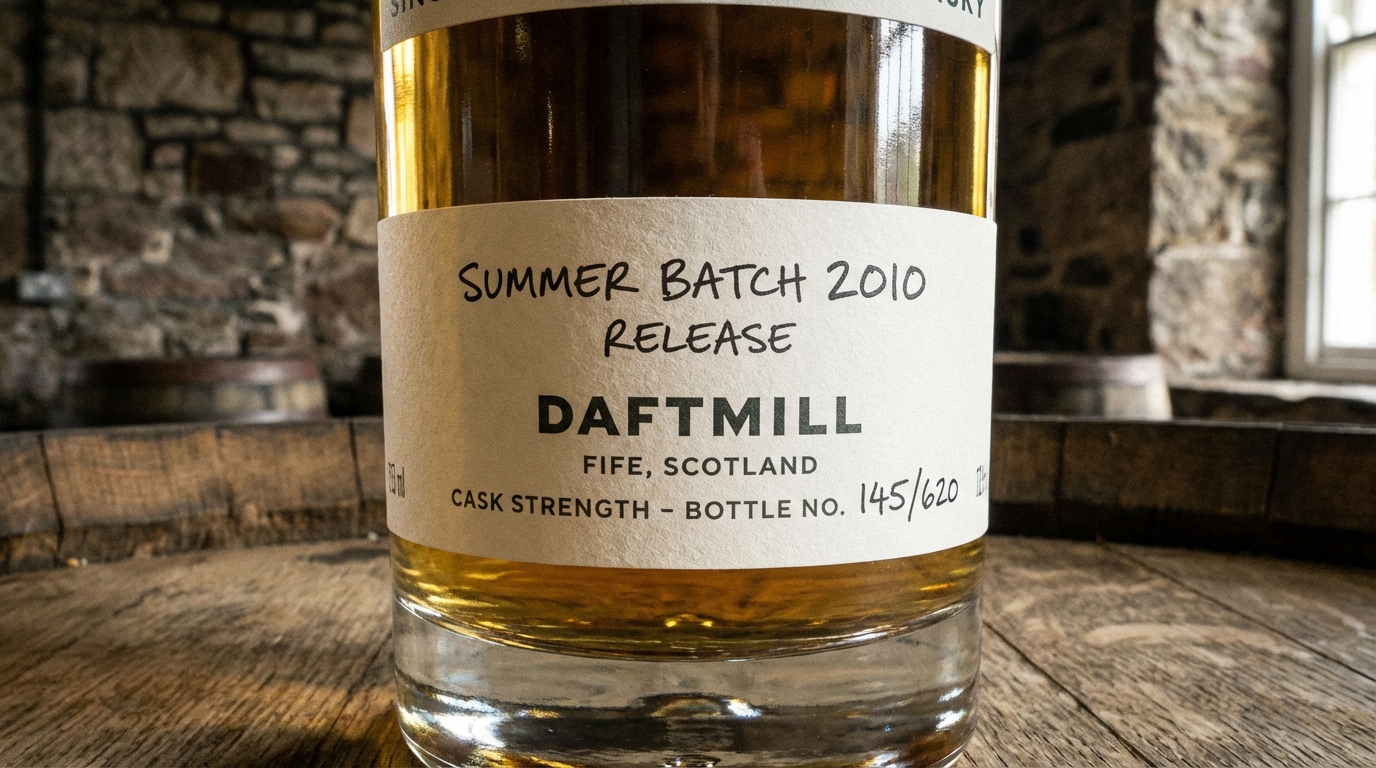
The distinction between Summer and Winter is not purely ceremonial. The whisky distilled in each season reflects different characteristics — in the grain, in the ambient conditions during distillation, and in how the spirit has developed over its maturation years. Summer distillate tends to produce a lighter, more fruit-forward character, with pronounced citrus and stone fruit notes. Winter distillate is generally fuller, with more weight on the palate and a tendency toward richer, spicier flavours. Both are bottled at 46% ABV for the standard UK releases, making them accessible for drinking while remaining close enough to natural strength to carry full flavour.
The 2006 Summer release — 1,665 bottles at 46% ABV — is widely considered the template for what Daftmill does best. Tasting notes from the distillery describe freshly baked Victoria sponge, curry leaves, and cinder toffee on the nose, with lemon zest, molten honey on toast, and marmalade on the palate. The finish runs to wood polish and marzipan. It is a whisky for a warm afternoon, as the distillery itself suggests.
The 2006 Winter UK bottling ran to 1,625 bottles at 46% ABV, while the export allocation added 1,265 bottles — a total that, even combined, falls well short of what a standard independent bottler might release in a single expression. Winter profiles lean toward stewed rhubarb, custard, dried coconut, and baked bread on the nose, with stewed fruits, Victoria sponge, and a lemon-grassy edge on the palate. The finish brings cinnamon, nutmeg, and clove with lingering vanilla.
The Summer and Winter model has continued through each subsequent vintage year. The 2008 Summer Export ran to 1,780 bottles at 46% ABV — a 12-year-old drawing on first-fill ex-bourbon barrels, producing grated Granny Smith apple, vanilla, and apricot jam on the nose, with oak spice, cardamom, and vanilla custard on the palate. The 2009 Summer (Asia allocation) extended to 1,790 bottles and introduced an Oloroso butt into the maturation mix alongside bourbon barrels, adding tropical fruit, dried figs, and sherry spice to the house profile.
A few things are consistent across every Summer and Winter release. All use first-fill ex-bourbon barrels as the primary vessel, typically from Heaven Hill. All are bottled without colouring or chill-filtration. All carry a specific vintage year on the label — the year of distillation, not release — so collectors can follow each season’s spirit through its maturation life. And all remain distributed exclusively through Berry Bros. & Rudd and a small network of specialist retailers. There are no supermarket allocations, no duty-free runs, and no large online-only releases.
Whisky values can rise and fall. This is not financial advice.
Beyond the standard Summer and Winter bottlings, Daftmill has produced a small number of single cask and special releases that represent the outer edge of its portfolio. These are rarer still than the regular seasonal releases — and that is saying something.
Single cask bottlings from Daftmill appear only occasionally, typically as allocations for specific markets or specialist retailers. These expressions are drawn from individual casks rather than small-batch vatting and are bottled at cask strength, giving each release a unique ABV and a more concentrated expression of Daftmill’s house character. Because the casks at Daftmill are small (the wash and spirit stills are not large enough to fill full hogsheads at a single run), yields from single cask releases can be very small — sometimes under 300 bottles.
The most recent significant release beyond the core Summer/Winter range is a cask strength 15-year-old, bottled at what Daftmill describes as “Fife Strength” — a deliberate nod to the farm’s identity and the terroir-driven philosophy that defines everything the distillery produces. This expression sits at the elder end of the Daftmill portfolio and demonstrates how the house style develops over extended maturation: the fruit becomes more concentrated, the oak integration deeper, and the complexity layers in ways that the younger releases, fine as they are, cannot yet achieve.
There are also export-specific releases that differ from the UK allocations. Market-by-market variation is a feature of Daftmill’s distribution model — different quantities, sometimes different cask compositions, occasionally different ABVs, all carefully documented on the distillery’s releases pages. Collectors tracking the full Daftmill canon quickly discover that a UK Summer release and an Export Summer release from the same vintage year are not the same whisky, and both may be worth acquiring.
What Daftmill has never done is produce an NAS (no age statement) expression, or rush a release to market ahead of its maturation. Every bottle carries a vintage year and an age statement. This commitment to transparency is unusual in a market where NAS releases have become the norm for managing stock at volume-driven distilleries. At Daftmill, it is simply the natural consequence of how they operate: they know exactly when each cask was filled, what went into it, and when it is ready.
The collectibility of Daftmill whisky is built on three pillars that reinforce each other so completely that the distillery has become, in the span of a single decade of releases, one of the most sought-after names in the Scotch whisky secondary market.
The first pillar is genuine, structural scarcity. Daftmill’s annual production ceiling of around 20,000 litres of pure alcohol — and frequent years where output falls well short of that — means total supply is permanently, irreversibly finite. The 629-bottle inaugural release was not a strategy. It was an honest count of the casks produced in the distillery’s first year. No subsequent release has come close to exceeding 5,000 bottles across all markets and cask types in a given vintage, and most sit well below that. When you understand that Berry Bros. & Rudd — one of the world’s great specialist wine and spirits merchants — is the primary distribution partner, and that the combined UK and export allocation for any single release might be measured in a few hundred cases, the scarcity picture becomes very clear.
The second pillar is critical quality. A distillery can be small and produce poor whisky. Daftmill does not. Independent critics and specialist publications have awarded the Summer and Winter releases consistently high scores across multiple vintages. The house style — clean, precise, fruit-forward Lowland whisky with impeccable cask management — has attracted serious critical respect. Scores in the mid-to-high 80s and low 90s are representative across the range, and no release has been dismissed as rushed, underdeveloped, or poorly matured. Quality consistency over a decade of releases is a meaningful data point for collectors: it means the brand has not grown on hype alone.
The third pillar is the story. Not every scarce, high-quality whisky becomes a collector legend. What separates Daftmill is the authenticity of its narrative. The Cuthbert brothers did not set out to create a cult whisky. They grow barley in Fife, as their farm has always done, and they make whisky from it when they can. The converted barn, the artesian well, the named harvest fields, the twelve years of patient maturation before a single bottle was sold — these are not brand positioning exercises. They are the facts of how Daftmill operates. That story resonates with a collector community that has become increasingly sceptical of manufactured scarcity and increasingly drawn to provenance it can verify.
For a deeper framework on what makes limited-run whiskies valuable at retail and on secondary markets, our guide to what makes a whisky bottle valuable covers the structural factors at play. Daftmill meets every criterion.
Collecting Daftmill requires patience, the right retailer relationships, and a clear understanding of the secondary market — because finding a bottle at retail is genuinely difficult.
At retail: The primary route to a new Daftmill release at release price is through Berry Bros. & Rudd, who handle UK distribution. Berry Bros. allocates bottles to customers and operates a waiting list for popular releases. Registering interest directly with BBR before a release is announced is the most reliable approach for new collectors. A small number of specialist independent retailers — including Glenbotal — source Daftmill from private collectors and specialist networks, offering access to older vintages and specific releases that have long since sold out at primary retail. Availability is never guaranteed and moves quickly when it appears.
On the secondary market: Daftmill bottles appear regularly at the main Scottish and UK whisky auction houses, including Scotch Whisky Auctions, Whisky Auctioneer, and Catawiki. The 2005 Inaugural has consistently attracted strong hammer prices — typically in the £300–£600 range, with exceptional lots in original packaging or with documentation reaching higher. More recent vintage releases tend to trade at smaller premiums over retail, but premiums remain consistent across the range. No confirmed Daftmill bottling has traded at or below its original retail price in the secondary market.
A note on authentication: Every genuine Daftmill release is documented on the distillery’s official website, including cask numbers, bottle counts, ABVs, and vintage years. Before purchasing on the secondary market, cross-reference the specific release details — ABV, bottle count, cask numbers — against the official record at daftmill.com. The distillery’s release transparency makes authentication relatively straightforward compared to many rare Scotch expressions.
What to pay: For current Summer and Winter releases sourced from private collections, expect to pay a meaningful premium over original retail prices. Bottles released at £85–£95 in 2018 now routinely trade in the £200–£400 range depending on vintage and specific release. The 2005 Inaugural commands more. Single cask releases at cask strength typically command the highest premiums per bottle due to their even more restricted availability. For guidance on how to assess whether a specific bottle is fairly priced, our guide to how much is my whisky worth provides a solid framework for working through secondary market valuations.
Building a collection: Given the annual release cadence — typically two core releases per year across UK and export markets, plus occasional single cask expressions — a complete Daftmill collection is an achievable goal for a committed collector, but requires sustained attention. Bottles from the 2005, 2006, and 2007 vintages are the hardest to find and command the highest premiums. More recent vintages (2009 onwards) are more accessible but still limited. Building across vintages, rather than chasing a single bottling, gives a collector a far more interesting and complete picture of how the distillery’s spirit has developed year on year. Our ultimate whisky collecting guide covers strategies for building a focused collection around limited-production distilleries like Daftmill.
Whisky values can rise and fall. This is not financial advice.
The Scottish whisky landscape includes a number of small-production distilleries whose limited releases attract serious collector attention. Understanding where Daftmill sits within that landscape helps explain why it has achieved such a distinctive position in such a short time.
Daftmill vs. Springbank: Springbank in Campbeltown is the most commonly cited point of comparison — another small, family-owned Scottish distillery with a traditional production model, low output, and a passionate collector following. Springbank produces considerably more whisky than Daftmill (though still far less than the industry giants), and its releases are more frequent and varied. The comparison is apt in terms of philosophy — both distilleries prioritise integrity over volume — but Daftmill’s output is in a different order of magnitude, and its provenance story is uniquely tied to a single farm rather than a distilling community.
Daftmill vs. Kilchoman: Kilchoman on Islay is one of the few other farm distilleries in Scotland operating at a genuinely small scale. Like Daftmill, it grows some of its own barley and emphasises provenance. But Kilchoman produces peated whisky and has grown its production volumes significantly since its founding in 2005, making it a rather different proposition today than it was a decade ago. Daftmill has shown no intention of scaling up, which is one of the core reasons its collector appeal remains undiminished.
Daftmill vs. independent bottlings from lost distilleries: Some collectors approach Daftmill as they would a rare independent bottling from a closed distillery — something finite, with no prospect of replenishment. There is something to this. The supply of any specific vintage year from Daftmill is genuinely finite in the way a lost distillery release is finite. But Daftmill has the additional appeal of being an active, producing distillery — new vintages continue to mature, new releases will emerge, and the story is still being written. For collectors who have explored the territory covered in our guide to Spey lost distillery bottlings, Daftmill offers a complementary experience: the finite charm of tiny production, without the melancholy of a closed still.
Daftmill vs. ultra-premium annual releases: Collectors who follow annual limited releases — such as those documented in our piece on the Laphroaig Cairdeas series — will recognise some structural similarities: an annual cadence, a loyal collector base, and a product that changes in character from year to year. The difference is scale. Cairdeas, though limited for Laphroaig, runs to far higher bottle counts than anything Daftmill has released. The collector experience at Daftmill is more intimate and more pressured — which, depending on your perspective, makes it either more rewarding or more frustrating.
What none of these comparisons fully capture is Daftmill’s uniqueness as a Lowland farm distillery. There is nothing quite like it in the current Scottish whisky landscape. The Lowlands as a region has historically been underrepresented in the collector market, dominated by light blending fillers for most of its industrial history. Daftmill is making the case, one seasonal bottling at a time, that Lowland whisky can be among the most compelling and collectable in Scotland.
Daftmill’s annual production capacity is capped at around 20,000 litres of pure alcohol per year, though actual output varies with the farming calendar. In a typical year, this translates to somewhere in the range of 100 casks filled across the Summer and Winter distilling seasons. Total annual bottle output across all releases rarely exceeds a few thousand bottles globally, making it one of Scotland’s lowest-volume producing distilleries.
Summer and Winter refer to the season in which the spirit was distilled. Daftmill only distils during two windows each year — mid-summer and winter — when farm activity permits. Summer distillate typically produces a lighter, more citrus and stone fruit-driven character. Winter distillate tends toward a fuller body with more richness, spice, and occasionally deeper dried fruit notes. Both are bottled at 46% ABV for standard UK releases, without colouring or chill-filtration.
New releases are distributed in the UK exclusively through Berry Bros. & Rudd and a small number of specialist independent retailers. Older vintages and sold-out releases are available through specialist retailers like Glenbotal, who source from private collections and established networks. Secondary market options include Scotch Whisky Auctions, Whisky Auctioneer, and Catawiki. Availability is limited and moves quickly — the best approach is to register interest with specialist retailers ahead of anticipated releases.
The 629 bottles represented the total yield from three first-fill bourbon casks — numbered 05/02, 05/03, and 05/07 — filled during the distillery’s first operational year in 2005. Daftmill’s stills are small (a 2,500-litre wash still and a 1,500-litre spirit still), and the casks held exactly what they held. There was no decision to limit the release for marketing purposes; 629 was simply the honest count after twelve years of maturation.
Yes. Daftmill is situated in Fife, which falls within the Scotch Whisky Association’s Lowland production region. Lowland whiskies are generally characterised by a lighter, more delicate style than Highland or Speyside expressions — a profile that aligns well with Daftmill’s clean, fruit-forward house character. Daftmill is one of the most prominent examples of fine Lowland single malt whisky currently in production.
The core Daftmill profile is clean, precise, and fruit-driven. Expect orchard fruit (apple, pear, apricot), citrus zest (lemon, orange marmalade), and baked goods (Victoria sponge, shortbread, vanilla custard) from first-fill bourbon cask maturation. The Summer releases tend lighter and more floral; Winter releases carry more weight and spice. Cask strength expressions and older releases develop greater complexity — deeper dried fruit, more integrated oak, hints of marzipan or ginger — while retaining the fundamental elegance of the house style.
That depends on context. At original retail prices (typically £85–£120 for standard releases), Daftmill represents outstanding value for a rare, authentically produced, non-chill-filtered single malt. On the secondary market, premiums are significant — and are supported by genuine scarcity, consistent quality, and a collector market that has grown steadily since 2018. For collectors who open and drink their bottles, the price-to-quality ratio remains compelling. For those assembling a collection of investment-grade limited releases, Daftmill’s combination of ultra-low production and critical acclaim places it among the stronger prospects in the Scotch whisky secondary market.
Secondary market prices vary by release and condition. The 2005 Inaugural (629 bottles, 55.8% ABV) typically trades in the £300–£600 range at auction, with exceptional examples reaching higher. Standard Summer and Winter releases from earlier vintages (2006–2009) trade at meaningful premiums over their original retail prices, typically in the £200–£450 range depending on vintage and condition. More recent releases command smaller but consistent premiums. Prices have been broadly stable with an upward trend since the distillery began releasing whisky in 2018.
There is no official Daftmill allocation list for consumers — the distillery sells exclusively through Berry Bros. & Rudd and a small number of specialist retailers. The best approach is to register with BBR directly and express interest in upcoming Daftmill releases. Building relationships with specialist independent retailers who source Daftmill from private collections — such as Glenbotal — is also a reliable route to access. Following both BBR and Daftmill’s own channels for release announcements allows you to move quickly when bottles become available.
Daftmill’s consistent track record of secondary market premiums, ultra-low production volumes, and growing critical and collector reputation make it one of the more credentialled rare whisky prospects in the current market. The 2005 Inaugural has already demonstrated sustained secondary market appreciation. Subsequent vintage releases have followed the same pattern, with prices holding well above original retail. That said, the whisky market is subject to changing tastes, economic conditions, and collector trends that no one can predict reliably. Whisky values can rise and fall. This is not financial advice.
The vast majority of Daftmill releases are matured exclusively in first-fill ex-bourbon barrels, primarily sourced from Heaven Hill in Kentucky. This is the foundation of the house style and its characteristic clean, fruit-forward profile. A small number of releases — including the 2009 Summer Asia allocation — have incorporated an Oloroso butt in the maturation, adding sherry-driven dried fruit and spice notes. These are the exception rather than the rule, and are always documented on the distillery’s release pages.
The Scottish Lowlands region includes Auchentoshan, Glenkinchie, Bladnoch, and a growing cohort of newer operations such as Holyrood, Kingsbarns, and Borders Distillery. Daftmill stands apart from all of these in its production model — it is the only true farm distillery in the region, growing its own grain and distilling seasonally around agricultural demands. Its production volume is smaller than any comparable active distillery in the Lowlands, and its release model — vintage-dated, age-stated, strictly limited — is unlike anything else in the region.
Daftmill is the product of two brothers who grow barley in Fife and make whisky from it when the harvest allows. That is the whole story, and it is enough. The 629 bottles of the 2005 Inaugural Release did not just launch a distillery into the collector market — they announced a set of values that every subsequent release has upheld: honest production, genuine scarcity, patient maturation, and total transparency about what is in the bottle and where it came from.
The Summer and Winter bottlings that have followed have built a body of work that stands as one of the most coherent and credible release programmes in contemporary Scotch whisky. Each vintage year adds a new data point to the picture of what Daftmill is, and each confirms the same conclusion: this is a distillery that cannot be hurried and will not be expanded, and the whisky it produces is among the most genuinely limited and consistently excellent in Scotland.
For collectors, that combination is rare. For drinkers who want to understand what Lowland Scotch whisky can be at its finest, Daftmill is essential. And for anyone who has been circling the brand, waiting for the right moment — there is no right moment. There is only the window when a bottle is available.
Glenbotal works with private collectors and specialist networks across the UK and Europe to source rare and limited-production whiskies including Daftmill. If you are looking for a specific vintage, building a collection, or simply want to know what is currently available, our team is ready to help.
Explore rare whisky at Glenbotal — or contact us directly for a free valuation of bottles you already hold.
Explore the full collection at Glenbotal — rare whisky sourced from private collectors across the UK and Europe.