
A rare Macallan 18 stored incorrectly — exposed to heat and light — can lose 20–30% of its auction value before a single drop is poured. Storage isn’t an afterthought. For serious collectors, it’s the foundation.
In this guide, I’m going to show you exactly how to store whisky bottles properly — from the fundamentals of temperature and light control to the specialist decisions that separate careful collectors from those who unknowingly damage what they’ve worked hard to acquire.
At Glenbotal, we’ve spent six years sourcing rare whisky from private collectors across the UK and Europe, and we’ve seen collections stored beautifully and collections stored carelessly. The difference in condition — and in value — is striking.
Here’s exactly what proper storage looks like, why each rule exists, and how to set it up whether you’re protecting three bottles or three hundred.
Most people assume that because whisky is bottled and sealed, it’s effectively inert. Put it in a cupboard, forget about it, retrieve it when the time is right. Simple.
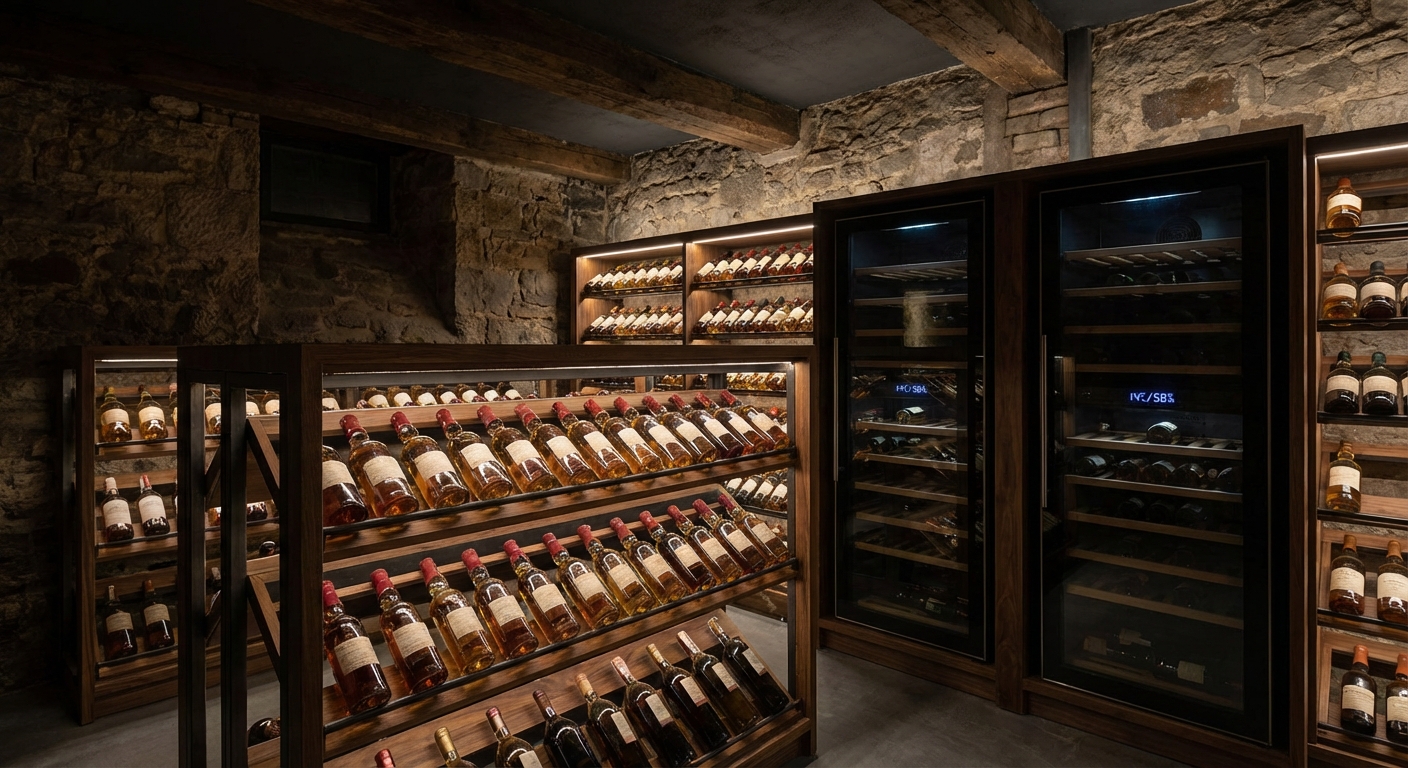
That assumption is the single most common way collectors destroy the value of what they own.
Whisky in a sealed bottle is stable — but it is not immune. Heat accelerates chemical reactions inside the liquid that alter flavour profiles over time. UV light degrades both the whisky itself and the label, and label condition is a significant factor in auction valuations. Humidity fluctuations cause corks to expand and contract, eventually allowing air ingress — the quiet killer of long-term storage quality.
Here’s the deal: the difference between a bottle stored with care and one stored negligently isn’t theoretical. Auction houses including Whisky Auctioneer and Scotch Whisky Auctions consistently note that label condition, fill level, and original packaging can shift a hammer price by 15–30% on the same expression. Storage is the silent force behind that gap.
The good news? Getting it right is straightforward. You don’t need a temperature-controlled vault to protect a home collection. You need to understand the rules — and apply them consistently.
These six rules form the foundation of responsible whisky care. They apply whether you’re storing a single special bottle or managing a dedicated collection room.
Always store whisky bottles upright — never on their side.
This is the most debated rule in whisky storage, and the answer is clear. Unlike wine, whisky is a high-ABV spirit — typically between 40% and 65% ABV. At that strength, prolonged contact between the liquid and the cork causes the cork to deteriorate. The alcohol breaks down the cork material, which can introduce off-flavours into the whisky and eventually compromise the seal.
Storing upright keeps the spirit away from the cork while still allowing the cork to maintain a small amount of moisture from the humid air inside the neck. This is the sweet spot — a healthy cork that doesn’t dry out, but also doesn’t degrade from constant alcohol contact.
The exception to this rule: bottles with synthetic stoppers or screw caps are not at risk from liquid contact, but storing them upright remains best practice for uniformity and label preservation.
The ideal storage temperature for whisky is between 15°C and 20°C — consistent, cool, and away from heat sources.
Temperature matters for two reasons. First, excessive heat accelerates the oxidation and chemical reactions that alter the whisky’s flavour compounds — not all of those changes are improvements. Second, and more practically relevant for collectors, repeated temperature fluctuations cause the liquid to expand and contract. Over time, this creates pressure changes inside the bottle that can force small amounts of whisky past even a healthy cork.
Avoid storing bottles near radiators, in kitchen cupboards next to ovens, or anywhere that experiences seasonal swings of more than 5–10°C. A cool, interior room — away from exterior walls that heat in summer and chill in winter — is ideal.
A consistent 15°C is preferable to an average of 18°C that swings between 10°C and 26°C. Stability is the priority.
Keep whisky away from direct sunlight and sustained artificial light — UV exposure is a significant and permanent threat.
UV radiation triggers photochemical reactions in whisky that degrade the flavour compounds developed during maturation. Research published in food chemistry literature confirms that light-induced oxidation in spirits is cumulative — brief daily exposure adds up over months and years. Additionally, UV light bleaches labels and causes box printing to fade, directly reducing the aesthetic and auction value of a bottle.
Dark glass offers some protection, but it is not sufficient on its own. Amber and dark green bottles filter UV better than clear glass, but no bottle glass provides complete UV blocking. The correct solution is storage in a dark environment — a closed cupboard, a dedicated cabinet, or a room that does not receive direct sunlight.
If you display bottles near a window, move them. The damage accrues every day you don’t.
Whisky is permeable — strong odours from the surrounding environment can contaminate the spirit over time.
This rule surprises many collectors, but corks are porous by nature. A bottle stored next to paint cans, cleaning products, strong cheeses, or even a heavily scented wood in a cabinet can, over years, absorb trace compounds that alter the whisky’s nose and palate. This is not hypothetical — it’s the mechanism behind why older bottles sometimes present unusual off-notes that cannot be attributed to maturation.
Keep storage areas clean, dry, and free from chemical odours. Avoid storing bottles in garages or utility rooms where paint, solvents, or petrol might be nearby. A dedicated, neutral-smelling space is the goal.
Aim for a relative humidity between 60% and 75% in your storage space — not too dry, not too damp.
Humidity is the cork’s natural ally. Too dry an environment — anything consistently below 50% RH — will cause corks to desiccate and contract, eventually allowing air to enter the bottle. This oxidation process is slow but irreversible, and you typically won’t know it has happened until you open the bottle and find the fill level has dropped or the spirit has taken on an unexpected bitterness.
On the other end, excessive humidity above 80–85% RH can damage labels, promote mould on cardboard packaging, and over time affect the quality of wooden cases and boxes — all of which matter to the collector’s market.
A small digital hygrometer (available for under £15) will tell you the humidity level in any storage space. If you’re running too dry, a small passive humidifier or even a bowl of water in the space can help maintain the right level.
Once properly stored, leave the bottle alone.
This is the simplest rule and the one most casually violated. Vibration and repeated movement disturb the sediment in aged expressions and can, over very long periods, contribute to fill level drops through micro-agitation of the cork seal. More practically, every time you move a bottle, you risk knocking it, disturbing the label, or returning it to a less ideal location.
If you have a collection you’re preserving for value rather than immediate consumption, designate a storage location, set it up correctly, and resist the temptation to rearrange or relocate bottles without good reason.
Understanding the rules is one thing. Implementing them in a real home environment is another. Here’s how to approach the practical set-up.
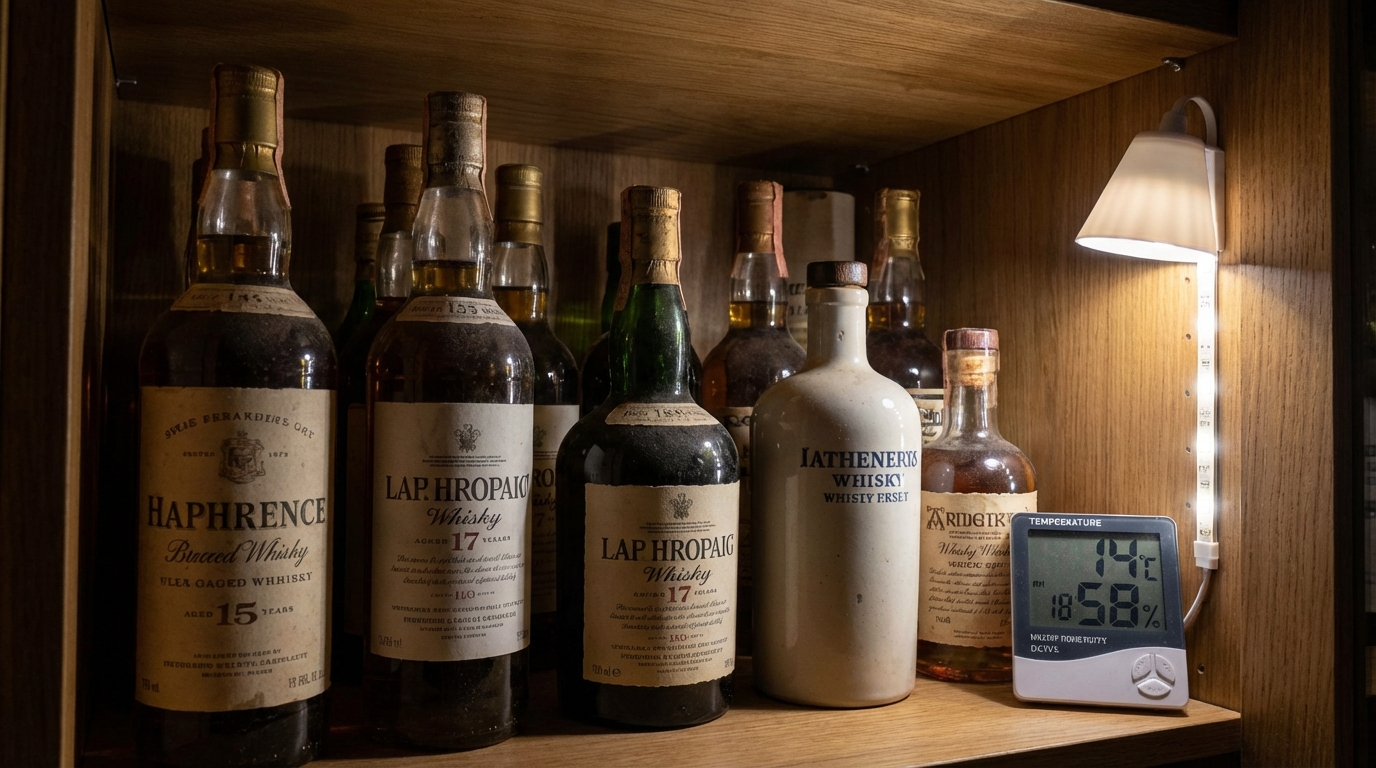
Dedicated cupboard (most collectors)
For collections up to 50 bottles, a well-chosen interior cupboard is entirely adequate. The requirements: away from external walls, no heat sources nearby, minimal light exposure, and enough ventilation that humidity doesn’t become stagnant and excessive. A simple wooden wine rack placed inside a dark cupboard, with bottles stored upright, covers the fundamentals.
Cost to set up a decent domestic storage space: £50–£200 depending on shelving and any climate monitoring equipment you choose.
Converted room or cellar (larger collections)
If your collection has grown to 50+ bottles or includes expressions valued above £500 per bottle, a more dedicated solution is worth considering. A north-facing interior room, a basement, or a converted loft space (insulated for temperature stability) can all work well. Add a quality digital thermometer-hygrometer, and you have a monitoring baseline to catch any environmental drift before it causes damage.
Professional whisky storage (serious collectors and investors)
For high-value collections — particularly those being held for investment or future sale — professional storage is a legitimate and increasingly popular option. Companies including Spirited Storage (UK) and Vaultex offer temperature-controlled, humidity-regulated, insured bottle storage facilities purpose-built for spirits. Costs vary but typically run from £5–£15 per bottle per year depending on collection size and level of insurance.
Professional storage has a clear advantage in the context of insurance valuation and auction provenance. A bottle with documented professional storage history carries more credibility at auction than one stored privately with no verifiable conditions.
If you’re unsure whether your current collection warrants professional storage, consider a free valuation from Glenbotal — it can help frame whether the cost-benefit case for professional storage makes sense for your specific collection.
Every collector faces this tension: the bottles are beautiful objects, and there’s genuine pleasure in seeing them displayed. But display and optimal preservation are often in direct conflict.
A bottle displayed on an open shelf, near a window, in a well-lit room, is losing condition every day. Labels fade, UV damage accumulates, temperature fluctuations affect the liquid, and dust settles on packaging that affects presentation at resale. For everyday drinking bottles or bottles you don’t intend to sell, this is a reasonable trade-off. For bottles you’re preserving as part of a collection — particularly rare or limited releases — display is a liability.
The practical solution many serious collectors use: display inexpensive or already-opened bottles, and store the rare and valuable pieces properly. If displaying a high-value bottle matters to you — for a visitor, for an event, for a photograph — take it out of storage temporarily, then return it.
Some collectors commission display boxes or cabinets with UV-filtering glass panels. These are available from specialist furniture makers and represent a genuine middle ground: the aesthetic pleasure of display with significantly better UV protection than standard glass. Expect to pay £300–£1,500+ for a bespoke cabinet.
For advice on which bottles in your collection are worth the most protection, our guide to what makes a whisky bottle valuable is a useful starting point.
Once you break the seal on a bottle, the storage equation changes significantly. Air has entered the system, and oxidation — the gradual chemical reaction between oxygen and the whisky’s compounds — has begun.
The rate of oxidation depends on two variables: how much air is in the bottle, and how much time passes. A bottle that is one-third full will deteriorate faster than a bottle that is nine-tenths full, simply because of the larger air gap above the liquid.
Here’s the deal with opened bottles:
For bottles more than half-full, upright storage in a cool, dark place with a tight closure will preserve quality well for several years. Use the original stopper wherever possible — it is specifically fitted to the bottle.
For bottles less than half-full, you have two practical options:
Option 1: Vacuum pump systems. A wine vacuum pump can remove the majority of oxygen from the headspace above the whisky, significantly slowing oxidation. These work reasonably well on shorter timescales (weeks to months). Vacu Vin makes widely available, affordable options starting around £10.
Option 2: Inert gas preservation systems. Products like Private Preserve — a blend of nitrogen, argon, and carbon dioxide — displace oxygen from the bottle with a heavier inert gas. This is the preferred method among serious collectors for preserving opened bottles over longer periods. A single canister costs around £10–£15 and can protect dozens of bottles.
For very old or very rare expressions, opening is a decision worth taking seriously before you make it. An unopened bottle of a discontinued expression or a limited run is typically worth more than the same bottle with an inch missing. Our guide to how much your whisky is worth can help you assess value before you decide whether to open.
Whisky’s value at resale — whether through private sale, broker, or auction — is assessed across several dimensions: the expression itself, the vintage, the fill level, the label condition, and the presence of original packaging. Storage directly affects every one of these except the first.
Fill level is the most visible storage indicator. A bottle losing liquid over time — whether through evaporation past a damaged cork or actual leakage — will be significantly discounted at auction. A very good fill (VG, meaning just below the base of the neck) is the standard. Anything described as “upper shoulder” or below typically sells for 20–40% less than the same bottle at a good fill level.
Label condition is the second major variable. Faded, torn, stained, or water-damaged labels reduce value substantially. UV exposure is the primary culprit for fading; humidity damage causes staining and peeling. Both are entirely preventable with correct storage.
Original packaging — particularly original tins, tubes, wooden boxes, and carry cases — can add 10–30% to a bottle’s value. Protecting the packaging with the same care you give the bottle itself is not excessive: store boxes flat, in dry conditions, away from light. Replace bottles inside their boxes when not displaying them.
Now: the inverse is also true. A well-preserved bottle in excellent condition, stored provably well, can outperform auction estimates when presented at sale. Collectors with documented storage records — consistent conditions, professional storage provenance — are increasingly valued by auction buyers who want to understand the chain of custody of what they’re purchasing.
At Glenbotal, we work with private collectors across the UK who have built collections over years and decades. When those collections come to market, condition and provenance are the difference between a satisfying sale and a disappointing one. It begins with storage — and it begins the day the bottle arrives.
For a deeper look at protecting and growing your collection’s long-term value, see our ultimate whisky collecting guide.
Understanding what to do is useful. Understanding what most collectors do wrong is often more valuable.
Mistake 1: Storing bottles in the kitchen
Kitchens are temperature-volatile environments — the oven, the dishwasher, and seasonal changes in ambient room temperature create exactly the kind of fluctuation that damages whisky over time. Moving your collection out of the kitchen is the single highest-impact change most collectors can make.
Mistake 2: Laying bottles on their side
The logic seems intuitive: it’s how you store wine, it looks good on a rack, and you’ve probably seen it in countless bar and restaurant displays. But as explained above, the high ABV of whisky means prolonged cork-liquid contact causes real damage. This is one of the most persistent and harmful myths in whisky storage.
Mistake 3: Ignoring opened bottles
Many collectors are meticulous about their sealed stock and completely neglect opened bottles sitting on a kitchen counter or bar shelf. An opened bottle of a 25-year-old expression left next to the hob is being actively damaged every week. Apply the same discipline to opened bottles as to sealed ones.
Mistake 4: Relying on original cardboard packaging as insulation
The original box is valuable for presentation and resale, but it does not provide meaningful UV or temperature protection. Bottles stored “in their boxes” on an open shelf are still exposed to the same ambient conditions as bottles without boxes. A box is not a storage solution — it is part of the presentation.
Mistake 5: Not monitoring conditions
Setting up a storage space and assuming it remains stable is a common oversight. Seasonal changes, new appliances, radiator adjustments — all of these can alter the temperature and humidity profile of a room. A £15 digital thermometer-hygrometer with data logging takes ten seconds to check and gives you early warning of any drift from ideal conditions. For collections worth thousands of pounds, this is a trivially low cost.
For a comprehensive list of the pitfalls that damage collections over time, our guide to whisky collecting mistakes covers both storage and acquisition errors in detail.
Proper whisky storage is not complicated. It requires a cool, dark, stable, odour-free environment with upright bottles and appropriate humidity — and consistent application of those conditions over time.
What separates experienced collectors from those who later regret their approach is treating storage as an active discipline, not a passive assumption. The bottle you bought for £400 today could be worth considerably more in ten years — but only if it’s been protected throughout.
Start by auditing your current storage against the six rules in this guide. If you find gaps — a warm kitchen shelf, an exposed display position, an opened bottle left unprotected — address them now, before the damage compounds.
Explore the collection at Glenbotal — or request a free valuation of bottles you already own. Understanding what your collection is worth is the first step to protecting it properly.
Always store whisky upright. Unlike wine, whisky’s high alcohol content (typically 40–65% ABV) degrades cork material when the two are in prolonged contact. Storing upright keeps the spirit away from the cork, preserving the seal and preventing off-flavours from entering the liquid.
The ideal storage temperature for whisky is between 15°C and 20°C. Consistency matters as much as the specific temperature — a stable 15°C is preferable to an average of 18°C that swings between extremes. Avoid heat sources, exterior walls, and any space that experiences significant seasonal variation.
Unopened whisky does not spoil in the traditional sense — it is shelf-stable for decades when stored correctly. However, poor storage conditions (heat, light, humidity fluctuations, or cork failure) can alter the flavour profile and reduce fill levels over time. A well-stored sealed bottle will hold its quality indefinitely. An opened bottle begins to oxidise and is best consumed within one to three years, depending on fill level.
Yes. UV light triggers photochemical reactions in whisky that degrade the flavour compounds developed during maturation. This damage is cumulative and permanent — it cannot be reversed. UV exposure also fades labels and bleaches packaging, which directly affects resale value. Store bottles in a dark environment, away from both direct sunlight and strong artificial lighting.
Aim for a relative humidity (RH) of 60–75%. Below 50% RH, corks can dry out and contract, allowing air into the bottle and causing oxidation. Above 80–85% RH, labels and cardboard packaging are at risk of mould, staining, and deterioration. A small digital hygrometer will measure the humidity in any storage space and costs around £10–£15.
You can, but it is not recommended for long-term storage. Freezing does not damage whisky chemically, but the repeated temperature cycling as the freezer opens and closes creates exactly the kind of fluctuation that is harmful over time. Additionally, very cold temperatures can cause chill filtration compounds to precipitate, affecting the whisky’s appearance. The freezer is fine for quickly chilling a dram before drinking; it is a poor long-term storage environment.
Replace the original stopper securely and store upright in a cool, dark place. For bottles under half-full, use an inert gas preservation product such as Private Preserve (a nitrogen/argon/CO₂ blend) to displace oxygen from the headspace before resealing. A vacuum pump system (such as Vacu Vin) is a lower-cost alternative that removes most of the oxygen above the liquid. The smaller the remaining headspace, the slower the oxidation.
Significantly. Fill level, label condition, and original packaging are all directly affected by storage quality and all directly influence auction and resale prices. A bottle in excellent condition can command 20–40% more than the same expression with damaged labels or reduced fill level. Documented storage provenance — particularly professional storage with verifiable conditions — adds additional credibility at auction.
For collections containing bottles valued above £500–£1,000 per bottle, or for collections being actively held as investments, professional storage is worth serious consideration. Purpose-built facilities offer precise temperature and humidity control, insurance, security, and provenance documentation — all of which add value when it comes to sale. Costs typically run from £5–£15 per bottle per year. For guidance on whether your collection warrants professional storage, a free valuation from Glenbotal is a sensible first step.
A wine fridge is a better option than an uncontrolled cupboard, with two caveats. First, most wine fridges are set to temperatures between 10°C and 14°C — slightly cooler than the ideal 15–20°C for whisky, but not harmful for long-term storage. Second, the vibration from a wine fridge compressor is a mild but continuous disturbance; for very old and valuable bottles this is worth considering. On balance, a quality wine fridge with adjustable temperature is a reasonable storage solution for a small to medium collection, particularly if space is limited.
Indefinitely, provided conditions are correct. Whisky does not continue to mature once bottled — the ageing process occurs in oak casks, not glass. A sealed bottle stored well will taste essentially the same in 30 years as it does today. The risk to long-term storage is not time itself, but the environmental factors covered in this guide: heat, light, humidity, and cork integrity.
Storing bottles in kitchens. Kitchens combine heat from cooking appliances, temperature volatility, humidity spikes from cooking, and often exposure to light — essentially the worst combination of all the factors that damage whisky over time. Moving a collection out of the kitchen and into a properly assessed storage space is the single most impactful improvement most collectors can make.
Explore the full collection at Glenbotal — rare whisky sourced from private collectors across the UK and Europe.