
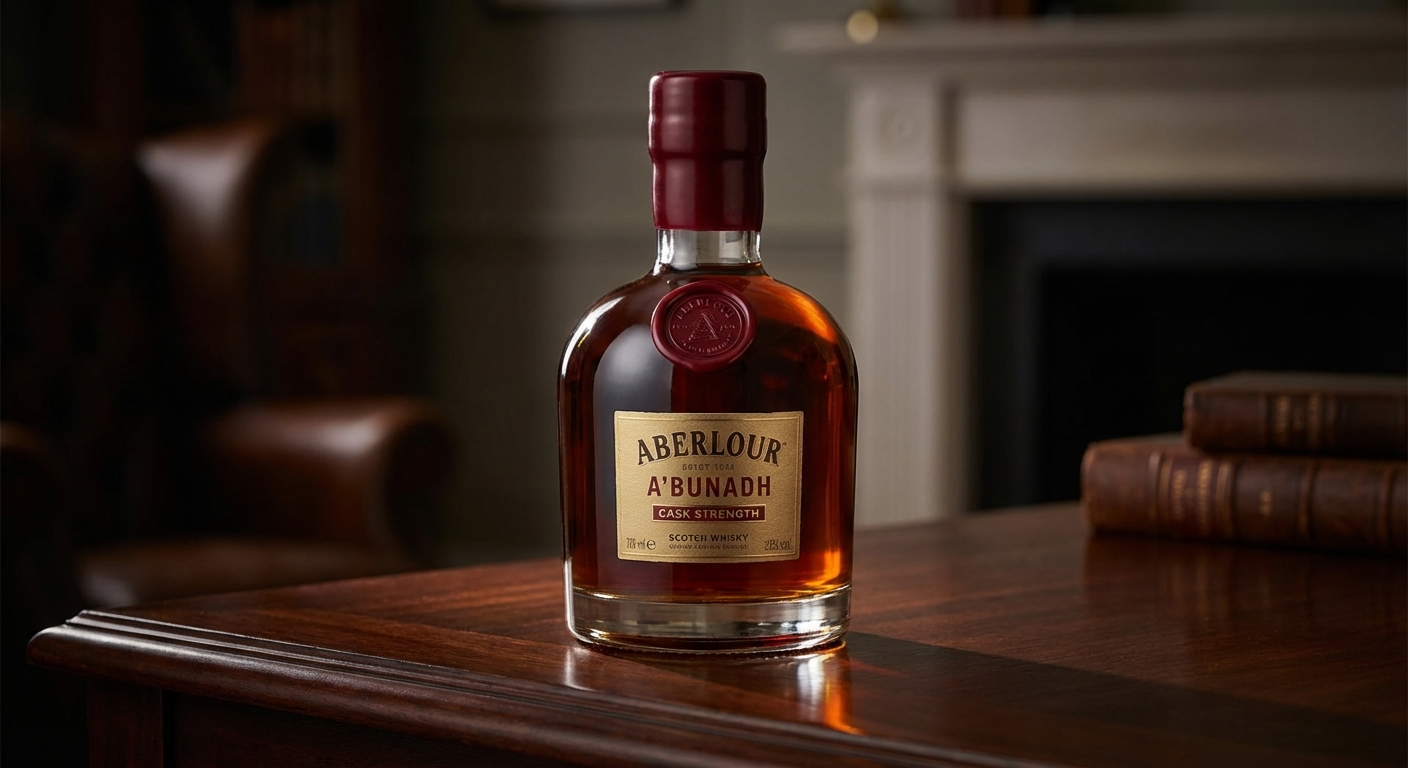
Aberlour A’bunadh has released more than 75 numbered batches since the early 1990s, each bottled at cask strength — typically between 59% and 62% ABV — from first-fill Oloroso sherry casks, with no chill-filtration and no added colour.
Few whiskies have built a collector following quite like Aberlour A’bunadh. It arrives without an age statement, without dilution, and without apology — a raw, unfiltered expression of what Speyside sherry maturation truly tastes like. In this guide you will learn exactly what A’bunadh is, why the batch system makes it a collector’s obsession, how the A’bunadh Alba differs, and which bottles are most sought-after on the secondary market.
A’bunadh (pronounced “a-boon-ah”) is a Scots Gaelic phrase meaning “of the origin” — and that name tells you everything about the philosophy behind the whisky.
This is Aberlour stripped back to its roots: no age statement, no dilution, no chill-filtration, no artificial colour. What you get in the bottle is exactly what came out of the cask.
Aberlour launched the A’bunadh expression to create something that reflected the distillery’s sherry heritage in the most direct possible way. Rather than blending to a consistent age or proof, each batch is assembled from first-fill Oloroso sherry casks and bottled at whatever strength those casks have yielded — typically between 59% and 62% ABV.
Non-age-statement (NAS) whisky often draws scepticism from collectors. The concern is that producers use NAS labelling to pass off younger spirit without accountability.
A’bunadh turns that assumption on its head. The distillery’s decision to drop the age statement here was never about cost-cutting — it was about freedom. Freedom to select casks purely on quality and flavour, not because they hit an arbitrary number of years.
The result is a whisky where every batch tells a different story. Some lean richer and darker; others show more dried fruit lift or spice. That variation is the point.
A’bunadh matures exclusively in first-fill Oloroso sherry casks — not sherry-seasoned, not ex-bourbon with a sherry finish, but dedicated sherry casks used for the very first time with whisky.
First-fill casks impart the deepest, most immediate flavour transfer. The wood has not yet given up its best to a previous spirit, so every year in cask draws out concentrated dried fruit, dark chocolate, Christmas spice and that distinctive rancio richness associated with serious sherry maturation.
This is the same tradition that made Aberlour’s distillery famous long before A’bunadh existed — and A’bunadh is its fullest expression.
Aberlour sits at the heart of Speyside, one of Scotland’s most celebrated whisky regions, and its history stretches back nearly 200 years.
The distillery was founded in 1879 by James Fleming, a local farmer and entrepreneur who recognised the exceptional quality of the local water and grain. It stands at the confluence of the Lour Burn and the River Spey, near the village of Charlestown of Aberlour on the slopes of Ben Rinnes.
The name Aberlour itself derives from the Gaelic “Obar Lobhair” — “mouth of the chattering burn” — referencing the Lour Burn that flows beside the distillery. The water used in production comes from local springs, renowned for their softness and purity, which give the spirit its characteristically approachable, rounded base.
The distillery has changed hands several times over its history. By 1975 it came under the ownership of Pernod Ricard, which merged it with Chivas Brothers in 2001. Today Aberlour sits within one of the world’s largest spirits portfolios — but the distillery itself retains its traditional character and remains a working, producing distillery in the classic Speyside mould.
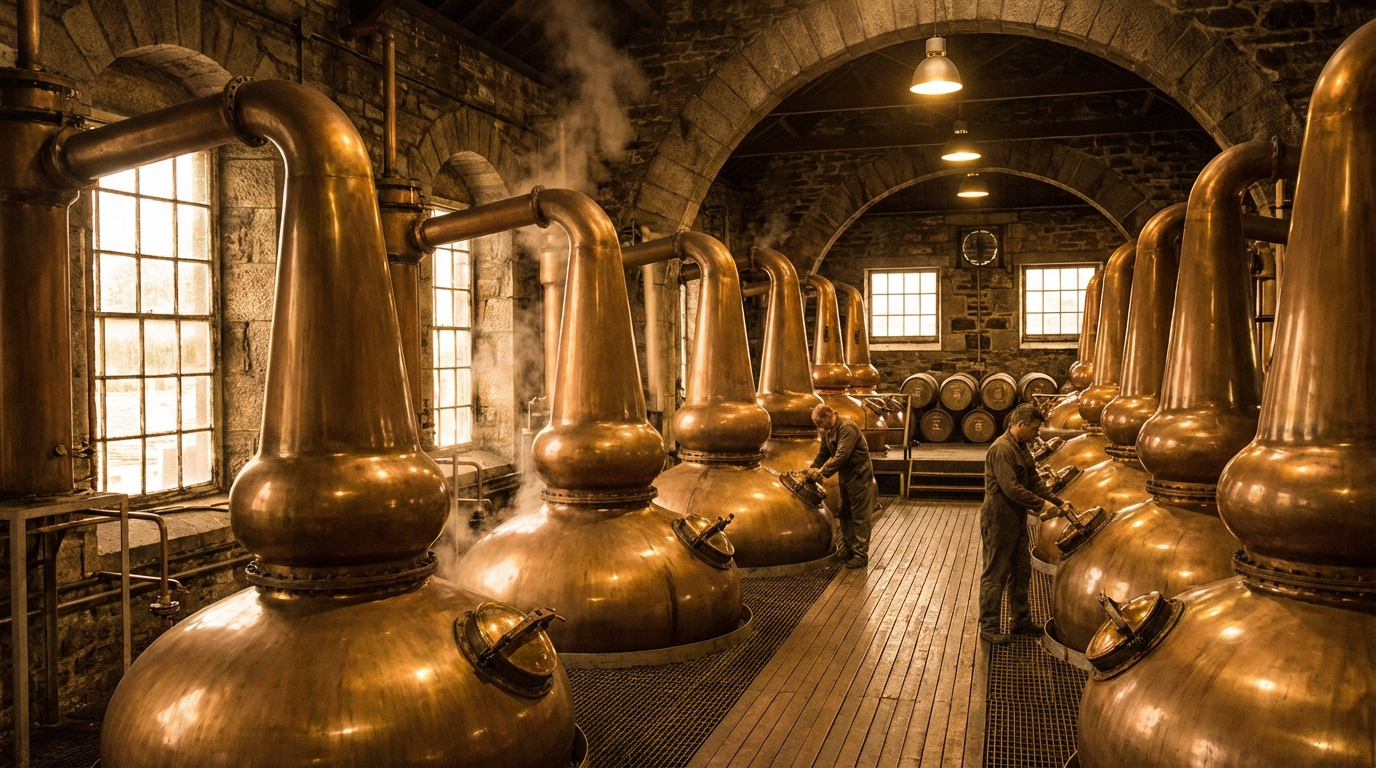
Aberlour operates four pot stills — two wash stills and two spirit stills — with a combined annual production capacity of approximately 3.9 million litres of pure alcohol. That scale puts it firmly among the larger Speyside operations, capable of supporting an extensive maturation programme across both bourbon and sherry casks.
By 2014, Aberlour was selling over 3.5 million bottles per year globally, making it one of the most commercially significant single malts in the world — even if its profile in collector circles is built on A’bunadh rather than its core range.
Long before A’bunadh, Aberlour was known for sherry cask maturation. The distillery’s 12 Year Old Double Cask and 18 Year Old expressions both lean heavily on sherry influence, and that institutional knowledge — knowing which casks to select, how long to mature, when to bottle — is what makes A’bunadh possible.
The distillery maintains a dedicated stock of first-fill Oloroso casks sourced from sherry bodegas in Jerez, Spain. These casks are central to the A’bunadh programme and represent a significant ongoing investment in quality.
Most whisky on the market is engineered for consistency. A’bunadh is engineered for character — and that distinction makes all the difference.
The mainstream whisky production model optimises for a stable, repeatable product: consistent ABV, consistent colour, consistent flavour profile. That means diluting to a standard strength, adding caramel colouring where needed, and chill-filtering to prevent haze at lower temperatures.
A’bunadh does none of these things.
Chill-filtration removes certain fatty acids and esters from spirit to prevent it from going cloudy when cold or when water is added. It also removes some of the flavour compounds responsible for mouthfeel and complexity.
A’bunadh skips this process entirely. The result is a whisky with a heavier, more textured body — one that may turn slightly cloudy when water is added, but which retains every molecule of flavour the cask has contributed. Collectors and serious drinkers consider non-chill-filtration a quality marker, not a compromise.
Many Scotch whiskies use a small amount of E150a caramel colouring to standardise appearance across batches. A’bunadh contains no added colour whatsoever.
This means the deep mahogany and ruby hues in each batch are entirely natural — drawn from years of contact with Oloroso sherry casks. It also means colour varies slightly from batch to batch, another form of authentic variation that collectors have come to appreciate and document.
Here’s the deal: Most whiskies are reduced with water to between 40% and 46% ABV before bottling. A’bunadh goes into the bottle at whatever strength it emerged from the cask — typically 59–62%. That extra alcohol is not just a number; it carries aromatic compounds that evaporate at lower strengths and delivers a viscosity and weight that cannot be replicated at standard bottling strength.
Drinking A’bunadh at full cask strength is an intense experience. Adding a few drops of water opens it up dramatically, releasing secondary and tertiary aromas that would otherwise be overwhelmed by the alcohol. This interactivity — the ability to control your own experience — is part of what makes cask strength collecting so engaging.
The distinction between first-fill and refill casks is critical in understanding why A’bunadh tastes the way it does. A first-fill sherry cask is being used for the very first time to mature whisky — the wood is still saturated with the residues of Oloroso sherry, and that influence transfers rapidly and deeply into the spirit.
Refill casks have already given up their most intense flavour contribution to a previous fill. They contribute subtler, more integrated wood character. A’bunadh’s exclusive use of first-fill casks gives it an intensity and richness that is rare among commercial single malts at any price.
The batch system is what transforms A’bunadh from an excellent whisky into a collector’s obsession.
Every release carries a sequential batch number — Batch 1, Batch 2, and so on — printed on the label and on the box. Each batch is assembled from a different selection of first-fill Oloroso sherry casks from different years of fill. The specific casks chosen, their age, their individual character, and the precise point at which they were deemed ready all vary.
No two first-fill sherry casks are identical. Even casks filled on the same day in the same warehouse will develop differently over time — affected by their position in the warehouse, the specific characteristics of the wood, and the idiosyncrasies of the sherry that previously occupied them.
When the master blender assembles a new batch of A’bunadh, they are selecting from a living inventory of maturing casks, each at a different stage of development. The goal is not to replicate the previous batch exactly, but to produce the best possible expression of the A’bunadh character from what is available.
Because A’bunadh is bottled at cask strength without dilution, the ABV varies from batch to batch depending on how the selected casks have evaporated over time. Typical bottling strengths fall between 59% and 62% ABV, though batches have come in slightly above and below this range.
Here is a representative illustration of how ABV has varied:
| Batch Range | Typical ABV | General Character |
|---|---|---|
| Batches 1–20 | 59.9–61.2% | Rich, dense sherry; collector rarities |
| Batches 21–40 | 59.6–61.8% | Refined, balanced; excellent entry points |
| Batches 41–60 | 60.1–62.1% | Bold, expressive; high collector interest |
| Batches 61–75+ | 59.8–61.4% | Current releases; strong secondary values |
ABV figures are indicative; check the specific batch label for exact strength.
Serious A’bunadh collectors maintain records of every batch they have tried, noting ABV, colour depth, nose, palate and finish. Online communities on platforms like Whiskybase and dedicated forums have catalogued dozens of batches with community ratings and tasting notes.
Certain batches acquire cult status — driven by unusually high ABV, outstanding community scores, or simply the fact that they were produced in limited quantity during a particular year. These batches command premiums on the secondary market that can be multiples of the original retail price.
Aberlour releases new batches of A’bunadh several times a year, though without a fixed schedule. As of 2026, the series has passed Batch 75, making it one of the longest-running numbered cask strength series in the industry.
Each new batch is typically available through specialist retailers for a period of weeks to months before selling through. Older batches, once sold out at retail, move entirely onto the secondary market — where supply is finite and demand from collectors continues to grow.
In 2019, Aberlour introduced a second expression under the A’bunadh name — A’bunadh Alba — and it is fundamentally different in character from the original.
“Alba” is the Scottish Gaelic word for Scotland itself. But where the name suggests a continuation of the original’s philosophy, the maturation tells a different story.
The original A’bunadh matures exclusively in first-fill Oloroso sherry casks. A’bunadh Alba matures in ex-bourbon barrels.
This is not a minor variation — it produces an entirely different flavour profile. Where the original delivers dried fruit, dark chocolate, Christmas cake and warming spice, A’bunadh Alba offers vanilla, coconut, orchard fruit, and a lighter, more open sweetness characteristic of American oak maturation.
Both are bottled at cask strength and without chill-filtration. A’bunadh Alba typically bottles around 57% ABV, slightly lower than the original’s typical range.
The original A’bunadh is for those who want sherry influence at full intensity. If your reference points are Glenfarclas 105, the Glenfarclas Family Casks, or the darker expressions from Speyside, the original is your natural home.
A’bunadh Alba suits those who prefer the bourbon cask style at cask strength — lighter in body, more approachable in some ways, but no less powerful in terms of ABV. It occupies a different space from the original rather than competing with it directly.
From a collecting standpoint, the original A’bunadh has the longer history, the deeper community of dedicated collectors, and the greater depth of secondary market data. Older batches of the original carry stronger secondary premiums.
That said, A’bunadh Alba is still a relatively young series. Its earlier batches are already appreciating as collectors recognise that the bourbon-style cask strength series has its own collector following. If you are building a collection today, both lines merit serious consideration — and tracking both series from the beginning is sound long-term strategy.
The early batches of A’bunadh are now genuinely rare. When a Batch 1 or Batch 5 appears at auction, it generates serious competition.
The A’bunadh series launched in the early 1990s when demand for cask strength single malts was a fraction of what it is today. Early batches were produced in relatively modest quantities, and most were consumed rather than collected. Pristine examples in original packaging with intact seals are scarce.
Several batches have acquired strong reputations across collector communities:
Batches 1–10 carry historical significance as the foundation of the series. Any bottle from this range in good condition commands a significant premium — not just for the liquid, but for provenance.
Batch 38 is frequently cited by tasting communities as one of the strongest releases in terms of sherry integration and balance. It was bottled at approximately 61.2% ABV and received notably high scores across multiple review platforms.
Batch 46 drew attention for its unusually deep colour and dense dried fruit character — a batch where the first-fill cask selection produced something exceptional.
Batch 60 marked a milestone in the series and was noted by reviewers for its combination of classic sherry richness and exceptional length on the palate.
Batches 70+ represent current and near-current releases. While they have not yet had time to appreciate significantly on the secondary market, the most recent batches with scores above 90 points on community platforms tend to sell out quickly at retail and command modest premiums when they do appear secondhand.
Now:
As a general orientation: early batches (1–20) in excellent condition regularly appear at auction in the £150–£350+ range depending on condition and provenance. Mid-series batches (30–60) with strong community scores trade between £80–£180. Current releases at retail sit in the £55–£75 range depending on retailer.
Disclaimer: secondary market prices are indicative estimates based on publicly available auction data. Prices change frequently — always verify current rates with a specialist retailer before making purchasing decisions. These figures do not constitute a formal valuation.
These figures shift with broader collector market conditions. Understanding what makes a whisky bottle valuable — condition, rarity, provenance, and community reputation — will help you assess any specific A’bunadh bottle accurately.
If you have A’bunadh bottles and are uncertain what they are worth, a free valuation is the most reliable first step.
Building an A’bunadh collection is one of the most accessible entry points into serious whisky collecting — the series is still in active production, prices are relatively approachable, and the collector community is large and well-documented.
Here is how to approach it strategically.
Start with the most recent two or three batches. Buy at least two bottles of each — one to open and explore, one to hold sealed. Current releases are at retail price, carry no secondary premium, and give you an immediate education in what A’bunadh tastes like at full strength.
Tasting your way through current batches also gives you the contextual knowledge to assess older batches intelligently. You will develop a sense for batch variation, for what a well-integrated sherry cask contributes, and for the ABV variations that define different releases.
Batches that have received consistent community scores above 88 points on platforms like Whiskybase represent the sweet spot for value collecting. They are old enough to be out of retail circulation but not yet in the price tier of the earliest batches.
Look for batches in the 30–60 range at specialist retailers and reputable auction platforms. Condition is critical — check the fill level (above shoulder is ideal), the seal integrity, and the label condition before purchasing.
Batches 1–20 are collector pieces in the truest sense. Before spending serious money on these bottles, educate yourself on authentication: what the original packaging looked like, how labels were printed across different production periods, and what fill levels are typical for bottles of a given age.
Glenbotal’s private collector network is a valuable source for verified earlier batches — bottles sourced with traceable provenance from serious collections, not anonymous auction lots of uncertain history.
Pro Tip: Never buy an early A’bunadh batch from an unknown seller without confirming the fill level and seal condition in photographs. A bottle that has been stored poorly can lose significant volume through evaporation, reducing both quality and value.
Keep records of every A’bunadh bottle you acquire: batch number, ABV, purchase date, source, price paid, and your own tasting notes if you open one. This documentation becomes your collection’s value record and supports any future insurance or resale needs.
The ultimate whisky collecting guide covers record-keeping, storage, and the full spectrum of collector strategy in greater depth.
A’bunadh occupies a specific niche: Speyside, sherry-dominant, cask strength, with a track record spanning decades. How does it compare to the other major cask strength NAS series?
Glenfarclas 105 is the other great Speyside sherry cask strength single malt, and the comparison between the two is one of the most enduring debates in collector circles. Read our deep dive on the Glenfarclas Family Casks for full context.
The key differences: Glenfarclas 105 is a permanent, consistent expression bottled at exactly 60% ABV with no batch variation. It is more predictable but less collectible in the batch sense. A’bunadh varies batch to batch, creating the variation and rarity dynamics that drive collector interest.
Glenfarclas 105 is older in concept (first released in 1968) and has a longer commercial history. A’bunadh has the deeper collector community and more active secondary market for specific releases.
Springbank Cask Strength is a very different proposition: lightly peated, Campbeltown-distilled, with a more saline and coastal character entirely distinct from Speyside sherry influence. It is released in batches with similarly strong collector following.
Where A’bunadh is rich, fruit-forward and warming, Springbank Cask Strength tends toward complexity, brine, and a broader flavour range that reflects the distillery’s uniquely traditional production methods. The two series attract overlapping but distinct collector communities.
The Bruichladdich Black Art series is the whisky world’s most deliberately mysterious cask strength release. The master distiller does not reveal the cask types, ages or maturation details for any Black Art edition — the recipe is genuinely unknown.
Black Art releases are rarer (typically one per year), more expensive at retail, and command steeper secondary premiums. They attract collectors who value the mystique and the unconventional.
A’bunadh, by contrast, is transparent about its production: sherry casks, cask strength, no chill-filtration. Its collector appeal comes from batch variation and depth of community documentation, not mystery.
The Laphroaig Cairdeas series occupies a completely different flavour territory — heavily peated, Islay-style, released annually for members of the Friends of Laphroaig loyalty programme.
Cairdeas changes cask type and character each year rather than maintaining a consistent production style. It rewards loyalty programme membership and annual vigilance. A’bunadh rewards batch-tracking and the deeper knowledge that comes from comparing dozens of releases across years.
The practical summary: A’bunadh is the definitive choice if your preference is sherry-forward Speyside at cask strength. For peat lovers, Cairdeas. For mystique and rarity, Black Art. For Campbeltown tradition, Springbank. These series do not compete — they serve different collector priorities.
“A’bunadh” is a Scots Gaelic phrase meaning “of the origin” — a name chosen to reflect the whisky’s back-to-basics philosophy of no dilution, no chill-filtration, no artificial colour, and no age statement. It is pronounced “a-boon-ah.”
A’bunadh is bottled at cask strength because the distillery’s intention is to deliver the whisky exactly as it emerged from the cask, without any reduction with water. Cask strength bottling preserves aromatic compounds and textural weight that would be lost through dilution, giving the whisky a power and complexity unavailable at standard 40–46% ABV.
Each batch of A’bunadh is assembled from a new selection of first-fill Oloroso sherry casks. The master blender chooses casks deemed ready at the time of production, resulting in a slightly different ABV, colour and flavour profile for each release. Batches are numbered sequentially and released several times a year without a fixed schedule.
As of 2026, Aberlour has released more than 75 numbered batches of A’bunadh since the series launched in the early 1990s. This makes it one of the longest-running numbered batch series in Scotch whisky. Aberlour has not publicly confirmed an exact batch count at any given time, and new batches continue to be released regularly.
A’bunadh varies by batch since it is bottled at cask strength without dilution. The typical range is approximately 59% to 62% ABV, though some batches have fallen slightly outside this range. A’bunadh Alba, the bourbon-cask variant, typically bottles around 57% ABV. Always check the specific bottle label for the exact figure.
The original A’bunadh matures in first-fill Oloroso sherry casks, producing a rich, dark, fruit-forward profile with notes of dried fruits, dark chocolate and warming spice. A’bunadh Alba matures in ex-bourbon barrels, producing a lighter, more vanilla and orchard-fruit-driven character. Both are bottled at cask strength without chill-filtration. They are distinct expressions rather than variants of the same recipe.
The most current batch is the ideal starting point for anyone new to the series — it is available at retail price without any secondary premium and delivers the full A’bunadh experience authentically. After tasting the current batch, comparing it against one or two mid-series batches (in the 40–60 range) from a specialist retailer is the most effective way to understand how batch variation works in practice.
Generally yes, though batch reputation matters as much as age. The earliest batches (1–20) command the strongest premiums due to rarity and historical significance. Mid-series batches with high community scores also carry premiums. Not all older batches are equally sought-after — condition, provenance and community consensus all influence secondary market value. See our guide on what makes a whisky bottle valuable for the full picture.
For a collector, yes — buying sealed bottles of current releases at retail is one of the most accessible ways to build a cask strength collection that has genuine long-term interest. Each batch is a distinct product rather than a repeat of the same bottle, so a run of five or ten consecutive batches represents meaningful breadth of coverage. Holding sealed batches in appropriate storage conditions while tracking community scores is a sound collecting strategy.
Current batches are available from specialist whisky retailers. Older and mid-series batches can be found through whisky auction platforms, private collector networks, and specialist shops such as Glenbotal that source directly from private collections across the UK and Europe. Glenbotal offers free valuations on A’bunadh bottles and can advise on which batches are currently available and at what price.
Aberlour A’bunadh is the rare whisky series that rewards both the drinker and the collector in equal measure.
It is approachable enough to open and enjoy — add a few drops of water, let it breathe, and it delivers one of the finest sherry-matured Speyside experiences available at any price. It is also complex enough, varied enough, and historically rich enough to sustain a serious collecting practice across dozens of numbered batches.
The series has been running for over thirty years. It has produced more than 75 batches, each a distinct snapshot of a particular selection of first-fill Oloroso casks. The early batches are genuinely rare; the middle batches carry documented reputations built by a global community of collectors; the current batches are accessible entry points into a collection that only deepens with time.
If you are serious about building a rare Scotch collection, A’bunadh belongs in it — not as a novelty, but as a cornerstone.
Browse the current selection of Aberlour A’bunadh batches at Glenbotal — sourced from private collectors across the UK and Europe, with free valuations available on any bottles you already hold. See the full A’bunadh collection at Glenbotal or Get Started with a free valuation on bottles you already own.
Explore the full collection at Glenbotal — rare whisky sourced from private collectors across the UK and Europe.