
Seven distilleries. Seven sherry cask finishes. One programme that has been quietly setting the standard for double-matured Scotch since the mid-1990s.
This guide covers everything worth knowing about the Diageo Distillers Edition series — from the mechanics of double maturation to the collector dynamics that make certain vintage releases genuinely hard to find. If you follow annual special releases, study Classic Malts, or are building a collection around consistently excellent single malt, this is the programme that deserves your full attention.
The Distillers Edition is Diageo’s annual series of double-matured single malts, each drawn from the Classic Malts range and finished in a specific fortified wine cask chosen to complement — not mask — the distillery’s core character.
The Classic Malts of Scotland were assembled by United Distillers (predecessor to Diageo) in 1988 as a curated portfolio representing the breadth of Scotch whisky’s regional styles. Lagavulin for Islay peat, Talisker for the maritime drama of Skye, Cragganmore for Speyside elegance, Glenkinchie for the lighter lowland grain, Oban for the West Highlands, and Dalwhinnie for the high-altitude cold of the Grampians. Later, Caol Ila joined the programme as an extension of the Islay representation.
The Distillers Edition takes each of these benchmark expressions and gives them a second act.
After the whisky reaches its standard maturation point, it is transferred into casks that previously held a specific category of sherry or fortified wine. This finishing period — typically running from several months to over a year, depending on the vintage and the master distiller’s assessment — adds a second layer of flavour that interacts with the distillery’s existing profile.
Most cask-finished whiskies on the market are produced opportunistically: distillers acquire interesting casks, finish a batch, and release whatever results. The Distillers Edition operates differently.
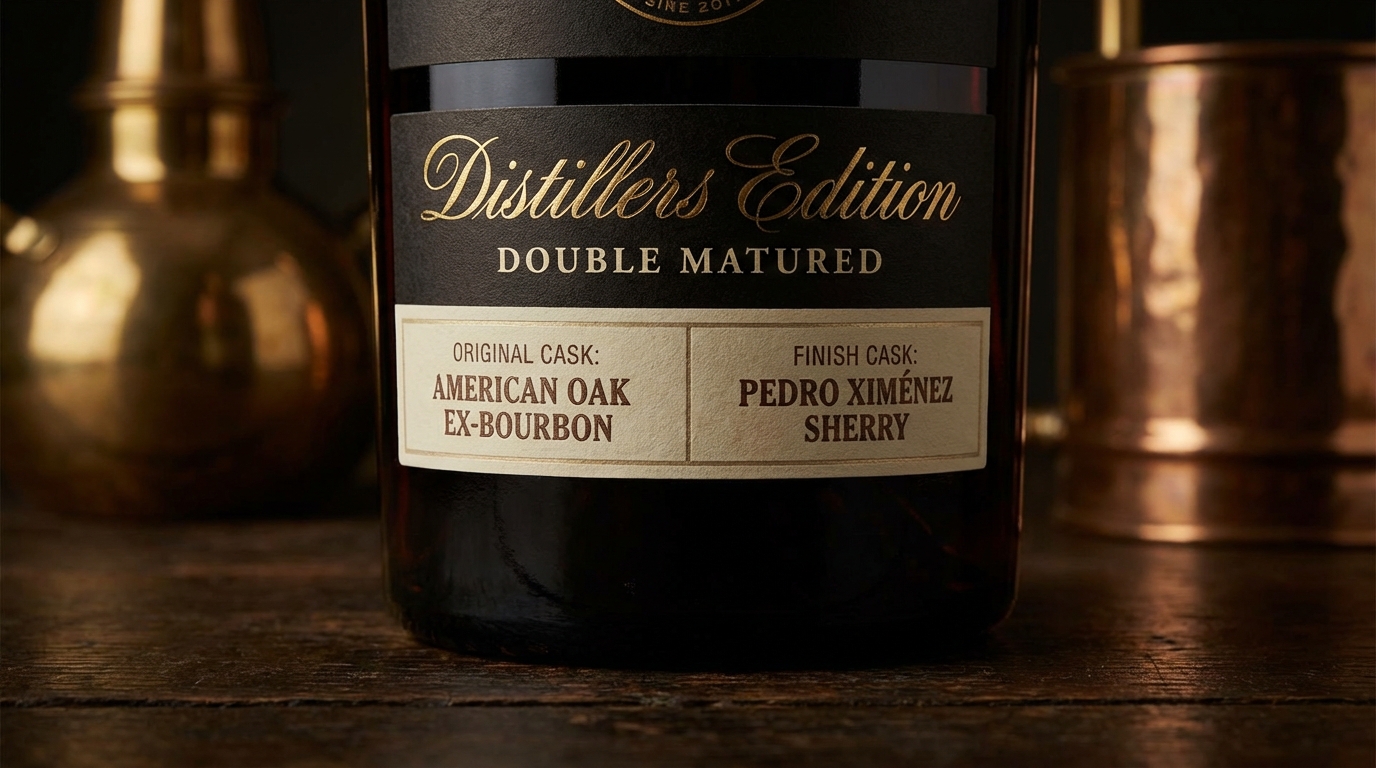
Each pairing is fixed and non-negotiable. Lagavulin always finishes in Pedro Ximénez. Talisker always finishes in Amoroso. Dalwhinnie always finishes in Oloroso. These are standing assignments, refined over decades of production, not seasonal experiments. That consistency is precisely what makes the series so useful for collectors: you know what you are getting from each distillery, and the variation between years reflects the natural differences in the base spirit, not changes in the finishing policy.
The Distillers Edition sits between the standard age-statement expressions and the rarer, higher-priced Diageo Special Releases. It is priced for regular enjoyment but produced in small enough quantities that older vintages become genuinely scarce. For the collector who wants a programme they can follow annually — buying to drink some and hold others — few series offer the same combination of consistency, pedigree, and accessible entry points.
Double maturation, sometimes called cask finishing, is the process of transferring a maturing whisky from its primary cask into a second cask — usually one that previously held a fortified wine or spirit — for an additional period before bottling.
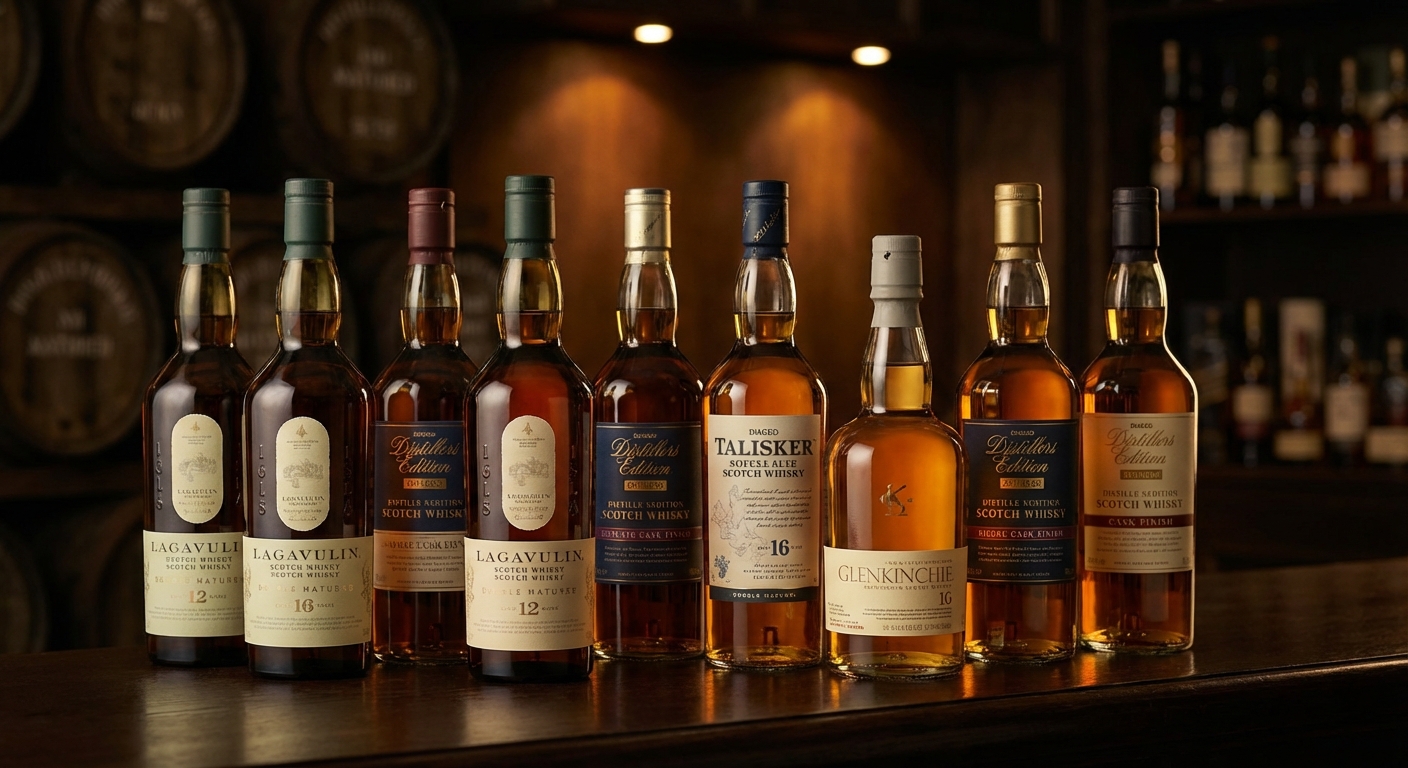
The science is straightforward but the craft is nuanced. Whisky is a living thing in wood: the liquid contracts and expands with temperature, drawing compounds from the cask walls with each cycle. A first-fill cask contributes the most flavour, a refill cask less, and a third-fill cask less still. When a whisky is moved into a finishing cask, it encounters a new set of wood compounds plus the residual wine or spirit left behind in the cask’s pores — a combination that begins to transform the spirit’s character almost immediately.
The specific cask type matters enormously. Pedro Ximénez sherry is the darkest, richest, most intensively sweet of the sherry styles — dense with dried fruit, molasses, and coffee. Oloroso is drier, nuttier, and more oxidative. Amoroso falls between the two: a sweetened Oloroso with more dried-fruit character than a straight Oloroso but less intensity than PX. Amontillado is lighter still, with nutty, hazelnut notes and a savoury edge. Montilla wine, from the Montilla-Morales region of southern Spain, is technically not a sherry at all — it comes from the Pedro Ximénez grape but is not from the Jerez appellation — and contributes a wine-forward, sometimes slightly grapey sweetness. Moscatel, the sweetest of the light sherries, adds floral, honeyed notes quite distinct from the heavier PX style.
The Distillers Edition uses all six of these cask styles across its seven expressions.
Here’s the deal: finishing is not about adding flavour on top of the spirit. At its best, finishing is an act of amplification and resolution.
The ideal finish takes something that was already there in embryonic form and brings it forward.
When PX sherry meets Lagavulin peat, the smoke does not soften — it deepens. The tar and seaweed notes become richer, more complex, wrapped in something dark and sweet. The same dynamic explains why Talisker’s black pepper and brine work so well with Amoroso’s dried fruit and salt: the cask does not moderate the spirit’s character, it completes it. When a finish is chosen badly — or when a spirit is left too long in the finishing cask — the result is a whisky that tastes like it is wearing someone else’s clothes. The Distillers Edition, over thirty years of production, has largely avoided that trap.
The finishing period for the Distillers Edition is typically shorter than many collectors assume — often six months to a year rather than the multi-year finishes sometimes used elsewhere in the industry. The brevity is intentional: it preserves the distillery character that makes each expression recognisable.
The Distillers Edition programme currently spans seven distilleries, each paired with a specific cask finish that has remained consistent across the series’ history.
Here is each expression in full detail.
Lagavulin is the undisputed centrepiece of the Distillers Edition range. The standard 16 Year Old is already among the most celebrated whiskies in Scotland; the Distillers Edition takes it to a different register entirely.
The cask: Pedro Ximénez sherry casks, the richest and most intensively sweet in the sherry spectrum.
Bottling strength: 43% ABV.
What the standard expression brings: Lagavulin 16 is famous for its enormous peat smoke — a billowing, medicinal, seaweed-and-iodine profile built on a body of dried fruit and dark chocolate that accumulates over sixteen years in American and European oak. It is one of the heaviest, most complex standard malts on the market.
How the PX finish changes the character: The Pedro Ximénez cask does not soften the peat — if anything, the smoke becomes more confident. What the finish adds is depth and sweetness beneath it: dark raisins, figs, coffee, and a syrupy richness that extends the finish considerably. The interaction between high-intensity peat and high-intensity sweet sherry produces something that shouldn’t work on paper but is magnificent in the glass. The finish lingers for several minutes, cycling through smoke, dried fruit, and the faintest hint of espresso.
Tasting profile: On the nose, tidal peat and coal smoke give way to dark Christmas cake and molasses. The palate delivers waves of seaweed, smoked meat, raisins, and prune syrup. The finish is extraordinarily long — warming, sweet, and still smoking at the very end.
For collectors interested in the Lagavulin Distillers Edition specifically, we have a dedicated deep-dive at /blog/lagavulin-distillers-edition.
Talisker from the Isle of Skye is one of the most instantly recognisable single malts in Scotland — all volcanic peat, maritime brine, and the distinctive black pepper explosion that arrives at the end of every sip. The Distillers Edition finishes it in Amoroso sherry casks.
The cask: Amoroso is a sweetened Oloroso sherry — darker and richer than Fino or Amontillado but less intensely sweet than PX. It contributes dried stone fruit, dark chocolate, and a soft, rounded sweetness.
Bottling strength: 45.8% ABV.
What the standard expression brings: Talisker 10 Year Old leads with sea salt, kelp, smoked fish, and the signature pepper note that makes it one of the most distinctive whiskies in the Classic Malts range. At 45.8% it has presence and weight.
How the Amoroso finish changes the character: The maritime edge is preserved but the Amoroso adds a layer of warm dried fruit — dates and dark plum — that sits between the brine and the pepper, creating a mid-palate bridge that the standard expression lacks. The finish extends considerably, with the pepper and brine now resolving into something almost warming and jammy. This is a richer, more layered version of Talisker without losing any of the characteristics that make the distillery distinctive.
Tasting profile: Nose: sea spray, smoked fish, and dried apricots. Palate: sea salt, dark plum, and building black pepper. Finish: long, warming, with the pepper note persisting through a layer of sweet dark fruit.
Cragganmore is perhaps the least discussed of the Classic Malts externally, yet among blenders and whisky professionals it has historically been regarded as the most complex Speyside in the range. The Distillers Edition finishes it in port wine casks.
The cask: Port pipes, the tall, torpedo-shaped casks used in port production, contribute deep red fruit character — raspberry, blackcurrant, cherry — along with a gentle tannin and wine note absent from sherry casks.
Bottling strength: 40% ABV.
What the standard expression brings: Cragganmore 12 Year Old is floral and honeyed, with apple blossom, malt, and a slightly smoky, almost herbal quality. It is light but precise — a whisky that rewards attention.
How the port finish changes the character: Port casks bring red fruit — raspberries and dark cherry — that transforms Cragganmore’s gentle profile without overwhelming it. The floral notes remain, but they now sit against a backdrop of dark berry jam and a faint wine-like acidity. The result is arguably the most approachable and food-friendly expression in the Distillers Edition range. At 40% ABV it is lighter than some of its siblings, but the port influence ensures the finish has colour and depth.
Tasting profile: Nose: wildflower honey, green apple, and fresh raspberry. Palate: malt, fruit cake, and dark cherry. Finish: medium length with lingering red fruit and a gentle tannic dryness.
Glenkinchie is the Lowland representative in the Classic Malts — a lighter, more delicate style that was historically underestimated but has earned significant respect among those who understand what Lowland whisky can achieve. The Distillers Edition finishes it in Amontillado sherry casks.
The cask: Amontillado occupies an interesting position in the sherry spectrum — it begins as a Fino, develops under a layer of yeast called flor, then is allowed to oxidise. The result is a medium-dry sherry with distinctive hazelnut, dried apple, and slightly savoury notes.
Bottling strength: 43% ABV.
What the standard expression brings: Glenkinchie 12 Year Old is grassy, floral, and gently sweet — a distillery character built around light grain and summer meadow rather than the heavier malt profile of Highland or Speyside expressions.
How the Amontillado finish changes the character: Amontillado adds hazelnut, almond, and a dry, almost savoury quality that gives Glenkinchie’s light frame a surprising backbone. The grass and flowers remain but they now sit alongside toasted nuts and dried citrus peel. It is the most cerebral of the Distillers Edition expressions — not the most obviously impressive, but arguably the most thoughtfully constructed.
Tasting profile: Nose: fresh cut grass, dried citrus, and toasted almonds. Palate: barley sugar, hazelnut, and light vanilla cream. Finish: medium, dry, nutty, with a faint herbal fade.
Oban is a fascinating distillery — small, coastal, tucked into a seaside town on the West Highlands, and producing a whisky that sits between the heavier Island malts and the more restrained mainland Highland style. The Distillers Edition finishes it in Montilla wine casks.
The cask: Montilla wine comes from the Montilla-Morales region of southern Spain and is made predominantly from the Pedro Ximénez grape, but unlike Jerez sherry it does not carry the DO Sherry certification. The casks contribute a wine-forward sweetness with grape, dried fig, and a lighter body than true PX sherry.
Bottling strength: 43% ABV.
What the standard expression brings: Oban 14 Year Old has a distinctive profile that blends sea salt, maritime peat (lighter than Islay), heather honey, and dried orange peel. It is a whisky of contrasts — the coast and the hills meeting in a single glass.
How the Montilla finish changes the character: Montilla casks add a layer of dried grape and sweet wine that complements Oban’s heather honey without pushing the sweetness into excess. The maritime character remains, and the finish develops an almost Mediterranean quality — dried figs, a suggestion of almonds, and the sea air from the standard expression now carrying a warm, wine-soaked quality.
Tasting profile: Nose: heather honey, sea salt, and dried fig. Palate: orange marmalade, roasted malt, and a gentle peat smoke. Finish: warming, fruity, with the maritime quality persisting beneath the wine notes.
Dalwhinnie is the highest-altitude and one of the coldest distilleries in Scotland, producing a whisky with a distinctive heather-and-honey character born of the long, slow maturation in its mountain climate. The Distillers Edition finishes it in Oloroso sherry casks.
The cask: Oloroso is a dry, oxidatively aged sherry with pronounced walnut, dried fruit, and a full-bodied richness. Unlike PX, Oloroso casks do not add intense sweetness — they add depth, dried fruit, and a robust, nutty complexity.
Bottling strength: 43% ABV.
What the standard expression brings: Dalwhinnie 15 Year Old is famous for its honey and heather character — soft, light, and deeply floral, with vanilla and a gentle sweetness that comes partly from the clean Highland water and partly from the slow maturation in the mountain cold.
How the Oloroso finish changes the character: Oloroso casks give Dalwhinnie a structural weight it lacks in its standard form. The heather honey now sits alongside dried fruit — sultanas and walnut — and a gentle spice that builds through the finish. The result is the same Dalwhinnie, but more confident: the lightness of the standard expression is replaced by something with genuine body and complexity without losing the floral character that defines the distillery.
Tasting profile: Nose: heather honey, beeswax, and dried sultanas. Palate: malt, walnut, vanilla cream, and building cinnamon spice. Finish: medium-long, warming, with honey and dried fruit persisting.
Caol Ila is the largest distillery on Islay and, despite its production volume, one of the most versatile and interesting. The Distillers Edition finishes it in Moscatel sherry casks — the lightest and most floral of the sherry styles used in the programme.
The cask: Moscatel (or Muscat) casks carry the character of the Muscat grape — light, floral, honeyed, with distinctive orange blossom and white grape notes quite unlike the darker sherry styles.
Bottling strength: 43% ABV.
What the standard expression brings: Caol Ila 12 Year Old is lighter in peat than Lagavulin but no less complex — a medicinal, lemony smoke profile with sea salt, fresh citrus, and a clean, almost mineral quality. It is a more approachable Islay than Lagavulin or Ardbeg while retaining full coastal peat character.
How the Moscatel finish changes the character: Moscatel casks add a delicate sweetness — citrus blossom, light honey, orange peel — that weaves through Caol Ila’s signature lemon-and-smoke profile without masking it. The result is perhaps the most elegant Islay expression in the Distillers Edition range: light peat smoke carrying floral, citrus-sweet notes, the maritime quality intact but softened at the edges. It is the most immediately accessible of the peated expressions and a good entry point for drinkers exploring the range.
Tasting profile: Nose: lemon smoke, sea spray, and orange blossom. Palate: light peat, citrus zest, honeycomb, and white pepper. Finish: medium, clean, with smoke and citrus fading together.
The Distillers Edition was first released in 1997, making it one of the longest-running annual cask-finish programmes in the Scotch whisky industry.
The programme was launched by United Distillers and Vintners (UDV) — the precursor company to Diageo — as a premium companion to the Classic Malts range, which had been introduced in 1988 as the first serious attempt by a major producer to position Scotch whisky as a range of distinct regional styles rather than a monolithic category.
The original Distillers Edition bottlings appeared with vintage dates — both a distillation year and a bottling year — a practice that continues to the present day. This vintage dating system is fundamental to the programme’s identity: it means that no two annual releases are identical, because the base spirit comes from a specific production year, and natural variation between seasons means different batches develop differently in cask.
The first release pairing — Lagavulin PX — set the template that the series would follow. The intention was not to produce an occasional experimental bottling but to establish a permanent, annually refreshed programme where each distillery had a fixed finishing cask and collectors could track the series from year to year.
Now: that decision — committing to a fixed pairing rather than experimenting annually with different casks — is what distinguishes the Distillers Edition from nearly every other cask-finish programme in the industry. Most producers treat finishing as a creative exercise, varying the cask type from release to release. Diageo’s programme makes the consistency itself the point.
When Guinness and Grand Metropolitan merged to form Diageo in 1997, the Classic Malts and the newly launched Distillers Edition became part of one of the world’s largest spirit portfolios. Under Diageo, the programme was formalised and expanded — Caol Ila was added to give the range a second Islay expression and to offer a lighter, more accessible peat alternative to Lagavulin.
The programme has maintained its annual release cycle since inception, with each year’s bottlings typically appearing in the autumn — timed to coincide with the peak whisky buying season and the annual release calendar that collectors follow closely.
Each Distillers Edition bottle carries two years on its label: a distillation year and a bottling year. The distillation year is when the new-make spirit entered cask for its primary maturation. The bottling year is when it was finished and bottled. The gap between the two tells you the total age of the expression, though the label does not present it as a formal age statement in the traditional sense.
This system is important for collectors. A bottle labelled 2006/2021, for instance, was distilled in 2006 and spent fifteen years in primary maturation plus its finishing period before being bottled in 2021. Older distillation years, particularly those from the 1990s and early 2000s, represent significantly more maturation time than current releases — and the whiskies in those bottles show it in ways that are immediately apparent to experienced tasters.
According to Diageo’s own documentation on the Classic Malts range, the Distillers Edition was created to offer whisky drinkers “a deeper experience” of the distillery characters they already knew — not a replacement for the standard expressions but a complementary exploration of what each site could achieve with additional maturation time in a complementary cask.[^1]
[^1]: Diageo plc, Classic Malts programme documentation. www.malts.com.
The Distillers Edition is not a rare whisky programme in the conventional sense — current releases are widely available at retail — but older vintages, particularly those from the first decade of the programme, have become genuinely scarce and command significant premiums at auction.
Please note: whisky values are subject to market fluctuation and past auction performance does not guarantee future returns. This is not financial advice — always verify current market values independently before making any purchasing or investment decisions.
The most collectible Distillers Edition bottles are generally those from the programme’s first ten years — 1997 through 2007 — for several reasons.
First, quantities were smaller in the early years of the programme before it achieved the distribution and demand it now enjoys. Second, these bottles represent significantly older whisky today: a Lagavulin Distillers Edition distilled in 1997 and bottled in 2000 has now been sitting in a bottle for over twenty years, and if stored correctly, represents a piece of programme history that cannot be replicated. Third, the original packaging and labelling from the early releases has a distinctly different aesthetic from current bottlings, which makes them instantly identifiable to collectors and adds to their documentary value.
Among specific vintages, Lagavulin Distillers Edition bottles from the late 1990s and early 2000s consistently attract the highest interest at UK auction houses. Talisker Distillers Edition from the same era follows closely. Caol Ila early releases, partly because the distillery was less prominent in the collector market during that period, can sometimes be found at prices that undervalue their relative age and quality.
The primary market for older Distillers Edition bottles is the specialist secondary market — dedicated whisky auction platforms, private collectors, and specialist retailers like Glenbotal who source from private estates and collections across the UK and Europe.
General wine and spirits auction houses also handle these bottles, though their buyer premiums can be significant. Online auction platforms that specialise in whisky tend to offer better selection and more transparent provenance documentation.
When purchasing older Distillers Edition bottles, condition matters considerably. The two variables to check are fill level (ullage) and label condition. A bottle with significant evaporation — more than a centimetre below the base of the neck — suggests storage conditions that may have compromised quality. Labels with water damage, fading, or separation reduce display value even if the whisky inside is perfectly sound.
For guidance on what gives a bottle its value in the collector market, see our guide at /blog/what-makes-a-whisky-bottle-valuable. For a broader framework on building a collection around annual series like the Distillers Edition, /blog/how-to-start-a-whisky-collection covers which distilleries consistently reward long-term collecting.
The Distillers Edition is not a primary investment vehicle in the way that Macallan Fine & Rare or Springbank limited releases can be. Current retail prices are relatively accessible, and secondary market premiums on recent vintages are modest.
Where the series becomes interesting for the patient collector is in the accumulation of complete vintage runs. A consecutive set of Lagavulin Distillers Edition bottles from, say, 2010 through the present represents not just individual bottles but a documented vertical of the same distillery’s annual output — the kind of curated collection that attracts serious buyer interest and commands a premium significantly above the value of the individual bottles separately.
For a wider perspective on whisky as a collectible asset, our guide at /blog/how-much-is-my-whisky-worth covers the key variables that drive secondary market values, and /blog/vintage-scotch-whisky-guide provides context on how age and provenance affect pricing.
The Distillers Edition and the Diageo Special Releases occupy different positions in Diageo’s portfolio, but they are frequently confused — understanding the difference is essential for anyone building a collection.
The Diageo Special Releases (now rebranded under various names including Prima & Ultima and the annual Special Releases collection) are limited, one-off bottlings of unusual casks — rare old expressions, experimental maturation, or single casks from distilleries that rarely appear at this age. They are released once per year in the autumn and are not renewed: when the bottles are gone, they are gone.
Prices reflect this scarcity. Special Releases typically retail at multiples of the Distillers Edition price and often sell out within hours of release at specialist retailers.
The Distillers Edition is annual, consistent, and deliberately not scarce in the same way. Current releases are designed to be available throughout the year at specialist whisky retailers at broadly stable prices. The programme’s value proposition is depth and consistency, not scarcity.
Here’s the deal: the two series are complementary rather than competitive. The Special Releases offer moments of genuine rarity — whiskies that will never be reproduced — while the Distillers Edition offers a long-term relationship with a distillery’s character, tracked through vintages over years and decades.
The collector who buys both is doing something smart: the Special Releases provide focal points of high value and rarity; the Distillers Edition provides the ongoing programme that keeps the collection active, drinkable, and growing.
Current Distillers Edition releases typically retail between £55 and £90 per bottle at specialist UK retailers, depending on the distillery and vintage. The Lagavulin and Talisker expressions command the highest retail prices, reflecting their overall market demand.
Special Releases from the same distilleries — when they appear — typically begin at £150-£200 and can reach several thousand pounds for the older, rarer expressions.
For a broader look at distilleries whose annual releases consistently reward collecting, see /blog/distilleries-worth-collecting.
The single most common mistake is treating the Distillers Edition as interchangeable with the standard age-statement expressions — buying them as if the finish is a minor variation rather than a meaningfully different whisky.
The Distillers Edition, like all malt whisky, is sensitive to UV light. The darker glass used in recent bottlings provides some protection, but early releases in lighter glass are particularly vulnerable. Sunlight or prolonged fluorescent light exposure over months or years will fade the label and can eventually alter the colour of the whisky visible through the glass — a red flag that reduces both display value and buyer confidence.
Store bottles upright (not on their sides — the high ABV can degrade the cork over time), in a dark environment, at a stable temperature. A dedicated whisky cabinet or cool cellar is ideal.
Many buyers focus on the bottling year — the more recent year on the label — without calculating the total age of the whisky. A bottle bottled in 2023 is not necessarily younger whisky than one bottled in 2019: the distillation year determines how long the spirit was in primary maturation, and older distillation dates mean more time in oak.
When comparing Distillers Edition bottles across vintages, always calculate from the distillation year, not the bottling year.
Some collectors dismiss the Distillers Edition as “just a finish” — implying that the cask treatment is cosmetic rather than substantive. This misreads the programme. The cask pairings in the Distillers Edition have been refined over nearly three decades of annual production. Each pairing has been tested across scores of vintages and adjusted for consistency. The programme has maintained its critical standing throughout that period, with most expressions receiving consistently high scores from independent whisky reviewers.[^2]
[^2]: Whisky Advocate, annual Distillers Edition reviews, various years.
Dismissing it means missing the genuine quality and the genuine collector interest in building a complete vintage run.
Lagavulin and Talisker are the headline expressions in the Distillers Edition range, and for good reason — they are exceptional whiskies. But the collector who focuses exclusively on the peated Islay expressions misses some of the most interesting work in the programme. Cragganmore with port, Glenkinchie with Amontillado, and Dalwhinnie with Oloroso represent subtler, less celebrated expressions that often outperform their reputations in blind tastings and remain significantly more affordable at auction than the Islay bottles.
Completists who acquire all seven expressions annually will find the full range more rewarding — and more valuable as a collection — than a run of any single distillery in isolation.
The Distillers Edition is Diageo’s annual programme of double-matured single malts, each drawn from the Classic Malts range and finished in a specific fortified wine or sherry cask chosen to complement the distillery’s core character. The programme has run since 1997.
Seven distilleries: Lagavulin (Pedro Ximénez finish), Talisker (Amoroso finish), Cragganmore (Port finish), Glenkinchie (Amontillado finish), Oban (Montilla finish), Dalwhinnie (Oloroso finish), and Caol Ila (Moscatel finish).
Double matured means the whisky has undergone two periods of maturation: the primary maturation in standard casks at the distillery, followed by a secondary finishing period in the specific cask type assigned to that distillery — for example, PX sherry casks for Lagavulin.
The first Distillers Edition releases appeared in 1997, launched by United Distillers and Vintners (which became Diageo later that year). The programme has produced annual releases consistently since then, making it one of the longest-running cask-finish programmes in Scotch whisky.
The two dates represent the distillation year (when the spirit entered cask for primary maturation) and the bottling year (when it was finished and bottled). The gap between them gives you the total age of the whisky, though it is not presented as a formal age statement.
Yes. Each distillery has a fixed cask type that does not change from year to year. Lagavulin always uses Pedro Ximénez, Talisker always uses Amoroso, Dalwhinnie always uses Oloroso, and so on. This consistency across decades is one of the defining features of the programme.
Caol Ila Distillers Edition is generally the most accessible entry point into peated whisky in the range. Its Moscatel finish adds floral, citrus, and honeyed notes that complement the lighter peat smoke, producing a whisky that is distinctly Islay in character without the intensity of the Lagavulin expression.
Generally yes, though the premium depends on the distillery and condition. Early releases (1997–2007) from Lagavulin and Talisker command the most significant premiums at UK whisky auction. The additional maturation time that accrues as these bottles age in storage also means the whisky inside continues to develop — though in bottle rather than in wood, so the changes are different from those in cask.
The Distillers Edition is an annual recurring programme with consistent cask pairings — available broadly at stable retail prices. The Special Releases are limited, non-recurring bottlings of unusual or rare casks released once per year. They are significantly more expensive, more scarce, and do not share the vintage-tracking framework that makes the Distillers Edition useful for building a longitudinal collection.
It varies by distillery: Talisker is bottled at 45.8% ABV; Lagavulin, Caol Ila, Dalwhinnie, Oban, and Glenkinchie are bottled at 43% ABV; Cragganmore is bottled at 40% ABV. The expressions are not cask strength, and no water is typically needed for the lower-ABV expressions.
Yes. Caol Ila produces a lighter, more citrus-forward peat style than Lagavulin or Ardbeg — often described as lemon smoke rather than the coal and seaweed profile of the southern Islay distilleries. The Moscatel finish amplifies this citrus quality and adds a floral sweetness, making it the most elegant and arguably most food-friendly peated expression in the Distillers Edition range.
Specialist secondary market retailers — those who source from private collections and estates — are the primary route. Dedicated whisky auction platforms also carry a range of older vintages. When buying older bottles, always verify the fill level, label condition, and provenance documentation before purchasing.
The Diageo Distillers Edition is thirty years of annual proof that cask finishing, done with discipline and consistency, produces something genuinely greater than the sum of its parts.
If you are new to the programme, start with the expression that aligns with what you already know you enjoy: Lagavulin if you love Islay peat, Dalwhinnie if you prefer lighter, honeyed Highlands, Cragganmore if Speyside elegance is your register. Buy the current vintage, drink it alongside the standard expression, and let the comparison tell you what the finish actually contributes.
If you are building a collection, the long game here is clear: a consecutive vintage run of any single distillery’s Distillers Edition bottles — tracked from one distillation year to the next — documents the character of that site over time in a way that few other series allow. Combine that with completist acquisitions of all seven expressions from the same year, and you have a collection that is both drinkable and genuinely rare at the older end.
Next week: see if you can locate a bottle from the early 2000s at auction and compare it to a current release from the same distillery. The difference in depth and integration is the most persuasive argument for this programme that any tasting note could offer.
See How the Distillers Edition collection looks at Glenbotal — rare and older vintages sourced from private collectors across the UK and Europe.
Explore the full collection at Glenbotal — rare whisky sourced from private collectors across the UK and Europe.