
In this guide you will find everything worth knowing about vintage Scotch whisky — what the term actually means, why certain decades produced bottles that now change hands for thousands of pounds, which distilleries define serious collecting, and how to buy safely in a market where provenance matters as much as the liquid itself.
This is Glenbotal’s central resource for the vintage Scotch pillar. Every section links out to deeper dives. Whether you are building a collection, researching a gift, or simply trying to understand what you have inherited, start here.
Let’s get into it.
Vintage in Scotch whisky refers to the year the spirit was distilled — not the year it was bottled.
This is the most important distinction in the entire vocabulary of rare whisky. A bottle labelled “distilled 1975” contains spirit that spent decades in oak before someone decided it was ready. The bottling year is almost incidental. What matters is when the barley, water, and yeast were first combined and the new-make spirit filled the cask.
This is meaningfully different from wine, where “vintage” describes the harvest year of the grape and broadly implies freshness or youth. Whisky does not work that way. A 1975 Macallan bottled in 2010 is a 35-year-old expression — and that long maturation in sherry-seasoned oak is precisely why collectors pursue it.
Here’s the deal: age statements and vintage dates are also not the same thing. An “18-year-old” single malt simply tells you the youngest whisky in the bottle has spent at least 18 years in cask. It says nothing about when that maturation began. A true vintage bottle specifies the distillation year on the label, giving the collector complete traceability from grain to glass.
Why does the distillation year matter so much?
Because conditions change. The barley strains used in 1965 are largely extinct. The style of direct-fired pot stills common in the 1970s has been replaced by far more controllable (but less characterful) indirect steam heating. Many of the worm-tub condensers that produced heavy, sulphury new-make were decommissioned in favour of shell-and-tube condensers. The water sources, the maltings, the cooperage practices — all of these shifted decade by decade. When you acquire a genuine vintage Scotch, you are acquiring a document of a specific historical moment in Scottish distilling.
Not every old whisky is a vintage. Not every vintage is particularly old.
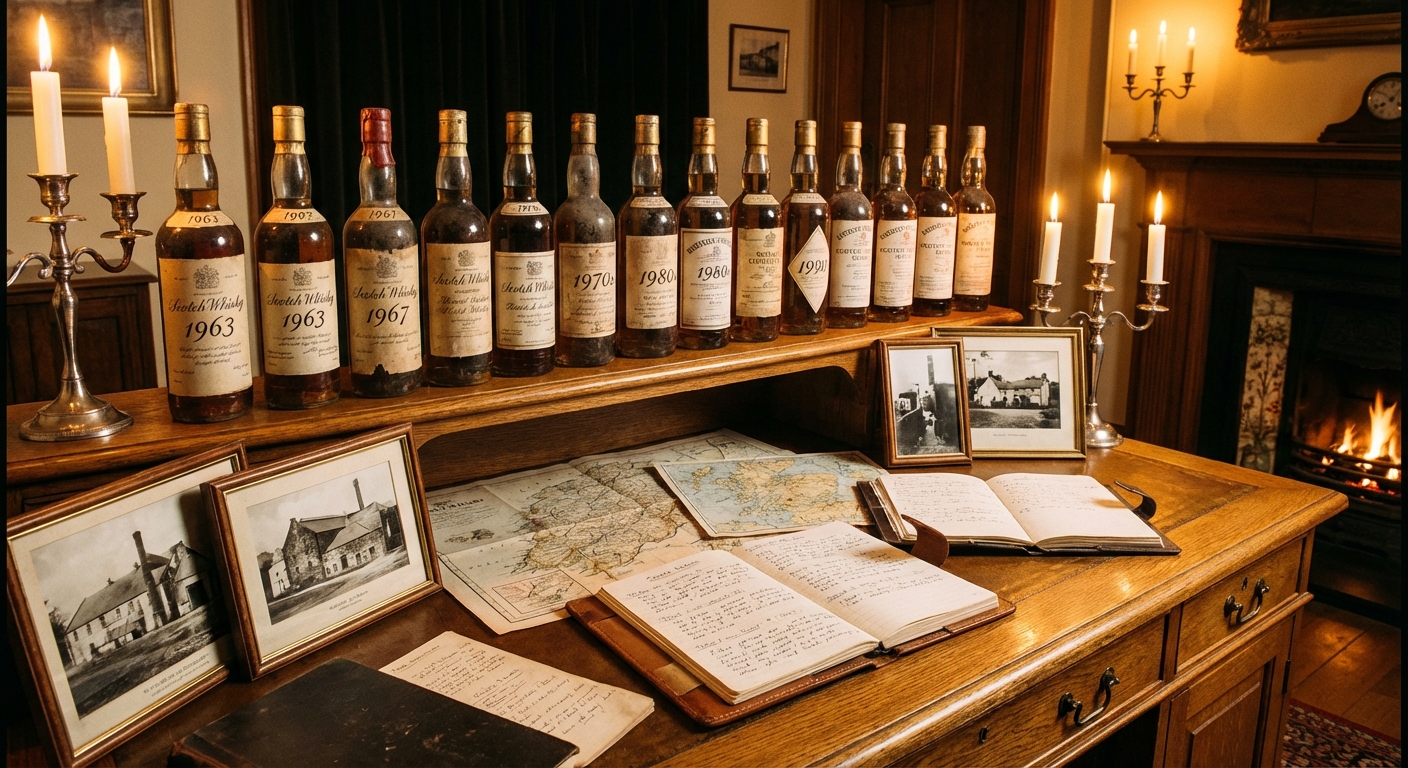
“Old” whisky in the modern market often just means a long-age-statement expression produced at scale — a 25-year-old or 30-year-old released annually by a major distillery, blended to a consistent house style. These are often excellent whiskies. They are not vintage.
A vintage Scotch is a single expression from a specific distillation year, usually drawn from individual casks or very small parcels. It is unrepeatable. When the last bottle from that parcel is sold, it is gone. No amount of money replicates it, because the conditions of 1968 cannot be reproduced.
“Vintage Scotch is as much about what can never exist again as it is about what is in the glass right now.”
This is why serious collectors and investors treat vintage Scotch differently from standard age-statement releases. The scarcity is structural, not artificial. And scarcity, in any market, underpins long-term value.
Whisky values can go down as well as up. The information in this guide is educational and does not constitute financial advice.
The vintage Scotch market has a clear hierarchy of eras. Older is not automatically better — the 1970s, for instance, are widely considered the finest decade for Speyside distilling. But each era has its own character, its own strengths, and its own collector constituency.
Bottles distilled in the 1960s represent the upper ceiling of vintage Scotch collecting. Supply is now extremely thin. Many distilleries from this era operated practices — floor maltings, direct coal firing, worm-tub condensers — that were phased out by the 1980s. The flavour profile is often dramatically different from any modern expression: heavier, more sulphurous, with a waxy, lanolin quality that modern distilling simply does not produce.
The 1960s were also a period of genuine creative freedom in Scottish distilling. Distillery managers had considerable autonomy over fermentation times, still charge sizes, and cask selection. The result was a diversity of character across distilleries that subsequent standardisation has reduced.
For collectors, a genuine 1960s single malt in good condition — correct fill level, intact label, no capsule damage — is a serious acquisition. Entry-level examples from lesser-known distilleries start in the hundreds. Macallan, Highland Park, and Springbank from this era routinely exceed four and five figures at specialist auction.
Ask most serious whisky collectors which decade produced the finest Scotch and the answer is almost always the same: the 1970s.
The 1970s combined the old-fashioned production methods of the 1960s with a period of economic pressure that, counterintuitively, worked in the whisky’s favour. The Scotch whisky industry suffered a significant overproduction crisis in the late 1970s and early 1980s — the so-called “whisky loch” — which meant vast quantities of spirit were laid down in cask and then simply left to mature for far longer than originally intended. Spirit that might have been bottled at 10 or 12 years was instead still sitting in cask at 20, 25, or 30 years old, developing complexity no commercial timeline would have permitted.
The production technology of the 1970s also retained many characteristics that would later disappear. Wooden washbacks, longer fermentation times, and worm-tub condensers were still common across the industry. The new-make character these conditions produced — particularly the heavy, meaty, sulphurous notes that integrate into extraordinary richness over decades — is now largely unobtainable from modern production.
For a deeper look at standout bottles from this period, see our guide to the best vintage whiskies from the 1970s.
The 1980s are, in many respects, the most interesting decade for collectors who want to build a serious collection without automatically paying 1970s prices.
The industry was in recovery from the whisky loch, distilleries were reopening, and production styles were beginning to diversify again. The Scotch Whisky Heritage Centre opened in 1989, signalling a growing consumer interest in the category’s history. Single malt as a distinct consumer proposition — rather than a blender’s raw material — was starting to emerge.
1980s vintages from major distilleries represent excellent value relative to the 1960s and 1970s. They are old enough to carry genuine complexity and historical character, but young enough that supply has not yet become critically thin. Many of the most interesting expressions from this decade are now hitting the 40-year mark — a significant milestone that tends to drive both quality and price.
Explore our guide to the best vintage whiskies from the 1980s for specific recommendations.
The 1990s represent the natural entry point for collectors who are new to vintage Scotch or working with a more modest budget.
This decade saw the consolidation of single malt as a premium consumer category. Major distilleries began investing in their own bottlings rather than selling almost everything to blenders. Quality control improved. The best distilleries of the 1990s produced outstanding spirit — and that spirit, now in its late twenties to mid-thirties, is entering what many consider its prime drinking window.
The 1990s are also the last decade before the global whisky boom of the 2000s dramatically inflated production costs and, in many cases, pushed distilleries toward shorter maturation periods to meet demand. The spirit laid down in the 1990s was produced without any anticipation of the premium market that would emerge for it. That innocence, in a sense, is part of what makes it interesting.
For a broad overview spanning the final years before the millennium, see our pre-millennium Scotch whisky guide.
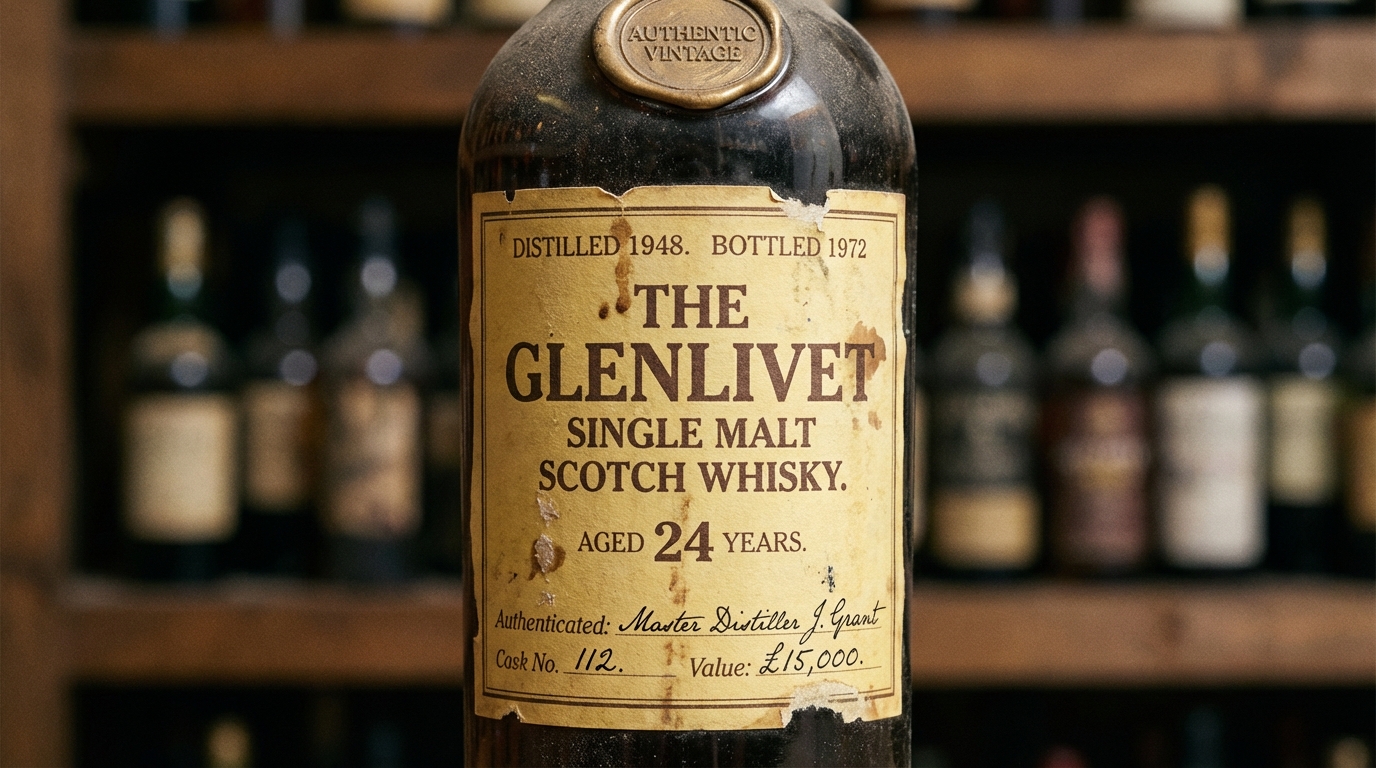
Macallan is the benchmark distillery for vintage Scotch collecting. Its historic expressions — particularly those matured in sherry-seasoned oak from González Byass and other premier bodegas — set the standard for richness, colour, and complexity that the entire category is measured against.
Pre-1990 Macallan, before the distillery shifted away from exclusively sherry-cask maturation, is now in extraordinary demand. The “Easter Elchies” and single cask expressions from the 1970s and 1980s are among the most sought-after bottles at specialist auction worldwide. Even relatively recent vintage releases — the Fine & Rare series, for instance — command significant premiums over standard age-statement expressions.
Springbank in Campbeltown is the contrarian choice that has become the serious collector’s choice. The distillery has never stopped using traditional production methods: floor maltings, direct-fired stills, worm-tub condensers. The result is a house style of profound depth and complexity that is simply unavailable elsewhere.
Vintage Springbank, particularly from the 1960s through the 1980s, is among the most distinctive whisky in existence. Its combination of coastal salinity, peat smoke, fruit, and the characteristic “Campbeltown funk” is entirely unlike anything produced in Speyside or the Highlands. Supply is very limited. Demand from serious collectors continues to grow.
Highland Park from Orkney occupies a unique position in vintage collecting. Its combination of lightly peated malt, heather honey character, and long maturation in high-quality sherry casks produces a style that ages exceptionally well. Vintage expressions from the 1960s and 1970s show a complexity and integration that even excellent modern releases cannot match.
The distillery’s output from the 1970s and 1980s, now available through specialist retailers and auction, consistently outperforms expectations relative to price. For collectors building a geographically diverse vintage collection, Highland Park is essential.
Glen Grant is perhaps the most underappreciated major distillery in the vintage Scotch market. Its historic expressions — particularly those bottled in the 1960s and 1970s for the Italian market, where Glen Grant was for decades the best-selling Scotch — often show extraordinary quality at prices significantly below comparable Macallan or Springbank.
The distillery’s house style leans toward orchard fruit, floral notes, and a clean, precise structure that allows age to add complexity without heaviness. Genuine vintage Glen Grant is a connoisseur’s choice with strong upside as collector awareness grows.
Glenfarclas remains one of the few major distilleries still family-owned, and its commitment to sherry-cask maturation has never wavered. The Family Casks series — annual releases of single casks going back to 1954 — is the most complete vintage archive of any single distillery, offering collectors a continuous record of how the distillery’s spirit has evolved across seven decades.
For a deep dive into this series, see our guide to Glenfarclas Family Casks.
Closed distilleries occupy a category of their own. When a distillery closes, its remaining stock is finite in absolute terms. There is no possibility of future production. Every bottle sold is one fewer in existence. This structural scarcity drives values that, for the most sought-after closed distilleries, have risen consistently for decades.
Port Ellen on Islay closed in 1983 and remains the most prestigious closed distillery in Scotch whisky. Its intensely peated spirit — beach bonfires, iodine, lemon zest — has become the reference point for a style of Islay whisky that no operating distillery currently replicates. Annual releases from Diageo’s Special Releases programme routinely sell out within hours. Single cask expressions at auction regularly exceed £2,000 per bottle, with the rarest examples going considerably higher.
Brora in Sutherland closed in the same year as Port Ellen, 1983, and produces an entirely different style: waxy, coastal, with a particular peat character described as “farmyard” or “heathery” that distinguishes it sharply from Islay peat. Vintage Brora has built a devoted international following among collectors who prize its combination of rarity, distinctiveness, and quality.
Rosebank, a Lowland distillery, closed in 1993 and produced a triple-distilled style of unusual delicacy — floral, grassy, with a light sweetness entirely unlike Highland or Island production. The limited supply of surviving bottles makes genuine Rosebank one of the rarer finds at specialist auction.
Littlemill, also a Lowland distillery, closed in 1994. It is less widely known than Port Ellen or Brora but has developed a strong collector following, particularly for its older expressions bottled in the 1980s and early 1990s. Its light, sometimes unorthodox character is an acquired taste — and one that commands serious premiums once acquired.
The most important rule in buying vintage Scotch is provenance.
Where has the bottle been? Who owned it? Is the fill level consistent with what you would expect for the age? Is the capsule intact? Is the label in the condition that storage history would predict?
For a full breakdown of the authentication process, read our dedicated guide on how to authenticate vintage whisky. The short version:
The following ranges are illustrative, based on specialist retail and auction data as of early 2026. Individual bottles vary significantly based on distillery, condition, fill level, and independent bottler versus official bottling.
Whisky values can go down as well as up. These figures are for reference only and do not constitute financial advice.
| Era | Entry Level | Mid-Range | Collector Tier |
|---|---|---|---|
| 1960s | £400–£800 | £800–£2,500 | £2,500–£10,000+ |
| 1970s | £200–£500 | £500–£1,500 | £1,500–£8,000+ |
| 1980s | £80–£200 | £200–£600 | £600–£3,000+ |
| 1990s | £40–£100 | £100–£300 | £300–£1,500+ |
| Closed distilleries (any era) | £300–£800 | £800–£3,000 | £3,000–£20,000+ |
For a full breakdown of what drives the variation within these ranges, see our guide to what makes a whisky bottle valuable and the companion piece on how much your whisky is worth.
The Rare Whisky 101 index tracks secondary market performance across the category and is the most widely cited benchmark for UK vintage Scotch valuation.
Learn what separates a genuine vintage Scotch from an age-statement release, how distillation year determines character, and why production changes across the decades matter to collectors and drinkers alike. 4 resources.
Explore what made each era of Scotch distilling distinctive — the production methods, the distilleries, and the specific expressions that collectors pursue most actively today. 4 resources.
A bottle distilled in someone’s birth year is among the most personal gifts in existence. These guides help you locate the right bottle, understand milestone age considerations, and navigate the market with confidence. 3 resources.
Whether you have inherited a bottle, built a collection, or want to understand the secondary market, these guides cover the seven factors that drive value, current price ranges by era, and the practical steps for selling rare whisky in the UK. 3 resources.
Long-form resources on the craft, history, and long-term rewards of serious whisky collecting — including an in-depth look at one of Scotland’s most storied single-cask series. 2 resources.
Vintage on a whisky label refers to the distillation year — the year the spirit was made and first filled into cask. It is not the bottling year. A bottle labelled “distilled 1978” contains whisky made in 1978, regardless of when it was bottled.
No. “Old” typically refers to how long a whisky has spent in cask, expressed as an age statement. “Vintage” specifies the actual distillation year. A 30-year-old whisky bottled today is old, but it is not vintage in the collector sense. A vintage Scotch provides distillation year provenance.
The 1970s combined traditional production methods — worm-tub condensers, direct-fired stills, long fermentation times — with the unintended benefit of the whisky loch overproduction crisis, which left vast quantities of spirit maturing far longer than planned. The result was exceptional complexity at age that no commercial timeline would have produced deliberately.
Port Ellen and Brora, both closed in 1983, are the most prestigious. Rosebank (closed 1993) and Littlemill (closed 1994) represent the Lowland tier. All four command significant premiums at specialist auction due to the absolute finitude of their remaining stock.
Check fill level, label condition, and capsule integrity. Cross-reference with verified auction records showing comparable bottles. Buy from specialist retailers or established auction houses with reputational accountability. Our full authentication guide covers the process in detail.
Entry-level examples from less prominent distilleries typically range from £200 to £500. Mid-range collector bottles — good distilleries, good condition — sit between £500 and £1,500. Premium expressions from Macallan, Springbank, or Highland Park from this era routinely exceed £2,000. Whisky values can go down as well as up.
Rare vintage Scotch has shown strong long-term secondary market performance, tracked by indices such as the Rare Whisky 101 benchmark. However, no investment in collectible assets is guaranteed. Values fluctuate with market conditions, collector trends, and global economic factors. Whisky values can go down as well as up. This is not financial advice.
An official bottling comes from the distillery itself. An independent bottling — from companies such as Gordon & MacPhail, Berry Bros & Rudd, or Signatory — is produced by a third party that purchased casks from the distillery. Both can be outstanding. Independent bottlings from the 1960s and 1970s are highly collectible and often represent the only surviving examples of spirit from distilleries that have since closed.
Store bottles upright (unlike wine, cork-sealed spirit bottles should not be stored on their side as the high alcohol content degrades the cork). Keep in a cool, dark environment away from direct light and temperature fluctuations. Do not open collector bottles unless you intend to consume them — once opened, secondary market value is lost.
Specialist retailers with established provenance networks, and dedicated whisky auction platforms. Glenbotal sources directly from private collectors across the UK and Europe, with full provenance documentation on every bottle. See the current collection.
The angel’s share is the spirit that evaporates through the cask walls during maturation — typically 2–3% per year in Scotland. This applies only to cask maturation, not to sealed bottles. Unusual ullage (low fill level) in a sealed bottle suggests storage problems and is a red flag when buying vintage Scotch.
Both options are valid depending on your priorities. Drinking a fine vintage Scotch is, after all, what it was made for — and a great 1970s Springbank or Highland Park is an extraordinary experience. But if the bottle has significant collector or resale value, opening it eliminates that secondary market value entirely. Decide before you buy which purpose the bottle is serving.
Vintage Scotch whisky is one of the few collectible categories where authenticity, scarcity, and genuine sensory quality intersect. The bottles produced in Scotland’s golden decades of the 1960s and 1970s are not simply old — they are the products of production methods, materials, and conditions that no longer exist. That irreversibility is what drives sustained collector interest, and it is what distinguishes serious vintage Scotch from the broader spirits market.
Whether you are taking your first steps into vintage collecting, looking for an exceptional birth year gift, or trying to understand what a cellar inheritance might be worth, the resources in this collection are the starting point. Each guide goes deeper into its specific topic. Every internal link leads somewhere useful.
Start with what matters most to you — a specific decade, a specific distillery, or a specific question about value — and follow the thread from there. The collection at Glenbotal is sourced directly from private collectors across the UK and Europe. Get Started — browse the current collection and get in touch if you have a specific bottle in mind.
Explore the full collection at Glenbotal — rare whisky sourced from private collectors across the UK and Europe.