
This guide covers the 1980s as a collecting era — the closed distilleries, the surviving expressions, and the bottles that serious collectors are still tracking down today. If you’re looking for a whisky bottled in someone’s birth year from the 1980s, see our Best Birth Year Whiskies from the 1980s guide instead.
The 1980s produced some of the finest Scotch whisky ever made — and most of it was never intended to be this rare. A perfect storm of overproduction, industry collapse, and permanent distillery closures transformed an ordinary decade of distilling into one of the most finite collecting eras in whisky history. Finding a genuine 1980s vintage expression today, from a closed distillery, in good condition, at a fair price, is the kind of thing that takes years of patience or the right specialist contact. After six years sourcing rare bottles from private collectors across the UK and Europe, Glenbotal has assembled a perspective on what’s still findable — and what’s worth acquiring now, before the window narrows further.
The story of 1980s Scotch begins not with excellence, but with crisis.
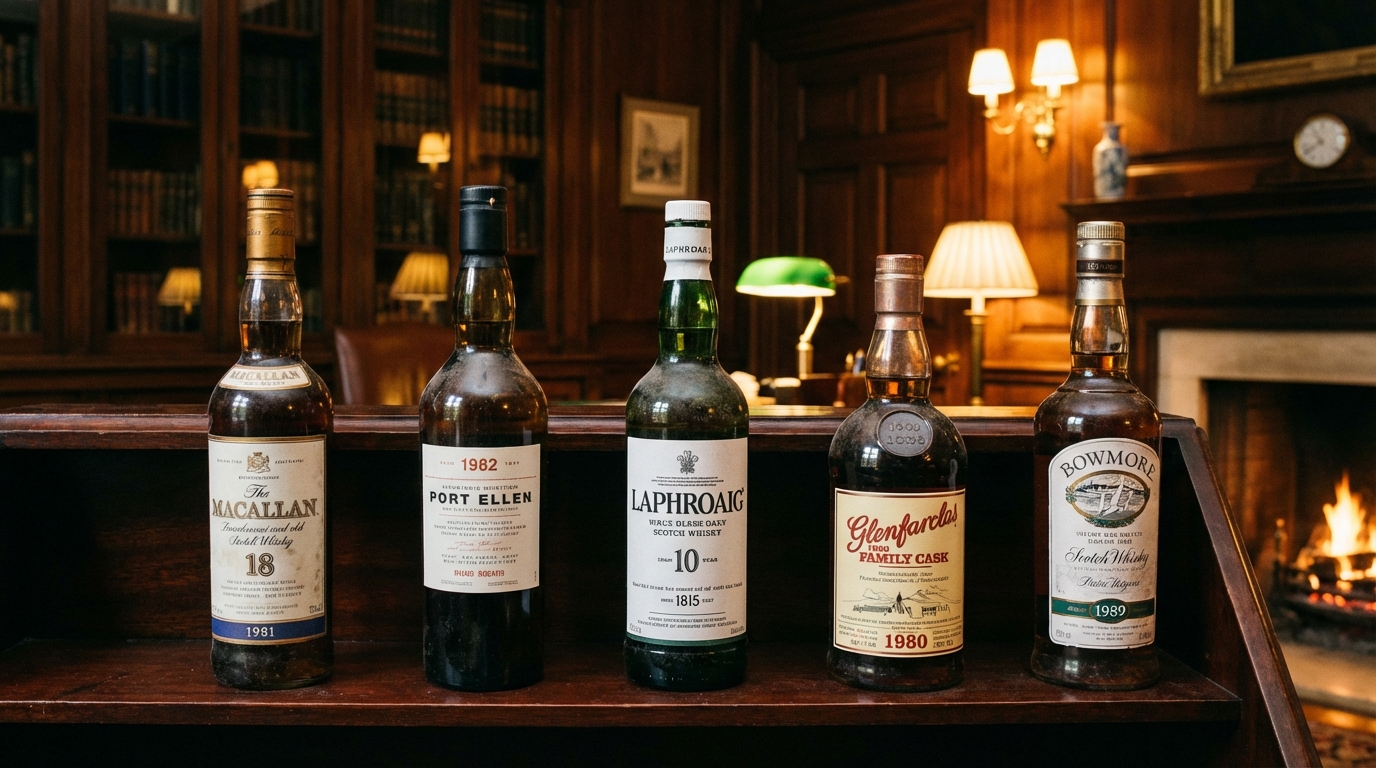
The whisky loch changed everything. Starting in 1981, a decade of overproduction caught up with the industry. Distilleries had been filling casks throughout the 1970s boom, confident demand would absorb everything. It didn’t. The result was a catastrophic surplus — warehouses bloated with maturing stock, prices collapsing, and buyers disappearing. By the mid-1980s, the industry had slashed output by a third, and sixteen distilleries had been mothballed, shut down, or demolished entirely.[^1]
That list includes names that now command extraordinary prices at auction: Port Ellen (closed 1983), Brora (closed 1983), Banff, Dallas Dhu, Convalmore, Glen Albyn, and Glenlochy among them. At the time, closure felt like failure. In retrospect, it marked the end of their production runs permanently — and every bottle that survived in private hands became finite the moment those doors closed.
Here’s the point collectors often miss: whisky distilled in the 1980s and bottled by independent houses over the following two to three decades represented an era of quiet, unhurried maturation. The industry wasn’t thinking about collectibility. Casks were filled with excellent spirit, left undisturbed in traditional dunnage warehouses, and released at ages of 12, 15, 18, or 21 years — mostly to a specialist audience that didn’t yet know what it had.
Forty years on, that spirit is gone. The casks have been emptied. The distilleries that produced it are silent. What remains in private cellars and specialist retail is the last of a finite supply — and it shrinks a little more each year.
The 1980s also coincided with a shift in the industry’s approach to wood maturation. The widespread use of ex-sherry butts from Spanish cooperages was at its peak. Many expressions from this decade carry a depth and complexity of sherry influence that is simply not replicable today, partly because the economics and sourcing of quality sherry wood have changed dramatically since then.
For the vintage Scotch whisky collector, the 1980s sit in a particular sweet spot: old enough to carry genuine complexity and historical weight, accessible enough that bottles occasionally still surface through specialist retailers and private collector networks, and scarce enough that the window for acquiring them at reasonable prices is clearly closing.
The expressions in this guide were selected against four criteria.
Genuine 1980s provenance. Every bottle here was either distilled during the 1980s or represents a style and expression synonymous with that decade’s production. We are not including expressions merely bottled in the 1980s without clear vintage credentials.
Availability. There is little value in listing expressions that exist only in auction catalogues at prices beyond most collectors. We have focused on expressions that specialist retailers do find — and that serious collectors can realistically acquire with patience and the right sourcing relationships.
Collecting significance. We prioritised expressions from closed distilleries, limited independent bottlings, and single-cask releases that represent genuine pieces of whisky history. Each entry includes context on why this particular bottle matters — not just what it tastes like.
Value at price point. The 1980s spans a wide spectrum — from entry-level independently bottled Speysides to five-figure closed distillery expressions. We have covered that range honestly, including where the genuine value lies and where premiums are speculative.
| Expression | Distillery Status | Typical Price Range | Best For | Rarity Level |
|---|---|---|---|---|
| Port Ellen 1980 (various bottlings) | Closed 1983 | £800–£5,000+ | Serious collectors | Extreme |
| Brora 1981–1983 | Closed 1983 | £600–£4,000+ | Highland enthusiasts | Extreme |
| Macallan 1980s Sherry Wood | Operating | £200–£800 | Approachable entry | High |
| Glenfarclas Family Casks 1980s | Operating | £300–£1,200 | Single cask depth | High |
| Dalmore 1980s Edition | Operating | £150–£250 | Entry-level rarity | Medium-High |
| Glen Nevis 1980s | Various | £200–£300 | Hidden gem hunting | Medium |
| Allt-A-Bhainne 1985 Old Malt Cask | Operating | £200–£300 | Speyside value | Medium |
| Gordon & MacPhail 1980s Speyside | Various | £150–£600 | Independent bottling depth | High |
Prices shown are indicative ranges based on specialist retail and auction data as of early 2026. Actual prices vary by bottle condition, provenance, and market conditions. Always verify current prices with a specialist before buying or selling. Rare whisky is not a regulated investment and results may vary.
Port Ellen from the early 1980s is, without question, the most significant closed-distillery expression the 1980s produced — and one of the most coveted bottles in all of Scotch whisky collecting.
The distillery on Islay’s south coast closed in 1983, part of the industry’s painful rationalisation during the whisky loch crisis.[^1] What makes Port Ellen extraordinary is not just the closure — it’s the character of the spirit itself. Heavily peated, maritime, with a signature combination of medicinal smoke, coastal brine, and deep tropical fruit that developed over extended maturation. No other Islay distillery has ever quite replicated it.
Diageo’s annual Port Ellen Special Releases, running from 2001 until they paused ahead of the distillery’s eventual reopening in 2024, introduced many collectors to the expression. But those official releases became harder to find and increasingly expensive with each passing year. Independent bottlings from houses like Gordon & MacPhail, Douglas Laing, Signatory, and Berry Bros & Rudd — filled in the 1980s and released through the late 1990s and 2000s — represent the other major source for genuine Port Ellen from this decade.
What makes it collectible:
Realistic collector expectations:
Best for: Collectors building a serious closed-distillery portfolio, or those seeking the single most historically significant Islay expression of the decade.
Not ideal if: Your budget is under £500 or you’re new to 1980s collecting — there are better starting points below.
Brora’s final years of production — 1981 to 1983 — represent some of the most distinctive whisky ever made on the Scottish mainland, and bottles from this period are among the rarest finds in Highland collecting.
Like Port Ellen, Brora closed in 1983 as part of the same industry contraction.[^2] Also like Port Ellen, it has since reopened — Diageo recommissioned the Sutherland distillery in 2021. But the original-era Brora, produced at the distillery before the four-decade hiatus, carries an entirely different character from the new make. The pre-closure spirit had a particular quality — a waxy, slightly smoky texture with heather, coastal grass, and a subtle maritime edge that distinguished it from other Highland expressions of the era.
What makes early 1980s Brora especially intriguing is the distillery’s production history from the 1970s. Between 1969 and 1973, Brora produced a heavily peated spirit to compensate for an Islay supply shortage during drought conditions. Some of this spirit was still in cask through the early 1980s — meaning bottles from this period can carry a peat character unusual for a Highland distillery, adding another layer of collector interest.
What makes it collectible:
Best for: Collectors focusing on mainland Scottish closed distilleries, or those who want a Highland counterpart to Port Ellen in their collection.
Not ideal if: You’re looking for something below £400 — authentic Brora from the early 1980s commands significant premiums.
For collectors who want a genuine 1980s vintage expression from a legendary operating distillery at a more accessible price point, Macallan’s sherry wood releases from this decade remain one of the most satisfying options on the market.
The Macallan’s relationship with sherry wood maturation in the 1980s was at its height. The distillery was filling almost exclusively into first-fill and second-fill sherry butts — often from Jerez cooperages with which the distillery had long-standing relationships. The resulting spirit, aged for 12 or 18 years and bottled through the 1990s, carried an intensity of dried fruit, Christmas spice, and dark chocolate that is simply not achievable with today’s cask economics.
The Macallan 18 Year Old distilled in 1980 and bottled in 1998, for example, is a genuinely different animal from the current 18-year-old expression — darker, denser, more resinous, with a concentration of sherry influence that reflects the wood quality of that era. Bottles occasionally surface through specialist retailers and at auction, and while prices have risen considerably over the past decade, they remain more accessible than closed-distillery expressions.
What makes it collectible:
Best for: Collectors seeking genuine 1980s Speyside depth from a distillery still in production, with expressions ranging from £200 upwards.
Not ideal if: You’re seeking closed-distillery exclusivity — Macallan’s continued popularity means its history is well-documented and priced accordingly.
Glenfarclas Family Casks represent one of the most ambitious and meticulously documented single-cask collections in the industry — and the 1980s releases within this series are among the most rewarding bottles available to the serious collector.
In 2007, Glenfarclas launched The Family Casks: a collection of single-cask bottlings covering every year from 1952 to 1994, subsequently extended forward. Each release is drawn from a single cask, bottled at cask strength, with the specific cask number and year recorded. The 1980s expressions — covering every year from 1980 to 1989 — offer a decade-by-decade insight into Glenfarclas’s production at a distillery that has remained firmly family-owned and independently operated throughout.
What distinguishes the Glenfarclas Family Casks from many other collector’s series is the transparency and consistency. Every bottle in the range is traceable, every cask is documented, and the distillery’s use of sherry wood throughout this period gives the 1980s expressions a richness and warmth that complements the restrained, elegant house style. Bottles from years such as 1981, 1984, and 1988 have all appeared through specialist channels and represent genuinely compelling single-cask collecting at fair prices relative to their rarity.
For a deeper exploration of this series, see our Glenfarclas Family Casks guide.
What makes it collectible:
Best for: Collectors who want documented provenance, single-cask uniqueness, and the ability to build a coherent 1980s decade collection from a single, trusted distillery.
Not ideal if: You prefer blended expressions or are seeking the cachet of a closed distillery.
The Dalmore 1980s Edition offers collectors a genuine, accessible entry point into 1980s vintage whisky — a distillery-bottled or independently bottled expression that carries the authentic character of the decade without the five-figure price tags.
Dalmore, based on the shores of the Cromarty Firth in the Northern Highlands, has long been associated with richly sherried, multi-cask maturation. Bottles from the 1980s — whether original distillery releases or those bottled by specialist independent houses — typically carry the distillery’s characteristic combination of dark chocolate, orange peel, and dried fruit, shaped by extended maturation in a mix of ex-bourbon and sherry casks.
The Dalmore 1980s Edition that surfaces through specialist retailers tends to be a carefully sourced expression: bottled at standard strength, in good condition, and presenting genuine period character at a price point accessible to collectors building their first 1980s portfolio. Glenbotal has sourced examples in the £150–£250 range — genuinely good value for a Highland expression with four-plus decades of age. See the current stock at glenbotal.co.uk for available expressions.
What makes it collectible:
Best for: Collectors taking their first steps into 1980s vintage whisky, or gifters seeking something historically significant at a manageable budget.
Not ideal if: You need the prestige of a closed distillery or the documented single-cask provenance of the Family Casks range.
Glen Nevis is one of those quietly fascinating entries in the 1980s collector’s lexicon — an expression that rewards the curious buyer who does their research rather than following the crowd.
Glen Nevis bottlings from the 1980s represent a style of Scotch that was entirely characteristic of the era: well-aged, unhurried, bottled at standard strength in classic squat or cylindrical glass with period labelling. The spirit itself carries the hallmarks of 1980s blending and bottling practice — a certain density, a particular vanilla and dried fruit character, and an authenticity that comes from being bottled when the industry was less self-conscious about its products. These bottles were not produced for collectors; they were produced for whisky drinkers. That lack of artifice is precisely what makes them interesting today.
Bottles of Glen Nevis from the 1980s, available in 75cl format at the standard 40% ABV of the era, occasionally surface through specialist retailers at prices in the £200–£300 range. At that price, they offer a genuine piece of whisky history at reasonable cost — and a style of whisky that reflects its era in ways that modern expressions simply cannot.
What makes it collectible:
Best for: Collectors interested in period authenticity and the aesthetics of 1980s whisky culture, or those building a broad vintage portfolio.
Not ideal if: You require the prestige documentation of a named single cask or a distillery with an established collector following.
For collectors seeking a verifiable vintage Speyside expression from 1985 with proper independent bottling credentials, the Allt-A-Bhainne 1985 Old Malt Cask offers exactly that — a 16-year-old single malt distilled in the mid-1980s, bottled by one of the most respected independent houses in the business.
Allt-A-Bhainne (pronounced alt-a-vane) sits in Speyside’s Livet valley and was established relatively recently — 1975 — as a purpose-built distillery supplying spirit for Seagram’s blends. That blending orientation means the distillery has rarely produced high-profile single malts, making independent bottlings like this Old Malt Cask release all the more interesting as collector’s pieces. The whisky itself is characterised by delicate orchard fruit, soft honey, and a gentle spice — a textbook Speyside profile from the mid-1980s, presented at cask strength after careful wood selection.
Old Malt Cask, part of the Douglas Laing portfolio, has a long track record of identifying and bottling quality casks that would otherwise go unnoticed. Finding a 1985 distillation from this house at around £249 represents genuine value for a dated, single-cask, independently bottled Speyside from the decade. Available at glenbotal.co.uk while stock lasts.
What makes it collectible:
Best for: Collectors seeking verifiable 1985 provenance and an independent bottling pedigree at a price point below £300.
Not ideal if: You want the prestige of a major distillery name — Allt-A-Bhainne’s profile is that of an insider’s choice.
Gordon & MacPhail represents the most important single source for 1980s vintage Scotch outside of distillery-bottled expressions — and their Speyside selections from this decade offer depth, variety, and impeccable provenance.
Founded in Elgin in 1895, Gordon & MacPhail has been filling and ageing casks for longer than most whisky collectors have been alive.[^3] Their approach — filling casks directly from the still, then maturing them at their own warehouses in Elgin — means that G&M bottlings from the 1980s represent a genuinely different proposition from either official distillery releases or most other independent bottlers. These casks were selected at the source, aged under careful supervision, and bottled when the whisky was judged ready.
G&M’s 1980s Speyside expressions — from distilleries including Longmorn, Linkwood, Strathisla, Glen Grant, and others — carry the characteristic depth of long sherried maturation from the era: dense, resinous, packed with dried fruit, dark spice, and a complexity that comes from genuine age rather than clever wood finishing. Some of these expressions are bottled at the venerable 40% ABV of the era; others, from later releases of 1980s-distilled casks, come at full cask strength with documented cask numbers.
What makes it collectible:
Best for: Collectors who understand independent bottling and want to explore the breadth of 1980s Speyside at every price point.
Not ideal if: You’re new to independent bottlings and prefer the familiarity of a single, famous distillery name.
The honest answer is: not easily, and not through mainstream retail.
The major supermarkets and off-licences don’t carry 1980s vintage expressions. Online marketplaces occasionally list bottles, but provenance verification is a serious concern — bottle condition, fill level, seal integrity, and storage history all significantly affect both value and drinkability. The risk of buying an improperly stored or misrepresented bottle without specialist knowledge is real.
The most reliable sources are:
Specialist retailers with private collector networks. Retailers who actively source from private collections — not just wholesale — have access to bottles that never appear at mainstream auction. Glenbotal sources from private collectors across the UK and Europe, which means 1980s expressions occasionally appear in stock that wouldn’t be available elsewhere. Browse the current collection at glenbotal.co.uk and use the free bottle valuation service if you’re assessing what you already own.
Established whisky auction houses. Scotch Whisky Auctions, Whisky Auctioneer, and McTear’s all regularly list 1980s expressions. Prices are transparent, and legitimate bottles are listed with photography and condition notes. The trade-off is that auction prices for sought-after expressions have risen sharply in recent years.
Private collector networks. The most interesting bottles often move through collector communities before they reach retail. Building relationships in the collector world — through specialist events, forums, and trusted retailers — is the long-term route to finding the best 1980s expressions at fair prices.
For a broader overview of where and how to source vintage Scotch, see our vintage Scotch whisky guide and ultimate whisky collecting guide.
The 1980s produced whisky during an era of industry crisis — and that crisis is precisely what makes the surviving bottles so extraordinary. Sixteen distilleries closed. Warehouses that had been filled with excellent spirit were left to mature quietly for decades while the industry contracted around them. What emerged, bottled by independent houses and sold to a relatively small specialist audience, was a body of whisky that the industry itself didn’t fully appreciate at the time.
That window of relative accessibility has largely closed. Port Ellen and Brora now command prices that reflect their true historical significance. The best independent bottlings of 1980s Speyside — Longmorn, Linkwood, Strathisla — are being quietly absorbed into private collections. The Glenfarclas Family Casks 1980s range grows harder to source with each passing year.
If you’re building a serious whisky collection, the 1980s deserve a place in it. Not because the prices are cheap — they’re not — but because this decade represents a finite chapter in Scotch whisky history that is still, just about, accessible to collectors who know where to look.
Glenbotal sources from private collections across the UK and Europe, which means 1980s expressions do appear in our inventory — sometimes at prices that reflect a private collector sale rather than auction market rates. See How we source rare whisky — and browse the full collection at glenbotal.co.uk or get in touch for a free valuation if you’re selling bottles from this era.
The 1980s were defined by the whisky loch crisis — a period of severe overproduction followed by industry contraction that permanently closed sixteen distilleries. Spirit distilled during this decade was aged quietly for years and bottled by independent houses before collector demand reached today’s levels. The combination of closed distilleries, discontinued styles of sherry wood maturation, and declining supply makes genuine 1980s expressions some of the most historically significant bottles in Scottish whisky history.
The two most significant are Port Ellen (Islay, closed 1983) and Brora (Sutherland, closed 1983), both now reopened but with their pre-closure spirit representing a categorically different product. Other closed distilleries whose 1980s spirit occasionally surfaces include Banff, Convalmore, Dallas Dhu, Glen Albyn, Glenesk, Glenlochy, Glen Mhor, Glenugie, Millburn, North Port, and St Magdalene — though bottles from these are significantly rarer and harder to verify.
Prices span an enormous range. Entry-level independently bottled Speyside expressions from lesser-known distilleries can be found in the £150–£300 range. Better-known distilleries like Macallan and Glenfarclas Family Casks typically start around £200–£400 and rise considerably for prime years and casks. Port Ellen and Brora from the 1980s command £600–£5,000+ depending on bottling, condition, and provenance. Official Diageo Special Releases of closed distilleries regularly exceed five figures at specialist auction.
It is not too late, but the window is narrowing. Bottles are still surfacing through specialist retailers, private collector sales, and whisky auction houses. The most accessible price points — independently bottled Speyside and Highland expressions — are still findable at reasonable prices. What has changed is the cost of the most prestigious expressions: Port Ellen and Brora prices have roughly doubled over the past decade. The time to act is now, not later.
Official Diageo Port Ellen Special Releases — particularly the early annual releases from the 2001–2015 period — regularly achieve the highest prices, with standout lots exceeding £4,000–£8,000 at auction. Among independently bottled expressions, old Brora and Port Ellen casks from respected houses like Gordon & MacPhail, Douglas Laing, and Signatory represent the most coveted finds. Glenfarclas Family Casks from prime years (1981, 1984, 1988) are also highly regarded.
Original bottlings (OB) were released directly by the distillery — either at the time or in subsequent years from casks they retained. Independent bottlings (IB) were produced by third-party houses — Gordon & MacPhail, Berry Bros & Rudd, Douglas Laing, Signatory — who either purchased casks directly from distilleries or aged their own fills. Both are genuine; the key difference is cask selection, wood policy, and bottling strength. IBs often represent single casks at cask strength, providing more unique flavour profiles and sometimes more transparent provenance.
Verification involves several factors: label authenticity (typography, wording, and distillery details consistent with the period), fill level (natural evaporation over decades should show some ullage), seal condition (original cork or stopper, intact capsule), and storage evidence (temperature-stable, away from light). For high-value expressions, provenance documentation from a known specialist retailer or auction house with a clear chain of ownership is essential. Glenbotal offers free bottle valuations — use this service before any significant purchase or sale. See our whisky valuation guide for the full process.
The best value in the £150–£350 range currently lies in independently bottled Speyside expressions from lesser-known distilleries: Allt-A-Bhainne, Linkwood, Longmorn, Strathisla, and similar. Gordon & MacPhail’s broader range regularly features 1980s-distilled expressions at these price points. The Glen Nevis 1980s Edition and Dalmore 1980s Edition also represent accessible entry points into the decade without the closed-distillery premiums.
Not categorically — but the 1980s carry a set of qualities that are harder to replicate. The sherry wood maturation of the decade was at its peak, using first-fill butts from traditional Spanish cooperages in ways that the industry moved away from in the 1990s. The closed distilleries (Port Ellen, Brora, and others) give the decade an irreplaceable set of expressions. That said, the 1990s produced excellent spirit too — and at lower price points than the 1980s today. For collectors, the 1980s represent greater historical significance; for drinkers, the 1990s may offer better value per dram.
The most reliable sources are specialist retailers with established private collector networks, reputable whisky auction houses (Scotch Whisky Auctions, Whisky Auctioneer), and curated independent bottler back-catalogues. Glenbotal sources 1980s expressions directly from private collectors across the UK and Europe — meaning bottles appear in stock that aren’t available through mainstream retail channels. Browse the current collection at glenbotal.co.uk for available 1980s vintage expressions.
Focus on closed distilleries (Port Ellen, Brora), single cask expressions with documented cask numbers, and bottles in original pristine condition with full fill levels. Independent bottlings from established houses (Gordon & MacPhail, Douglas Laing) carry better documentation and secondary market liquidity than lesser-known bottlers. Always buy from a specialist with a clear return policy and provenance documentation. For a full breakdown of value factors, see our how much is my whisky worth guide.
[^1]: Scotch Whisky Association / Wikipedia — 16 distilleries closed during the whisky loch crisis beginning 1981.
[^2]: Brora Distillery Wikipedia — Brora ceased production in early 1983 and reopened in 2021 after a 38-year closure.
[^3]: Gordon & MacPhail, established Elgin 1895 — one of the longest-operating independent whisky bottlers in Scotland.
Explore the full collection at Glenbotal — rare whisky sourced from private collectors across the UK and Europe.