
Most lists tell you what to buy. This one tells you what actually exists — and where it still can be found.
Finding a birth year whisky from the 1960s isn’t just difficult — it borders on the extraordinary. Bottles distilled over six decades ago have filtered through generations of collectors, private cellars, and auction houses, and the truly special examples rarely appear on open shelves. Yet for anyone born in the 1960s — or buying a gift for someone who was — there is nothing quite like presenting a whisky that has been quietly ageing since the year of their birth.
At Glenbotal, we have spent six years building a private collector network spanning the UK and Europe specifically to source bottles like these. We have handled thousands of rare expressions and maintain over 100 verified Trustpilot reviews from collectors and gifters who have found exactly what they were looking for. Here is what we know about the finest 1960s birth year whiskies that can still be found today — and what to look for when you search.
The 1960s represent a golden era for Scotch whisky production. Scotland’s distilleries were running at capacity during this period, supplying a global blended whisky market at the height of its commercial boom. The irony is that most of the exceptional single malt whisky being made at the time was destined for blending vats — which means the small proportion that was retained as single malt and has survived to today is genuinely extraordinary.
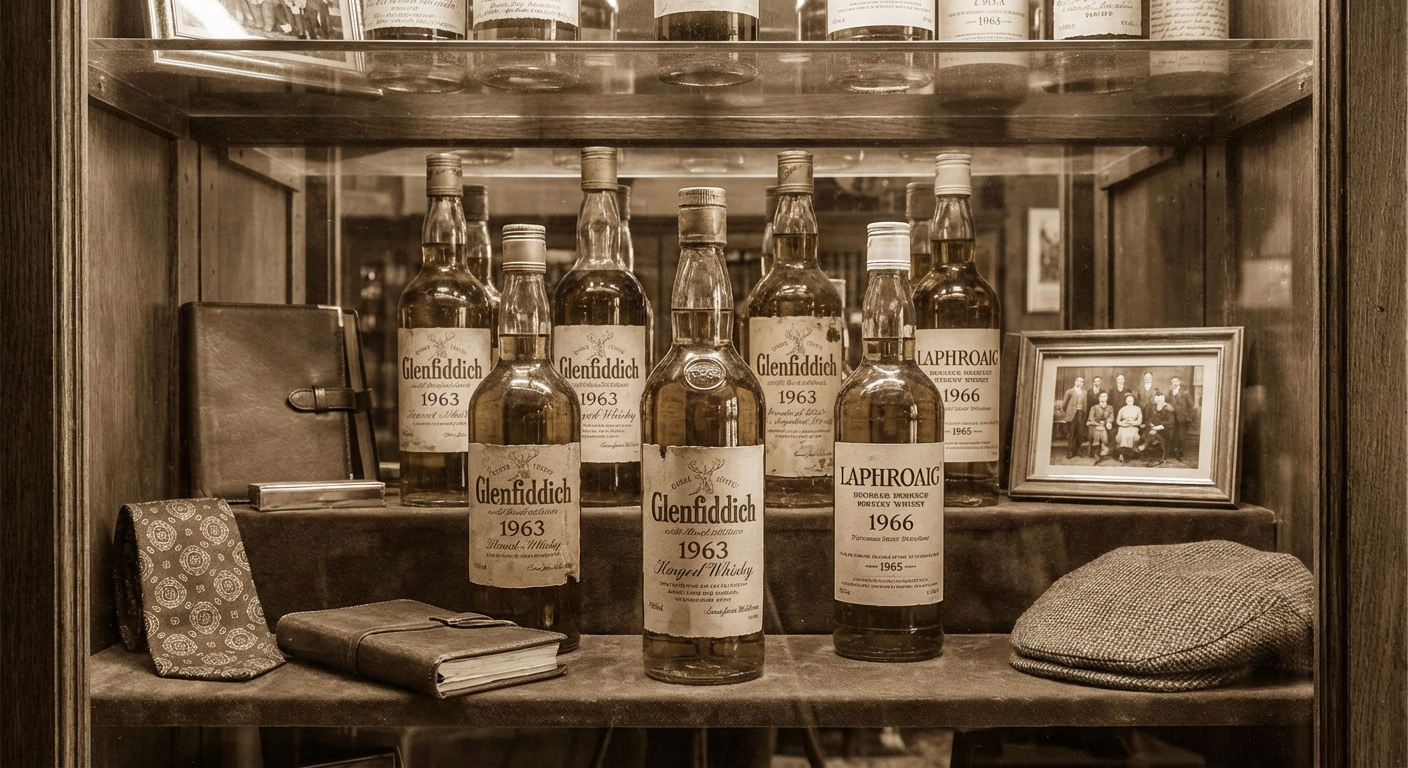
“The 1960s produced some of the most complex Scotch whisky ever distilled — and the world barely noticed at the time.”
Production methods in the 1960s were resolutely traditional. Worm tub condensers were still the norm at most distilleries. Sherry and port casks from Spain and Portugal were plentiful and relatively inexpensive, and distilleries thought nothing of filling their finest second-fill and first-fill oloroso casks with spirit that would later be drawn off for blending. What remained — and what was eventually bottled as single malt — reflects the character of those casks and that era in ways that cannot be replicated.
The 1970s would bring expansion, the 1980s would bring a brutal market crash, and dozens of distilleries would close permanently before the end of the century. The 1960s came just before all of that. The whisky made in that decade carries the flavour of a more settled, unhurried era in Scottish distilling.
It gets better: because these bottles were not originally intended to be collectibles, many were priced and stored accordingly. Private cellars across the UK and Europe still hold bottles that have rarely been seen at auction — which is precisely why sourcing through specialist networks like Glenbotal’s yields expressions that never appear at Bonhams or Whisky Auctioneer. If you want to understand the full landscape of vintage Scotch whisky collecting, the 1960s are the decade to start with.
Not every 1960s whisky deserves a place on this list. We applied four criteria to every expression considered:
Rarity and scarcity. The bottle must exist in genuinely limited quantities. Widely available reissues or modern reproductions are excluded. We are focused on original distillate from the 1960s, whether distilled and bottled then or distilled in the 1960s and bottled later as a long-aged single malt.
Provenance and authenticity. We only include expressions from distilleries with verifiable records of 1960s production, and bottlings from independent bottlers — principally Gordon & MacPhail and Cadenhead’s — with documented records of cask acquisition from that era.
Flavour distinction. A great birth year whisky must be worth drinking, not just owning. Each expression here has a recognised flavour profile that distinguishes it from more recent releases.
Realistic findability. There is no value in recommending bottles that ceased to exist twenty years ago. Each entry on this list represents a category of expression that, with the right connections, can still be sourced — either through auction, private collectors, or specialist retailers like Glenbotal.
| Bottle / Expression | Distillery | Region | Style | Rarity | Best For |
|---|---|---|---|---|---|
| Glenfarclas Family Casks 1960s | Glenfarclas | Speyside | Rich sherry, dried fruit | Very High | The ultimate birth year gift |
| G&M Connoisseurs Choice 1960s | Various Speyside | Speyside | Variable — refined, elegant | High | Collectors seeking diversity |
| Springbank 1960s Vintage | Springbank | Campbeltown | Briny, complex, oily | Extremely High | Serious collectors only |
| Bowmore 1960s Vintage | Bowmore | Islay | Tropical, peated, honeyed | Extremely High | Islay enthusiasts |
| Highland Park 1960s | Highland Park | Orkney | Heather, smoke, sherry | Very High | Those wanting balance |
| Mortlach 1960s | Mortlach | Speyside | Meaty, rich, full-bodied | High | Speyside power drinkers |
| Bruichladdich 1960s | Bruichladdich | Islay | Coastal, gentle peat | Very High | Approachable Islay style |
| Glenlivet 1960s | Glenlivet | Speyside | Floral, light, classic | High | Classic Speyside collectors |
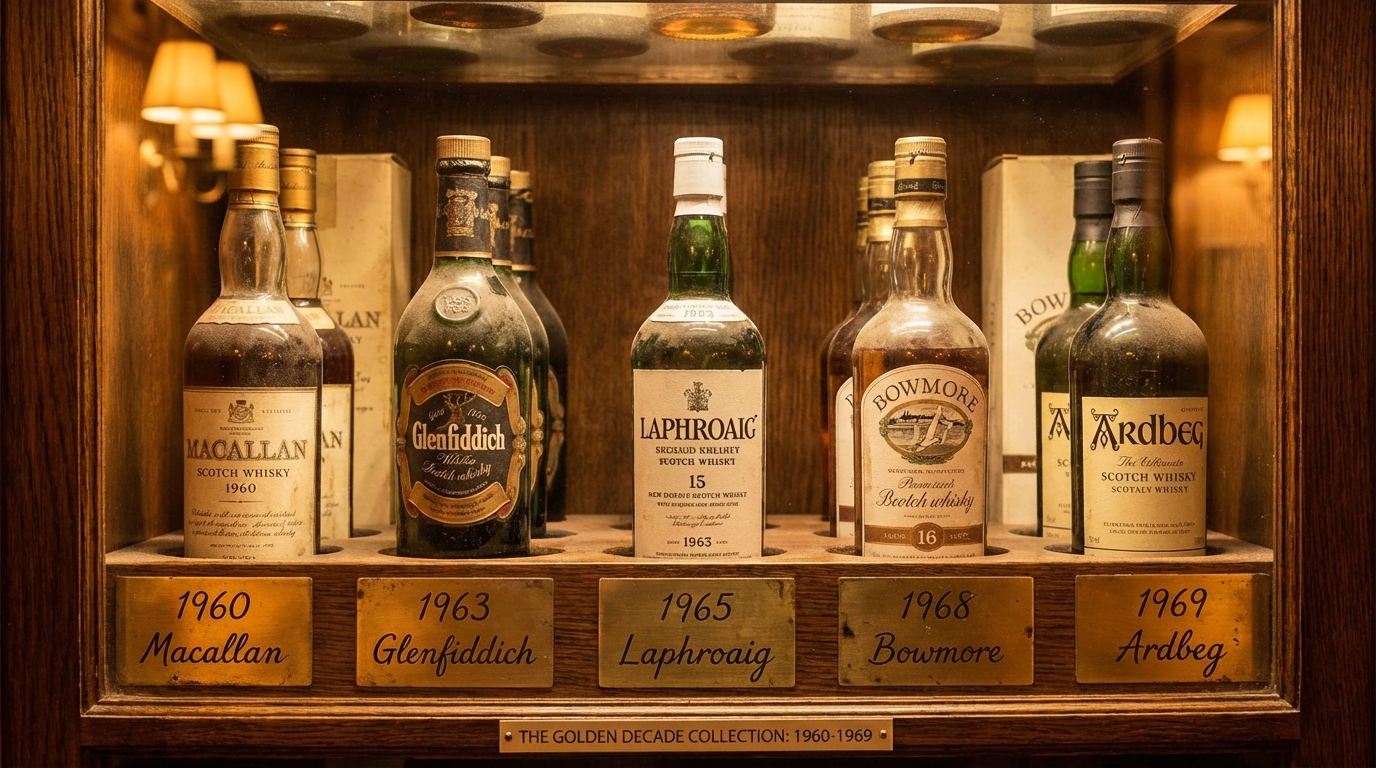
If there is one distillery that defines the 1960s birth year whisky category, it is Glenfarclas — and the Family Casks series is the reason why.
The Grant family has owned and operated Glenfarclas without interruption since 1865, making it one of the last genuinely independent Speyside distilleries. When the family launched The Family Casks collection in 2007, they did something almost unheard of in the industry: they released 43 single cask bottlings covering every year from 1952 to 1994. For collectors born anywhere in the 1960s, this meant a single cask bottling from the exact year of their birth — drawn from the distillery’s own warehouses, bottled at cask strength, without colouring or chill-filtration.
The 1960s Family Casks expressions are now among the most sought-after bottles in the range. The distillery maintains approximately 68,000 casks maturing on site with stock traceable back to the early 1950s — an almost unrivalled depth of archive. Each 1960s vintage presents the house character of Glenfarclas at its most concentrated: deep oloroso sherry influence, dried figs, rich Christmas cake, and a woody, resinous backbone that only decades of contact with premium Spanish oak can produce.
What makes it special:
Best for: Anyone born in the 1960s who wants the definitive birth year gift, or a serious collector adding an anchor piece to a vintage Scotch collection. The Family Casks are the gold standard in this category.
Where to find it: Private collectors, specialist retailers like Glenbotal, and major whisky auctions. Earlier vintages (1960–1964) are increasingly scarce — request a free valuation if you believe you already own one.
Gordon & MacPhail is arguably the most important name in vintage Scotch whisky — and their Connoisseurs Choice range from the 1960s represents some of the most accessible and diverse vintage bottlings still in circulation.
Founded in Elgin in 1895, Gordon & MacPhail has been bottling single malt whiskies for over 115 years and currently offers expressions from around 70 distilleries. Their genius as an independent bottler was filling casks at distilleries across Scotland during eras when the distilleries themselves had no interest in single malt releases, then patiently ageing and releasing those casks decades later. The Connoisseurs Choice range — launched in the early 1970s — draws on exactly this archive, and some of the original fillings date to the 1960s.
Now: what this means for a birth year whisky collector is access to 1960s distillate from distilleries that would never have bottled it themselves. Mortlach, Linkwood, Caperdonich, Longmorn — distilleries whose output went almost entirely into blends during the 1960s — exist as single malt expressions today only because Gordon & MacPhail had the foresight to fill their own casks at those sites. Forbes magazine characterised Gordon & MacPhail in 2023 as “one of the most prestigious independent bottlers in the industry,” and their 1960s Connoisseurs Choice expressions command serious prices at auction.
What makes it special:
Best for: Collectors who want to explore 1960s Speyside expressions from multiple distilleries, or gifters whose recipient has a known preference for a specific distillery whose 1960s output was absorbed by blenders.
Where to find it: Specialist retailers, whisky auction houses (Bonhams, Whisky Auctioneer), and private collector networks. Glenbotal’s European collector contacts surface Gordon & MacPhail 1960s expressions periodically — browse the collection or enquire directly.
Springbank is the rarest of rarities: a genuinely independent, family-owned Scottish distillery that has performed every step of production in-house — from floor malting to bottling — for nearly two centuries.
Established in Campbeltown in 1828, Springbank survived the near-total collapse of the Campbeltown whisky industry that wiped out all but two of the region’s thirty-plus distilleries. It did so by maintaining traditional methods when commercial pressures pushed others towards shortcuts. The distillery uses 100% of its own floor-malted barley, operates a two-and-a-half-times distillation process that requires genuine stillman skill, and bottles entirely on site. Limited annual production of 750,000 litres means that 1960s-era Springbank in any form is genuinely scarce.
The flavour profile of 1960s Springbank reflects everything distinctive about Campbeltown as a region: a briny coastal character, waxy texture, complex peat influence, and a richness that speaks to the direct-fired stills and traditional worm tub condensers of that era. Where Speyside 1960s whisky tends toward refinement and dried fruit, Campbeltown whisky from the same period has a depth and oiliness that is entirely its own.
Here’s the deal: Springbank from the 1960s rarely comes to market. When it does — through private sales, specialist retailers, or collector auctions — prices reflect that scarcity. But for a whisky collector born in that decade, a confirmed Springbank from their birth year is among the most distinguished bottles they could own. Consult our guide to finding birth year whisky for the practical steps involved.
What makes it special:
Best for: Serious collectors who understand Campbeltown as a whisky region, or gifters whose recipient has a deep knowledge of Scotch whisky and wants something truly exceptional rather than decorative.
Where to find it: Private collector networks, specialist auction houses, and established retailers with direct sourcing relationships. Springbank 1960s expressions are not found by casual searching — patient specialist sourcing is required.
Bowmore 1960s expressions are among the most celebrated and most discussed bottles in vintage Scotch whisky — and a confirmed 1960s Bowmore remains a landmark acquisition for any serious collector.
Founded in 1779, Bowmore is the oldest running distillery on Islay. Its position beside Loch Indaal on the west coast of the island gives the warehouses — some of which sit below the tidal waterline — a unique maturation environment that collectors and distillers alike have long credited with contributing to Bowmore’s distinctive flavour. The 1960s expressions matured in those same below-ground dunnage warehouses, and the combination of Islay air, coastal proximity, and the sherry casks prevalent at that time produced something that has never been entirely replicated.
The character that collectors know and seek in 1960s Bowmore is markedly different from the distillery’s modern output. Where contemporary Bowmore tends toward restrained peat and clean tropical fruit notes, the older expressions — particularly those matured in first-fill oloroso sherry casks through the 1960s and 1970s — carry a deep, waxy, honeyed complexity alongside the signature Islay smoke. The Bonhams rare spirits department has noted Bowmore among its exceptional results, with a single vintage 1965 expression appearing in their auction records.
What makes it special:
Best for: Collectors who specifically love Islay whisky, or anyone seeking a birth year bottle that combines extreme rarity with one of Scotland’s most storied distilleries. Also an outstanding investment-grade acquisition.
Where to find it: Specialist retailers, major whisky auction houses, and private collectors. Glenbotal’s network regularly surfaces Islay vintage expressions — free valuations are available if you are buying or selling. See our ultimate whisky collecting guide for investment considerations.
For collectors who want a 1960s birth year whisky that demonstrates every dimension of great Scotch in a single glass, Highland Park from this era is the answer.
Founded in 1798 on the most northerly whisky-producing island in Scotland, Highland Park occupies a unique position in the Scotch whisky landscape. Its location on Orkney means the whisky matures in one of the coolest, most wind-exposed environments in the country — conditions that slow the ageing process and produce a different kind of complexity to mainland distilleries. The peat used at Highland Park is distinctive: drawn from local Orkney peat bogs, it contains a higher proportion of heather than the coastal peats of Islay, producing a smoke that is softer, more floral, and more integrated.
The 1960s expressions from Highland Park reflect an era when the distillery’s floor maltings and traditional equipment were producing whisky of exceptional depth. Matured in first-fill sherry casks from Spanish Oloroso producers — a practice Highland Park has maintained throughout its history — the 1960s expressions combine the distillery’s characteristic heather-and-honey sweetness with the rich dried fruit and spice that only decades of sherry wood contact can deliver. In 2018, Highland Park ranked second in whisky auction sales globally, demonstrating the sustained collector demand for their special and vintage releases.
What makes it special:
Best for: Collectors who want the broadest possible flavour experience from a 1960s expression — smoke, sherry, heather, citrus, and spice in balance. An excellent choice for someone new to vintage Scotch who wants a definitive example.
Where to find it: Private collectors, specialist whisky retailers, and auction houses. Highland Park 1960s expressions appear through both official limited releases and Cadenhead’s / Gordon & MacPhail independent bottlings.
Mortlach is whisky’s best-kept secret — the first legal distillery in Dufftown, a key component in Johnnie Walker blends for a century, and a producer of 1960s single malt expressions that leave experienced tasters searching for superlatives.
Established in 1823 by James Findlater under the Excise Act of the same year, Mortlach holds the distinction of being Dufftown’s original legal distillery — predating Glenfiddich (1887), Balvenie (1892), and every other distillery in what became the whisky capital of Scotland. William Grant himself managed Mortlach for two decades before leaving to found Glenfiddich next door. The distillery’s unique “2.81 times distillation” process — an idiosyncratic partial redistillation that retains a heavier, more complex spirit — was already established by the 1960s and produces a spirit that is heavier in body, richer in texture, and more intense in flavour than almost any other Speyside malt.
Gordon & MacPhail has bottled Mortlach as a single malt under their Connoisseurs Choice label for decades, and 1960s distillate from Mortlach represents one of the most distinctive expressions in their archive. The flavour profile is characterised by what whisky writers call “meaty” or “fleshy” richness — a concentrated savouriness alongside dried fruit, dark chocolate, and leather notes that become more pronounced with extended cask maturation.
What makes it special:
Best for: Collectors with experience of older Speyside whisky who want something that departs from the elegant, lighter Speyside style — and anyone who considers richness and texture the hallmarks of great whisky.
Where to find it: Specialist retailers and private collectors. Gordon & MacPhail Mortlach 1960s expressions surface periodically at specialist auction. Glenbotal’s network holds contacts with collectors who have acquired Mortlach from this period.
Bruichladdich in the 1960s was an underrated Islay distillery producing coastal single malt without the heavy peat influence of its neighbours — making it an ideal entry point for collectors exploring vintage Islay whisky.
The Harvey brothers founded Bruichladdich in 1881 on the western shore of Islay’s Loch Indaal, directly across the water from Bowmore. Through the 1960s the distillery was a going concern, producing whisky that contributed to blended Scotch while small quantities were retained in cask. In 1969, the distillery was sold to Invergordon Distillers Ltd — a transition that makes 1960s stock, filled under the previous ownership, particularly interesting from a provenance perspective.
What distinguishes 1960s Bruichladdich from its Islay contemporaries is the relative lightness of the peat influence. The distillery has historically produced a less heavily smoked spirit than Ardbeg, Laphroaig, or Lagavulin, and the 1960s expressions reflect this: coastal salinity, gentle waxy texture, orchard fruit notes, and a whisper of peat that supports rather than dominates. For collectors who appreciate the Islay terroir without wanting maximum phenolic intensity, 1960s Bruichladdich offers something genuinely singular.
What makes it special:
Best for: Collectors who want an Islay birth year whisky without the challenging peat intensity of Ardbeg or Laphroaig, and those interested in the provenance of pre-revival island distilleries.
Where to find it: Specialist retailers and private collector networks. Bruichladdich pre-revival stock has become increasingly rare as remaining bottles change hands. See our birth year whisky guide for guidance on assessing provenance.
The Glenlivet was the first distillery in Scotland to take out a licence under the Excise Act of 1823, and its 1960s expressions represent the Speyside style at its most historically grounded and classically defined.
Glenlivet’s distilling heritage stretches back to the earliest days of legal Scotch whisky production. By the 1960s, the distillery was producing the floral, approachable, fruit-forward Speyside spirit for which the region became globally known. Destined largely for blending during this era, the small quantities retained as single malt reflect a whisky that has had six decades to develop and deepen while retaining the lightness and elegance that defines classic Speyside character.
Gordon & MacPhail — based in nearby Elgin — have documented a long history of bottling Glenlivet as a single malt, and their 1960s vintage expressions remain among the most complete records of the distillery’s character from that period. A Gordon & MacPhail Glenlivet 1940 70-year-old bottled in 2011 became one of the landmark releases in their Generations series, demonstrating the archive depth of their Glenlivet holdings. The 1960s expressions, while less dramatically aged, offer a more accessible point of entry to genuinely historic Speyside whisky.
What makes it special:
Best for: Those who prefer the lighter, more floral end of the Speyside spectrum, or collectors for whom the historical significance of the distillery matters as much as flavour intensity.
Where to find it: Specialist retailers with access to Gordon & MacPhail archive stock, private collector sales, and whisky auction houses. Our guide to the best birth year whiskies from the 1970s offers comparison context if you are exploring across decades.
Here’s the deal: 1960s birth year whiskies do not appear in high street shops. Finding one requires a specific approach.
Step 1 — Define the brief. Decide whether the distillation date or the bottling date matters more to you. A whisky distilled in 1965 and bottled in 1990 is a legitimate 1965 birth year whisky. A whisky bottled in 1965 but distilled earlier may also qualify depending on the recipient’s preference. Read our complete birth year whisky guide for the full framework.
Step 2 — Choose your channel. Options include: specialist retailers like Glenbotal (who source directly from private collectors), major whisky auction houses (Bonhams, Whisky Auctioneer, Hart Davis Hart), and private collector sales. Each channel has different pricing, availability, and authentication standards.
Step 3 — Verify provenance. Authentic 1960s bottles should have original labels consistent with the era, fill levels appropriate for age (some natural evaporation is expected over 60+ years), and documentary evidence of origin where possible. Glenbotal offers free bottle valuations — use this service whether you are buying or assessing a bottle you already own.
Step 4 — Set a realistic budget. Entry-level 1960s expressions from independent bottlers start at £500–£1,500 depending on distillery and provenance. Distillery official releases and single cask expressions from sought-after distilleries (Springbank, Bowmore, Glenfarclas Family Casks) can reach £3,000–£15,000 or more. Our guide to whisky valuation provides detailed pricing context.
Disclaimer: All price ranges quoted are indicative estimates based on historical auction and retail data. Results may vary significantly by condition, provenance, and market timing. Always verify current prices with a specialist before purchasing. This is not financial advice and Glenbotal does not guarantee any specific resale or investment value.
Step 5 — Be patient and specific. The best 1960s birth year bottles surface through relationships and specialist networks, not through quick online searches. Glenbotal’s private collector network across the UK and Europe means we encounter bottles that never reach public auction. A specific enquiry for a named distillery and birth year will almost always produce better results than a general search.
A 1960s birth year whisky is among the most distinctive and personally meaningful gifts in the world of rare spirits. Whether you are looking for the defining Speyside expression of a Glenfarclas Family Cask, the coastal intensity of a 1960s Bowmore, or the classical elegance of a Gordon & MacPhail Connoisseurs Choice from a now-silent distillery, the bottles exist — they simply require specialist knowledge and the right connections to find.
At Glenbotal, we have spent six years building precisely those connections. Our private collector network across the UK and Europe means we regularly source expressions that never appear at public auction, and our team offers free bottle valuations for anyone buying or selling. With thousands of rare bottles handled and over 100 Trustpilot reviews from satisfied collectors and gifters, we are confident we can help you find the right 1960s expression.
Start Exploring the Collection at Glenbotal — or get in touch directly to discuss a specific birth year, distillery, or budget. We will do the searching for you.
Yes, absolutely. A well-preserved 1960s Scotch whisky in an unopened, properly stored bottle is perfectly safe to drink and, in most cases, at peak complexity. Scotch whisky does not continue to age or deteriorate once bottled — the key factor is storage conditions, not the age of the liquid. Bottles stored upright, away from light, in stable temperatures (around 15°C) will be in excellent condition. Some natural colour shift and minor cork deterioration are normal over 60+ years but do not affect the whisky if the bottle remains sealed.
Prices vary enormously by distillery, bottler, age, and condition. Entry-level independent bottler expressions (Gordon & MacPhail Connoisseurs Choice, Cadenhead’s) typically start at £500–£1,500. Glenfarclas Family Casks from the 1960s typically range from £2,000–£6,000 depending on the specific year. Highly sought-after distilleries like Springbank, Bowmore, and Highland Park from this era can reach £5,000–£20,000 for confirmed single cask expressions. The rarity of the specific vintage year and the condition of the bottle are the primary price drivers.
The main channels are specialist rare whisky retailers (Glenbotal, The Whisky Exchange, Master of Malt), major whisky auction houses (Bonhams, Whisky Auctioneer, Hart Davis Hart), and private collector sales facilitated by specialist brokers. For the most elusive 1960s expressions, specialist retailers with private collector networks — like Glenbotal — will have access to bottles that never appear at public auction.
Authentic 1960s Scotch whisky bottles should have labels consistent with the era’s printing and design conventions. Look for distillery and bottler names as they were styled in that period, appropriate fill levels (some evaporation over 60+ years is normal — roughly 1–2% per year), original capsules or corks, and any accompanying documentation such as receipts, auction certificates, or private cellar records. Independent bottler releases from Gordon & MacPhail or Cadenhead’s will have their own authentication characteristics. If in doubt, Glenbotal offers free bottle valuations and can advise on provenance.
Among the highest-valued 1960s expressions are confirmed single cask Springbank vintage bottlings, Glenfarclas Family Casks from the earliest years of the decade (1960–1963), and authenticated Bowmore 1960s expressions matured in first-fill sherry casks. At auction, exceptional 1960s single casks from sought-after distilleries have realised £10,000–£30,000 or more. The Macallan and Highland Park also produce extremely high-value 1960s expressions when they appear. Value is determined by distillery reputation, cask type, age, and condition.
The most consistently celebrated are Glenfarclas (sherry-matured Speyside), Gordon & MacPhail fillings at Mortlach and Glenlivet, Springbank (Campbeltown), Bowmore (Islay), and Highland Park (Orkney). These distilleries combined traditional production methods with premium sherry cask maturation in a way that has produced whisky of extraordinary depth. The quality of cask management in the 1960s — sherry butts and puncheons from Spain and Portugal were plentiful — is the defining factor.
The distillation date (also called the vintage date) refers to when the spirit was made and placed into cask. The bottling date is when it was drawn from the cask and bottled. A whisky distilled in 1965 and bottled in 1995 has a 1965 distillation date and a 1995 bottling date — it spent 30 years in oak and is genuinely from 1965. Whisky bottled in 1965 but distilled earlier (say 1950 with a 15-year age statement) has a 1965 bottling date but is not a 1965 vintage. For birth year gifting, the distillation (vintage) date is what matters most.
For gifting, an unopened (sealed) bottle is strongly preferred and commands significantly higher value. An opened bottle has potential contamination, oxidation, and diminished fill-level concerns that make authentication and quality assurance more complex. For investment purposes, only unopened bottles with intact closures retain full value. Some collectors do acquire opened bottles for drinking, but these are priced accordingly and are not suitable as birth year gifts.
It is extremely difficult. The most accessible entry point for confirmed 1960s distillate tends to start at £500–£600 for Gordon & MacPhail Connoisseurs Choice expressions from less sought-after distilleries in good but not perfect condition. Below this price point, bottles claiming 1960s provenance should be scrutinised carefully — the economics of genuine 1960s single malt mean that undiscovered bargains are exceedingly rare. That said, private collector sales occasionally surface bottles at below-auction prices, particularly for expressions from distilleries with less public recognition.
Key label elements to check: the distillery name as it appeared at the time (some distilleries traded under different names pre-1970s); the bottler name and address (Gordon & MacPhail’s Elgin address, Cadenhead’s Campbeltown address); the vintage or distillation year; the bottling year or age statement; the cask type and number (for single casks); and the alcohol by volume. Absence of “no artificial colouring” or “non-chill filtered” statements is normal for the era — these were not standard label disclosures until decades later. Original tax strips or stamps (where applicable) are also a useful authenticity indicator.
The whisky investment market has shown sustained growth over the past decade, with rare and vintage single malts generally outperforming many traditional asset classes. The finite supply of 1960s whisky — no more can ever be produced — combined with growing global demand from collectors in Asia, the Americas, and Europe creates strong fundamentals. However, investment returns depend heavily on distillery desirability, condition, provenance documentation, and market timing. Consult our ultimate whisky collecting guide for a detailed investment framework, and use Glenbotal’s free valuation service before making a significant purchase.
Explore the full collection at Glenbotal — rare whisky sourced from private collectors across the UK and Europe.