
Finding a whisky distilled in your birth year is something no standard bottle can replicate — and if you were born in the 1970s, you’re looking at one of the most historically significant decades in Scotch production.
If you were born in the 1970s — or you’re searching for a gift that marks a 1970s birth year — you’re entering genuinely rare territory. Whisky distilled during this decade was laid down before the modern collector era existed, before distilleries started planning for future scarcity, and long before the concept of “birth year whisky” became a gifting category. That makes surviving bottles from the 1970s not just old — they’re a direct window into a Scotland that no longer exists.
This guide covers the best Scotch whisky expressions distilled or bottled in the 1970s that serious collectors and thoughtful gifters can realistically find today. We’ll cover legendary closed distilleries, family-owned independents, and the bottlers who had the foresight to lay down casks that are now irreplaceable. Whether you’re celebrating a 50th or 55th birthday, a significant anniversary, or building a collection, these are the bottles worth knowing.
The 1970s were, paradoxically, both a boom and a catastrophe for Scotch whisky. Production expanded dramatically throughout the decade as distilleries raced to meet rising global demand. Blenders and distillers alike filled warehouses with casks, confident that appetite for Scotch would keep growing indefinitely.
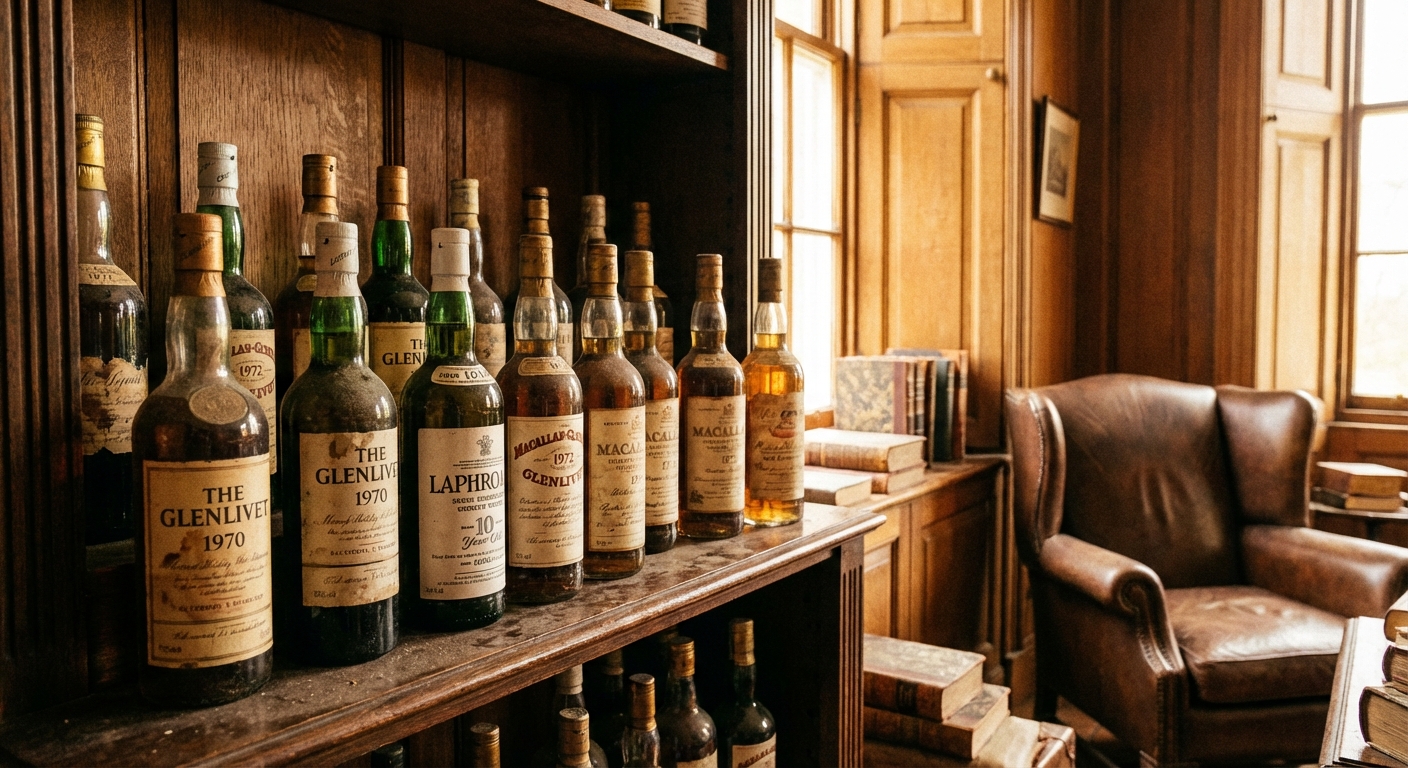
It didn’t. The economic pressures of the early 1980s — combined with what became known in the industry as the “whisky loch,” a catastrophic overproduction crisis — brought the boom to an abrupt halt. Beginning in 1981, the industry slashed production by roughly a third and kept it suppressed for nearly a decade. At least sixteen distilleries were shuttered permanently during this period, including names that are now among the most coveted in the whisky world: Brora, Port Ellen, Dallas Dhu, Convalmore, Banff, Glenugie, and others.
Here’s the deal: the whisky distilled in the 1970s was never intended to become collectible. It was made to be blended or, at best, bottled as accessible single malts. Nobody was thinking about 50-year-old expressions or birth year gifting. That indifference to future scarcity is precisely what makes surviving bottles so valuable — and so scarce.
There are additional characteristics that define 1970s Scotch. Production methods were less standardised than today. Many distilleries still used worm tub condensers, fired their stills directly, and sourced their barley locally. The result was spirit with a distinctly different character to modern expressions — often more robust, more complex, and with what enthusiasts describe as “warehouse funk” or “old wood” notes that simply cannot be replicated in a modern facility.
The sherry cask culture of the era also deserves mention. Before the Jerez cooperage industry changed practices in the late 1980s and 1990s, Spanish sherry butts were genuinely wine-soaked — not seasoned with the efficiency of modern production. Whisky matured in these casks absorbed layers of dried fruit, dark chocolate, and spice that is now extraordinarily difficult to reproduce.
“A bottle distilled in the 1970s doesn’t just taste different from modern whisky — it comes from a different Scotland entirely, one with different water, different wood, different hands, and in many cases, a distillery that no longer exists.”
This list focuses on expressions that serious collectors and gifters can realistically encounter — either through specialist retailers like Glenbotal, at auction, or through private collector networks. We applied four criteria:
Rarity. Preference is given to expressions from closed distilleries or expressions where remaining stock is genuinely finite. An expression that can be freely restocked was deprioritised.
Provenance. Each bottle featured here comes from a distillery or independent bottler with a verifiable and respected track record. Provenance is everything when authenticating 1970s whisky, and we only include names where that chain of custody is well-established.
Authenticity. The 1970s collector market has seen its share of controversy around fill levels, recorking, and provenance claims. The expressions listed here are those with the strongest documentary history and the most reliable third-party verification.
Value for purpose. For a birth year whisky, monetary value and emotional value should align. We’ve included a range — from bottles accessible under £500 to trophy-level expressions worth several thousand — to reflect the different reasons people search for 1970s whisky.
For a broader introduction to buying vintage Scotch, see our vintage Scotch whisky guide and our detailed walkthrough on how to find a birth year whisky.
| Bottle / Expression | Distillery | Region | Rarity | Best For |
|---|---|---|---|---|
| Brora 1970s (Diageo Special Releases) | Brora (closed 1983) | Northern Highlands | Extreme | Trophy collector |
| Port Ellen 1970s (Diageo Special Releases) | Port Ellen (closed 1983) | Islay | Extreme | Islay devotee |
| Glenfarclas Family Casks 1970s | Glenfarclas | Speyside | Very High | Sherry cask lover |
| Gordon & MacPhail Connoisseurs Choice 1970s | Various | Speyside / Highland | High | Provenance-focused buyer |
| The Macallan 1970s Vintage | The Macallan | Speyside | Extreme | Prestige gifting |
| Springbank 1970s | Springbank | Campbeltown | Very High | Traditional craft collector |
| Bowmore 1970s | Bowmore | Islay | Very High | Peated elegance |
| Cadenhead’s Authentic Collection 1970s | Various | Multiple | High | Value-conscious collector |
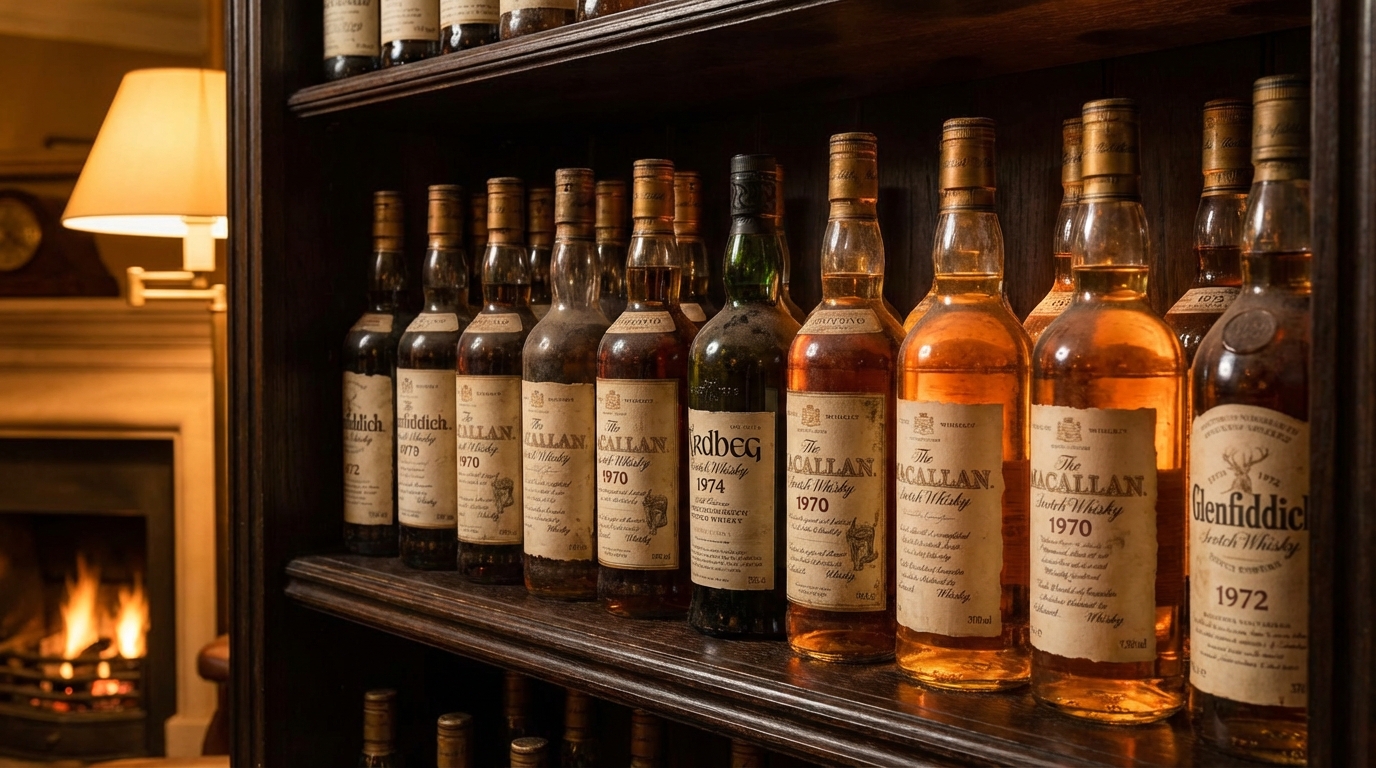
Brora is arguably the most mythologised closed distillery in all of Scotch whisky — and for good reason.
This Northern Highland distillery produced two distinct styles during the 1970s. Between 1969 and July 1973, Brora made heavily peated spirit specifically to compensate for an Islay whisky shortage caused by drought in that region. These expressions carry a peat profile more associated with Islay than the Highlands, giving them a layered quality — the structure of a Highland malt wrapped in an unexpected smoky core. After 1973, the distillery returned to a lighter, more classically Highland style before closing permanently in 1983.
The significance of this split profile cannot be overstated for collectors. An early-1970s Brora distilled in the peated years offers a flavour that no living distillery can reproduce — it occupies a space entirely its own on the flavour map of Scotch whisky. Later expressions from the decade, 1974–1982, offer the lightly peated Highland elegance that the distillery was originally famous for.
Diageo has bottled Brora annually through its Special Releases programme since 2002, drawing down ever-diminishing stocks. A 40-year-old Brora 1972 released in 2014 carried a retail price of £7,000 — at the time, the most expensive single malt Diageo had ever released. Even independent bottlings from Cadenhead’s and Gordon & MacPhail from the 1970s decade regularly command four-figure sums.
What makes it special:
Best for: The collector who treats whisky seriously and wants a bottle with genuine historical weight. Brora from the 1970s is a once-in-a-lifetime acquisition, not an everyday pour.
Port Ellen is the bottle that defined the idea of the “lost distillery” as a collector category.
Closed in 1983, Port Ellen was an Islay distillery whose production was originally intended almost entirely for blending. It was only after the closure that remaining casks were rerouted into single malt bottlings — which means virtually every Port Ellen ever released as a single malt is a 1970s or early 1980s distillation. The distillery is now widely acknowledged as producing some of the greatest Islay single malts ever recorded: intensely smoky, waxy, maritime, and with a complexity that decades of Highland Park or Laphroaig maturation cannot replicate.
Diageo began releasing Port Ellen annually from 2001, always drawing from the same pre-1983 stocks. Each release has carried progressively older ages, as the remaining casks continue to mature. These bottles — typically between 30 and 38 years old at time of release — regularly sell at auction for multiples of their original retail prices. The distillery reopened in March 2024 following a £185 million Diageo investment, but new make spirit will require decades of maturation before it can touch the complexity of these 1970s expressions.
Port Ellen’s flavour profile is one of the most recognisable in all of Scotch: heavy coastal peat smoke, a distinctive medicinal quality, notes of iodine, sea salt, and lemon zest, with a waxy texture that gives the spirit a remarkable mouthfeel. No other Islay distillery produces the same character, which is precisely why collectors and enthusiasts have driven prices skyward.
What makes it special:
Best for: The Islay devotee who wants the pinnacle expression of the style, or the collector who understands that existing Port Ellen stocks represent one of the most finite whisky resources in Scotland.
No independent family-owned distillery has done more to preserve the 1970s era for collectors than Glenfarclas.
In 2007, Glenfarclas launched The Family Casks — a collection of 43 single-cask bottlings covering every vintage from 1952 to 1994. The ambition was extraordinary: one cask, one year, bottled at natural strength with no filtration and no colouring. For the 1970s vintages, this means a direct, unmediated connection to whisky that was distilled, filled, and left alone in a dunnage warehouse on the Speyside estate — in some cases for over 50 years.
Glenfarclas has matured its whisky exclusively in first-fill and refill sherry casks for generations. During the 1970s, before the shift towards cheaper ex-bourbon maturation that swept through much of the industry, this was simply how Speyside malt was made. The result for Family Casks from this era is whisky of remarkable richness: dried fruits, dark chocolate, stem ginger, Christmas cake, and a long, warming finish with genuine complexity that comes only from multi-decade sherry wood influence.
Individual casks from the 1970s vary significantly by year and cask type. A 1973 Family Cask matured in a first-fill sherry butt will be a dramatically different experience from a 1978 hogshead expression — and that individuality is part of the collection’s appeal. The distillery still holds stock from every year from 1953 to present, though 1970s casks grow scarcer with each annual release.
What makes it special:
Best for: The enthusiast who wants a sherry cask expression of serious depth, or a gifter who wants to present a bottle with a story that extends from the 1970s to the present in an unbroken family line.
Gordon & MacPhail have been filling and laying down casks from distilleries across Scotland since 1895 — making them the most authoritative independent source of 1970s vintage Scotch.
The Elgin-based family firm began filling casks at distilleries including Glenlivet, Longmorn, Mortlach, Linkwood, and dozens of others throughout the 1960s and 1970s. Their Connoisseurs Choice range was launched specifically to present these aged single cask expressions — often from distilleries that had no tradition of their own bottlings, or in some cases, from distilleries that subsequently closed. When Gordon & MacPhail bottles a 1970s Glenlivet or Linkwood, the provenance is essentially unimpeachable: the spirit was distilled at the source, filled into a Gordon & MacPhail cask on site, transported to their Elgin warehouses, and held there for decades.
This makes their 1970s expressions particularly significant for buyers who prioritise authenticity. The chain of custody has never left a single company’s hands. Their more recent Generations range includes expressions from this era bottled at remarkable ages — 50 years or older — drawing on casks that were filled when the company’s current directors were children.
Tasting profiles across their 1970s portfolio vary widely by distillery. A 1970s Mortlach tends to be meaty, powerful, and intensely Speyside; a Linkwood from the same era is typically more floral and elegant; Longmorn expresses rich nuttiness and a honeyed mid-palate. What unites them is the quality of the original spirit and the careful maturation that only a company with Gordon & MacPhail’s patience and resources can deliver.
What makes it special:
Best for: The buyer who places provenance and authenticity above all else, and who wants the assurance of a name that has been doing this for over 125 years.
The Macallan’s reputation as the pre-eminent Speyside single malt rests substantially on its 1970s and 1980s distillations.
During the 1970s, Macallan was producing whisky almost exclusively in genuine sherry casks sourced directly from Jerez — before the cost pressures of the 1990s and 2000s altered the cooperage supply chain irrevocably. The oak used was typically old-growth Spanish oak, genuinely seasoned with Oloroso sherry, and the resulting spirit absorbed a depth of colour and flavour that is now extraordinarily difficult to replicate. A 1970s Macallan, aged for 18 or more years in these conditions, typically presents with deep amber colour, dried fruit, dark chocolate, ginger, and a long, spiced finish.
Finding authentic 1970s Macallan in bottle today requires care. The brand’s premium status has driven significant collector demand, and fake or compromised bottles do circulate. The most reliable sources are specialist retailers with authenticated private collections — precisely where Glenbotal’s network operates. Official Macallan releases from this era, particularly older bottlings of the 18 Year Old or the pre-rebranding “Fine & Rare” series, can command substantial prices at auction. Independent bottlings from the 1970s, through bottlers such as Gordon & MacPhail or Cadenhead’s, often represent better-value alternatives with equally strong provenance.
The Macallan’s 1970s expressions are among the most universally recognisable in the collector world — a point of reference against which many other aged Speyside whiskies are measured. For gifting, a bottle with clear 1970s distillation credentials carries an immediate and widely understood prestige.
What makes it special:
Best for: Prestige gifting where the name recognition matters as much as the liquid, or for collectors building a reference set of great Speyside malts.
Springbank occupies a category entirely its own — the last survivor of a once-thriving Campbeltown whisky industry, and a producer of extraordinary integrity.
The distillery closed in 1979 due to the deteriorating state of the UK economy, reopening only in 1989. Whisky distilled just before that closure — 1977, 1978, 1979 — was laid down in a period of real uncertainty, and the expressions that survived are among the most sought-after in the Campbeltown category. Springbank is the only Scottish distillery that still performs every step of production on-site, from floor malting to bottling. In the 1970s, this level of hands-on craft was the norm rather than the exception — but Springbank has never abandoned it.
The distillery’s production method involves two-and-a-half times distillation, which produces a spirit uniquely positioned between the light, fruity character of a triple-distilled malt and the robust weight of a double-distilled one. Traditional worm-tub condensers limit copper contact and produce a richer, oilier spirit. The result in 1970s expressions is typically maritime, slightly peated, with notes of brine, green apple, old leather, and a long, savoury finish that is unlike anything else in Scotch.
Because the distillery closed for a decade, there was no continuous replenishment of stock during the 1980s. Authentic 1970s Springbank is genuinely finite — there was simply no production between 1979 and 1989 to add to the supply. Official distillery releases of 1970s expressions appear sporadically, often at significant ages; independent bottlings through Cadenhead’s (which shares the same owner as Springbank) represent the most reliable alternative channel.
What makes it special:
Best for: The collector who values tradition and craft above brand prestige, and who appreciates that Campbeltown’s near-extinction as a whisky region makes these expressions historically irreplaceable.
Bowmore is the oldest licensed distillery on Islay, established in 1779 — and its 1970s expressions occupy a special place in the history of peated Scotch.
During the 1970s, Bowmore produced spirit with a peat level and style that differs notably from both earlier and later decades. The distillery has long been known for a paradoxical combination of heavy Islay smoke and an unusually floral, almost perfumed quality — a characteristic that is particularly pronounced in expressions from this era. Older collectors often refer to the 1970s Bowmore house style as having more coastal brine and natural peat character before any changes in production practice. The whisky is typically described with notes of dark chocolate, dried fruits, sea spray, peat smoke, and a distinctive floral top note.
Bowmore’s 1970s expressions appear principally through independent bottlers. Gordon & MacPhail and Cadenhead’s both held stocks from the distillery during this decade, and bottles periodically surface through specialist retail channels and auction. Official distillery releases drawing on 1970s casks are extremely rare and command significant premiums — a reflection of the fact that the best-known release associated with this era, the Black Bowmore series (distilled in 1964 but bottled in the 1990s and 2000s), established the template for what a Bowmore aged expression could achieve.
For gifters and collectors, a 1970s Bowmore from a credentialed independent bottler — with clear cask number, distillation date, and bottling records — represents one of the most emotionally compelling Islay expressions available. The combination of age, provenance, and the island’s unmistakable terroir creates a bottle that speaks for itself.
What makes it special:
Best for: The Islay enthusiast who wants a peated expression with the weight and complexity that only multi-decade maturation delivers, from one of Scotland’s most historically significant distillery sites.
William Cadenhead’s is Scotland’s oldest independent bottler — and for buyers who know where to look, it represents one of the best ways to access genuine 1970s single malt at a range of price points.
Cadenhead’s was founded in 1842 in Aberdeen and is now based in Campbeltown, owned by J&A Mitchell & Company — the same family company that owns Springbank distillery. Their Authentic Collection range represents single cask bottlings at natural cask strength, with no colouring, no chill filtration, and a commitment to transparency that predates the modern craft spirits movement by over a century.
Throughout the 1970s, Cadenhead’s filled and purchased casks from distilleries across Scotland, including Highland Park, Glen Grant, Longmorn, and others. Their approach was unsentimental: identify good spirit, fill it into cask, and wait. The result is a range of 1970s expressions from distilleries that may or may not still exist — some have closed, some have changed their production methods dramatically, and some are now so famous that original-era bottlings from independent sources trade at significant premiums.
A Cadenhead’s 1970s bottling from, for example, a now-closed Highland distillery offers something that official releases often cannot: genuine surprise. The liquid in the bottle represents what that distillery was actually producing for its own consumption and blending purposes in that decade — not a self-conscious collector’s expression, but a working distillery’s everyday output preserved in amber. That authenticity, with Cadenhead’s century-and-a-half of credibility behind it, is a powerful combination.
What makes it special:
Best for: The buyer who understands the independent bottler world and wants to explore 1970s Scotch beyond the headline names, at price points that reflect quality rather than brand marketing.
Finding an authentic 1970s whisky requires more care than picking up a current release. Here’s where to start.
Specialist retailers with private collector networks. This is the most reliable route. Glenbotal sources directly from private collectors across the UK and Europe, which means bottles surface that never appear at auction or in mainstream retail. The advantage is that provenance has typically been verified before the bottle is offered for sale, and any questions about fill level, capsule condition, or documentation can be answered directly. If you’re searching for a specific year — 1972, 1975, 1978 — a specialist retailer can often search their network proactively.
Whisky auctions. Major auction houses including Whisky Auctioneer, Scotch Whisky Auctions, and McTear’s regularly carry 1970s expressions. Auction is where genuine rarities surface, but it also requires the buyer to conduct their own due diligence on provenance and condition. Fill levels matter significantly for 1970s bottles — any ullage (evaporation below the expected fill line) should be factored into both the price you’re willing to pay and expectations around flavour.
Private sales. Some of the best 1970s bottles never reach public auction. They change hands through collector networks quietly, often at prices negotiated privately. Services like Glenbotal’s free valuation service work in both directions — they help sellers understand what their bottles are worth and connect them with buyers who are actively searching for specific expressions. See our guide on how much your whisky is worth for more context.
What to check before buying. For any 1970s bottle, verify: the fill level (a photograph in good light is essential), the capsule and label condition, the provenance documentation if available, and ideally the bottling records if it’s an independent expression. Our birth year whisky guide covers the full authentication process in detail.
Birth year whisky from the 1970s is not simply a collector’s indulgence. It’s a tangible connection to a decade that shaped modern Scotch in ways that are still being felt — through the distilleries that closed, the production methods that changed, and the casks that have been quietly maturing ever since. Whether you’re drawn to the smoky mythology of Brora or Port Ellen, the sherry-soaked tradition of Glenfarclas Family Casks, or the quiet authority of a Gordon & MacPhail Connoisseurs Choice from a forgotten Speyside distillery, these bottles offer something genuinely irreplaceable.
At Glenbotal, we’ve spent six years building a private collector network across the UK and Europe specifically to surface bottles like these. We offer free valuations, work with thousands of bottles, and carry over 100 verified Trustpilot reviews from collectors and gifters who’ve trusted us with exactly this kind of search. If you’re looking for a specific 1970s birth year expression — a particular distillery, a particular year — we can search for it on your behalf.
For more, explore our companion articles: best birth year whiskies from the 1960s, best birth year whiskies from the 1980s, and our full birth year whisky guide.
Yes, absolutely — provided the bottle has been stored correctly. Scotch whisky that has been sealed in bottle does not continue to age or deteriorate in the way that wine does. The liquid that was distilled and matured in the 1970s remains exactly as it was when bottled. The key conditions are storage upright, away from direct sunlight and significant temperature fluctuations, and with the original seal intact. A 1975 single malt in good condition is every bit as drinkable today as it was when first bottled.
The range is substantial. Entry-level verified 1970s expressions from independent bottlers — a Cadenhead’s or Gordon & MacPhail bottling of a lesser-known Speyside or Highland malt — typically begin around £400–600. Mid-tier expressions from respected distilleries like Glenfarclas Family Casks or Bowmore typically range from £700 to £2,000 depending on the specific year and cask. Trophy expressions from closed distilleries — Brora, Port Ellen, Macallan of significant age — can range from £3,000 to £10,000 or more.
The most sought-after names are the closed distilleries: Brora and Port Ellen in particular, followed by Dallas Dhu, Convalmore, and Glenugie. Among still-operating distilleries, Glenfarclas, The Macallan, Springbank, and Bowmore have the strongest 1970s reputations. The independent bottlers — Gordon & MacPhail and Cadenhead’s — offer access to a wider range of distilleries, including some that are no longer well-known.
The most significant closed distilleries with 1970s stock that has reached bottle include Brora (Northern Highlands, closed 1983), Port Ellen (Islay, closed 1983), Dallas Dhu (Speyside, closed 1983), Convalmore (Speyside, closed 1985), Glenugie (Eastern Highlands, closed 1983), Banff (Speyside, closed 1983), and Glen Albyn (Inverness, closed 1983). All of these were operational throughout the 1970s, and surviving bottlings from each represent genuinely finite collector resources.
Authenticity checks for 1970s bottles should cover several areas. First, examine the fill level — significant ullage (the gap between the liquid and the capsule) is normal with age, but extreme ullage may indicate evaporation from a compromised seal and should be factored into valuation. Second, check the capsule and label condition: minor wear is expected, but significant damage or inconsistencies in font, labelling style, or distillery address may warrant further investigation. Third, verify against known bottling records where possible — specialist retailers like Glenbotal and databases like Whiskybase maintain records of known releases. Finally, buy from a trusted source with a clear returns and authenticity policy.
The distillation date is when the spirit was produced and put into cask — this is the date that determines whether a whisky qualifies as a “1970s expression.” The bottling date is when the cask was emptied into bottle. A whisky distilled in 1973 and bottled in 2020 as a 47-year-old is still a 1970s distillation; it matured for nearly five decades before leaving the barrel. For birth year gifting, the distillation date is usually the relevant reference point, as it marks when the spirit’s journey began.
Yes, and it matters in two ways. For valuation purposes, significant ullage reduces a bottle’s market value — collectors expect bottles to be near-full or to have documented provenance explaining any reduction in fill. For drinking purposes, ullage above a certain level may indicate that oxidation has affected the whisky through a compromised seal, which can alter flavour. When evaluating a 1970s bottle, request clear photographs taken in natural light from multiple angles to accurately assess fill level before purchase.
It is possible, though options are limited. The most realistic route to genuine 1970s whisky under £500 is through independent bottlers — a Cadenhead’s or Gordon & MacPhail expression from a less-famous Speyside or Highland distillery. Blended Scotch from the 1970s in original bottles can also be found at lower price points and may hold more personal significance than commercial value. Be cautious of anything claiming to be a famous single malt from a prestigious distillery at significantly below-market prices — authentication is particularly important at the lower end of the market.
For gifting, the priority is usually a combination of recognisable name, clear birth year provenance, and presentation condition. The Macallan 1970s vintage leads on name recognition. Glenfarclas Family Casks lead on story and presentation — a single-cask bottling from a specific year with documented distillery provenance makes an exceptionally compelling gift. Bowmore or Brora from the 1970s are powerful gifts for whisky enthusiasts who understand the significance of those names. For someone who is not a whisky collector, a bottle that tells a clear, simple story — “this was distilled in the year you were born, in a distillery that has since closed” — often has more emotional impact than technical specifications.
Rarity in the 1970s is concentrated in a handful of areas: heavily peated Brora from 1969–1973 (the period when the distillery was making Islay-style spirit), Port Ellen from any year in the 1970s, and original distillery-bottled Macallan expressions from the early 1970s in pre-rebranding liveries. Beyond those headline names, certain individual Glenfarclas Family Casks from specific years — particularly 1970, 1971, and 1972 — are considered exceptionally rare given the limited number of surviving casks from those early years. Any cask-strength, single-cask independent bottling from a now-demolished distillery (Glenugie, Banff) represents near-unique whisky history.
There is no equivalent. Unlike some other aged spirit categories, Scotch whisky cannot be ordered speculatively for a birth year — you cannot contact a distillery today and commission a 1970s whisky. The only 1970s Scotch that exists is the 1970s Scotch that was actually distilled then, matured, and either already bottled or still in cask. This absolute finite supply — with no possibility of future production — is precisely what gives these bottles their character and their value.
Explore the full collection at Glenbotal — rare whisky sourced from private collectors across the UK and Europe.