
The Lagavulin Distillers Edition has been released every year since 1995 — yet each vintage is subtly different, and the right year matters more than most buyers realise.
This guide covers everything serious collectors and Islay enthusiasts need to know about the Lagavulin Distillers Edition. You’ll understand exactly what the Pedro Ximénez finish does to one of Scotland’s most intensely peated malts, why the Classic Malts programme made this expression possible, and which vintages to seek out — and which to approach with more caution. Whether you’re buying your first DE or building a vertical collection, this is the guide you’ll want to bookmark.
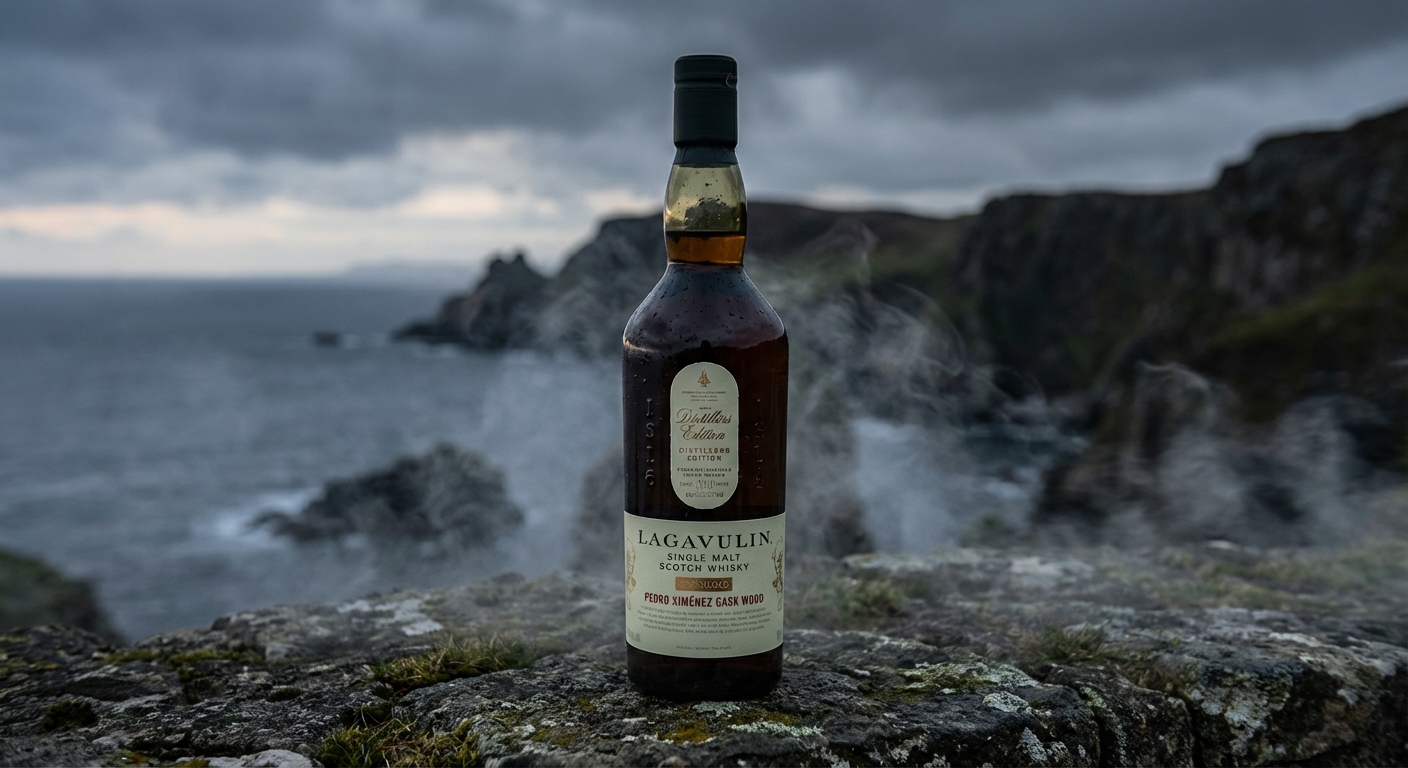
The Lagavulin Distillers Edition is the standard 16 Year Old, aged a second time in Pedro Ximénez sherry casks — officially described as a “double matured” single malt Scotch whisky.
It starts life the same way as the regular Lagavulin 16: distilled at the Lagavulin distillery on the southern shore of Islay, matured for sixteen years primarily in refill American oak ex-bourbon casks, then bottled at 43% ABV. What separates it from the standard expression is one additional step — a finishing period in casks that previously held Pedro Ximénez sherry, the richest and sweetest wine in the sherry spectrum.
The result is Lagavulin’s signature coastal peat, seaweed, and brine character, layered with dark dried fruits, toffee, figs, and a sweetness that would seem impossible in such a heavily peated malt — until you taste it.
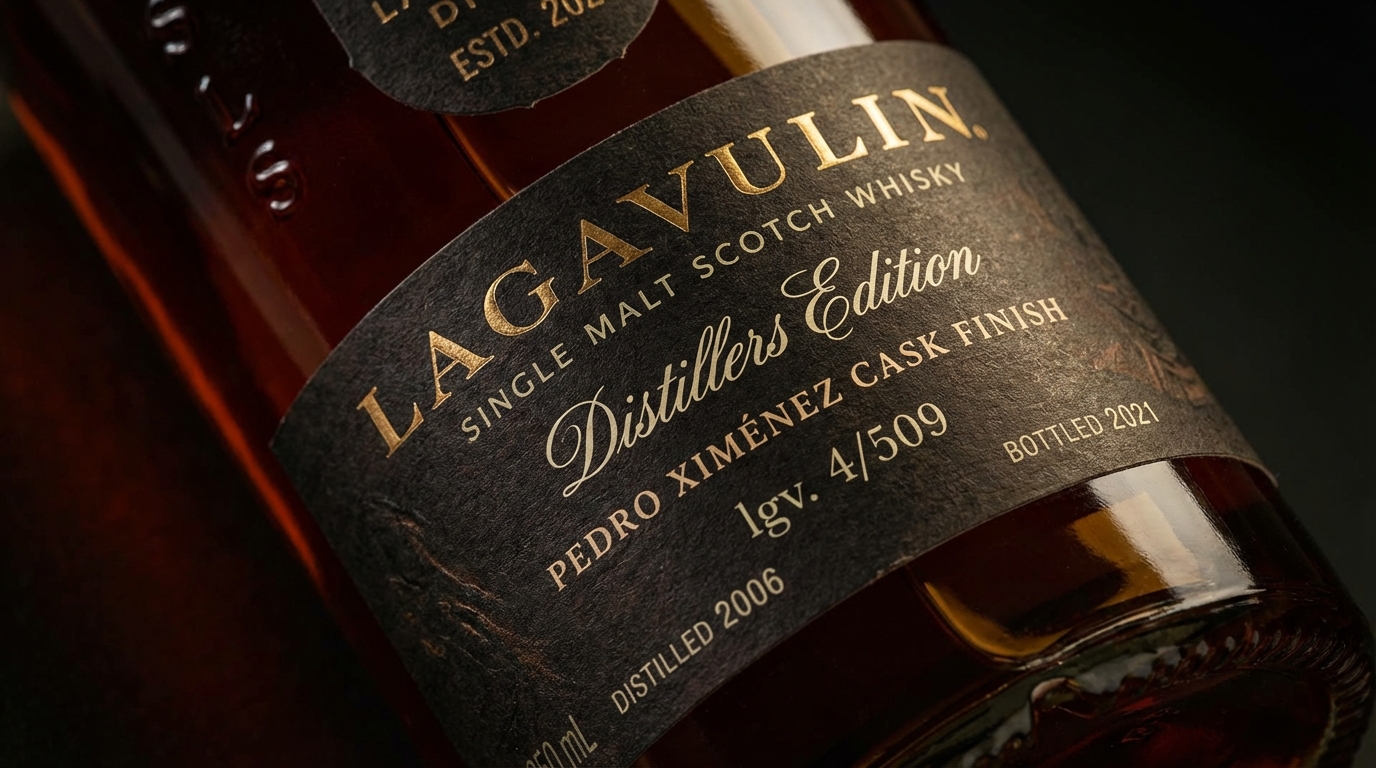
Released annually as a vintage-dated expression, each bottle carries two years on the label: the distillation year and the bottling year. A bottle labelled “2007 2023” was distilled in 2007, spent sixteen years in refill oak, then received its PX finish before bottling in 2023. This dating system is specific to the Distillers Edition series and tells the collector precisely which spirit is inside.
Lagavulin is not alone in this programme. Diageo produces Distillers Edition releases for all six original Classic Malts distilleries, each paired with a different sherry or wood finish chosen to complement that distillery’s character. Oban gets Fino, Talisker gets Amoroso, Glenkinchie gets Amontillado. But of the six, Lagavulin’s pairing — the most powerful malt with the sweetest possible finish cask — is arguably the boldest contrast and produces the most dramatic result.
The standard bottling strength of 43% is the same as the regular Lagavulin 16. It’s not cask strength, which means it’s accessible to a broad audience and doesn’t require water to open up. Some collectors prefer the Lagavulin 12 Year Old Cask Strength for a more raw, uncut experience, but the DE at 43% represents a considered balance — enough body to carry the PX influence, not so much alcohol that it masks the interplay between smoke and sweetness.
Understanding the Lagavulin Distillers Edition means understanding the Classic Malts programme — the marketing initiative that effectively invented the modern single malt category as mass-market consumers know it.
In 1988, United Distillers (the Scotch whisky arm of Guinness, later to become Diageo following the 1997 Guinness-Grand Metropolitan merger) launched an audacious marketing project. They selected six single malt whiskies — one from each of Scotland’s main whisky regions — and packaged them as a unified premium collection: the Classic Malts of Scotland.
The six were:
This was a watershed moment. Before 1988, single malts were largely the preserve of serious enthusiasts and trade buyers. The Classic Malts gave casual drinkers a framework: here are six distinct characters, each tied to a place, each representing a different face of Scotch whisky. Lagavulin 16 was positioned as the Islay representative — the smoke bomb at the end of the spectrum, the one that would challenge and reward in equal measure.
Within the Classic Malts six, Lagavulin has always been the most assertive. The 16 Year Old at 43% ABV is not a gentle introduction. It’s full-bodied, heavily peated — measurable at around 35 parts per million (ppm) of phenols — and carries the coastal character of its Islay home: brine, iodine, medicinal smoke, and a long, warming finish.
That intensity was both its virtue and its limitation. Lagavulin built a fierce following among peat devotees, but the full-force smoke could be a barrier for drinkers who wanted something from Islay without quite such a committed character. The Distillers Edition, launched seven years after the Classic Malts programme, was in part a response to that: the same foundational spirit, with enough sweetness to invite a wider audience in — without compromising what makes Lagavulin Lagavulin.
United Distillers became Diageo in 1997, and Diageo has continued both the Classic Malts positioning and the Distillers Edition series ever since. The DE is now firmly part of the annual Lagavulin calendar, released alongside the core range. Diageo’s scale gives them access to significant stocks of quality finishing casks — something smaller independent distilleries cannot always guarantee — which is why the consistency of the DE programme year to year is broadly reliable, even as individual vintage character shifts.
Pedro Ximénez is not just any sherry. It’s the sweetest, darkest, most concentrated wine in the sherry spectrum — and what it leaves behind in a cask transforms the whisky that follows.
Pedro Ximénez (pronounced pe-dro him-é-neth, often abbreviated to PX) is produced primarily in the Montilla-Moriles region of Andalusia in southern Spain, though it is also made in Jerez de la Frontera. The production method is unusual: the grapes are laid out under the Andalusian sun after harvest, losing water through evaporation — a process called soleo — before fermentation begins. This concentrates the natural sugars to extraordinary levels, producing a wine described by the wine trade as “intensely sweet, dark dessert sherry” with dominant flavours of raisins, molasses, dark chocolate, dried figs, and prunes.1
A glass of PX sherry has a viscosity that makes it pourable in long, slow threads. The sugar content is among the highest of any commercial wine. When this wine is aged in oak casks, it saturates the wood deeply. When those casks are emptied and shipped to Scotland for whisky finishing, the spirit absorbs the concentrated residue of that sweetness — but it does not simply become sweet.
Here’s the deal: a finish is not a flavour injection. It’s a conversation between the cask residue and the spirit.
For a heavily peated Islay malt like Lagavulin, the PX finish modulates rather than masks. The peat smoke remains present and identifiable — this is still, unmistakably, an Islay whisky. But the finish rounds the edges, introduces dried fruit sweetness against the smoke, and adds texture and length. On the nose, the PX influence shows as honey, toffee, and dark fruit layered beneath the coastal smoke. On the palate, figs and raisins emerge mid-palate before the peat smoke reasserts in the finish.
The contrast is the point. PX sherry and Islay peat are, in theory, polar opposites on the flavour spectrum. In practice, they amplify each other in the same way that salt amplifies sweetness in cooking: the smoke makes the sweetness taste sweeter, and the sweetness makes the smoke taste more complex.
Not all sherry finishes are equal, and collectors increasingly understand the distinction. Oloroso sherry — the most common sherry cask type in Scotch whisky — produces nutty, dried fruit, and walnut-oil notes. Amontillado is drier and more oxidative. PX is in a category of its own: it adds the most concentrated sweetness, the deepest colour, and the most apparent dried-fruit character of any sherry type.
For Lagavulin’s intensely peated character, PX is arguably the one sherry cask capable of matching it without being overwhelmed. A Fino finish would have disappeared. An Amontillado might have produced complexity without presence. PX meets Lagavulin’s peat on equal terms.
The Lagavulin Distillers Edition has been released annually since 1995, and while the format is consistent, the vintage year inside the bottle shapes the character of every release.
It’s reasonable to ask: if the same distillery is producing the same spirit every year, using the same PX finishing casks and the same 43% ABV, why do vintages vary? The answer lies in the nature of Scotch whisky production.
Barley quality, seasonal temperature during fermentation, the condition of the copper pot stills in a given year, and the specific parcels of refill casks used for the sixteen-year maturation all introduce variation. Islay’s climate — maritime, damp, and variable — means that angels’ share rates and the interaction between spirit and cask evolve differently across decades. A spirit laid down in a particularly cold, wet year absorbs different character from its casks than one laid down in a warmer, drier period.
Then there is the PX finish itself. The casks used will vary in how much residual sherry they carry. A very active PX cask might add pronounced sweetness in three months; a more depleted cask might require longer. Master distillers calibrate the finishing period accordingly, but natural variation remains. The best vintages are those where the maturation and finishing align into something greater than the sum of their parts.
The Distillers Edition has been in continuous production long enough that a secondary market for older vintages has developed. Several years are consistently cited by collectors and enthusiasts as outstanding:
Early 2000s releases (1991–1995 distillation vintages): The oldest DE bottles, distilled in the early-to-mid 1990s and released in the 2007–2011 period, are now relatively scarce. The spirit from this era was produced from older-style Lagavulin recipes before any modification to the fermentation or distillation regime. Bottles from this period attract collector interest and command meaningful premiums on the secondary market.
Mid-2000s distillations (c.2001–2005): Generally regarded as solid, representative expressions of the DE format — the PX influence well-integrated with the peat, the coastal character clear and present. These represent “correct” Lagavulin DE without being outliers in either direction.
2007 distillation (released 2023): Recent releases in the 2022–2024 bottling window have been well-received, with tasters noting the peat character remains assertive and the PX finish adding structured sweetness without excessive weight.
Important: Whisky vintage assessments are inherently subjective, and market conditions for older bottles change. For current availability and pricing of specific vintage years, see our free bottle valuation service at Glenbotal.
Collector’s note: The Distillers Edition is not produced in limited quantities in the same way as single-cask releases. It is an annual commercial release, which means older vintages become scarce simply by being consumed — not because they were produced in small numbers. The older the distillation year, the fewer bottles remain in circulation.
The double-date system is worth understanding clearly:
A bottle labelled “2006 2022” contains spirit distilled in 2006, matured for approximately sixteen years, then finished in PX casks and bottled in 2022. When buying on the secondary market, this label information is the primary tool for identifying the age and character of the spirit inside.
The Distillers Edition makes most sense when you understand where it sits within the broader Lagavulin family — and how it compares to expressions at either side of it in terms of age, intensity, and collector positioning.
The youngest permanent expression in the range, the 8 Year Old was reintroduced in 2016 to mark the distillery’s 200th anniversary, following a single-cask release for Whisky Magazine in 2014. It is bottled at 48% ABV — higher than both the 16 and the DE — and reveals a very different aspect of the distillery’s character.
Where the 16 Year Old is settled, rounded, and brooding, the 8 Year Old is raw, brighter, and more aggressive. The peat is sharp rather than deep, the coastal note almost medicinal, and the spirit itself more forward and lively. It is an excellent demonstration of how dramatically time in wood transforms Lagavulin’s output.
For collectors: the 8 Year Old is an affordable entry into the Lagavulin range and a useful reference point for understanding how the 16 and the DE evolved from the same base spirit.
The benchmark. Lagavulin 16 at 43% ABV has been one of the most consistently acclaimed single malts in the world since the Classic Malts programme launched it to international prominence. It matures entirely in refill American oak ex-bourbon casks, with no secondary finishing.
The flavour profile is the foundation from which the DE is built: peat smoke, coastal brine, iodine, oak spice, dry smoke on the finish. It is demanding but completely coherent — every element serves the character.
The DE vs the standard 16: The standard 16 is drier, more austere, and arguably more “honest” to Islay character. The DE is richer, more fruit-forward, and more approachable. The standard 16 suits drinkers who want peat without compromise; the DE suits those who want complexity built around the peat.
Neither is objectively better. They are different conversations with the same spirit.
Released annually as part of Diageo’s Special Releases programme, the Lagavulin 12 Year Old is a cask strength bottling — typically arriving somewhere between 54% and 57.5% ABV, varying by year. It is younger than the 16 and unbuffered by dilution.
This is the expression for those who want Lagavulin in its most uncompromising form. The higher ABV amplifies everything: peat, smoke, coastal brine, and the raw energy of younger spirit. A few drops of water are strongly recommended to open it up.
The 12 Year Old Cask Strength occupies a different collecting space from the DE. It is also an annual release but attracts more collector interest due to its ABV variation and the year-to-year character differences that cask strength bottlings naturally produce.
At the top of the Lagavulin hierarchy sit the Special Releases — older, rarer, and priced to match. These bottles appear infrequently and represent a categorically different tier from the DE.
Lagavulin 25 Year Old: Released periodically by Diageo, the 25 Year Old offers the same foundational character with decades of additional wood influence. The peat becomes more integrated, the oak spice more complex, and the overall impression more contemplative. These bottles retail above £300 when available and appreciate on the secondary market.
Lagavulin 37 Year Old: A genuinely rare expression that appears only occasionally. Spirit this age carries significant oak influence — the peat is still present but deeply embedded, almost archaeological. These bottles are collector-tier purchases. For context on valuing older expressions like this, our guide to what makes a whisky bottle valuable covers the key factors.
Nick Offerman Edition: Released in partnership with actor Nick Offerman (a vocal Lagavulin enthusiast following his Parks and Recreation appearances), the Offerman Edition is an 11 Year Old finished in Caribbean rum casks. It occupies a different flavour space from the rest of the range — more tropical fruit, still peated — and appeals to a cross-audience of fans and collectors.
For a broader view of distilleries worth building a collection around, Lagavulin’s combination of consistent annual releases and rare special expressions makes it one of the more coherent collecting propositions in Scotch whisky.
The Lagavulin Distillers Edition sits in an interesting position in the collector market: it is premium enough to be worth holding, but accessible enough to be enjoyed without guilt.
The DE occupies what might be called the “serious casual” tier of whisky collecting. It is not cheap — current retail typically positions it above the standard 16 — but it is not so expensive that buying a bottle feels like an investment decision rather than a pleasure.
This makes the DE an excellent starting point for collectors who want to begin tracking Lagavulin’s annual output without committing to the more significant outlay of the Special Releases. Buying one bottle per vintage year and setting a proportion aside builds a useful vertical over time without requiring a dedicated cellar budget.
Sealed bottles of older DE vintages — particularly those with distillation years in the 1990s and early 2000s — have quietly accumulated value on the secondary market. The mechanism is simple: unlike a Special Release that was always scarce, early DE bottles were produced in reasonable quantities but have been consumed over the years, leaving fewer sealed examples. As the whisky inside has aged further in the bottle and the collectible profile of the series has grown, surviving examples have appreciated.
Disclaimer: Whisky values on the secondary market are not guaranteed and can fall as well as rise. Past appreciation of specific bottles does not predict future performance. Any statement about bottle values in this article is informational only. Always check current market values before buying or selling rare bottles.
For those already holding older bottles, Glenbotal offers free valuations sourced against current market data — a useful first step before deciding whether to sell or hold.
The question collectors frequently ask: is it better to buy multiple DE vintages, or save capital for a single Special Release?
There’s no universal answer, but the two strategies serve different goals:
For most collectors beginning with Lagavulin, the DE vertical is the more achievable and arguably more interesting project. The vintage Scotch whisky guide covers the broader principles of building a collection around annual releases from a single distillery.
Bottles intended for long-term holding should be stored upright, in a dark environment, away from temperature fluctuations and direct light. Unlike wine, whisky does not evolve meaningfully in a sealed bottle — what you’re preserving is the condition of the seal and the label, not the maturation of the spirit. Boxes, capsules, and fill levels all affect secondary market value if you eventually decide to sell.
The most common mistake is treating the Distillers Edition as simply “Lagavulin 16 with sherry” — and therefore either expecting too much from the sherry influence, or dismissing it as a gimmick.
The PX finish adds complexity and dried-fruit sweetness, but it does not transform Lagavulin into a Speyside-style sherry monster. The peat is still dominant. Buyers expecting a sherried whisky in the style of a heavily sherry-matured Glenfarclas or Macallan will find the DE unfamiliar — and that’s the point. It is a peated whisky with sherry influence, not the reverse. Taste it expecting Lagavulin first and a PX layer second.
If you are buying to drink in the near term, any recent vintage from the current or previous few years will serve you well. If you are buying to hold, consider whether older distillation vintages — where the spirit inside is genuinely aged spirit now further down the maturation curve — justify the premium over current releases. Don’t pay a premium for a vintage year without understanding what the age on the label actually represents.
On secondary markets and at auction, bottles are sometimes listed without full label detail. Always verify the complete label information — both years of the double date — before purchasing. The standard 16 and the DE share visual similarities in packaging, and the price difference between them can be significant. If buying from a private seller or estate, check for the PX finishing cask designation on the label.
For older vintages on the secondary market, condition matters. Check fill level (the height of whisky in the bottle relative to the cork), capsule condition, and label integrity. A low fill level can indicate evaporation from a faulty seal, which may affect both flavour and value. Bottles from private collections with documented storage history are preferable to those with unknown backgrounds.
The DE doesn’t exist in isolation. Collectors who focus exclusively on the DE without understanding the standard 16, the 12 Year Old Cask Strength, and the Special Releases miss the full picture of Lagavulin’s output. The most informed buyers are those who can triangulate the DE against the rest of the range — and those buyers consistently make better purchasing decisions.
The standard Lagavulin 16 is aged entirely in refill American oak ex-bourbon casks and bottled at 43% ABV without any secondary finishing. The Distillers Edition uses the same base spirit — 16 years old, 43% ABV — but receives an additional finishing period in Pedro Ximénez sherry casks after the initial maturation. The result is a richer, more fruit-forward expression with dried fruit, toffee, and dark honey notes layered over Lagavulin’s signature peat and coastal character. The smoke is still clearly present; the PX finish adds complexity and sweetness rather than replacing the distillery’s core character.
Pedro Ximénez is the sweetest and most concentrated of all sherry styles, produced from sun-dried grapes in southern Spain’s Montilla-Moriles region. When PX casks are used to finish a peated whisky, the residual sherry imparts intense dried fruit flavours — raisins, figs, prunes, molasses — which contrast with and complement the smoke. Far from masking the peat, a well-judged PX finish amplifies the complexity of the whisky by creating a sweet-smoke tension that neither element could achieve alone.
The DE uses a double-date label format unique to the Distillers Edition series. The first year is the distillation year — when the spirit was made. The second year is the bottling year — when the whisky was finished and bottled. A bottle showing “2007 2023” contains spirit distilled in 2007, matured for approximately 16 years, then given a PX finish before bottling in 2023. The total time from distillation to bottle is typically 16–17 years.
Vintage assessments are subjective and depend on individual flavour preferences. Earlier vintages — those with distillation years in the 1990s and early 2000s — are now relatively scarce and attract collector premiums, but “scarcer” does not automatically mean “better drinking.” Recent releases with distillation years in the mid-2000s are well-regarded and offer strong value. The most reliable approach is to taste across two or three available vintages if possible, rather than relying on vintage reputation alone.
The DE occupies a useful space in the Lagavulin collecting hierarchy: it is annually released, consistently produced, and appreciates in value as older vintages become scarce through consumption rather than artificial limitation. It is not as rare as the Special Releases and therefore not as volatile in value, but a well-curated vertical of DE vintages represents a coherent and enjoyable collection. Older distillation-year bottles from the 1990s can command meaningful premiums on the secondary market.
The 12 Year Old Cask Strength (released annually as part of Diageo’s Special Releases) is younger, unbuffered by dilution — typically bottled between 54% and 57.5% ABV — and more raw in character. It shows Lagavulin’s peat in a more aggressive, unfinished form. The DE is older, softer, and has the additional dimension of PX sweetness. The two expressions reveal opposite ends of what Lagavulin spirit can do: the 12 Year Old is about intensity and raw energy; the DE is about integration and complexity.
The DE is released annually, typically in the autumn as part of Diageo’s broader Special Releases calendar. The exact timing varies year to year. Retailers list it as it becomes available, and demand in recent years has meant that popular vintages can sell out quickly through official retail channels — though bottles typically remain available through specialist retailers for longer.
The Lagavulin Distillers Edition is bottled at 43% ABV, consistent with the standard Lagavulin 16 Year Old. It is not a cask strength bottling. This ABV level gives the whisky enough body to carry the PX sweetness and peat character without the spirit alcohol becoming dominant, and makes it accessible without the need to add water — though, as with any whisky, a small amount of water can open up additional aroma and flavour if preferred.
The Classic Malts of Scotland programme launched in 1988 under United Distillers (later Diageo), selecting six single malts to represent Scotland’s main whisky regions. Lagavulin 16 was the Islay representative. The Distillers Edition series was introduced in 1995 as a premium extension of the Classic Malts concept, with each of the six distilleries receiving a finishing cask chosen to complement their core character. Lagavulin was paired with Pedro Ximénez — widely considered the boldest pairing in the series, matching the most intensely peated malt with the sweetest possible sherry finish.
Older DE vintages — particularly those with distillation years in the 1990s and early 2000s — are primarily available through specialist whisky retailers, private collector sales, and whisky auctions. They are no longer available through standard retail channels. Specialist retailers who source from private collections across the UK and Europe, such as Glenbotal, are typically the most reliable source for specific older vintage years. Prices vary significantly by distillation year and bottle condition.
It makes an excellent gift for Islay whisky enthusiasts and for anyone who appreciates heavily peated malts with additional complexity. The double-date format on the label adds interest and conversation value. For gifters wanting to personalise a purchase — for instance, finding a bottle with a distillation year matching a significant date — the DE’s vintage dating system makes this achievable. The packaging is presentation-quality without being ostentatious.
The Lagavulin Distillers Edition is one of the most successful experiments in finished whisky: proof that even the most assertive Islay peat character can be made more interesting, rather than less, by the right cask finish.
Start with a current vintage — it will give you the clearest picture of what the DE does at its best. Then, if the combination speaks to you, work backwards through older distillation years. The ones from the 1990s are getting harder to find, but they’re worth the search.
For collectors: one bottle to open, one bottle to hold. That’s the Distillers Edition at its most rational.
Compare Lagavulin Distillers Edition vintages at Glenbotal — including older vintage years sourced from private collectors across the UK and Europe.
1 Pedro Ximénez grape and wine profile: Wikipedia — Pedro Ximénez
2 Classic Malts of Scotland programme history and original six distilleries: Wikipedia — Classic Malts of Scotland
3 Lagavulin distillery history and full range of expressions: Wikipedia — Lagavulin distillery
Explore the full collection at Glenbotal — rare whisky sourced from private collectors across the UK and Europe.