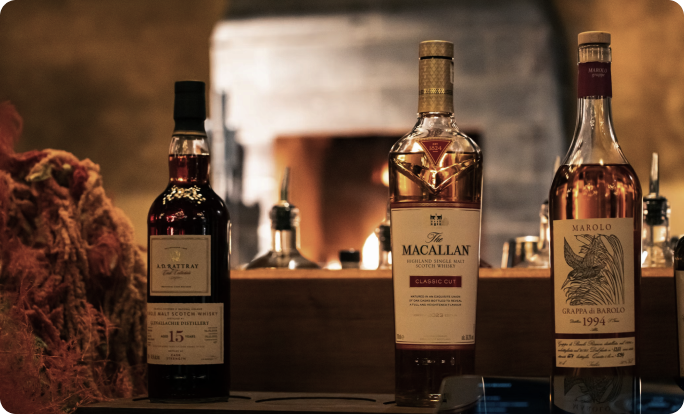
Research by the Scotch Whisky Association estimates that counterfeit and fraudulent spirits cost the industry hundreds of millions of pounds annually — and collectors buying vintage bottles without the right knowledge are among the most exposed.
In this guide, I’m going to show you exactly how to authenticate a vintage whisky bottle — step by step, with the same methods used by serious collectors and auction specialists. These are the techniques that have protected buyers from costly mistakes across thousands of transactions. Here’s precisely what you need to know before you buy a rare, hard-to-find bottle.
Most collectors assume the problem is confined to shadowy online marketplaces. It isn’t.
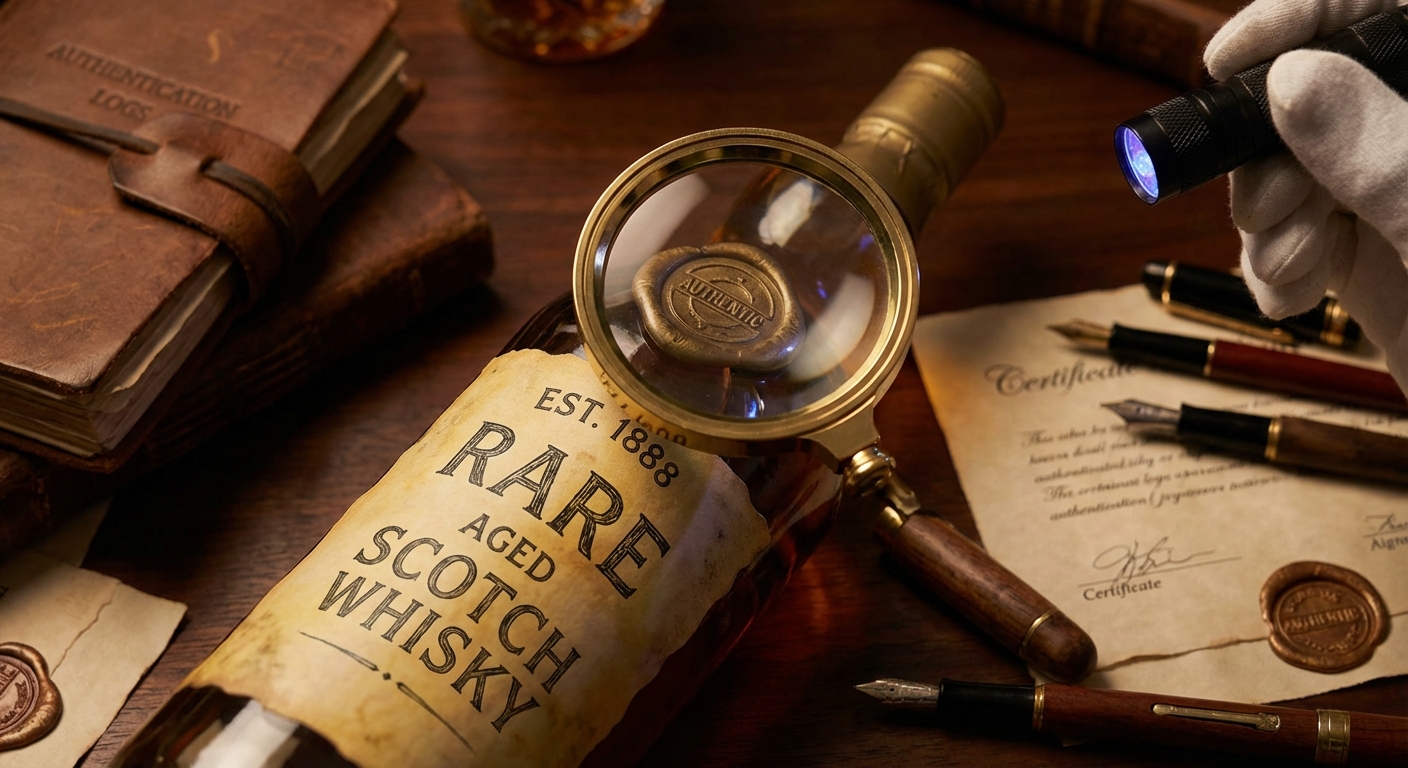
Counterfeit vintage whisky has appeared at established auction houses, private sales, and even within respected private collections. In 2017, a study by researchers at the University of Glasgow and Stellenbosch University used radiocarbon dating to analyse 55 bottles claiming to be pre-1970s Scotch — and found that a significant proportion contained whisky distilled far more recently than claimed. Some bottles labelled as 1800s-era single malts contained whisky that post-dated the Second World War.
Here’s the deal: the financial incentive for faking a rare bottle is enormous. A genuinely authenticated 1960s Macallan can sell for tens of thousands of pounds. The cost of producing a convincing-looking fake — period-style label, matching capsule, old glass — is a fraction of that. When the margin is this high, forgeries follow.
Buying from a trusted specialist with deep knowledge of the market offers meaningful protection. But even then, knowing what to look for yourself is the difference between a confident purchase and a costly regret. Let’s go through every step.
The label is the forger’s first battleground — and often their most obvious weakness.
Start with the typography. Printing technology changed significantly across the twentieth century. Labels from the 1950s and 1960s were typically letterpress-printed, producing a slightly embossed quality on the paper. Offset lithography became common in the 1970s. Modern inkjet or laser printing leaves a flat, hyper-uniform finish that letterpress never did — and that uniformity is a tell.
Look at the paper itself. Genuine vintage labels age in specific ways: the paper yellows from the outside edges inward, adhesive residue sometimes bleeds through to the front, and old glue contracts over decades causing fine wrinkles at the label edges. A freshly applied label on an old bottle will sit unnaturally flat and clean.
Now:
Also check the tax stamp or revenue label if present. UK duty stamps were mandatory on spirits bottles until 1983. Their presence — or absence — needs to match the claimed bottling date.
The capsule is often the most reliable physical indicator of a bottle’s genuine age — and the hardest element for forgers to replicate convincingly.
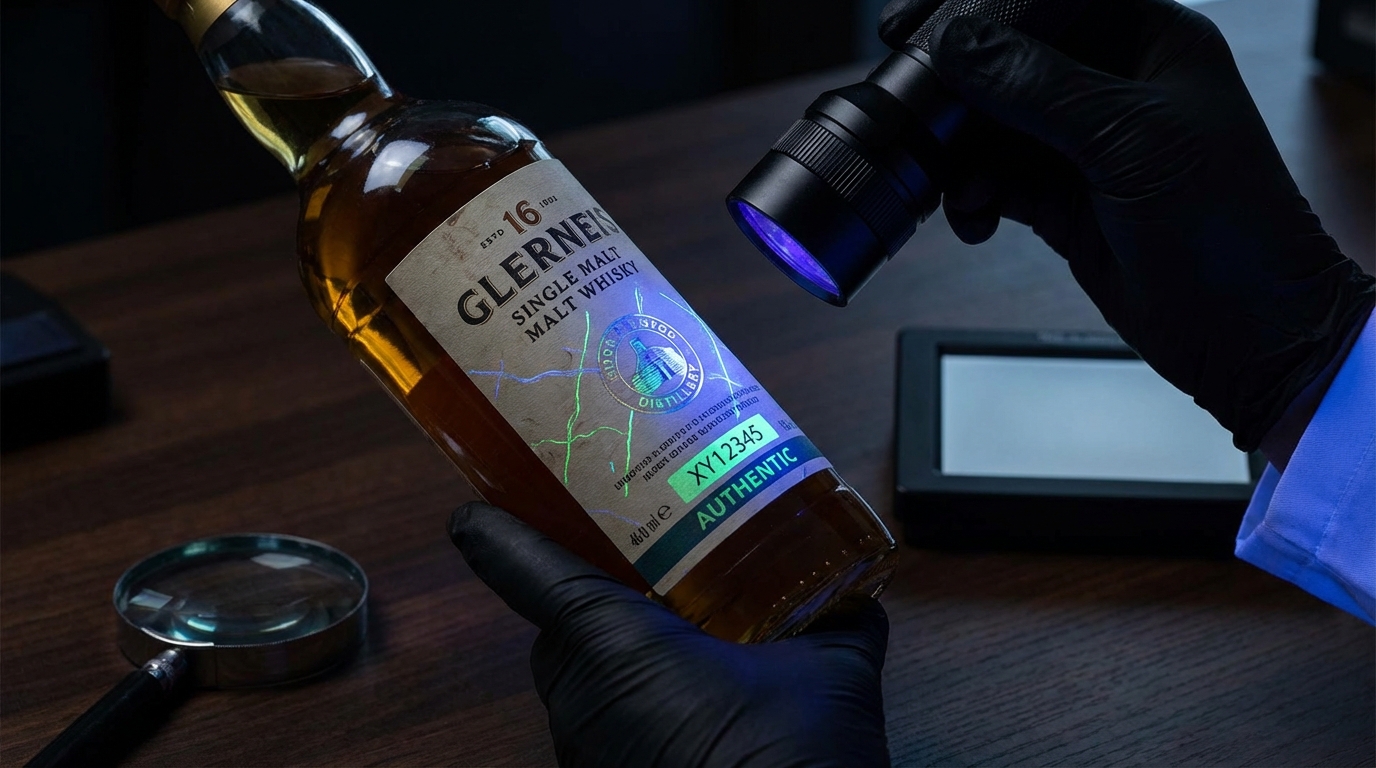
Lead capsules were standard on premium Scotch whisky until the late 1980s and early 1990s, when health concerns prompted a shift to aluminium, tin, and eventually wax. A bottle purportedly bottled before 1990 from a major distillery should carry a lead capsule — soft, slightly dull, and with a distinct heft when you press the top. Modern foil capsules feel lighter, sharper-edged, and more uniform.
Examine the seam. Authentic lead capsules were machine-crimped at bottling and then age in place. The crimps should be consistent, with no sign of the capsule having been removed and reapplied. Forgers who refill bottles often struggle to replicate period-correct crimping — look for small tears, irregular folding, or evidence that the foil has been stretched.
Now check the capsule’s oxidation pattern. Lead ages to a soft grey patina, developing a matte surface over decades. It should not be shiny. If the lead looks fresh — even if it appears to be lead — consider whether it was recently sourced and applied.
Finally, check that capsule colour and style matches the distillery’s known presentation in that era. Distilleries maintained consistent capsule colours by expression: Macallan red capsules, Glenfiddich gold, Glenlivet green. Deviations from period-correct colours, without documented explanation, are worth investigating.
Fill level is one of the most misunderstood indicators in vintage whisky authentication — and one of the most important.
Whisky evaporates through corks and seals over time. This natural loss is called the “angels’ share.” Unlike wine, where fill level is a direct proxy for storage quality, whisky evaporation rates depend on storage conditions: a bottle kept in a warm room loses more than one kept cool and dark. The type of closure matters too — wax-sealed bottles lose less than those with simple corks.
As a general guide, acceptable fill levels for an upright-stored bottle are:
Here’s what matters: fill level alone does not prove authenticity, but fill level inconsistent with the claimed age and storage conditions is a strong indicator something is wrong. A purported 1960s bottle at nearly full fill with no evidence of cold cellar storage should prompt questions, not confidence.
Also check the colour of the spirit through the glass. Very old whiskies often show a deep amber or mahogany hue from extended contact with oak. Suspiciously pale liquid in a bottle claiming significant age is worth examining.
Bottle shapes, glass quality, and manufacturing marks all changed across the twentieth century — and those changes create a physical timeline forgers cannot easily falsify.
Glass manufacturing methods evolved significantly. Pre-1920s bottles were often hand-blown or mould-blown, producing slight irregularities in wall thickness and gentle undulations across the surface. The base of genuinely old bottles often shows a pontil mark — the scar left where the blowpipe was detached during hand production. Its presence on a bottle claiming 19th-century origin is consistent; its absence on a bottle claiming pre-1900 provenance is suspicious.
From the 1920s through the 1970s, most spirits bottles were machine-made, with seam lines running to the top of the neck. Check the seam line: in genuinely old bottles, this line can be slightly uneven. Modern machine bottles have perfectly uniform seams.
Now look at the bottle’s base markings. Manufacturing codes, mould numbers, and plant codes on bottle bases can often be cross-referenced against glass manufacturer records. Owens-Illinois, for example, used specific plant codes that changed at known points in their history. If a bottle claiming 1960s origin carries a base code from a plant that opened in 1975, the timeline doesn’t hold.
Finally, check the embossing. Many distilleries embossed their bottles with the distillery name or logo. Embossing on genuine period bottles has a particular depth and regularity that differs from modern reproduction glass. Look at the letter edges: genuine period embossing has a slightly frosted quality where the glass was pressed against the mould.
Provenance — the documented ownership history of a bottle — is the single most powerful authentication tool available to collectors.
A bottle with clear, traceable provenance is substantially lower risk than one offered without any history. When evaluating provenance, ask:
Auction house provenance is the strongest form. Bonhams, Scotch Whisky Auctions, and Whisky Auctioneer all maintain lot records, and many serious bottles have appeared in multiple auctions over decades with photographic documentation at each stage. If a seller can produce auction records, cross-check the lot number against the auction house’s public archive.
Private cellar provenance — bottles that have been in the same family or collection for decades without passing through the market — is harder to verify but not worthless. Look for supporting evidence: old invoices, gift receipts, photographs of the collection in situ, correspondence referencing the bottle, or even the storage conditions of the cellar itself.
Be cautious with any bottle offered as “recently discovered” without documentation. The most common cover story for a fake is a vague claim of a recently cleared estate or inherited collection with no paperwork.
The single best defence against a convincing fake is comparing it in detail against multiple verified examples of the same bottling.
This is where serious collectors develop an advantage over time. Reference materials that help with cross-referencing include:
Here’s the deal: if you cannot find a single verified photograph of a comparable bottling anywhere in auction records or collector databases, that is a significant warning sign. Genuinely rare bottles do appear rarely — but genuinely rare and previously unknown to the entire collector community is rare enough to warrant serious caution.
For further context on what makes specific bottles valuable and how the market prices rarity, see our guide to what makes a whisky bottle valuable.
For any bottle worth more than a few thousand pounds, professional authentication is not an optional extra — it is due diligence.
The whisky authentication landscape has professionalised significantly. Options include:
Auction house pre-sale review: If you are considering purchasing a bottle from auction, most major houses offer a condition report and their specialists will have reviewed the bottle prior to listing. This is not infallible — major auction houses have listed fakes — but it provides a baseline assessment.
Independent specialist authentication: Services such as those offered by The Rare Whisky Shop and specialist consultants can physically examine a bottle and produce a written assessment. Costs typically range from £150 to £500+ depending on the specialist and the scope of the assessment. For a bottle valued at £5,000 or more, this is an easily justified expense.
Radiocarbon and isotope dating: The most forensically rigorous method. The University of Glasgow’s research demonstrated that radiocarbon dating can establish whether a whisky was distilled before or after 1950 with a high degree of accuracy — and can narrow production dates further with additional isotope analysis. Laboratory testing costs approximately £300–£600 per sample. For bottles valued above £10,000, this is the gold standard.
Spectroscopic analysis: Near-infrared (NIR) and nuclear magnetic resonance (NMR) spectroscopy can characterise the chemical fingerprint of a spirit. While these methods are more commonly used in commercial fraud detection, some specialists have access to reference libraries of authenticated vintage whiskies that allow comparison testing.
When seeking professional verification, ask the specialist to provide a written report with their methodology and findings, not just a verbal opinion. A well-documented authentication report also adds to the bottle’s provenance for future sales.
Disclaimer: Authentication costs quoted here are indicative estimates based on publicly available information. Always verify fees directly with the specialist before commissioning a report, as prices may vary.
For more on mistakes that cost collectors money at this stage, see our guide to common whisky collecting mistakes.
Use this checklist when evaluating any vintage bottle:
Authenticating a vintage whisky bottle is a skill built from careful observation, good reference material, and — when the stakes are high — the right specialist support. The seven steps above form the core methodology used by experienced collectors and auction specialists worldwide.
Here’s what to do first: before any significant purchase, run through the checklist above. Even a five-minute visual assessment of label, capsule, fill level, and bottle glass will catch the majority of obvious fakes. If you pass the visual check, the next step is provenance — ask for documentation and trace it.
And when in doubt? Buy from a trusted specialist who has already done this work on your behalf.
At Glenbotal, every bottle in our collection has been assessed for authenticity before it reaches the shop. With 6 years of specialist experience, a private collector network spanning the UK and Europe, and thousands of bottles assessed, we know what genuine provenance looks like — and what it doesn’t.
Get Started — Browse the Full Collection at Glenbotal and buy with confidence — every bottle assessed, every provenance checked.
More common than most buyers expect. A 2018 study by scientists from the University of Glasgow and Stellenbosch University tested 55 bottles purporting to be rare pre-1970s Scotch and found that a significant proportion had been misdated. Forgeries appear not just in private sales but have been documented at major auction houses, making informed authentication skills essential for any serious collector.
No — not without testing. Highly skilled forgers can produce visually convincing labels, source period-correct glass, and apply aged-looking capsules that pass casual inspection. Absolute certainty for high-value bottles requires scientific analysis such as radiocarbon dating or isotope profiling, which can establish production dates to within a decade even for the liquid inside the bottle.
No. Fill level is one indicator among many, not a standalone proof. A high fill level is reassuring for a claimed recent bottling but can be suspicious for a genuinely old bottle — it suggests either exceptional storage or that the bottle was refilled. Equally, a low fill level in an old bottle does not confirm authenticity; it merely confirms the liquid has evaporated, which could happen to a fake kept in warm storage. Always use fill level in conjunction with label, capsule, glass, and provenance checks.
The most common giveaways are incorrect typography, paper that is too clean or too evenly aged, printing methods inconsistent with the era, era-incorrect wording (such as ABV percentages on a pre-1985 bottling), absent duty stamps, and label adhesion that looks too fresh. Forgers often source high-resolution scans of genuine labels and print them on modern paper — the result can look visually convincing but fails scrutiny of paper quality, ink texture, and physical aging patterns.
Reputable auction houses have in-house specialists who physically inspect every lot before listing — examining labels, capsules, fill levels, bottle form, and provenance documentation. Many also consult external specialists for particularly rare or high-value bottles. Auction records themselves become part of a bottle’s provenance trail, as a lot number and catalogue photograph provide independent documentation of the bottle’s existence and condition at a specific point in time.
It can be — provided you buy from a trusted specialist with a verifiable track record, clear returns policies, and demonstrated knowledge of what they are selling. Buying from private sellers on general marketplaces without authentication documentation significantly increases risk. Look for Trustpilot reviews, visible provenance information, and a seller prepared to answer detailed questions about a bottle’s history. See our vintage Scotch whisky guide for further guidance on buying safely.
The Macallan is consistently the most targeted distillery for counterfeiting, because its older expressions command the highest prices in the secondary market. A genuine 1960s Macallan Fine and Rare can sell for tens of thousands of pounds, making even an expensive fake dramatically profitable. Dalmore, Glenfarclas, Springbank, and pre-Diageo era silent distillery expressions such as Port Ellen and Brora are also frequently targeted because of their rarity and collector demand.
Only with extreme caution — and only at a price that accounts for the authentication uncertainty. A bottle with no traceable history is not necessarily a fake, but it carries meaningfully higher risk. If you proceed with an undocumented bottle, the price should reflect that uncertainty; if the seller is pricing it as if provenance exists, that mismatch is itself a red flag. For guidance on evaluating risk against value, see our whisky collecting mistakes guide.
Yes. Independent whisky specialists, major auction houses, and laboratory services all offer authentication assessments. Visual and physical inspection from a specialist typically costs £150–£500 depending on the provider and scope. Radiocarbon dating of the liquid costs approximately £300–£600 per test and is currently the most definitive method for establishing whether a whisky’s production date matches its claimed age. For bottles valued above £5,000, professional authentication is strongly advisable before purchase or sale.
For a physical specialist assessment — label, capsule, glass, and provenance review — expect to pay £150–£350. For a full written report suitable for insurance or resale purposes, allow £300–£500. Radiocarbon dating runs £300–£600 per sample and is typically worth commissioning for any bottle valued above £5,000. Authentication costs are almost always recoverable in the value added to a bottle with a verified report, particularly if you are planning to sell or insure the collection. For guidance on what your bottle might be worth, see our whisky valuation guide.
No. An intact wax seal is encouraging but not proof. Forgers can replicate wax seals, and original wax can be carefully removed and reapplied around a refilled bottle with a degree of skill. The wax seal should be considered alongside all other physical and documentary evidence, not treated as a standalone authentication.
Start with auction archive photographs from Scotch Whisky Auctions, Whisky Auctioneer, and Bonhams — search by distillery and approximate decade. These archives contain thousands of photographed lots with detailed condition notes and are publicly searchable at no cost. The Malt Whisky Yearbook and specialist collector forums are also useful reference points. If no comparable example appears in any public archive after thorough searching, treat that absence as a warning sign.
Explore the full collection at Glenbotal — rare whisky sourced from private collectors across the UK and Europe.