Longrow Red is one of the few annual whisky releases that genuinely earns the word rare — each edition pairs Campbeltown’s most heavily peated malt with a different wine cask, producing a bottle that never repeats itself and never sticks around for long.
Some annual releases announce themselves loudly. The Longrow Red does the opposite — it appears quietly each year, sells out before most collectors have had a chance to deliberate, and disappears into private cellars across the world. Each edition pairs Springbank’s heavily peated Longrow expression with a different wine cask finish, from New Zealand Pinot Noir barriques to South African Malbec barrels, producing a series where no two bottles taste the same and no edition can be replicated. For collectors who value both rarity and flavour complexity, the Longrow Red sits in a category of its own. This guide covers every confirmed release in the series — with verified ABVs, cask sources, and collector context — so you know exactly what you’re looking for and why it matters.
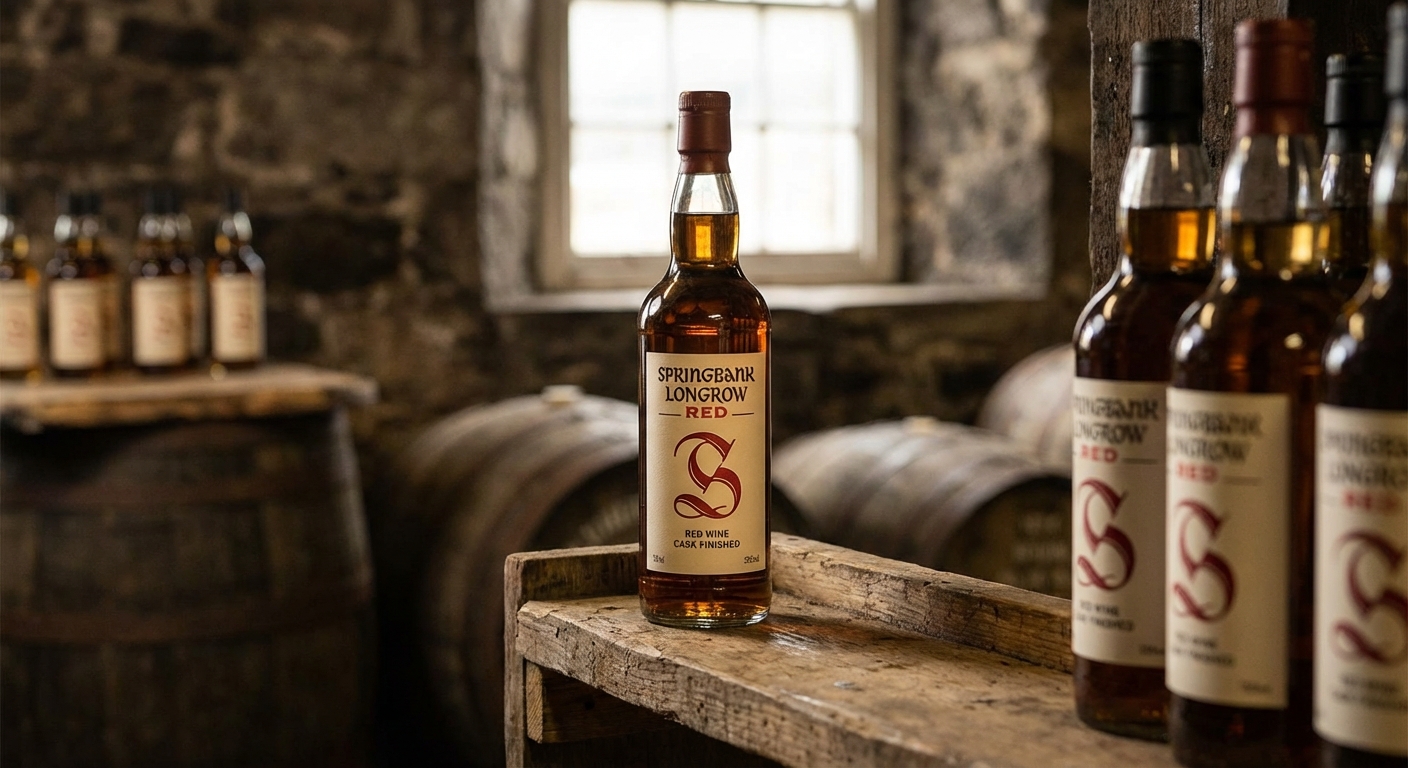
Springbank Distillery in Campbeltown produces three distinct single malts under one roof — a feat virtually unmatched in Scotch whisky production. Longrow is the most heavily peated of the three, using malt dried over peat smoke for approximately 48 to 55 hours, sourced from Islay. The result is a significantly smokier profile than Springbank’s house style, closer in peat character to an Islay malt but with the saline, maritime edge that is unmistakably Campbeltown.
Unlike the core Longrow range — which includes the no-age-statement bottling and occasional peated expressions — the Longrow Red series is defined by its wine cask finishing philosophy. Each release spends the majority of its maturation in ex-bourbon or refill casks, then undergoes a final finishing period of two to four years in a specific wine cask. The wine cask is always sourced from a named vineyard or estate, adding a provenance dimension that most distilleries simply do not bother with.
Springbank releases the Longrow Red once a year, typically in the late winter or early spring. The release is announced through Springbank’s website and allocated through a small network of specialist retailers and the distillery’s own shop. Bottle counts across confirmed editions have ranged from approximately 9,000 to 10,000 bottles worldwide — a number that sounds substantial until you account for global collector demand. Bottles regularly sell out within hours of allocation, and secondary market prices climb steeply in the months and years that follow.
The series has no fixed age statement — each release carries its own age, determined by when the spirit was laid down and when the distillery deemed it ready. Editions have ranged from 10 years old to 15 years old, with the wine cask finishing period forming the final chapter of each whisky’s maturation story.
These rankings are based on four criteria applied equally across all confirmed editions:
Collector demand and secondary market premium. Editions that command the largest premiums on the secondary market reflect both scarcity and sustained interest from serious collectors. A bottle trading at two or three times its original retail price tells a different story than one still available at release price.
Critical reception. Where verified tasting notes and scores from established reviewers exist, they inform the ranking. The emphasis here is on balance — how well the wine cask and the peated spirit work together, rather than raw power or novelty.
Rarity and bottle count. Smaller editions with limited geographic distribution rank higher for collectability, all else being equal.
Provenance and cask distinction. Editions sourced from named, single-estate wine casks — with a clear and traceable origin — score higher than those with less specific provenance.
| # | Release | Wine Cask | Age | ABV | Bottles | Rarity |
|---|---|---|---|---|---|---|
| 1 | Longrow Red 2024 | Pinot Noir (French, single estate) | 7 years | 57.1% | Limited | Very High |
| 2 | Longrow Red 2022 | Pinot Noir (Valli, New Zealand) | 15 years | 51.4% | ~9,400 | Very High |
| 3 | Longrow Red 2012 | Cabernet Sauvignon (Angove’s Long Row, Australia) | 11 years | ~46% | Limited | Extremely High |
| 4 | Longrow Red 2021 | Malbec (De Toren, Stellenbosch, South Africa) | 10 years | 52.5% | ~10,000 | High |
| 5 | Longrow Red 2020 | Cabernet Sauvignon (Chilean) | 13 years | 51.6% | ~9,000 | Very High |
| 6 | Longrow Red 2023 | Tawny Port | Undisclosed | Undisclosed | Limited | Very High |
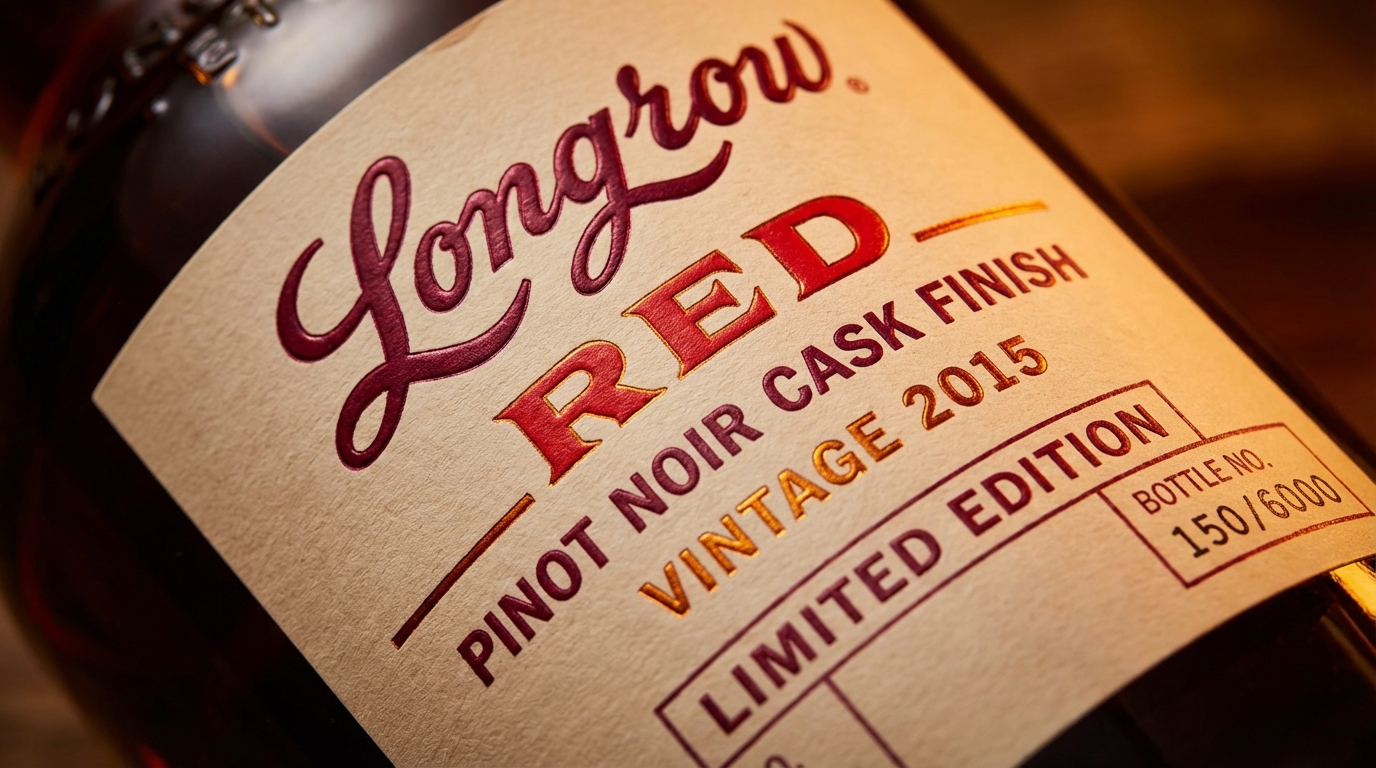
Cask: Single estate French Pinot Noir barriques | Maturation: 4 years ex-bourbon, 3 years Pinot Noir | ABV: 57.1% | Release: 2024
The 2024 edition sits at the top of this ranking for several reasons, beginning with its ABV. At 57.1%, this is the most powerful cask-strength Longrow Red release confirmed in the series, and that strength is not incidental — it is the result of a shorter overall maturation (seven years) that allows the raw, peaty character of the new make to remain present and forceful beneath the wine cask influence.
The maturation split is instructive. Four years in ex-bourbon casks builds a foundation of vanilla and light citrus, then three years in single estate French Pinot Noir barriques introduce layers of red fruit — strawberry, cranberry, cherry — without softening the smoke into obscurity. Reviewers who assessed this edition noted that the peat “plays a subtle role further back on the palate,” which, for a whisky at this ABV, represents genuine balance rather than brute force.
For collectors, the 2024 edition matters because it was released through ballot via a small number of specialist retailers including Royal Mile Whiskies. Ballot allocations of Springbank-family releases are a reliable signal of genuine demand outstripping supply — and post-ballot secondary prices have reflected that consistently across previous editions. If the 2022 Pinot Noir is any guide, bottles of the 2024 will only become harder to source as the years pass. This is a bottle that serious collectors pursuing the complete Longrow Red set will not want to miss.
Cask: Pinot Noir barriques, Valli Vineyards, Central Otago, New Zealand | Maturation: 11 years ex-bourbon, 4 years Pinot Noir | ABV: 51.4% | Bottles: ~9,400 | Release: 2022
The 2022 edition is the most mature Longrow Red confirmed in the series at 15 years old, and it carries that age with an unusual degree of elegance. Valli Vineyards in Central Otago, New Zealand, is an internationally regarded Pinot Noir producer, and the choice of cask adds a layer of vinous credibility to this release that goes beyond marketing copy.
The extended finishing period of four years in Pinot Noir barriques is the longest wine cask period confirmed across the series. That extra time has produced a nose that reviewers describe as notably mellow — bramble jam, red apple, tobacco — before the underlying smoke reasserts itself on the palate. The tension between the polished wine influence and the rugged peat is the defining character of this edition: it is simultaneously the most wine-forward and the most technically accomplished of the confirmed Longrow Red releases.
At 9,400 bottles, the 2022 represents one of the smaller production runs in the series. The combination of age statement, named single-estate cask, and a release year that is now several years in the past makes this an actively sought edition on the secondary market. Collectors who secured it on release have seen meaningful appreciation — and those who did not are now paying a significant premium to catch up.
Cask: Cabernet Sauvignon hogsheads, Angove’s Long Row, Australia | Maturation: 7 years ex-bourbon, 4 years Cabernet Sauvignon | ABV: ~46% | Release: 2012
The 2012 edition is the earliest confirmed release in the Longrow Red series, and its age alone makes it one of the most collectible bottles in this guide. More than a decade after release, bottles in original condition from the 2012 edition are rarely seen and, when they do appear, attract serious collector interest.
The cask origin is one of the most unusual in the series. Angove’s Long Row is an Australian wine estate whose own name — Long Row — creates a deliberate and elegant parallel with the Longrow distillery. The Cabernet Sauvignon hogsheads contributed exactly what you would expect from that variety: blackberry, dark plum, a hint of leather and cedar, and a dry, tannic finish that worked particularly well with the spirit’s smoky, saline backbone. Tasting notes from the period describe a “light peatiness” balanced by sweetness on the nose, evolving to oak, leather, and blackberry with cinnamon on the palate.
At a release price of around £47.99, the 2012 now represents an entirely different value proposition. This is the edition that established the series’ identity — the founding bottling that proved Springbank’s instinct for wine cask finishing was not a novelty but a genuine programme. For collectors building a complete set, finding a bottle of the 2012 is the hardest task of all.
Cask: Refill Malbec red wine casks, De Toren Private Cellar, Stellenbosch, South Africa | Maturation: 7 years ex-bourbon, 3 years Malbec | ABV: 52.5% | Bottles: ~10,000 | Release: February 2021
The 2021 Malbec edition stands out in the series for the specificity of its cask provenance. De Toren Private Cellar in Stellenbosch is one of South Africa’s most decorated boutique wine estates, known for Bordeaux-style blends of exceptional quality. The refill Malbec casks sourced from De Toren contributed a more restrained wine influence than fresh casks would have — the “refill” designation is important here, as it means the casks had already previously held whisky, reducing the intensity of the wine tannins and allowing the Longrow spirit’s peaty character more room to express itself.
The result is a whisky of notable integration. At 52.5%, there is genuine substance on the palate without the outright power of the 2024 cask-strength edition. The peat is present and assertive; the Malbec adds dark fruit — blackberry, plum, a hint of chocolate — without dominating. This edition has been described as one of the better-balanced releases in the series precisely because the refill cask approach prevented the wine from overwhelming the spirit.
Released at £57.00 through Cadenhead’s — Springbank’s retail arm — the 2021 Malbec was available for one day before selling through. At 10,000 bottles, it had the largest confirmed production run in the series, yet it remains consistently hard to source at anything close to its original retail price.
Cask: Chilean Cabernet Sauvignon | Maturation: Predominantly ex-bourbon, final finish in Cabernet Sauvignon casks | ABV: 51.6% | Age: 13 years | Bottles: ~9,000 | Release: 2020
The 2020 edition returns to Cabernet Sauvignon — the same variety that defined the founding 2012 release — but sources its casks from Chile rather than Australia, producing a noticeably different flavour profile. Chilean Cabernet Sauvignon is typically characterised by riper, more generous fruit than its Australian or Bordeaux counterparts, with dark cherry, blackcurrant, and a softer tannic structure.
At 13 years old and 51.6% ABV, this is a confident, well-structured whisky. The additional maturity compared to the 2021 Malbec adds depth and complexity to the oak influence, and the Chilean Cabernet Sauvignon casks have contributed a fruit-forward wine character that sits comfortably alongside the peat. With approximately 9,000 bottles — the smallest confirmed production run in the series alongside the 2022 — the 2020 edition is among the harder releases to source.
The comparison with the 2012 Cabernet Sauvignon is instructive for collectors: the 2012 uses Australian casks and is older; the 2020 uses Chilean casks and is two years younger at release. Neither tastes like the other. That diversity within a single grape variety is one of the reasons the Longrow Red series holds such fascination for collectors who study it closely.
Cask: Tawny Port | Release: 2023 | Details: Limited, full specifications not publicly confirmed
The 2023 Tawny Port edition sits at the bottom of this ranking not because it is the least desirable, but because the least verified information is available about it. Tawny Port casks are a departure from the predominantly red wine cask focus of earlier releases — Tawny Port is an oxidatively aged, fortified wine with a distinctive nutty, dried fruit, and caramel character that is quite different from a fresh red wine barrel.
Where earlier editions used wine casks from specific producers in named wine regions, the confirmed details on the 2023 Tawny Port release are more limited in the public record. What is known is that it follows the series’ established pattern of limited release through specialist retailers and Cadenhead’s, with a production run consistent with previous editions.
For collectors, the 2023 Tawny Port represents an interesting stylistic pivot. Tawny Port casks tend to add warmth, raisin, dried orange peel, and a nuttiness that red wine casks do not — the interaction with the Longrow peat character would produce something markedly different from the Pinot Noir or Malbec editions. As more tasting notes and secondary market data accumulate for this release, its position in any ranking may shift considerably. It earns its place in this guide as part of the complete Longrow Red picture, and for any collector building the full set, it is as essential as any other.
Start with the current and recent releases. The 2024 Pinot Noir is the most recent edition and, despite being in the recent past, will become progressively harder to source as it moves deeper into private collections. The 2021 Malbec and 2022 Pinot Noir are the next most accessible — not readily available, but still appearing through specialist retailers and private sales.
Register for allocation lists. Springbank-family releases — including the Longrow Red — are typically distributed through a small network of specialist retailers who maintain customer lists. Royal Mile Whiskies, Master of Malt, The Whisky Exchange, and independent specialists like Glenbotal regularly handle Springbank allocations. Being on the right lists before a release is announced is how collectors secure bottles at retail rather than paying secondary market premiums.
Track the secondary market. Auction platforms including Scotch Whisky Auctions and Whisky Auctioneer are the primary venues where older Longrow Red editions appear. Monitoring hammer prices across several auctions gives you the clearest picture of what each edition is genuinely worth — and where the real demand lies. For context, editions from the earlier part of the series regularly sell for three to five times their original retail price.
Consider condition carefully. Longrow Red bottles have become collector items in their own right — original packaging, intact tax stamps, and level fills all affect secondary value. If you are collecting to hold rather than to drink, condition is as important as provenance.
For a broader perspective on building a rare whisky collection, including how to store, insure, and eventually sell rare bottles, the ultimate whisky collecting guide is essential reading. And if you are weighing the Longrow Red series against other annual releases, our guides to the Laphroaig Cairdeas series and the Aberlour A’bunadh series offer useful comparisons on the annual release collector model.
The Longrow Red series is annual — and finite. Each year, one edition is released and one is gone. Miss an edition at release and you are buying it on the secondary market at a premium. The series rewards those who are paying attention.
No two editions taste alike. The variety of wine cask sources — Australian Cabernet Sauvignon, South African Malbec, New Zealand Pinot Noir, Chilean Cabernet Sauvignon, Tawny Port — means the series is not a repetition but a genuine annual experiment in flavour. Collectors who drink as well as collect will find real diversity here.
Secondary market values reflect sustained demand. The Longrow Red is not a series that spikes on release and then fades — it builds collector interest over time. Earlier editions are actively sought by collectors building complete sets, and values have trended upward across most confirmed releases.
The earlier the release, the harder it is to find. The 2012 founding edition is now extremely rare in good condition. The 2020 and 2021 editions are uncommon. The 2022 and 2024 editions still appear through specialist retailers and auction, but availability narrows every year.
Campbeltown single malt is still undervalued relative to Speyside and Islay. Springbank’s output consistently over-performs in blind tastings relative to its market price — and the Longrow Red, as one of its most limited and distinctive releases, may still represent genuine value for the collector prepared to move decisively.
For context on what drives value in rare whisky more broadly, our guides on what makes a whisky bottle valuable and how much is my whisky worth provide a clear framework for understanding the market.
The Longrow Red series is everything an annual release should be: genuinely limited, purposefully varied, and built on a distillery philosophy — Springbank’s commitment to traditional production and unhurried maturation — that gives every edition real provenance. Where many annual releases trade on brand recognition alone, the Longrow Red earns its status through the quality of what is in the bottle.
For collectors, the message is straightforward. The earlier editions — particularly the 2012 Cabernet Sauvignon — are now exceptionally rare and should be treated as priority acquisitions if condition and price are right. The 2022 Pinot Noir and 2021 Malbec are the most reliably sought-after of the recent run. The 2024 Pinot Noir, at cask strength and from a single estate French source, is the most exciting edition in years and will almost certainly be viewed as a highlight of the series as it matures in the bottle.
At Glenbotal, we source rare and limited whisky from private collectors across the UK and Europe — including Springbank-family bottles that no longer appear on the shelves of mainstream retailers. If you are building a Longrow Red set, or looking for a specific edition, Get Started — browse the collection at glenbotal.co.uk and contact us for a free valuation if you have bottles of your own to sell.
Based on publicly confirmed information, the Longrow Red series includes at least six verified editions: the 2012 Cabernet Sauvignon (the founding release), a 2020 Chilean Cabernet Sauvignon, the 2021 Malbec, the 2022 Pinot Noir, a 2023 Tawny Port, and the 2024 Pinot Noir. Springbank has not published a comprehensive chronological list of every edition, and there may be releases between 2012 and 2020 that have not been fully documented in the public record. Collectors researching the complete set are advised to consult specialist retailers and whisky auction records for a fuller picture.
Standard Longrow is a heavily peated Campbeltown single malt matured primarily in ex-bourbon and refill sherry casks, bottled at a range of ages and strengths. The Longrow Red series differs in its annual release model and its defining characteristic: a final maturation or finishing period in a specific wine cask — a different variety each year. The wine cask finishing adds a fruit and tannin dimension that the standard Longrow does not carry, while retaining the core peated Campbeltown character. Each Longrow Red edition is also limited and non-repeating, making it a distinct collector’s proposition compared to the regular range.
Yes. Longrow is produced using malt dried over peat smoke for approximately 48 to 55 hours, creating a phenolic level significantly higher than Springbank’s house malt. In the Longrow Red series, this heavy peat character is balanced — sometimes in tension, sometimes in harmony — with the wine cask finish. The degree to which the peat comes through varies by edition: the 2024 cask-strength Pinot Noir shows peat “further back on the palate” due to its power, while the Malbec editions tend to show a clearer peat-fruit interplay. But in every confirmed Longrow Red release, the peat is present and significant.
Each Longrow Red edition is matured first in ex-bourbon casks — typically refill barrels — for the majority of its maturation period, often seven to eleven years. The spirit is then transferred into wine casks for a finishing period of two to four years. The wine casks are sourced from specific producers: confirmed sources have included Angove’s Long Row in Australia, De Toren Private Cellar in Stellenbosch, South Africa, and Valli Vineyards in Central Otago, New Zealand. The choice of refill versus fresh wine casks significantly affects the intensity of wine influence — the 2021 Malbec used refill casks, producing a more subtle integration, while the 2022 Pinot Noir used fresh barriques for a more pronounced wine character.
The 2012 Cabernet Sauvignon — the founding release of the series — is the most difficult to source and commands the highest premiums when it appears. Bottles in original condition from the 2012 edition are genuinely rare and would be treated as priority acquisitions by any serious collector of the series. Among more recent releases, the 2022 Pinot Noir has shown the strongest secondary market appreciation, driven by its combination of age statement, named single-estate cask, and smaller production run of approximately 9,400 bottles. The 2024 cask-strength Pinot Noir is expected to build a similar collector premium as its availability on the primary market diminishes.
At release, Longrow Red editions are available through a small network of specialist retailers with Springbank allocations — including Cadenhead’s (Springbank’s own retail arm), Royal Mile Whiskies, and other independent specialists. Current and recent editions are often distributed by ballot rather than open sale, reflecting demand far exceeding supply. Post-release, bottles appear through specialist rare whisky retailers like Glenbotal, through whisky auction platforms including Scotch Whisky Auctions and Whisky Auctioneer, and occasionally through private sales. Older editions from earlier in the series are rarely seen on the open market and typically require either a collector network or a patient watch of auction calendars.
ABVs across confirmed Longrow Red editions range from approximately 46% (2012 Cabernet Sauvignon) to 57.1% (2024 Pinot Noir). The series does not follow a fixed ABV — each edition is bottled at whatever strength the distillery determines appropriate for that particular maturation. Recent editions have tended toward the 51–57% range, reflecting the growing collector preference for higher-strength, non-chill-filtered bottlings. All confirmed editions are bottled at natural colour and without chill filtration, consistent with Springbank’s approach across its entire range.
For collectors interested in the intersection of regional character, production craft, and annual series dynamics, the Longrow Red is one of the most compelling series in Scotch whisky. The series is backed by Springbank Distillery’s reputation as one of the most respected — and most traditional — distilleries in Scotland. The annual format creates genuine scarcity with each successive release, and the variety of wine cask sources means the series rewards both drinking and long-term holding. Secondary market prices for older editions have shown consistent appreciation. For the collector who values rarity, provenance, and a distillery with genuine production integrity, the Longrow Red deserves serious consideration. See our broader guide to whisky collecting for more context.
Springbank and Longrow are two distinct single malt expressions produced at the same distillery in Campbeltown. Springbank uses lightly to moderately peated malt and is triple-distilled in a manner unique to Campbeltown; Longrow is heavily peated and double-distilled, producing a smokier, more assertive spirit. The Longrow Red series is specific to the Longrow expression — it is not a Springbank product, even though both come from the same building. A third expression, Hazelburn, is unpeated and triple-distilled, completing Springbank’s three-distillate model. For more on Springbank’s family of releases and what drives value in the broader Campbeltown category, see our guide to what makes a whisky bottle valuable.
Finding older Longrow Red editions requires a combination of patience, network, and market knowledge. The most reliable routes are: specialist rare whisky retailers with private collector networks (where bottles from earlier editions occasionally surface), whisky auction platforms where you can set saved searches for specific editions, and collector communities where members occasionally sell or trade bottles. For a free valuation of any Longrow Red bottle you already own, or to enquire about sourcing a specific edition, Glenbotal offers free valuations and active sourcing through its private collector network. Also see our guide on how much is my whisky worth for a clear picture of current secondary market context.
The Longrow Red occupies a distinctive position among annual release series. Unlike the Laphroaig Cairdeas series, which focuses on varying cask types including sherry, port, and oloroso across an Islay peat base, the Longrow Red is specifically dedicated to wine casks — always red, always from a named producer. The Aberlour A’bunadh series offers a cask-strength annual release model, but uses a consistent Oloroso sherry maturation rather than changing the cask type each year. The Longrow Red’s annual variety makes it simultaneously more unpredictable and more collectible — each edition is a genuinely different proposition, not a refinement of the same template.
Prices and secondary market values are for reference only — always verify current prices before buying or selling. Glenbotal does not guarantee availability of any specific release. For current stock and free bottle valuations, visit glenbotal.co.uk.
Explore the full collection at Glenbotal — rare whisky sourced from private collectors across the UK and Europe.