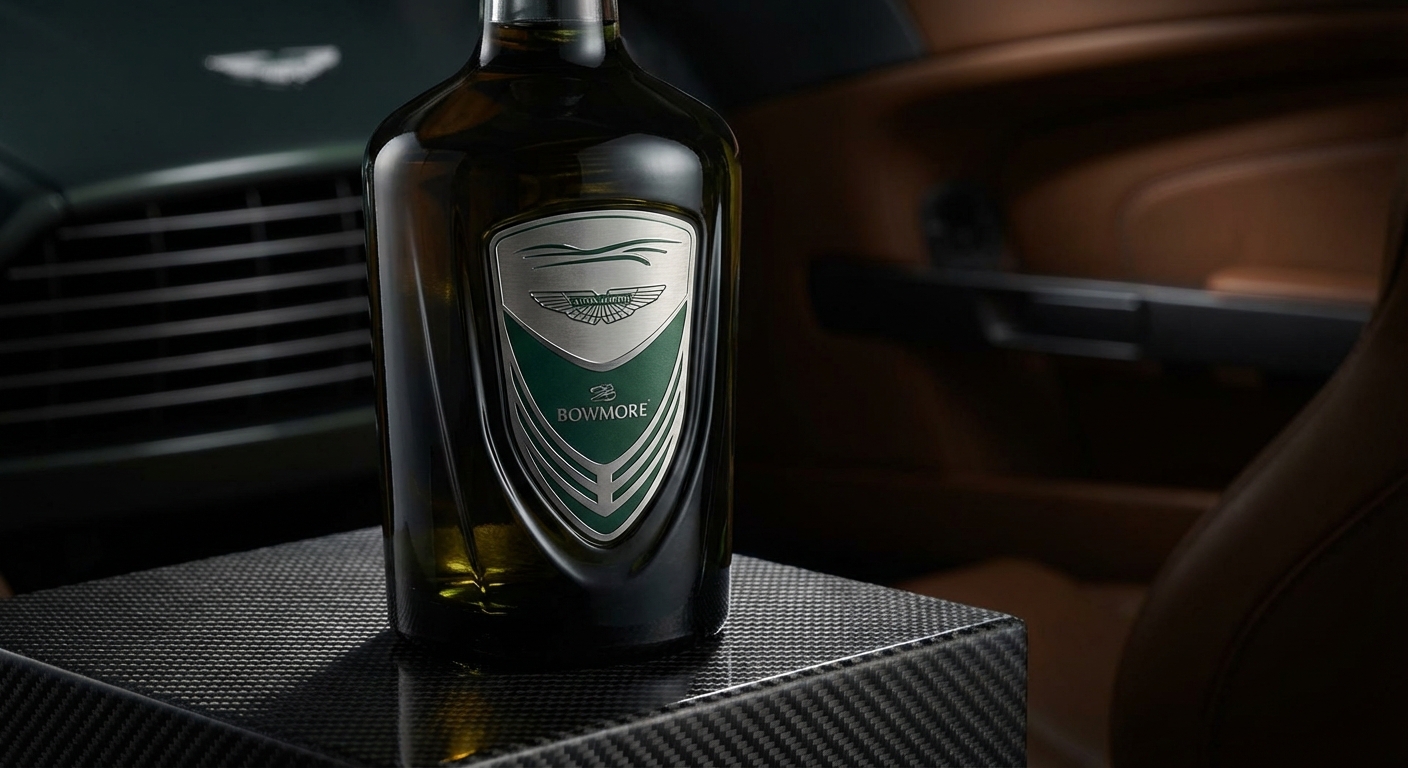
The Bowmore x Aston Martin collaboration is considered by independent analysts at Noble & Co to be among the world’s most collectable single malt partnerships — and every release has sold out on launch day.
Two British icons. One partnership built on shared obsessions: craftsmanship, precision, and the relentless pursuit of the extraordinary. This guide covers every release in the Bowmore x Aston Martin collaboration from its 2020 launch through the ultra-rare Masters’ Selection series, the opulent Arc-52, and the one-of-a-kind expressions that now trade hands for multiples of their original price. If you collect luxury brand collaborations — or simply want to understand why these bottles matter — you are in the right place.
The Bowmore and Aston Martin partnership is not a licensing deal dressed up in fancy packaging — it is a collaboration between two organisations that genuinely share a philosophy.
Both brands are rooted in British craftsmanship at the highest level. Bowmore has been distilling on Islay since 1779 — the island’s first licensed distillery, and by some measures Scotland’s second oldest. Aston Martin has been building cars since 1913, turning mechanical engineering into something closer to sculpture. The gap between them is over a century of separate history, but the underlying values have always rhymed.
The partnership was announced in 2020. At its core, the collaboration centred on a simple idea: the same principles that make a great Aston Martin — obsessive attention to detail, refusal to compromise, rarity as a feature not a marketing claim — are the same principles that make a truly great Scotch whisky. An independent 2023 study by Noble & Co recognised the partnership as contributing to Bowmore’s status among the world’s most collectable single malts.
Aston Martin builds each car in very small numbers. The DB5, the Vantage, the DBR1 race car — these are not products of mass production. They are expressions of what a small, dedicated team can achieve when volume is removed as a consideration.
Bowmore operates the same way with its upper-tier releases. The No. 1 Vaults — a damp, sea-level maturation cellar built partly below the tidal waterline of Loch Indaal — produces whisky in quantities defined entirely by what the casks yield, not by market demand. When a cask is ready, you bottle what you have. You do not manufacture more.
For collectors, provenance matters enormously. A collaboration between a 245-year-old Islay distillery and an automotive brand that produced the world’s most famous movie car — James Bond’s DB5 — carries a cultural weight that puts it in a different category from most limited editions. You are not just buying whisky. You are buying a piece of interlocking British heritage, bottled.
The timing is significant. The partnership launched during a period when luxury brand collaborations were reshaping the upper end of the collectables market. Whisky and automotive crossovers — see also Macallan with Bentley, Highland Park with Lamborghini — had proven that both audiences overlapped considerably. The Bowmore-Aston Martin pairing, however, was built on deeper institutional alignment: both brands are owned by groups with long-term luxury credentials (Suntory and the Aston Martin Lagonda group respectively), and both were committed to making the partnership last longer than a single release cycle.
Bowmore is not simply old — it is the foundational distillery of an island that now defines peated Scotch whisky for the world.
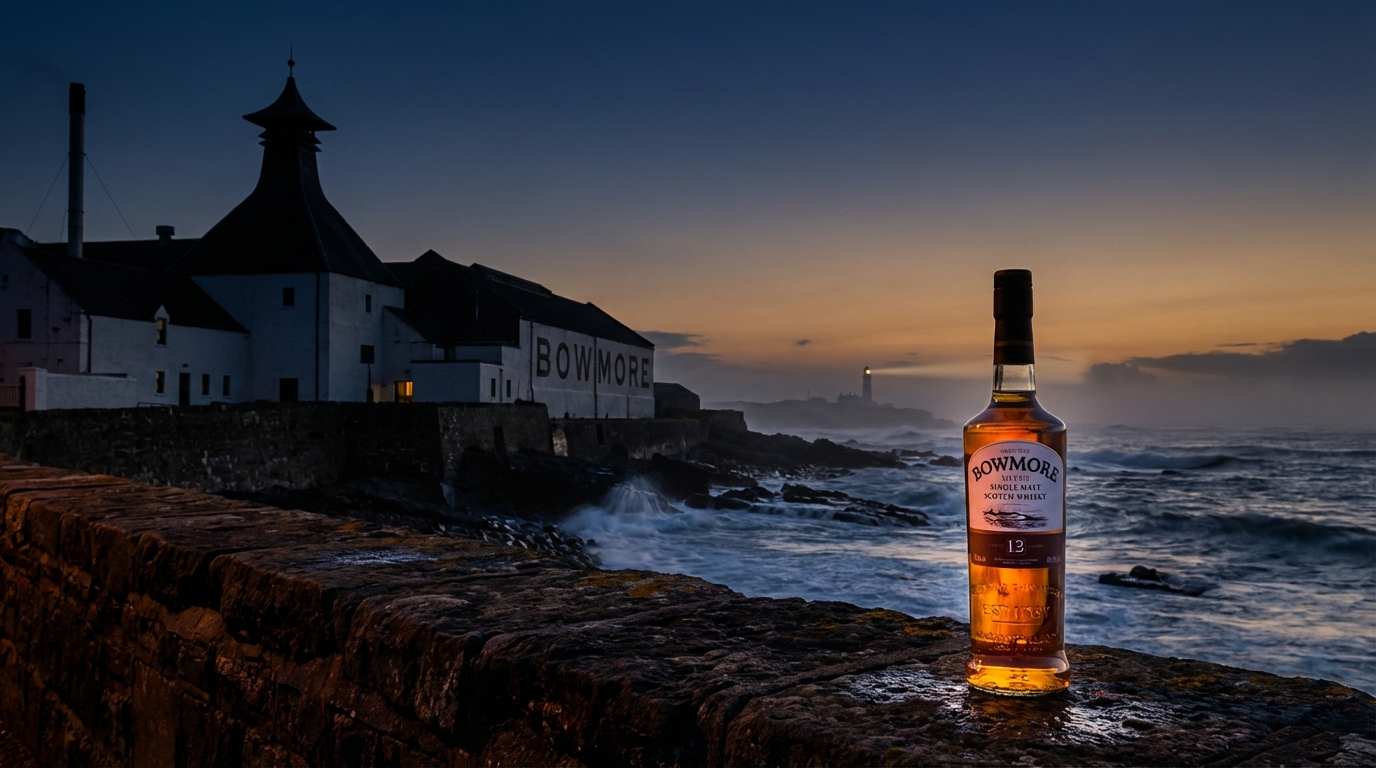
The distillery was established in 1779 by John P. Simson on the shore of Loch Indaal, the great sea loch that almost cuts Islay in half. Its position at the mouth of the loch means the whisky matures in conditions that no inland distillery can replicate: salt-laden Atlantic air seeps through the warehouse walls, interacting with the spirit through the oak over decades.
The No. 1 Vaults are the heart of Bowmore’s rarest releases — and the reason the Aston Martin collaboration could be built on genuinely exceptional liquid.
Built partly below sea level, the vaults stay cool and humid year-round. The angel’s share — the whisky that evaporates through the cask — is lower here than in warmer warehouses, meaning more liquid survives over very long maturation periods. Casks left in the No. 1 Vaults for 40, 50, or even 60 years retain more volume than they would in a conventional dunnage warehouse.
This is why Bowmore can offer 52 and 54-year-old expressions that would be financially impossible for most distilleries. The liquid is simply there to bottle.
The historical weight of the vaults is considerable. In 2012, Bowmore released its 1957 expression — the oldest Islay single malt ever released at that point — with only 12 bottles in existence. In 2023, a charity bottle drawn from the vaults sold at Sotheby’s for £562,500, setting a record for an Islay whisky at auction.
Bowmore’s claim as Islay’s oldest distillery is not disputed. It predates Lagavulin (1816), Laphroaig (1815), and Ardbeg (1815) by decades — and it was operating a full generation before most Scottish distilleries were brought into the licensed system at all.
The ownership story runs from founder Simson through the Mutter family (a German dynasty with deep Glasgow commercial ties), through a series of Scotch whisky groups, to Morrison Bowmore Distillers Ltd in the 1950s, until Suntory — the Japanese spirits giant — acquired the business in 1994. Suntory’s custodianship has been widely credited with expanding investment in the estate and enabling the long-maturation releases that now define Bowmore’s top tier.
Bowmore is a medium-peated Islay malt. This is important context for the Aston Martin collaboration releases, because the peating level sits between the aggressively smoky end of the island (Laphroaig, Ardbeg, Octomore) and the unpeated expressions from Bruichladdich. The result over very long maturation is a whisky where smoke becomes a background note — a signature rather than a flavour that dominates every other characteristic.
With age, Bowmore develops stone fruit, dark chocolate, toffee, and the unmistakable coastal brine that comes from decades of seaside maturation. These are flavours that complement rather than compete with long cask influence — which is exactly why the Masters’ Selection and Arc series work as well as they do.
The Masters’ Selection is the ongoing annual series at the heart of the Bowmore x Aston Martin collaboration — and each edition is different enough to reward collecting the full run.
The series launched with the collaboration itself and has released at least four editions, each drawing on different cask combinations and presenting slightly different age statements and flavour profiles. All editions share a commitment to small production volumes, non-chill filtration at natural colour, and packaging that references Aston Martin’s design language.
The first release established the template. A 21-year-old single malt drawn from six distinct casks — a combination of Tawny Port American Oak casks and Oloroso Sherry butts — it was designed as an introduction to the collaboration’s ambitions.
The tasting profile reflects that cask selection beautifully. The colour is a deep mahogany, driven by the Tawny Port influence. On the nose: Manuka honey, dark chocolate, and maple syrup. The palate delivers dark chocolate and vanilla against sherry layers, with Bowmore’s characteristic raw peat smoke emerging in the background. The finish is long, warming, and full of oaky spices and chestnut cream.
It sold out quickly. As a launch edition with a clean single cask origin story, Edition 1 quickly became the most sought-after in the series for completist collectors.
Edition 2 moved the series forward with a 22-year-old expression drawn from American oak hogsheads and sherry butts. The ABV came in at 51.5%, delivering more weight on the palate than the first edition. At launch it was priced at £390 and distributed exclusively through The Whisky Shop via their W Club ballot.
Tasting notes describe honey, sea salt, peaches, eucalyptus, and drying peat smoke — a profile that reads as more coastal and mineral than the first edition’s dark fruit orientation. It was made available exclusively through The Whisky Shop via their W Club ballot system, which itself reflects the scarcity position these releases occupy: not simply sold on a shelf, but rationed through a membership waiting list.
Edition 3 continued the annual cadence of the series. While full specifications are not disclosed at public retail level in the same way as Edition 2, the release maintained the same core philosophy: a 21 or 22-year-old maturation, non-chill filtered, drawn from hand-selected Bowmore casks with an intentional cask combination chosen for depth of flavour rather than consistency with previous years.
Edition 4 returned to the 21-year age statement. The current listing on Bowmore’s own website shows this most recent Masters’ Selection as an active product in their permanent range listing, which indicates the series has sufficient collector demand to be maintained year-on-year. Like its predecessors, it is listed out of stock — which is, in practice, how every release in this series ends.
The Masters’ Selection bottles carry packaging that directly references Aston Martin design principles. The presentation is darker and more architectural than Bowmore’s standard range — think grille-black and carbon accents rather than the heritage-cream labels on the 12 and 18-year-old core expressions.
All editions are produced in limited quantities, all are non-chill filtered (which preserves flavour integrity and makes the whisky cloud slightly with water or cold — a sign of quality, not a defect), and all carry the dual-brand endorsement of Bowmore’s Master Distiller and Aston Martin’s design team.
Pro Tip: If you are considering collecting the full Masters’ Selection run, Edition 1 and Edition 2 are the most actively traded on the secondary market. The price gap between editions has been widening as the series establishes a track record.
The Arc-52 is not just the most expensive release in the Bowmore x Aston Martin partnership — it is one of the most remarkable old Scotch whiskies released in the last decade.
The “Arc” name carries deliberate weight. In the context of this collaboration, it evokes the arc of time — half a century of maturation in the No. 1 Vaults — and the aerodynamic arc of Aston Martin’s most iconic silhouettes. Both meanings apply.
The original Arc-52 is a 52-year-old single malt drawn from a sherry butt and an American oak ex-Bourbon hogshead. These two cask types represent the extremes of flavour influence available to a blender: sherry gives dark fruit, spice, and richness; ex-Bourbon gives vanilla, custard, and lighter tropical fruit. Over 52 years, the interaction between those two influences produces a complexity that simply cannot be manufactured in a shorter maturation window.
The tasting profile confirms this. The nose delivers vanilla, custard cream, peach, pear, kumquat, mandarin, and guava — an extraordinary tropical fruit development that speaks directly to the half-century of patient maturation. On the palate: green grapes, peach melba, clementine, lime zest, tobacco leaves, and peat ash. The finish is herbal and medicinal, with exotic fruits, praline, and butterscotch.
This is whisky that has evolved far beyond what its raw ingredients would have predicted. The distillate that went into the cask in the early 1970s has become something genuinely different — as transformed by time as a raw sketch by a concept designer becomes a finished Aston Martin body.
The Mokume Edition of the Arc-52 adds a third dimension to the release. Mokume is a Japanese metalworking technique in which layers of different metals are folded and worked together to create organic, wood-grain patterns — used extensively in blade making and luxury object design.
Here it references both the layering of cask influences and the Japanese dimension of Bowmore’s ownership under Suntory. The Mokume Edition draws from three cask types — Bourbon, sherry, and claret — adding a wine-cask dimension that the original Arc-52 does not have.
The flavour profile shifts accordingly: fresher and more fruit-forward, with apricots, green apple, orange zest, guava, menthol, and liquorice root on the nose. The palate brings honey sweetness with macadamia and walnuts and a long, drying marine finish.
The Bowmore Mokume Edition Arc-52 is a direct conversation between Scottish whisky tradition, Japanese craft philosophy, and British automotive design. There are very few bottles in existence.
The Arc-54 extends the series to a 54-year-old expression — distilled in November 1968, making it a spirit from what Bowmore describes as “a golden era of distilling,” when the distillery had expanded its still house and modernised its operations.
At 42.3% ABV, the Arc-54 Iridos Edition represents the outermost reach of what long maturation in the No. 1 Vaults can produce. The Iridos Edition is a one-of-one piece — a single unique bottle — auctioned at Sotheby’s London in May 2025, with proceeds supporting communities around Suntory’s Scottish distilleries.
The name “Arc” itself, in this context, derives from the Latin for rainbow and the concept of iridescence — present in the titanium top of the Iridos decanter, engineered through temperature-variation metalworking to produce shifting colour in the light. The decanter was hand-crafted alongside a string-grain calfskin case made by Florentine artisans.
Cask composition: an Oloroso sherry seasoned European oak butt, a refill sherry butt, and an American oak ex-Bourbon hogshead — three casks, three layers of time, one bottle.
Every single release in the Bowmore x Aston Martin collaboration has sold out. Not eventually — immediately.
This is the clearest signal available to a collector: demand structurally exceeds supply from the first day of sale, which means secondary market prices move upward from day one rather than settling at or below retail.
Please note: the following represents general market context for educational purposes only. Past secondary market performance does not guarantee future values. Whisky collecting carries financial risk, and values can fall as well as rise. Always seek independent financial advice before making investment decisions.
The mechanics are straightforward. The Masters’ Selection series draws on a fixed number of hand-selected casks. Each edition is defined by what those specific casks contain — there is no ability to produce more bottles after the fact. When Bowmore and Aston Martin set an edition size, that number is immovable.
Distribution is typically controlled through specialist retailers and ballot systems — The Whisky Shop’s W Club allocation for Edition 2 is a clear example. This means the bottles do not reach a general retail shelf where casual buyers might purchase them; they go directly to engaged collectors who have pre-registered interest.
Both factors combine to create a structural scarcity that is genuine rather than manufactured.
The Masters’ Selection editions have traded at auction and on secondary specialist platforms at premiums above their retail release prices. Edition 1 in particular — as the series’ launch bottle — commands a premium as a collectible in its own right, independent of its value as whisky.
For reference, the Arc series occupies a different price bracket entirely. The Arc-54 Iridos Edition’s Sotheby’s sale in 2025 demonstrated the upper end of what this collaboration’s most extreme expressions can achieve. The 2023 charity bottle from the No. 1 Vaults sold for £562,500 at Sotheby’s — a benchmark that contextualises what genuinely old Bowmore liquid can command.
For context on understanding how collaboration releases are valued across the broader market, see our guide on what makes a whisky bottle valuable and our deeper analysis of how much your whisky might be worth.
The standard Bowmore range — the 12, 15, 18, and 21-year-old core expressions — is produced in volumes sufficient to meet global distribution. These are excellent whiskies, widely available, and reasonably priced for their quality.
The Aston Martin collaboration releases are categorically different in three ways:
See our broader guide to distilleries worth collecting for how Bowmore sits within the wider landscape of collector-grade Islay distilleries.
Understanding where the Aston Martin releases sit within Bowmore’s broader portfolio is essential to evaluating them as collector objects.
The Masters’ Selection sits above the standard age-statement range but below the ultra-rare No. 1 Vaults and Arc series in terms of liquid age and price. Think of it as the collaboration’s accessible tier — expensive, genuinely rare, and serious whisky — positioned where a serious collector can engage without the six-figure commitment that the Arc releases require.
| Expression | Age | ABV | Price Range | Notes |
|---|---|---|---|---|
| Bowmore 12 Year Old | 12 years | 40% | ~£35–45 | Core range, widely available |
| Bowmore 15 Year Old | 15 years | 43% | ~£55–65 | Darkest expression |
| Bowmore 18 Year Old | 18 years | 43% | ~£75–90 | Deep sherry influence |
| Bowmore 21 Year Old | 21 years | 43% | ~£130–160 | Upper standard tier |
| Masters’ Selection Ed. 1 | 21 years | NAS | Sold out | Collaboration exclusive |
| Masters’ Selection Ed. 2 | 22 years | 51.5% | £390 RRP | Collector tier |
| Arc-52 | 52 years | NAS | Premium | Exceptional rarity |
| Arc-54 Iridos | 54 years | 42.3% | Auction only | One of one |
NAS = Not age-stated on packaging; figures represent verified product details where available.
The jump in price between the standard 21-year-old and Masters’ Selection Edition 2 reflects not just the extra year of maturation but the fundamentally different cask programme, the much smaller production volume, and the collaboration premium. This is a pattern you see across the rare whisky market — for more context see our vintage Scotch whisky guide.
The standard Bowmore range is bottled at 40–43% — industry-standard strengths that suit everyday drinking. The Masters’ Selection Edition 2 at 51.5% is a cask-strength or near-cask-strength bottling, which means it has not been significantly reduced with water after maturation.
This matters to collectors for two reasons. First, it preserves more of the flavour compounds that dilution would strip away. Second, the higher strength is itself a signal of quality intent — producers only bottle at cask strength when they believe the liquid is strong enough to warrant it, and when the collector audience is sophisticated enough to appreciate it.
For a broader education on what to look for when evaluating rare whisky, our ultimate whisky collecting guide covers the full framework.
The Bowmore x Aston Martin releases attract collectors who are new to whisky — and that creates predictable errors.
Here is what to avoid.
Collaboration bottles at this price level attract fakes and misrepresented secondhand sales. The packaging for Masters’ Selection editions is distinctive, but secondary market listings are not always accompanied by the original box, certificate of authenticity, or purchase documentation.
Always buy from an authorised retailer or established specialist auction house. If a bottle at this tier arrives without its original packaging intact, treat that as a serious red flag. Our guide on how to authenticate vintage whisky covers the full verification process.
Some collectors, particularly those new to whisky collaboration series, assume that buying any edition of the Masters’ Selection is equivalent to buying any other. It is not. Each edition has a different cask programme, a different age statement, and a different ABV — and each has its own collector trajectory.
Edition 1 commands a specific premium as the series’ origin point. Edition 2 is the most accessible for those who want a verified ABV and an entry point at a known retail price. Later editions carry their own distinctions.
Buying only Edition 4 and assuming you have ‘the Aston Martin Bowmore’ is like buying only the latest model year of the DB5 and assuming you have covered the range.
This applies to all rare whisky but is particularly relevant at the price points the collaboration commands. Whisky in bottle does not continue to mature, but it can degrade significantly if stored incorrectly: direct sunlight fades labels and can affect the spirit through photochemical reaction, temperature fluctuations expand and contract the cork causing slow evaporation, and poor humidity management can dry out corks entirely.
Store collaboration bottles upright (unlike wine, whisky does not benefit from cork contact), in dark, stable conditions with moderate humidity. For more on this, see our full guide to storing rare whisky.
It will not. No release in this series has seen a secondary market price decline after sell-out. The structural scarcity is real — bottles are not being manufactured in a back warehouse somewhere. If you are evaluating a Masters’ Selection at secondary market pricing and waiting for the market to soften, you are likely to wait indefinitely while the price continues to move upward.
The Bowmore x Aston Martin collaboration launched in 2020. The partnership was built around shared values of craftsmanship, British heritage, and commitment to exceptional quality in limited quantities. The Masters’ Selection series has released annually since the collaboration began.
At least four editions have been released as of 2025. Edition 1 is a 21-year-old drawn from Tawny Port American Oak casks and Oloroso Sherry butts. Edition 2 is a 22-year-old at 51.5% ABV priced at £390 at launch. Edition 3 and Edition 4 followed the annual release cadence, each with distinct cask profiles.
The Masters’ Selection is the collaboration’s ongoing annual series — a 21 or 22-year-old limited edition released each year at a collector-appropriate price point. The Arc-52 is a fundamentally different tier: a 52-year-old single malt drawing on the oldest stocks in Bowmore’s No. 1 Vaults, released in extremely small numbers at a price that reflects both the age of the liquid and the rarity of finding intact casks of that age.
The higher ABV reflects a near-cask-strength bottling philosophy: the whisky has been minimally diluted from the strength at which it came out of the cask. This preserves flavour intensity and is a signal of quality intent — it is the bottling approach favoured for collector-grade releases where the audience is expected to add their own water to preference rather than have it adjusted for them at the bottling stage.
All Masters’ Selection editions sold out at release and have traded at above-retail prices on the secondary market. The Arc series occupies its own price bracket, with the Arc-54 Iridos Edition auctioned at Sotheby’s in 2025. That said, whisky collecting carries genuine financial risk — values can fall and liquidity is not guaranteed. This is not financial advice; consult an independent adviser before making investment decisions.
New editions are typically available through The Whisky Shop and other specialist UK retailers via ballot or waiting list. Secondary market sources including established specialist auction houses occasionally have earlier editions. Glenbotal sources bottles from private collectors across the UK and Europe — explore the current collection to see what is available.
The Aston Martin DBR1 is one of the most storied racing cars in British motorsport history — a Le Mans-class racer that won the 1959 World Sportscar Championship. Within the Bowmore collaboration context, it represents the pinnacle of the series: a release named after Aston Martin’s most revered competition vehicle, drawing on the oldest or most exceptional casks available, and produced in the smallest quantities of any release in the series.
Yes. Bowmore was established in 1779 by John P. Simson, predating all other Islay distilleries still in operation today. It also makes a strong claim to being Scotland’s second oldest licensed distillery overall. The long operational history is directly relevant to the collaboration: it means the distillery’s oldest casks, now in their fifth and sixth decade of maturation, come from a period when Islay whisky was being made in ways that cannot be replicated today.
The No. 1 Vaults at Bowmore are built partly below sea level on the shore of Loch Indaal. The cool, humid, salt-air conditions slow the angel’s share — the annual evaporation from casks — which means more liquid survives over long maturation periods. Casks stored in the No. 1 Vaults for 50-plus years retain more volume than they would in a standard warehouse, which is why Bowmore can produce viable quantities of 52 and 54-year-old expressions at all. The 2023 Sotheby’s charity sale of a No. 1 Vaults bottle for £562,500 reflects the market’s appreciation of this heritage.
It sits at the top tier of brand collaboration whiskies. Comparable partnerships include The Macallan’s work with Bentley and Highland Park’s releases with Lamborghini. The Bowmore-Aston Martin collaboration is distinguished by its longevity (an ongoing annual series rather than a one-off), the extreme age of the liquid in the Arc releases, and the depth of thematic alignment between the two brands — both British, both long-established, both built around craft values rather than volume.
That depends on whether you are primarily a collector or a drinker. As a collector object, an unopened bottle with full packaging and provenance retains maximum value. As whisky, the Masters’ Selection editions are exceptional expressions designed to be experienced. If you own more than one bottle, the usual approach among serious collectors is to open one and keep one sealed. If you have only one, that is a question only you can answer — but it would be a very fine glass of whisky either way.
The Bowmore x Aston Martin collaboration is the rare thing in the collectables world: a partnership where the underlying object — the whisky — is as exceptional as the packaging and provenance.
The Masters’ Selection series gives collectors an annual entry point into a genuinely important collaboration. The Arc-52 offers access to one of the finest old Islay malts available on the market. And the Arc-54 exists at a level where the bottle itself becomes a piece of applied craft rather than simply a vessel.
If you are new to collecting this series: start with Edition 2 if you can source it, understand the full range before you buy, and treat the storage and provenance requirements seriously from day one.
If you are a seasoned collector evaluating whether to add an Arc-52 or Arc-54 to your holding: you already know the answer. There will not be another one.
See how Glenbotal can help you source rare Bowmore releases and other collector-grade Scotch — explore the collection at Glenbotal.co.uk.
Explore the full collection at Glenbotal — rare whisky sourced from private collectors across the UK and Europe.