Royal Salute was born in a velvet-lined box as a coronation gift for a queen. Seventy years on, its Polo Series sits at the intersection of two worlds — Scotch whisky and the sport of kings — producing bottles that collectors track, gift-givers covet, and auction rooms watch closely.
This guide covers every significant Polo Series release, the history that gives them meaning, and what separates a display piece from a genuine investment. Whether you’re deciding between the 21 Year Old and the Estancia Edition, or weighing whether the 38-year-old expression justifies its position in your collection, you’ll find the answer here. We’ll also look honestly at what drives premiums on the secondary market — and what doesn’t.
Royal Salute did not evolve into luxury. It was created as luxury, on commission, for a specific moment in history.
On 2 June 1953, Elizabeth II was crowned Queen of the United Kingdom at Westminster Abbey. Chivas Brothers — the Aberdeen-based blending house — marked the occasion by releasing a commemorative Scotch whisky, aged a minimum of 21 years to mirror the 21-gun salute fired in honour of royal occasions. The name itself is drawn from that same tradition: a royal salute, fired in respect, in celebration, in ceremony.
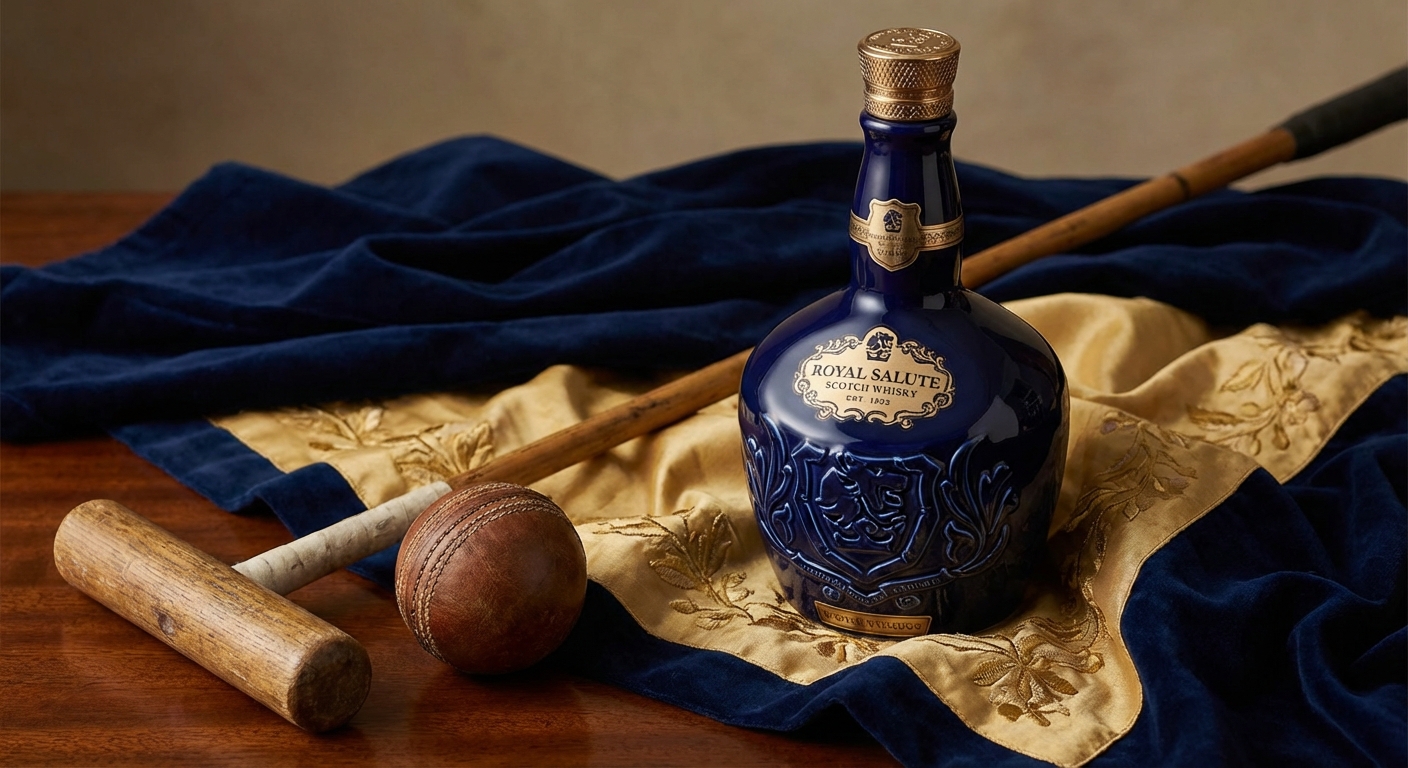
The original 1953 expression was bottled in a hand-crafted ceramic flagon — a deliberate departure from glass — because Chivas Brothers understood that the vessel matters as much as what is inside it. The flagons were produced by Wade Ceramics in Staffordshire, each one individually crafted, decorated with rich royal blue, deep red, or hunter green. The bottle was not packaging. It was an object.
The brand’s informal motto — We Begin Where Others End — refers to its minimum age statement. While the standard Scotch whisky industry works in 12, 15, and 18-year expressions, Royal Salute considers 21 years its starting point, not its premium tier.
That is a material commitment. Holding whisky for 21 years locks up warehousing, stock, and capital for two decades before a single bottle reaches a shelf. It signals a position: this is not a volume play. It is a long game.
Pernod Ricard acquired Chivas Brothers — and with them, Royal Salute — in 2001. The brand’s core philosophy has remained intact. The 21-year minimum has never been relaxed. The ceramic flagons have never been replaced with glass.
Royal Salute occupies a curious and advantageous position. It has genuine provenance — the 1953 coronation is an unimpeachable origin story — yet it continues to release new expressions that extend and refresh the range. It sits comfortably in premium hotel bars, duty-free airport lounges, and the private cellars of collectors who understand that blended Scotch at this age and quality level is a different proposition to an entry-level blend.
For a collector, origin matters. A bottle that can be traced to a specific cultural moment — and whose provenance is backed by one of the world’s largest spirits groups — starts from a position of credibility that newer luxury brands spend decades trying to build.
Polo and Royal Salute share the same cultural vocabulary: heritage, precision, exclusivity, and a studied nonchalance about wealth.
Royal Salute’s association with polo is not a recent marketing alignment. The brand has been the official whisky of the sport’s most prestigious circuits for years, sponsoring events including the Royal Salute Coronation Cup at Guards Polo Club in Windsor and marquee tournaments across Argentina, the United States, and Southeast Asia. This is not a product endorsement. It is an immersion.
Polo is among the oldest team sports in the world, with origins traced to Persia and Central Asia dating back 2,500 years. It arrived in Britain via India, carried by cavalry officers and adopted enthusiastically by the aristocracy. The Guards Polo Club — founded in 1955, two years after Royal Salute’s own birth — sits in Windsor Great Park, literally in the shadow of Windsor Castle. The connection between the sport and the Crown is not metaphorical.
A polo match is not simply a sporting event. It is a social ritual. The divot-stomping at half-time, the hampers, the occasion-dressing — polo operates on a register that resonates directly with the world Royal Salute inhabits. You don’t have to play to understand the appeal. You only have to appreciate the aesthetic.
The commercial logic is clear. But the creative logic is more interesting.
Royal Salute’s polo partnership has produced a dedicated product series — the Polo Collection — spanning multiple age statements, packaging formats, and limited editions. Each expression in the series carries design cues drawn from the sport: mallet imagery, equestrian detailing, the colour palettes of polo grounds and stables.
These are not sticker jobs. The Polo Series expressions are genuinely distinct from the core range in both liquid and presentation. The Estancia Edition, for instance, draws its inspiration directly from the pampas of Argentina, where some of the world’s finest polo ponies are bred and the sport’s highest-goal players train.
The polo partnership gives Royal Salute a creative canvas that the core range, bound by its coronation heritage, cannot fully explore. It allows the brand to be both ceremonial and adventurous.
The Polo Series is not a single product. It is a growing family of expressions, each occupying a distinct position in the collector hierarchy.
Here is what you need to know about each major release.
The entry point to the Polo Series — and the most widely encountered — is built on the same base as the flagship 21 Year Old Signature Blend, with presentation adapted for the polo context.
The liquid is a blend of grain and malt whiskies, all aged a minimum of 21 years. Strathisla distillery, Chivas’s spiritual home in Keith, Speyside, provides a significant portion of the malt backbone. The nose runs to dried fruit, honey, and gentle oakiness with a suggestion of vanilla. On the palate it opens up to soft spice, ripe orchard fruit, and a long, warming finish.
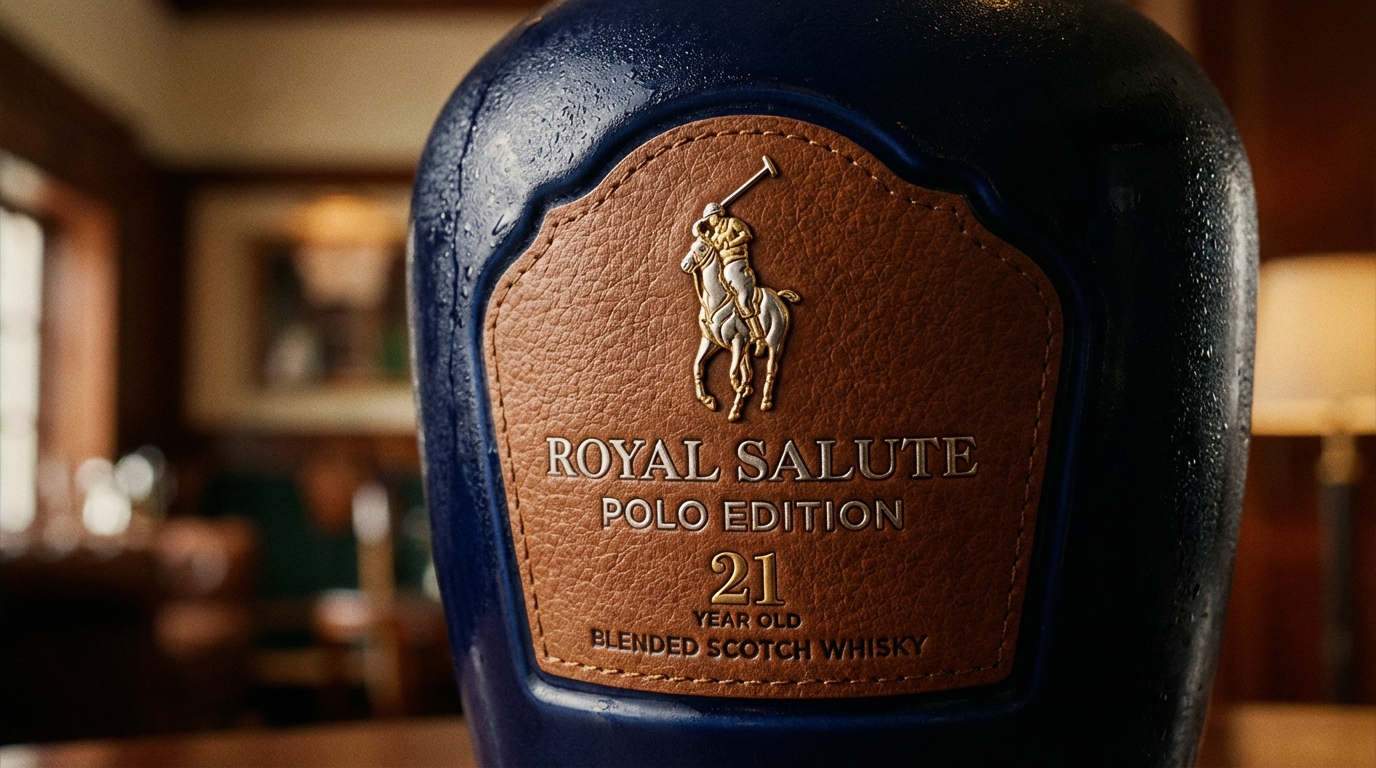
The key differentiator is the packaging. The Polo Edition arrives in a ceramic flagon designed with equestrian motifs and the distinctive Royal Salute crest. The flagon colour varies across years and markets — collectors who pursue the full run of annual releases find this variation itself a point of interest.
The Polo 21 Year Old has been released in numbered editions for specific polo tournaments and seasons, making individual years subtly distinct. A 2015 tournament edition differs from a 2019 edition in ways that matter to completists.
The Estancia Edition takes the Polo Series in a more immersive, narrative direction.
“Estancia” refers to the large ranch estates of Argentina that form the beating heart of high-goal polo. The country produces some of the world’s most prized polo ponies and a disproportionate share of the sport’s elite players. It is polo’s spiritual homeland in the Southern Hemisphere, and the Estancia Edition pays direct tribute to it.
The liquid inside is a 21 Year Old blend, consistent with Royal Salute’s minimum age commitment, but the character has been composed to reflect the Argentine inspiration: richer, warmer, with a fuller mid-palate weight. Notes of dark toffee, leather, dried fig, and a faint tobacco complexity that distinguishes it from the more classically Speyside-leaning Polo 21.
The ceramic flagon for the Estancia Edition features rich earth tones — warm ochres and brown-golds — drawn from the pampas landscape. A mallet motif, branded saddlery details, and the Argentine flag colours appear in the decorative scheme. It is immediately identifiable to anyone who knows the range.
Production quantities for the Estancia Edition have been deliberately limited, reinforcing secondary market interest. Unlike the standard Polo 21, the Estancia Edition is not a rolling annual release but a discrete limited expression, making example condition and completeness of original packaging critical to value.
This is the apex of the Polo Series, and one of the most significant expressions in the entire Royal Salute range.
The 38 Year Old designation means every whisky in the blend has been maturing for nearly four decades. The liquid complexity that comes from 38 years in oak is qualitatively different from anything a 21-year expression can offer — more profound integration, more layers of secondary and tertiary flavour, and a rarity that is simply a function of time.
The blend draws on whiskies from distilleries across Scotland’s whisky regions, carefully selected and combined to produce something that is unmistakably Royal Salute — ceremonial, composed, unhurried — but with an added dimension of depth. Expect dried stone fruits, beeswax, old leather, sandalwood, and a finish that stays for several minutes.
The ceramic decanter for the 38 Year Old Polo Blend is a significant object in its own right. Larger, heavier, and more ornate than the 21 Year Old format, it is finished in deep navy with gold detailing and arrives in a presentation case lined in suede. Opening the packaging is an event.
Bottles from early releases of the 38 Year Old Polo Blend now appear at specialist whisky auctions, and they command premiums reflecting both the liquid’s rarity and the growing recognition that ultra-aged blended Scotch is undervalued relative to single malts of comparable age. Collectors who bought on release have seen that gap close meaningfully. For more on what drives auction premiums, see our guide to what makes a whisky bottle valuable.
Beyond the three headline expressions, Royal Salute has produced a series of polo tournament-specific limited releases — bottles commissioned for or tied to specific events including:
These event-specific bottles occupy a specialist corner of the market. Condition is paramount — bottles that retain original tournament programmes, certificate cards, or secondary packaging command a significant premium over unboxed examples. Their limited production runs mean they rarely appear in volume on the secondary market.
To understand the Polo Series, you need to understand where it sits within the full Royal Salute hierarchy.
The brand’s range covers an unusually wide spectrum of age and price, from the 21 Year Old that anchors the collection to expressions with no practical ceiling on rarity.
The original expression from 1953, still unchanged in recipe. This is the benchmark: the whisky against which every other Royal Salute release is calibrated. It arrives in the classic ceramic flagon — available in red, blue, and green — and serves as the entry point for collectors building their first Royal Salute bottle.
The Polo 21 Year Old and Estancia Edition share this foundation liquid or a closely related composition. Understanding the Signature Blend gives you a baseline for appreciating what the Polo editions do differently.
The Stone of Destiny expression takes its name from the ancient coronation stone of Scottish kings — moved to Edinburgh Castle, where it remains. It is a 38-year-old blend and the equivalent non-polo expression at that age tier.
For collectors tracking the 38 Year Old Polo Blend, the Stone of Destiny provides a useful comparison point. Both are 38 years old; they differ in composition, character, and packaging. Side-by-side comparison is a legitimate collecting discipline.
Royal Salute has produced a small number of ultra-aged expressions at the 52-year age statement — a number chosen to correspond with the number of precious and semi-precious stones set in the Imperial State Crown. These are among the rarest blended Scotch whiskies in existence.
At this age tier, the market is effectively private. Prices run into the tens of thousands of pounds per bottle. For serious collectors interested in the full Royal Salute story, understanding the 52 Year Old — even without owning one — contextualises the brand’s ambition and the depth of its aged stock inventory. See our vintage Scotch whisky guide for more context on how ultra-aged blends are valued.
Named after the 62-gun salute fired at the Tower of London on the occasion of the birth of a royal, this expression occupies the upper mid-tier: aged, powerful, and characterful, but more accessible than the 38 or 52 Year Old expressions. It broadens the range’s price architecture and creates a natural progression for collectors moving up through the tier.
| Expression | Age | Position | Polo Series? |
|---|---|---|---|
| Polo 21 Year Old | 21 Years | Core Polo Entry | Yes |
| Polo Estancia Edition | 21 Years | Limited Polo | Yes |
| 38 Year Old Polo Blend | 38 Years | Polo Pinnacle | Yes |
| 21 Year Old Signature Blend | 21 Years | Core Range | No |
| Stone of Destiny | 38 Years | Core Range | No |
| 62 Gun Salute | N/A | Mid-Premium | No |
| 52 Year Old | 52 Years | Ultra Rare | No |
The ceramic flagon is not decoration. It is a fundamental part of the Royal Salute value proposition — and understanding it is essential to collecting intelligently.
Wade Ceramics of Staffordshire has produced Royal Salute flagons since the brand’s inception. Each flagon is hand-decorated, meaning no two are precisely identical. The production process for the ceramic vessels is itself labour-intensive — this is not a bottle produced at industrial scale.
For the collector, this creates several practical considerations:
Condition is everything. A ceramic flagon that has suffered chips, hairline cracks, or glaze damage loses disproportionate value relative to a glass bottle with similar damage. The vessel is part of the collectible. A damaged flagon cannot be replaced, and buyers on the secondary market apply a substantial discount for anything less than pristine.
Original presentation packaging — the outer box, the certificate of authenticity, the supporting literature — all add meaningfully to value. A Polo 38 Year Old in its original suede-lined presentation case is a different object to the same bottle without case.
Completeness matters at auction. Specialist whisky auctioneers such as Whisky Auctioneer, Scotch Whisky Auctions, and Hart Davis Hart all note that Royal Salute ceramic flagons with full original packaging command premiums of 20–40% over unboxed examples in comparable condition.[^1]
The Polo Series commands premiums on the secondary market for a combination of reasons:
For a deeper analysis of secondary market dynamics for premium Scotch, see how much is my whisky worth.
Unlike single malt releases that often publish production run sizes, Royal Salute rarely discloses exact bottle counts for limited Polo Series expressions. This opacity is itself part of the mystique — but it also means buyers must rely on secondary market liquidity as a proxy for scarcity. Low sale frequency combined with upward price drift is a reasonable indicator that supply is genuinely constrained.
The rule of thumb for Royal Salute Polo bottles: if you are waiting for a restock, you may be waiting indefinitely.
The Polo Series sells to two audiences simultaneously, and the bottle’s future value depends almost entirely on which category the buyer places it in.
Royal Salute Polo Series bottles are among the most defensible luxury whisky gifts available to a UK buyer.
The rationale is simple: the object communicates its own value. Unlike a bottle of aged single malt that requires whisky knowledge to interpret, a Royal Salute Polo ceramic flagon reads as a luxury object to anyone who picks it up. The weight, the hand-decoration, the suede-lined box — these are cues that require no translation.
For gifting contexts — significant birthdays, milestone anniversaries, retirement, or a thank-you of genuine substance — the Polo 21 Year Old sits in a price bracket that signals seriousness without requiring the buyer to liquidate assets. The Estancia Edition steps up the specificity and the impression of knowing what you are doing. The 38 Year Old Polo Blend is the gift for when the occasion demands something that will not be forgotten.
Here’s the deal: the best gifts are ones the recipient would never buy for themselves. The Polo Series lives exactly there.
The investment calculus is more nuanced — and warrants careful reading.
Legal disclaimer: Whisky purchased as an investment is not regulated by the Financial Conduct Authority (FCA). Past price performance does not guarantee future returns. The whisky investment market carries liquidity risk; not all bottles will realise their estimated secondary market value. Always conduct independent due diligence before purchasing whisky with investment intent.
That said, here is the honest picture.
The secondary market for Royal Salute Polo Series bottles has been constructive. Sealed, complete-in-box examples of the Polo Estancia Edition and the 38 Year Old Polo Blend have appreciated from original retail prices at specialist auction. The combination of limited production, a growing collector base for premium blended Scotch, and increasing awareness of Royal Salute outside its traditional UK market — particularly in Asia, where gift-giving culture drives strong demand for prestige whisky — has supported prices.
The 38 Year Old Polo Blend is the most investable expression in the series, by virtue of its age statement and scarcity. A 21-year-old blended whisky, however beautifully presented, competes in a tier where new releases arrive each year. A 38-year-old expression from a limited polo tournament release competes with nothing current.
What investors should know: The difference between a bottle that appreciates and one that merely sits is almost always condition. Understanding what makes a whisky bottle valuable is step one. Step two is understanding that storage matters — ceramic flagons should be stored upright, at stable temperature and humidity, away from direct light.
For the collector building a diversified whisky portfolio, the Polo Series complements single malt holdings with blended Scotch exposure at a tier where genuine scarcity exists. Our ultimate whisky collecting guide covers portfolio construction in detail.
The most interesting Polo Series buyers occupy both categories simultaneously. They purchase a bottle as a meaningful gift — to themselves, to a milestone birthday recipient — with the awareness that it is not a depreciating object. A bottle that is both the right thing to open on a 25th wedding anniversary and a reasonable store of value is, frankly, ideal.
The most expensive mistake in whisky collecting is not the bottle you didn’t buy. It is the bottle you bought incorrectly.
The single most value-destructive error with Royal Salute collecting. A Polo 38 Year Old without its original suede-lined case, certificate, and protective outer carton is not the same lot as the same bottle complete. Buyers who strip packaging for display or storage unknowingly reduce the secondary market value of their holding by a material amount.
What to do instead: Store everything. Every piece of paper, every insert, every certificate. If buying from a secondary source, always confirm completeness before purchase and price accordingly if anything is missing.
Not all Polo 21 Year Old expressions are equivalent. The annual tournament editions produced for specific polo events are distinct releases with year-specific packaging. A buyer who lumps a 2012 Coronation Cup edition with a 2019 Polo Season edition as “both the same Polo 21” is missing the collecting logic.
What to do instead: Build a record of which editions you hold. Note the year, the specific tournament or series name, the flagon colour, and any certificate details. This documentation is your provenance record — and provenance is value. See our distilleries worth collecting guide for how provenance tracking works across different producer types.
Ceramic flagons are more sensitive than glass bottles. They should be stored upright — never on their side, which risks the stopper or cork deteriorating in contact with whisky at constant tilt. They are vulnerable to thermal shock (rapid temperature change) and should not be stored in environments where temperature swings are dramatic.
What to do instead: A consistent temperature between 12–18°C, away from direct light and vibration. A dedicated whisky cabinet or temperature-controlled storage is ideal. If you are building a collection of meaningful value, professional storage is worth considering. See our guide to vintage Scotch whisky for storage best practices in detail.
This surfaces regularly. A seller prices an opened Polo Estancia Edition at close to sealed-bottle price, arguing the whisky is still largely present. The sealed-bottle premium exists for a reason: the investment case requires an intact, unopened bottle. An opened bottle is for drinking — and should be priced and valued accordingly.
What to do instead: Separate your drinking stock from your collection. If a bottle is for drinking, open it and enjoy it. If it is for the collection, do not open it. These are different objects with different purposes.
The Royal Salute Polo Series is a dedicated family of expressions released under the Royal Salute brand that celebrates the brand’s partnership with polo — the equestrian sport. The series includes the Polo 21 Year Old, the Polo Estancia Edition, the 38 Year Old Polo Blend, and various limited tournament-specific releases. Each expression maintains Royal Salute’s minimum 21-year age statement and arrives in the brand’s signature hand-decorated ceramic flagons.
All Royal Salute expressions adhere to the brand’s founding principle: every whisky in every blend is aged a minimum of 21 years. The Polo 21 Year Old and the Estancia Edition use a 21-year age statement. The 38 Year Old Polo Blend uses whiskies aged a minimum of 38 years. Royal Salute’s tagline — “We Begin Where Others End” — refers to this 21-year minimum.
The ceramic flagon was chosen for the original 1953 coronation release to mark the occasion as something distinct from an ordinary commercial whisky. Produced by Wade Ceramics in Staffordshire, the hand-decorated flagons are individually crafted, meaning no two are precisely the same. The choice also signals permanence — a ceramic vessel is an heirloom object, not a disposable container. The flagons have remained central to the brand’s identity for over 70 years.
The Polo Estancia Edition is a limited Royal Salute release inspired by the estancias — the large ranch estates — of Argentina, where high-goal polo is played and the world’s finest polo ponies are bred. The 21-year-old blend has a richer, warmer character than the standard Polo 21, and arrives in a ceramic flagon with warm earth-tone colouring and equestrian detailing drawn from the Argentine polo aesthetic. It is a limited release and not a rolling annual expression.
No. Both are 38-year-old Royal Salute expressions, but they are distinct blends. The 38 Year Old Polo Blend is produced specifically for the Polo Series, with its own composition and presentation — the navy and gold ceramic decanter with equestrian detailing and suede-lined case. The Stone of Destiny has its own presentation and character. Collectors who pursue Royal Salute at this age tier often seek both.
Some do. Limited editions — particularly the Estancia Edition and the 38 Year Old Polo Blend — have appreciated at specialist whisky auctions when offered as sealed, complete-in-box examples. The 21 Year Old Polo releases, by contrast, are more widely produced and appreciate more modestly. Note: Whisky purchased with investment intent is not regulated by the FCA. Past performance does not guarantee future returns. Always seek independent financial advice before purchasing whisky as an investment. Results may vary.
Specialist rare whisky retailers like Glenbotal source Royal Salute Polo Series bottles from private collectors and estates across the UK and Europe. Standard retail channels tend to carry only the current 21 Year Old Polo Edition; older and more limited releases — including the Estancia Edition and early 38 Year Old Polo Blend bottles — require a specialist source.
The flagon should be in pristine condition — no chips, cracks, or glaze damage. The stopper should be intact and uncompromised. The bottle should be sealed and unopen. Original packaging — presentation case, certificate of authenticity, outer carton, and all printed inserts — should be complete. Condition standards at specialist auction are high; anything less than excellent condition draws a meaningful price discount.
Both brands are owned by Chivas Brothers, part of Pernod Ricard, and both use Strathisla in Speyside as a key distillery in their blends. They operate at different price and positioning tiers. Chivas Regal is a premium blended Scotch starting at 12 years old; Royal Salute is an ultra-premium brand whose minimum age is 21 years. They share lineage but serve different occasions and collector profiles.
Royal Salute is closely associated with the Guards Polo Club in Windsor Great Park, where it sponsors the Coronation Cup — a high-goal tournament held annually in late summer. The brand also supports polo events in Argentina, the United States, Singapore, and across the Middle East, reflecting the sport’s global premium footprint. Specific tournament editions are often released in connection with these events.
Royal Salute does not routinely publish precise production run figures for its limited Polo Series expressions. Secondary market liquidity provides the clearest indication of scarcity — the 38 Year Old Polo Blend appears infrequently at specialist auctions, suggesting relatively constrained supply. When bottles do appear, they are typically absorbed quickly.
Historically, single malts dominated the collector market. That has shifted. Ultra-aged, limited-production blended Scotch from heritage brands now commands serious attention from collectors who recognise that the blending art — holding back aged stock, composing complex multi-distillery blends over decades — is as demanding as any single malt production. Royal Salute, with its 21-year minimum, its coronation heritage, and its limited series of distinctive ceramic expressions, sits at the apex of that reappraisal.
Royal Salute’s Polo Series is the most coherent expression of what a luxury blended Scotch can be: rooted in history, aligned with a credible prestige culture, and packaged in a way that communicates value without a word of explanation.
The entry point — the Polo 21 Year Old — is the right starting place for collectors new to the range. It delivers on the Royal Salute promise, arrives in the ceramic flagon that defines the brand, and at its best represents a polo tournament edition with its own year-specific identity.
The Estancia Edition is for the collector who wants something that will not be at the standard retailer next season. The richer liquid, the Argentine inspiration, and the limited production make it a more distinctive choice — and a more interesting one to track on the secondary market.
The 38 Year Old Polo Blend is in a different conversation entirely. It is one of the more serious ultra-aged blended Scotch whiskies available, backed by ceramic presentation that is genuinely impressive, and it occupies a scarcity tier that the 21-year expressions cannot match.
What to do first: Get Started with the ultimate whisky collecting guide and establish the tier that suits your collection and your budget. What to do next: Focus on condition and completeness — these are the two variables that separate a wise Royal Salute purchase from an expensive one.
[^1]: Specialist whisky auction houses including Whisky Auctioneer and Scotch Whisky Auctions note that original presentation packaging is a consistent driver of premium pricing for collectable whisky releases. Royal Salute’s ceramic decanters are explicitly noted as condition-sensitive in auction grading criteria.
Further reading and sources:
Explore the full collection at Glenbotal — rare whisky sourced from private collectors across the UK and Europe.