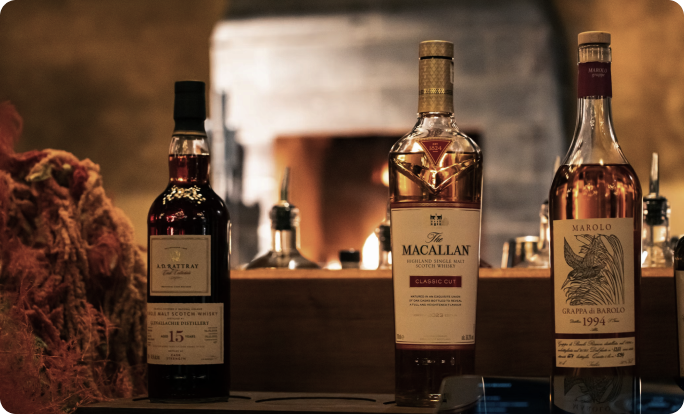
Mortlach is one of only a handful of Scottish distilleries where a single change to the distillation process — implemented in 1897 — defined a flavour profile so distinct it earned the Beast of Dufftown a nickname that has stuck for over a century.
This is the guide for collectors who already know their Speyside from their Islay and want to understand exactly why Mortlach’s limited releases command the prices they do. By the end you will know the cask compositions, ABVs, and collector rationale for every major Mortlach special release — from the flagship Diageo Special Releases appearances to the ultra-rare expressions that trade quietly at four-figure prices. You will also know what separates a bottle worth buying today from one worth buying now and drinking next decade.
Mortlach is the oldest legal distillery in Dufftown, founded in 1823, and it produces one of the most singular single malts in Scotland.
That is not marketing language. It is the consensus of collectors, blenders, and critics who have worked with the spirit for decades. Mortlach sits in the Speyside region, which is associated with fruit-forward, approachable malts. Mortlach does not belong to that category. Its spirit is meaty, sulphurous in the best possible sense, deeply complex, and built for time in cask. Blenders at Diageo — which has owned Mortlach since 1925 via successive acquisitions — have historically treated it as one of the most prized components in the Johnnie Walker range, particularly the top expressions.
The distillery did not receive wide public attention as a single malt until 2014, when Diageo launched a luxury tier of Mortlach bottlings. Before that, most whisky drinkers had never tasted it neat. Collectors who discovered it through that 2014 launch — or through the subsequent Diageo Special Releases programme — quickly understood why the blenders kept it for themselves for so long.
Dufftown is sometimes called the Whisky Capital of Scotland. The town has seven working distilleries within a few miles of each other, including Glenfiddich, Balvenie, and Kininvie. Mortlach holds a particular status among them because it was there first, and because its character is the most pronounced.
The local saying goes: Rome was built on seven hills; Dufftown was built on seven stills. Mortlach’s six stills — three wash stills and three spirit stills — produce a spirit unlike anything its neighbours make, and the reason is architectural as much as agricultural.
The collector’s case for Mortlach rests on three pillars: scarcity, distinctiveness, and Diageo’s track record with premium releases.
Mortlach as a single malt was largely unavailable in meaningful volumes until relatively recently. That gives older independent bottlings — especially Gordon & MacPhail releases — genuine rarity. A 1989 G&M Mortlach won Whisky of the Year at the 2023 International Whisky Competition, which sent secondary market values for comparable vintages sharply upward.
The distinctiveness of the spirit means it does not occupy a crowded category. Collectors looking for another fruity Speyside have many choices. Collectors wanting this specific combination of meat, dark fruit, and spice have one: Mortlach.
And Diageo’s Special Releases programme, which has featured Mortlach in multiple years, gives collectors defined entry points — finite editions with named cask compositions and documented release histories.
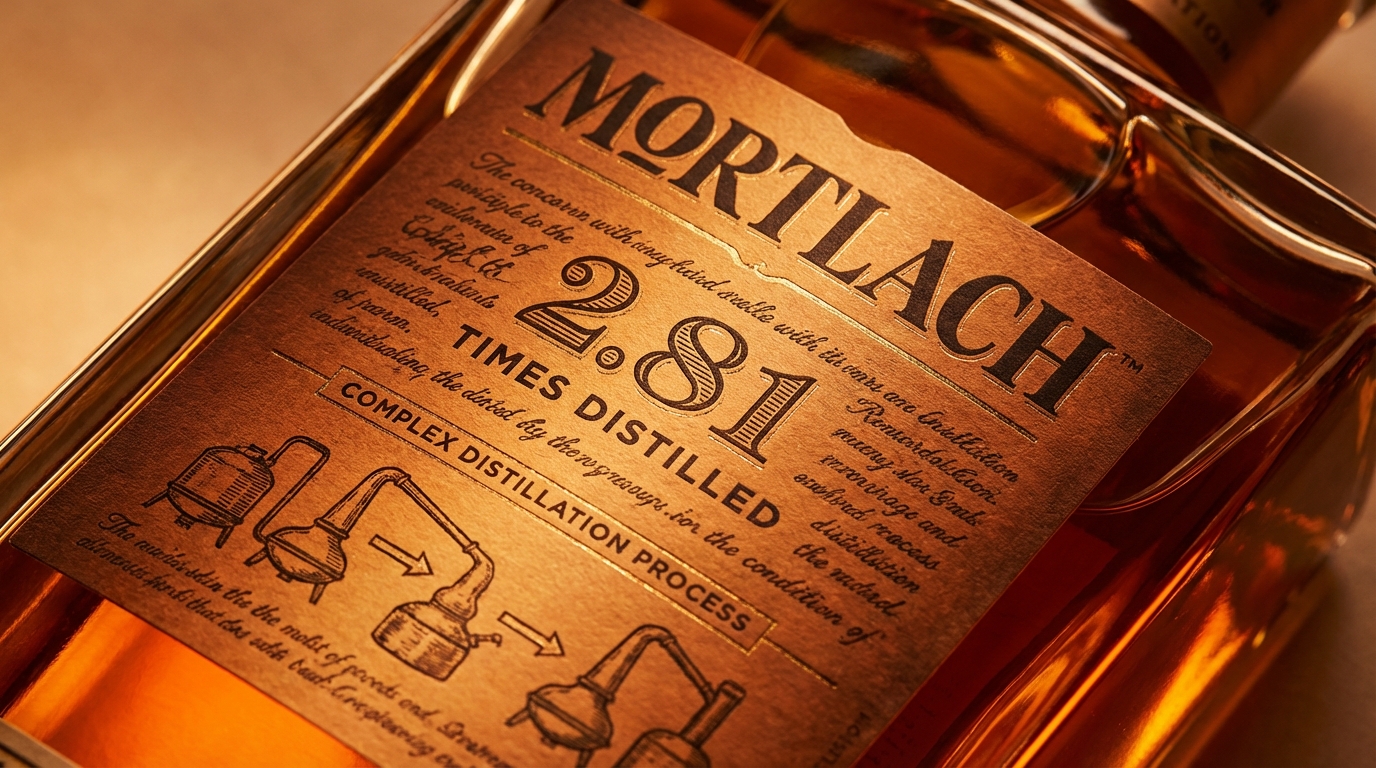
The 2.81 times distillation process is the single most important technical fact about Mortlach, and understanding it explains everything about the spirit’s character.
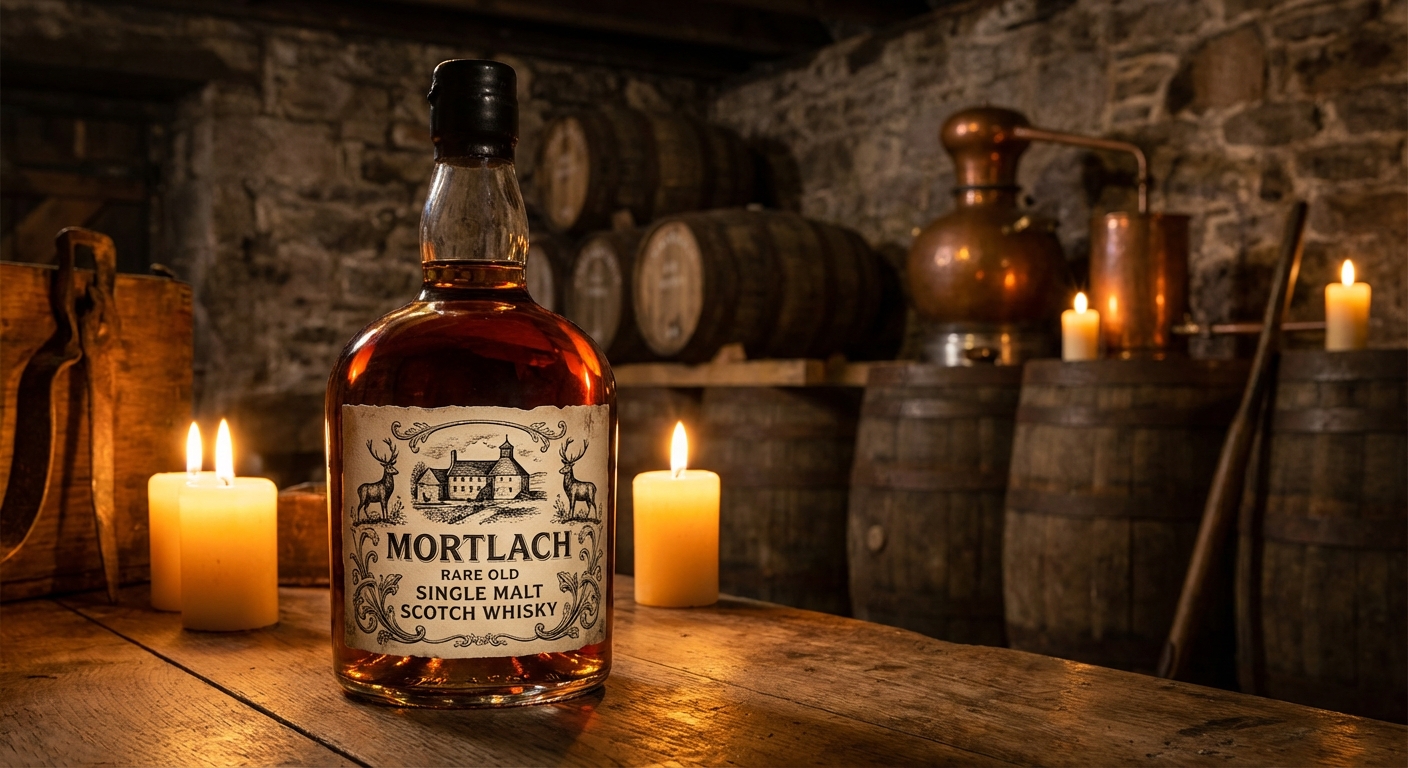
Most Scotch single malts are distilled twice. Some, like Springbank, are distilled two-and-a-half times. Mortlach uses a process implemented in 1897 by Alexander Mitchell Cowie and distillery architect Charles Doig that results in each batch of spirit being effectively distilled 2.81 times. This is not a round number chosen for branding purposes — it is the mathematical result of how the six stills interact.
Here’s the deal: the distillery’s three wash stills and three spirit stills are not identical in size. The smallest spirit still — known as the Wee Witchie, and the namesake of Mortlach’s 12-year-old expression — handles a portion of the low wines differently from the others, running a proportion of the spirit back through an additional partial distillation. The result is a heavier, more complex new make spirit with a distinctive meaty, sulphurous quality that other distilleries simply cannot replicate without copying the exact still configuration.
This process means Mortlach’s character is locked in at the production stage — it cannot be approximated by blending or by cask selection alone.
When you compare Mortlach aged in refill American oak to Mortlach aged in sherry butts, the underlying spirit character remains recognisably the same. That is unusual. Many lighter spirits are essentially transformed by their cask. Mortlach carries its identity through. Which means that when a cask type is chosen for a special release — Pedro Ximénez, virgin oak, Calvados — it is adding to the spirit’s character rather than defining it.
This distinction matters when evaluating whether a special release is worth collecting. A Mortlach in an interesting cask is interesting. A lighter spirit in the same cask might be more interesting. The collector’s question is whether the cask has elevated the spirit or simply replaced it, and with Mortlach the answer is consistently the former.
Mortlach’s production capacity is 3.7 million litres per year — substantial by Speyside standards, but the vast majority goes into the blending stream. The proportion released as single malt has historically been small, which is part of why collectors pay attention when named limited editions appear.
The Wee Witchie still — the smallest of the three spirit stills — sits at the heart of the flavour process. It receives a cut of partially distilled spirit and runs it again, creating the additional complexity. Think of it like a conversation between two stills rather than a single monologue. The spirit emerges richer, fuller, and with what tasters consistently describe as a meaty or savoury undertone beneath the fruit and spice.
Before chasing limited releases, serious collectors understand the core range — it sets the baseline and tells you what cask variation does to the house spirit.
Diageo launched the current Mortlach single malt range in 2014 with four luxury expressions. The range has been refined since, but the key bottles that form the accessible end of the collection are:
Named after the small still that defines the distillery’s character, the 12-year-old is the entry point. It is matured primarily in refill American oak with some European oak influence. The result is the cleanest expression of the house style: red meat on the nose, dried fruit, a gentle sulphur note that is entirely appropriate, and a long finish with oak spice.
At 43.4% ABV it is not cask strength, but it is not diluted either — Diageo chose a middle path that preserves the character without requiring the drinker to add water. Collectors typically do not hold this as a long-term investment piece, but it is essential context for understanding what any of the limited releases are doing with the spirit.
The 16-year-old represents the first point at which the Mortlach house style opens up meaningfully. Additional time in cask allows the meatiness to integrate more fully with fruit and oak. Dried apricot, leather, and a more prominent floral note join the savoury backbone.
This is often the expression that converts collectors who were sceptical about the meaty character — at sixteen years old, the complexity earns the weight.
The 20-year-old and 25-year-old expressions represent the top of the standard range. Both operate at 43.4% — Diageo’s consistent choice for this range — and both reward patience. The 25-year-old in particular is often cited as an undervalued bottle relative to equivalent age statements from more fashionable distilleries.
The core range matters because it is the control group. When a special release is presented at cask strength or with an unusual cask finish, the question of what it adds over the standard range becomes answerable.
The Diageo Special Releases programme is one of the most important annual events in Scotch whisky collecting, and Mortlach has been among its most anticipated inclusions.
Diageo launched the Special Releases programme in 2001 as a curated collection of rare single malts bottled from exceptional casks within their distillery estate. The programme releases bottles annually, typically in September or October, at cask strength, in limited quantities, with distinctive packaging. For collectors, Special Releases appearances represent documented, finite editions — the exact opposite of the perpetually-available core range.
Each Special Releases bottle carries its distillery, age, ABV, cask composition, and edition number. This specificity is what makes them collectible in a structured way: two collectors comparing bottles from the same distillery across different years can have a precise, factual conversation about what changed and why.
Diageo’s blending team retains access to the oldest and most unusual casks across their entire estate. For Mortlach, that means access to ex-sherry butts, virgin oak casks, and unusual wine cask finishes that are not commercially viable for the standard range but are extraordinary as one-off releases.
The Mortlach Special Releases entries are selected specifically for cask quality and complexity — these are the barrels that the blending team considers exceptional even within a distillery known for exceptional spirit.
For collectors, this is meaningful. Diageo does not release substandard casks into the Special Releases programme — the reputational cost is too high. Every Mortlach that appears in Special Releases has been assessed against the entire estate’s available casks and chosen for its merits.
Mortlach’s appearances in the Diageo Special Releases programme across multiple years have collectively demonstrated a pattern: the distillery performs especially well with ex-sherry cask maturation, with wine cask finishes, and at higher ABVs where the meaty character integrates fully with fruit-driven cask influence. Collectors who have followed the programme year-on-year have been rewarded with bottles that hold and appreciate in value — partly because production volumes are small and partly because demand from Mortlach specialists has grown.
For context on how Diageo’s annual programme works alongside independent releases and why distillery provenance matters so much for value, what makes a whisky bottle valuable covers the underlying mechanics in detail.
The named special editions represent Mortlach at its most intentional — each bottle the result of a specific cask selection decision and a deliberate presentation.
Beyond the core range and the numbered Diageo Special Releases entries, Mortlach has produced a series of named limited editions that have become the focus of serious collector attention. Each carries a distinct identity: a name tied to the character of the whisky, a specific cask composition, and a finite production run. Here is a detailed account of each.
Mortlach Rare Old was the first of the 2014 luxury range and the bottle that introduced most collectors to single malt Mortlach.
It carries no age statement, which was a deliberate choice — Diageo wanted to communicate complexity without constraining the blend to a specific vintage. The spirit is drawn from a combination of older and younger casks, married together to achieve a consistent expression of the distillery character. European oak sherry casks provide the primary maturation influence, with refill American oak also contributing.
The result is the most immediately recognisable Mortlach for newcomers: dried fruit, a savoury backbone, Christmas cake spice, and a finish that sustains longer than most no-age-statement malts. It bottled at 43.1% ABV, in a distinctive heavy glass decanter-style bottle that has become part of the Mortlach aesthetic.
Rare Old is the collector’s reference point. If you want to understand what a Mortlach Special Release is doing differently, you start here.
The Wee Witchie sits within the core range but is worth noting here because it is the named expression most directly connected to the distillery’s technical identity. Named after the smallest still in the distillery — the one that performs the partial re-distillation at the heart of the 2.81 process — it frames the limited editions in context.
When collectors discuss special releases, the Wee Witchie is the common reference: “Does it have the same meaty backbone?” It almost always does, but understanding why requires knowing the still it is named after.
The Lure of the Blood Moon is among Mortlach’s most visually distinctive releases and one of the most sought-after for collectors focused on the Diageo Special Releases programme.
Released as part of the Diageo Special Releases, The Lure of the Blood Moon drew on Mortlach’s capacity to absorb complex cask influence without losing its identity. The release used a combination of cask types — including American and European oak with fortified wine influence — to deliver a whisky with deep dried fruit, dark chocolate, and the signature meaty character of the house.
The name references the traditional blood moon, whose deep red colour mirrors the spirit’s rich, dark hue when held against light. This naming approach — evocative rather than clinical — is typical of Diageo’s presentation for Mortlach’s premium editions. It positions the whisky as an experience as much as a product.
The Blood Moon release reached secondary market prices well above its retail RRP within months of release, which established a clear pattern for subsequent Mortlach special editions: collectors who allocated at retail and waited were consistently rewarded.
Importantly, the release also introduced a wider audience to Mortlach’s ability to handle fortified wine cask influence — a characteristic that has informed every named release since.
Midnight Dusk is the natural companion to Blood Moon, sharing its premium positioning within the Diageo Special Releases programme.
The release continued Mortlach’s exploration of fortified wine cask maturation, with virgin oak among the supporting cask types. The combination of virgin oak’s aggressive tannins with a spirit as robust as Mortlach produces something unusual: the tannins do not overwhelm the fruit as they would with a lighter spirit. Instead they integrate, adding structure to the dried fruit and spice notes.
Midnight Dusk bottled at higher ABV than the standard range, which allowed the spirit’s full weight to show. Collectors who opened bottles rather than holding them found a whisky that improved significantly in the glass over an hour — the classic mark of a complex, high-strength Scotch.
The edition size was limited. Bottles that came to secondary market in the months after release showed a premium over retail that reflected genuine demand from collectors rather than speculative flipping.
The Whistling Bramble represents Mortlach’s most fruit-forward special release — a deliberate shift in emphasis without abandoning the house character.
The Whistling Bramble drew its name from the bramble note that appears prominently in the whisky — a combination of the spirit’s natural red fruit tendency and the influence of the cask selection. Port pipes and sherry butts contributed heavily, producing a whisky with more obvious berry fruit than any previous Mortlach special edition.
Collectors initially debated whether the fruit-forward profile compromised the house character. The answer, across multiple tastings, was that the meaty backbone remains present — it simply sits behind the fruit rather than leading. For collectors who found earlier Mortlach expressions too assertive, the Whistling Bramble offered a more accessible entry point to the premium range.
The edition was finite and sold out quickly at retail. It has since become one of the more common Mortlach special releases to appear at auction, suggesting many buyers who purchased at retail had it earmarked for resale. Prices on the secondary market reflect steady demand from drinkers rather than purely from collectors, which is actually a positive sign for long-term value stability.
This release sits alongside distilleries worth collecting as a case study in how a distillery can deploy cask variation to attract a broader collector base without diluting its reputation.
Katana’s Edge is the most complex and celebrated of Mortlach’s named special editions — the release that most fully realised the distillery’s potential when cask selection and spirit character align perfectly.
The Katana’s Edge name references precision — a Japanese sword’s edge — and the whisky earns it. This release drew on casks that had previously held Japanese-style whisky or were influenced by Japanese cooperage traditions, bringing a cedar and sandalwood dimension to the Mortlach profile alongside the usual dried fruit and meat. The combination is striking: familiar Mortlach depth with an entirely new aromatic layer on top.
Tasting Katana’s Edge, you encounter the nose in stages: first the cedar and dried herb note, then the characteristic dark fruit of Mortlach’s sherry cask influence, and finally the meaty, almost umami base that defines the distillery. On the palate the precision of the name is earned — the flavours are distinct and well-separated, not the muddy complexity of a whisky that has been over-finished.
Katana’s Edge released in very limited quantities. Collectors who allocated at retail typically did so based on reputation rather than having tasted the whisky first — the track record of previous Mortlach Special Releases was sufficient evidence. On the secondary market it commands a substantial premium, and bottles that have emerged at auction have achieved prices that reflect both its rarity and the quality of the whisky inside.
Now: Katana’s Edge is the release that most convincingly demonstrates why Mortlach warrants serious collector attention. It achieves something that is genuinely difficult — it adds to the spirit’s character rather than replacing or obscuring it.
The Mortlach 30 Year Old Midnight Malt, released in 2024, is the most extraordinary and most expensive Mortlach ever offered to collectors.
This release was a genuine departure. Where previous Mortlach specials had worked within familiar cask categories — sherry, port, virgin oak — the 30-year-old Midnight Malt used three entirely distinct cask types in sequence: Bordeaux wine casks, Calvados casks, and Guatemalan rum casks, with a final period in quarter casks. The quarter cask maturation at the end of a 30-year journey is unusual — it concentrates the spirit rapidly and can either refine or confuse a whisky. Here, it refined.
The 2024 release bottled at 49.8% ABV — cask strength in practice, though presented simply as natural colour and non-chill-filtered. Edition size was 350 bottles worldwide. RRP was $5,300, positioning it firmly in the ultra-premium tier alongside the most expensive annual Diageo releases.
The Midnight Malt was unveiled at the Frieze LA art show as part of a partnership with designer Suchi Reddy, which further signalled Diageo’s intent to position Mortlach at the intersection of whisky collecting and art collecting. For established Mortlach collectors, this release is a career acquisition — the kind of bottle that defines a collection rather than merely adding to it.
For more context on how ultra-premium releases like this fit into a broader Scotch collection, the vintage Scotch whisky guide covers the landscape in detail.
The secondary market for Mortlach special releases has strengthened materially since 2020, driven by greater awareness of the distillery and Diageo’s increasingly confident presentation of the brand.
Disclaimer: Whisky values fluctuate and results may vary. The figures below represent approximate observed values at time of writing and are not financial advice. Always verify current market prices with a specialist before making any decisions based on expected resale value.
Here is the broad pattern across Mortlach’s special release tiers:
| Expression | Approx. RRP at Release | Observed Secondary Market Range |
|---|---|---|
| Mortlach Rare Old | £85–£100 | £100–£150 |
| The Lure of the Blood Moon | £90–£120 | £150–£250 |
| Midnight Dusk | £100–£130 | £175–£280 |
| The Whistling Bramble | £95–£130 | £160–£260 |
| Katana’s Edge | £110–£150 | £220–£380 |
| 30yo Midnight Malt (2024) | $5,300 | Emerging market, limited data |
The pattern across the named editions shows consistent 1.5x to 2.5x appreciation over retail for bottles in good condition with intact packaging. Katana’s Edge sits at the top of that range because of its limited edition size and the complexity of the whisky.
Three factors drive secondary market performance for Mortlach above all others: edition size, cask complexity, and timing within the collector cycle.
Edition size is the most obvious lever. The 350-bottle Midnight Malt is inherently rarer than a release of a few thousand bottles, and the market reflects that. Cask complexity matters because collectors who have tasted their allocation are willing to pay above market to acquire additional bottles if the quality exceeded expectations — and with Mortlach, it often has.
Timing within the collector cycle is more subtle. Mortlach’s secondary market strengthened when the G&M 1989 vintage won Whisky of the Year in 2023. That award raised the distillery’s profile among collectors who had not been tracking it, creating demand for any available Mortlach with age and provenance. The direct beneficiaries were the most collectible of the named editions.
For a full framework on assessing whisky value for collection purposes, how much is my whisky worth walks through the methodology.
Gordon & MacPhail’s Mortlach bottlings represent a separate and sometimes overlooked part of the collector market. The 1989 vintage that won the 2023 International Whisky Competition Whisky of the Year was drawn from a cask that G&M had held for decades — a reminder that independent bottlers with deep distillery relationships can access whisky that never appears in official releases.
Collectors looking for distilleries worth collecting frequently overlook the independent bottler angle. For Mortlach specifically, G&M’s archive is worth systematic attention. Comparable vintages to the award-winning 1989 — late 1980s and early 1990s single casks — have appreciated sharply in the secondary market following the award.
The most expensive mistake in Mortlach collecting is treating the named editions as interchangeable.
They are not. Each release has a distinct cask composition, a distinct ABV, and a distinct relationship with the house spirit. Buying Mortlach special editions without understanding the cask details is like buying a Bond bottling without knowing the vintage — you may acquire something valuable, but you are doing so without the knowledge that would let you evaluate whether it is the right bottle for your collection.
Collectors sometimes skip the core range entirely and move straight to special editions, then find they lack the baseline to evaluate what they are drinking. The Wee Witchie 12-year-old is cheap relative to the special releases and absolutely necessary as context. Spend the £55–£70 and spend an evening with it before chasing anything with a four-figure price tag.
Not every limited release appreciates. The Whistling Bramble, for example, has appeared at auction more frequently than other Mortlach editions, which suggests a portion of buyers acquired it for resale rather than because of genuine collector demand. Prices have been stable but not exceptional. The lesson: edition size and quality matter more than the limited label itself.
For a full treatment of what separates an investment-grade bottle from a merely-limited one, what makes a whisky bottle valuable covers the criteria in detail.
Mortlach’s high-ABV special releases are not especially vulnerable to oxidation if sealed, but the packaging matters enormously for secondary market value. The Midnight Malt’s presentation was designed as part of the collectible proposition — buyers at the $5,300 price point expect the original packaging to be pristine.
A Mortlach Katana’s Edge without its original box and labelling loses a significant proportion of its secondary market value. Proper storage — upright, away from direct light, stable temperature — is not optional for collector-grade bottles. How to store whisky bottles covers the basics and the details.
Official Mortlach releases get the most attention, but some of the most extraordinary Mortlach available to collectors comes from independent bottlers — Gordon & MacPhail especially, but also Signatory Vintage and That Boutique-y Whisky Company. These releases often offer better value per unit of quality than official limited editions, particularly for older vintages.
The catch is that they require more research. Label information for independent bottlings varies, and dating bottles from the pre-2014 era when Mortlach was rarely available as a single malt requires some knowledge of bottling code systems. The ultimate whisky collecting guide covers the research framework for exactly this kind of due diligence.
This is the mirror of Mistake 2. Collectors who have done the work — who know the cask composition, have tasted the whisky, and understand the edition size — sometimes still hesitate. The Mortlach special releases that have appreciated most sharply did so quickly after release, driven by word of mouth among collectors who tasted their allocations.
When a Mortlach special release is known to be good, the price gap between retail and secondary market closes fast. Katana’s Edge is the clearest example. The lesson: conviction and speed matter once the research is done.
Mortlach uses a 2.81 times distillation process implemented in 1897, which uses six stills of unequal size to create a heavier, more complex spirit than standard double-distillation produces. The result is a meaty, savoury flavour profile entirely distinct from the fruit-forward character most associated with Speyside.
The Beast of Dufftown is Mortlach’s nickname, earned through its unusually powerful and complex spirit character. Where most Speyside malts are approachable and fruit-forward, Mortlach’s meaty, sulphurous backbone earned it a reputation as something wilder — hence the beast. It is a term of respect among collectors.
Mortlach has appeared in the Diageo Special Releases programme across multiple years since the programme’s expansion in the 2010s. Each appearance features a distinct cask composition, ABV, and edition size. The programme runs annually, typically releasing in autumn, and Mortlach is among the distilleries that collectors actively track within it.
As of 2026, the rarest official Mortlach single malt release is the 30 Year Old Midnight Malt from 2024, produced in an edition of just 350 bottles worldwide, priced at $5,300. Beyond this, certain Gordon & MacPhail single cask releases from the 1980s and early 1990s are genuinely scarce, with the 1989 vintage having won Whisky of the Year at the 2023 International Whisky Competition.
Mortlach’s special releases have used European oak sherry butts, Pedro Ximénez casks, virgin American oak, port pipes, Calvados casks, Bordeaux wine casks, and Guatemalan rum casks. The house spirit is robust enough to benefit from all of these without being overwhelmed — which is part of what makes the cask selection programme so interesting to follow.
That depends entirely on whether you are buying to drink or to hold. As a drinking whisky, the quality of the spirit justifies a premium over the core range. As an investment, the track record of similar Mortlach limited releases is positive — but this is not financial advice and whisky values are not guaranteed to appreciate.
Mortlach occupies a specific niche within the Diageo estate: it is not as immediately famous as Lagavulin or Talisker, but among serious collectors it commands equivalent respect. Its secondary market performance within the Special Releases programme has been consistently strong, particularly for releases with complex multi-cask compositions.
The Wee Witchie is the smallest of Mortlach’s three spirit stills. It plays a central role in the 2.81 times distillation process by receiving a portion of the low wines and re-running them, creating additional complexity. The distillery’s 12 Year Old expression is named after it.
Store bottles upright to minimise cork contact with spirit. Keep them away from direct light, particularly UV. Maintain a stable temperature between 10°C and 18°C. Retain all original packaging — the box, tissue, and any accompanying documentation — as these significantly affect secondary market value. Consult how to store whisky bottles for comprehensive guidance.
Current and secondary market Mortlach expressions are available through specialist UK retailers and via private collector networks. Glenbotal sources Mortlach bottles from private collectors across the UK and Europe. For independent bottlings and older vintages, specialist auction houses with dedicated whisky categories are the most reliable source.
Yes. A Gordon & MacPhail Mortlach distilled in 1989 won Whisky of the Year at the 2023 International Whisky Competition — one of the most significant single results for the distillery’s reputation as a single malt. The award is documented by the International Whisky Competition and has been widely reported in the trade press.[^1]
Start with the core range. The Wee Witchie 12 Year Old establishes the house character clearly and affordably. Move to the Distiller’s Dram 16 Year Old to see how age affects the spirit. Once you understand both, the special releases become far easier to evaluate and appreciate.
Mortlach is the most distinctive distillery in Speyside, and its special releases programme is one of the most coherent and consistently rewarding in Scottish whisky.
The 2.81 times distillation process creates a spirit with a character that cannot be replicated elsewhere. Diageo’s decision to release it in limited, named, cask-specific editions over the past decade has given collectors a structured way to engage with the distillery’s potential. From the introductory Rare Old through Blood Moon and Midnight Dusk, the Whistling Bramble and Katana’s Edge, to the extraordinary 30 Year Old Midnight Malt — each release represents a deliberate addition to a coherent body of work.
This week: buy the Wee Witchie 12 Year Old if you have not already. Taste it twice — once on opening, once after an hour in the glass. Note what you find.
Next month: identify the Mortlach named edition that most interests you based on the cask composition, and research its availability and secondary market history.
In 90 days: if you are going to add a special release, you will know by then whether you are buying to drink, to collect, or both. That distinction shapes every decision that follows.
See How Glenbotal Sources Mortlach — rare expressions from private collectors across the UK and Europe, available now.
[^1]: International Whisky Competition 2023. Whisky of the Year results. The winning bottling was a Gordon & MacPhail Mortlach distilled in 1989.
Sources consulted: Wikipedia contributors, “Mortlach Distillery,” en.wikipedia.org/wiki/Mortlach_distillery (accessed March 2026); Whisky Advocate, “Mortlach Goes Ultra-Aged With a Rare 30 Year Old,” whiskyadvocate.com (March 2024); WhiskyNotes archive, Mortlach category, whiskynotes.be.
Explore the full collection at Glenbotal — rare whisky sourced from private collectors across the UK and Europe.