Glenfiddich’s Experimental Series proves that innovation and tradition are not opposites — they are the most productive conversation in whisky.
When the world’s best-selling single malt decided to stop playing it safe, the results were extraordinary. Five releases, five entirely different ideas, five reasons why Glenfiddich’s Experimental Series has earned a permanent place on the shelves of serious collectors and adventurous drinkers alike. This is the definitive guide to every bottle in the range — what makes each one special, why some are harder to find than others, and how to think about them as a collection.
The Glenfiddich Experimental Series is a collection of single malt Scotch whiskies, each one built around a single bold idea that pushes against the boundaries of traditional whisky-making. Launched in 2017, the series sits apart from the standard core range and the prestigious Grand Series — this is where Glenfiddich’s Malt Master, Brian Kinsman, is given permission to ask “what if?”
Each release carries a numbered designation — Experiment No. 01 through No. 05 — underscoring the scientific spirit behind the project. These are not simply flavoured whiskies or gimmicks dressed up in unusual bottles. They are genuine collaborations: with a craft beer brewer, with twenty global whisky experts, with a Canadian icewine maker, with peated malt and Latin rum distillers, and with an apple cider brandy producer from Somerset. The outcomes are single malt Scotch whiskies that could only have come from Glenfiddich — but taste unlike anything the distillery had bottled before.
For collectors, the series represents a fascinating intersection of experimental distillery output and collector scarcity. Several expressions have been discontinued or are only available through secondary market sources, making the complete set genuinely difficult to assemble. For drinkers, the series offers five strikingly different flavour profiles from the same distillery — a masterclass in what cask choice, finishing, and collaborative creativity can achieve.
In an industry often defined by heritage, age statements, and reverence for the past, the decision to launch a formally named Experimental Series was a significant statement. Glenfiddich — the distillery that almost single-handedly invented the premium single malt category in the 1960s — was choosing to use its authority and reputation to take risks rather than play it safe.
The series was born from a very simple question: what happens when Glenfiddich’s Malt Master works alongside experts from entirely different craft traditions? The answer, it turns out, is that you get whiskies that cannot be made any other way. Every release in the Experimental Series is the product of genuine cross-disciplinary collaboration, not a marketing exercise dressed up as innovation.
Malt Master Brian Kinsman, who has worked with Glenfiddich for over two decades, has described the series as an opportunity to follow creative instincts that would otherwise have no outlet in a distillery’s commercial schedule. The results are deliberately unpredictable — and that unpredictability is precisely the point.
Brian Kinsman is the architect of every expression in the Experimental Series. His role at Glenfiddich extends well beyond the core range: he is responsible for identifying which casks have the most interesting potential, maintaining the house style across dozens of concurrent maturations, and deciding when a new idea is ready to become a real product.
For the Experimental Series, Kinsman has repeatedly sought out collaborators who operate at the top of their own fields but have no prior connection to Scotch whisky. The IPA Experiment emerged from a conversation with a Speyside craft brewer. Winter Storm required him to travel to the Niagara region of Canada to spend time learning how icewine is made, understanding the character of the casks before committing to the project. This is the intellectual seriousness that separates the Experimental Series from novelty releases.
Glenfiddich has always been a distillery willing to move first. It was the first Scottish distillery to market single malt Scotch whisky internationally in a serious and sustained way, beginning in the 1960s. It pioneered distillery visitor experiences before they became standard. The Experimental Series is entirely consistent with that long history — a distillery that earns the right to experiment by first proving it can make extraordinary whisky by conventional means.
The series also reflects a broader truth about the whisky market in the 2020s: collectors and serious drinkers want more than just older age statements. They want provenance, craft, and innovation. The Experimental Series delivers all three, in a format that is distinctly and undeniably Glenfiddich.
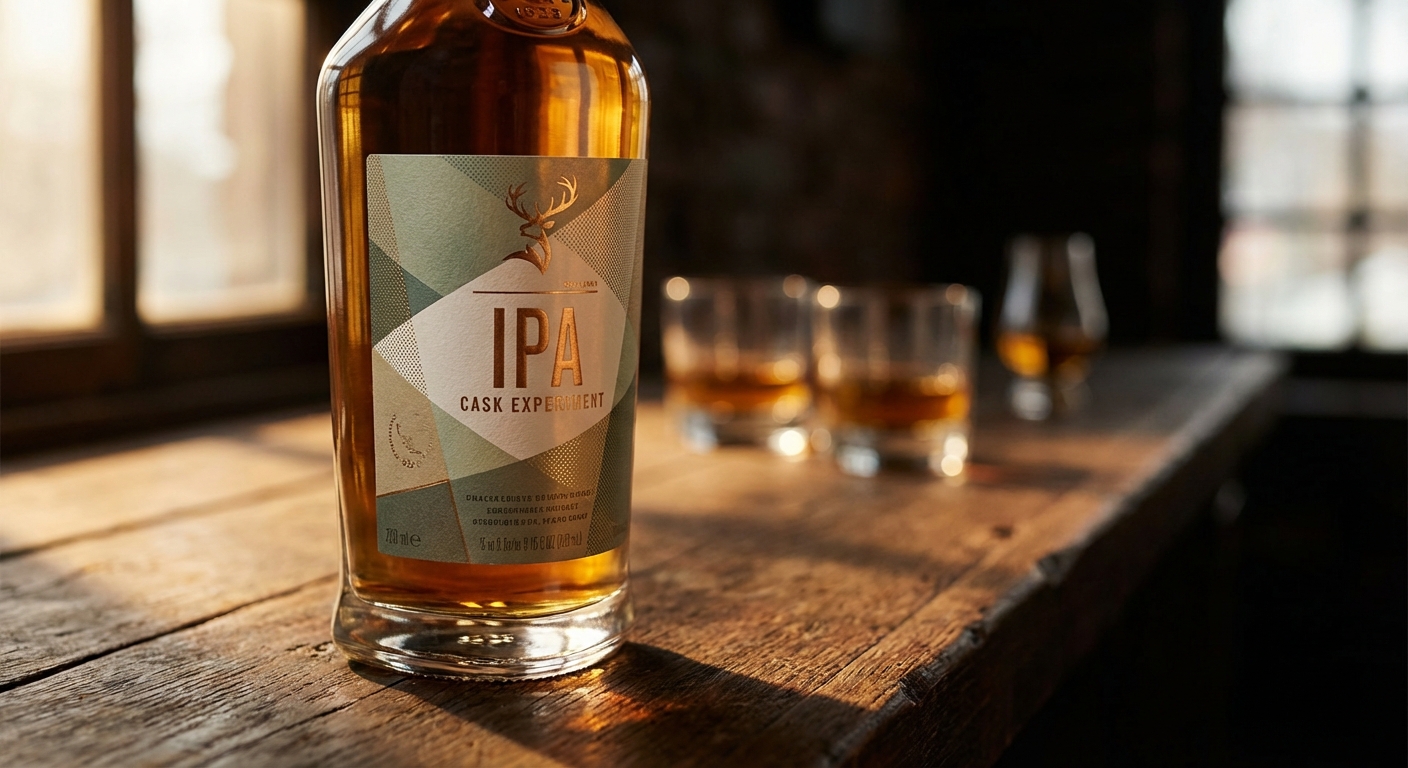
The idea: Finish Glenfiddich single malt in casks previously used to mature a bespoke craft IPA beer.
The IPA Experiment was the release that announced the series to the world, and it did so with considerable confidence. To create Experiment No. 01, Brian Kinsman worked with Speyside brewer Seb Jones to develop a custom India Pale Ale whose casks would then be used to finish Glenfiddich whisky. This was not a case of repurposing off-the-shelf beer barrels — the IPA itself was designed specifically to produce casks with the right flavour compounds to interact beautifully with the whisky inside.
The result is a single malt with a flavour profile unlike anything else in the Glenfiddich range. The nose opens with fresh green apple and William’s pear — classic Glenfiddich orchard fruit — but layered over that are aromatic hops and a brightness that immediately signals something different is happening. The palate delivers vibrant citrus alongside creamy vanilla, with hop notes woven through in a way that is botanical rather than bitter. The finish is long, sweet, and lingers with a distinctive green hop freshness.
The ABV sits at 43%, positioned comfortably for both drinking and collecting. The IPA Experiment was groundbreaking not just for Glenfiddich but for the whisky industry as a whole — at its launch it was credibly described as the first whisky of its kind to be aged in IPA craft beer casks. That claim to innovation alone gives it a permanent place in the history of Scotch whisky experimentation.
Collectibility: As the first release in the series and the one that launched the concept, Experiment No. 01 holds a special place in collector narratives. Original release bottles in excellent condition with intact packaging are sought-after, particularly as the series has grown in retrospective prestige. If you are looking to build a collection around Glenfiddich, the IPA Experiment is an essential first piece.
The idea: Bring together twenty of the world’s leading whisky experts — brand ambassadors, specialist retailers, writers, and industry figures from twenty different countries — and ask each one to select a single cask from the Glenfiddich warehouses. Vatting those twenty casks produces Experiment No. 02.
Project XX (the “XX” representing the Roman numeral for twenty) is the most collaborative expression in the series, and arguably the most complex. Each of the twenty selectors spent time in the Glenfiddich warehouses, tasting through casks and choosing the one they believed held the most character, the most interest, the most potential. The casks included ex-bourbon barrels, sherry butts, and a range of other wood types — the diversity of selection is what gives Project XX its remarkable depth.
In the glass, the whisky presents as a deep gold colour. The nose is welcoming and generous: classic Glenfiddich fruitiness with apple blossom and ripe pear, underscored by rich vanilla oak, golden sugar, and a subtle touch of liquorice that suggests the sherry cask contributions. The palate opens deep and mellow, with a candyfloss sweetness giving way to toasted almonds, warm cinnamon spice, and a crisp tannin structure that keeps everything in balance. The finish is long and satisfying, with a savoured sweet oakiness that lingers.
At 47% ABV — higher than the standard core range — Project XX has the weight and presence of a whisky designed to stand up to scrutiny. The crowd-sourced model is genuinely novel: the character of the final blend was never predetermined by a single palate. Twenty experts, twenty casks, one extraordinary outcome.
Collectibility: Project XX is highly regarded among Glenfiddich collectors because the production method is inherently unrepeatable in exactly this form. The specific selectors, the specific casks, the specific vintage — these variables cannot be recreated. It is the kind of whisky that represents a moment in time, which is precisely the quality that makes a bottle worth holding on to. For those interested in what makes a whisky bottle valuable, Project XX demonstrates several of the key criteria simultaneously.
The idea: Take a 21-year-old Glenfiddich single malt and finish it for up to six months in French oak casks that previously held Canadian icewine.
Winter Storm is the most luxurious and the most technically demanding release in the Experimental Series. Brian Kinsman travelled to Canada’s Niagara wine region to understand icewine production firsthand — a process where grapes are left on the vine until temperatures drop to around -10°C, then harvested by moonlight and pressed while still frozen. The resulting wine is extraordinarily concentrated and sweet, and the casks it matures in carry intense residual flavour compounds.
Only the oldest Glenfiddich stocks were deemed robust enough to withstand the intensity of the icewine finish. The 21-year age statement — unique within the Experimental Series — means these are whiskies that have already spent over two decades developing extraordinary depth in Glenfiddich’s own casks before the icewine finishing process begins. Six months in those Canadian casks is enough to transform the top layer of flavour without obscuring the complexity that two decades of Speyside maturation have built beneath.
The colour is golden, with tropical fruit and candied sweets on the nose beautifully balanced by underlying wine notes that speak to the icewine influence. The palate delivers sweet candied fruit and Turkish delight, with lychee flavours emerging mid-palate and a drying, elegant sensation in the finish. It is an unconventional whisky in the best possible sense — the marriage of Scottish single malt tradition and Canadian winemaking craft produces something genuinely unlike any other Scotch on the market.
Collectibility: Winter Storm carries the highest prestige within the Experimental Series for several reasons: the 21-year age statement, the rarity of the icewine finishing process, and the sheer cost and complexity of the production. Bottles in original condition are increasingly hard to find through mainstream retail channels. If you are building a whisky collection with an eye on long-term scarcity, Winter Storm is the expression in this series that deserves the most attention. Its combination of age, technique, and innovation places it alongside the finest releases in the Glenfiddich Grand Series.
The idea: Blend lightly peated Glenfiddich whisky with malts matured in bourbon barrels, then finish the entire vatting in Latin rum casks.
Fire & Cane is the most unexpected expression in the series because it does two things that seem like they should cancel each other out, yet somehow produce something extraordinary. Peat and sweetness are traditionally counterpoints — the smoke of Islay versus the fruit of Speyside. By combining peated whisky with a rum cask finish, Glenfiddich created a release that asks the drinker to experience both simultaneously, and find that they are not in conflict at all.
The nose is immediately striking: billowing soft peat notes, like smoke carried on a distant wind, sit alongside rich sweet toffee and zesty fresh fruit with a thread of warm spice. It is not the aggressive, medicinal peat of an Islay whisky — it is approachable, almost romantic smoke, the kind you might associate with a campfire rather than a kiln. On the palate, that impression deepens: Highland peat warmth, oak notes, toffee, sharp green fruit, sweet baked apple, and soft smoke weave together in a way that rewards slow sipping. The finish lingers beautifully with alternating smokiness and sweetness, neither dominating.
The rum cask element is the crucial third variable. Latin rum casks — typically from Caribbean or South American rum production — bring a sugarcane sweetness, tropical fruit notes, and a distinctive warmth that acts as a bridge between the smoke and the fruit. It is precisely the kind of imaginative cask combination that the Experimental Series exists to explore.
Collectibility: Fire & Cane occupies a unique space in the series as the only expression that ventures into peated territory. For collectors who focus on building a complete Glenfiddich collection, it represents an essential flavour direction that exists nowhere else in the distillery’s output. The rum cask finishing technique also places it in an interesting position relative to broader rare whisky trends, where unusual cask finishes increasingly drive secondary market interest.
The idea: Finish Glenfiddich single malt in casks previously used to hold Somerset Pomona — a blend of apple cider brandy and pressed apple juice from the orchards of Somerset, England.
The Orchard Experiment is the fifth and most recent numbered release in the series, and in many ways the most poetic. It was created through a collaboration between Brian Kinsman and Matilda Temperley, Master Distiller of the Somerset Cider Brandy Company — a producer with a craft heritage as long and as serious as any Scottish distillery’s. The casks that Glenfiddich sourced for this finishing experiment had held Somerset Pomona, a unique product that sits somewhere between cider brandy and pressed juice, and which imparts a distinctive apple-orchard character to anything matured within its staves.
The result is described as “crisp and sweet” — a flavour profile that sits at the natural crossroads of Glenfiddich’s traditional orchard fruit house style and the apple-forward influence of the Somerset casks. The whisky is at once the most familiar and the most distinctive in the Experimental Series: familiar because Glenfiddich has always expressed itself in terms of pear and apple, and distinctive because no other whisky on the market has been finished in Somerset Pomona casks. This is a genuine world first.
The collaboration with Matilda Temperley also speaks to the collaborative ambition that runs through the entire Experimental Series. This is not a whisky made by whisky people alone — it is a whisky made by two master craftspeople from two very different British traditions, finding common ground in the orchards of Somerset and the warehouses of Dufftown.
Collectibility: As the most recent numbered release, the Orchard Experiment is the expression most likely to remain available through specialist retailers — but that availability will not last indefinitely. For collectors assembling the full set, this is the piece to secure now. Its status as the first whisky ever finished in Somerset Pomona Spirit casks gives it an undeniable claim to historical significance within the broader story of innovative Scotch whisky production.
Glenfiddich operates two distinct premium tiers above its core range, and understanding the difference between the Experimental Series and the Grand Series is essential for collectors and serious drinkers.
The Grand Series comprises Glenfiddich’s most prestigious standard releases: expressions like Grand Cru (finished in French cuvée casks), Grand Yozakura (finished in Japanese Awamori casks), and other elevated bottlings that represent the pinnacle of the distillery’s cask-finishing programme. These are whiskies defined by quality and prestige — they are designed to be the best possible expression of Glenfiddich’s house character, elevated through exceptional cask selection and finishing.
The Grand Series whiskies carry age statements that reflect decades of maturation, are presented in premium packaging, and command prices that reflect their position at the top of the standard Glenfiddich range. For a full breakdown of these releases, see our guide to the Glenfiddich Grand Series.
The Experimental Series is defined not by prestige but by curiosity. The goal of each release is not to produce the definitive Glenfiddich — it is to ask a question that has never been asked before, and to let the answer speak for itself. This means the Experimental Series whiskies are sometimes unconventional in profile, sometimes challenging, and always interesting in ways that the Grand Series is not designed to be.
Where the Grand Series looks upward — toward the most refined, most aged, most prestigious expression of the house style — the Experimental Series looks outward. It seeks inspiration from craft beer, from global expertise, from icewine, from peat, from Somerset orchards. The two series represent different relationships between Glenfiddich and the wider world of craft and flavour.
For collectors comparing Glenfiddich against other distilleries or building a complete portfolio, the honest answer is: both, for different reasons. The Grand Series represents the most prestigious standard bottlings — the ones most likely to appreciate in value over time as they become harder to source. The Experimental Series represents innovation and historical significance — the record of what Glenfiddich chose to explore at a specific moment in whisky history.
A collector who holds both complete series owns not just bottles of whisky but a comprehensive record of one of the world’s most important distilleries at the height of its creative ambition. That is a collection worth building.
There are five numbered releases in the Glenfiddich Experimental Series, and assembling all five is a genuine collecting challenge — not because any single bottle is impossibly rare, but because several are no longer in regular production and are only available through specialist retailers and secondary market sources. The complete set represents a coherent narrative: five experiments, five ideas, five different answers to the question of what Glenfiddich can become.
Collectors who want the complete numbered sequence (No. 01 through No. 05) should prioritise earlier releases, particularly the IPA Experiment and Winter Storm, which are most consistently described as difficult to source in good condition. Project XX and Fire & Cane sit in the middle of the availability spectrum — findable, but not abundant. The Orchard Experiment remains the most accessible, though that will change as time passes.
Like all single malt Scotch whiskies, the Experimental Series should be stored upright, away from direct light, in a stable temperature environment. The key variables that affect condition — and therefore value — are fill level, label condition, and original packaging. Many of the Experimental Series releases came with distinctive secondary packaging that is worth retaining.
For guidance on the broader factors that affect a bottle’s value, our guide to what makes a whisky bottle valuable covers the essential principles in detail.
Several Experimental Series releases appear regularly on the secondary market, and prices have generally moved upward as the series has gained retrospective prestige. Winter Storm, in particular, commands a meaningful premium over its original retail price when found in excellent condition. The IPA Experiment, as the series’ founding release, carries a collector premium that is likely to increase as time separates it further from its original launch.
For collectors unsure about the current value of bottles they already hold, Glenbotal offers free valuations — a service that allows you to understand exactly what your collection is worth before making any decisions about buying or selling.
The broader context matters here. When you look at the ultimate whisky collecting guide, three factors consistently define collections that hold and grow their value: distillery prestige, production innovation, and scarcity. The Experimental Series scores strongly on all three.
Glenfiddich is one of the handful of distilleries whose name alone carries global recognition and collector credibility. The Experimental Series whiskies are produced using genuinely novel techniques that cannot simply be repeated — the specific casks, the specific collaborators, the specific timing are all unrepeatable variables. And several expressions in the series are already difficult to source, with that difficulty increasing over time.
Skim Stopper: The complete Glenfiddich Experimental Series set — all five numbered releases in excellent condition with original packaging — is among the most coherent and intellectually compelling collections a Scotch whisky enthusiast can assemble.
If you already hold Experimental Series bottles and are considering whether to drink, hold, or sell, the calculation depends on the specific expression and your own timeline. Winter Storm and the IPA Experiment are the bottles most worth holding for long-term appreciation. Project XX’s unique production method gives it a strong claim to lasting collector interest. Fire & Cane and the Orchard Experiment are bottles worth drinking now while keeping an eye on market movements.
Glenbotal’s team works directly with private collectors across the UK and Europe and can provide context on current market conditions alongside any valuation request. With six years in the rare whisky market and thousands of bottles sourced and sold, we understand these expressions well.
Skim Stopper: Every Glenfiddich Experimental Series release shares one quality: it represents a decision that the distillery’s Malt Master made to follow creative curiosity wherever it led, regardless of commercial convention. That is rare. Bottles that embody that kind of institutional courage tend to matter more, not less, as time passes.
There are five numbered releases in the Glenfiddich Experimental Series: Experiment No. 01 (IPA Experiment), Experiment No. 02 (Project XX), Experiment No. 03 (Winter Storm), Experiment No. 04 (Fire & Cane), and Experiment No. 05 (Orchard Experiment). Each carries a numbered designation that reflects the sequential nature of the series.
The IPA Experiment is the first release in the Experimental Series, launched in 2017. It is a single malt Scotch whisky finished in bespoke IPA craft beer casks, developed in collaboration between Malt Master Brian Kinsman and Speyside brewer Seb Jones. At launch, it was described as the first whisky of its kind — a genuine world first in cask innovation. It bottled at 43% ABV and delivers fresh orchard fruit, vibrant citrus, and aromatic hop notes.
Project XX (Experiment No. 02) is a single malt Scotch whisky created by vatting twenty casks, each selected by a different whisky expert from a different country. The “XX” is the Roman numeral for twenty. Each of the twenty selectors — brand ambassadors, specialist retailers, and industry figures — spent time in the Glenfiddich warehouses choosing their preferred cask. The resulting expression is bottled at 47% ABV and offers remarkable complexity, with deep gold colour, candyfloss sweetness, toasted almonds, and a long, satisfying finish.
Yes, effectively. While Glenfiddich has not always given the Experimental Series releases formal limited edition designations, they are produced in finite quantities and several expressions are no longer in regular production. The series is not a permanent, perpetually restocked range like the core 12, 15, and 18-year-old expressions. Availability varies significantly by expression, and several can now only be found through specialist retailers and secondary market sources.
Winter Storm (Experiment No. 03) is generally considered the most collectible expression in the series, for three reasons: it carries a 21-year age statement (the oldest in the series), it uses the rarest and most technically demanding finishing process (Canadian icewine casks), and it is the most difficult to source in good condition. The IPA Experiment, as the series’ founding release, also holds strong collector interest as the expression that established the concept.
ABV varies by expression. The IPA Experiment is bottled at 43% ABV. Project XX is bottled at 47% ABV, reflecting its more robust, multi-cask character. Winter Storm, Fire & Cane, and the Orchard Experiment are also non-chill filtered at appropriately elevated strengths suited to their profiles. The elevated ABVs in several expressions — particularly Project XX — give the whiskies more presence and depth than the standard core range.
The series has five numbered releases as of 2026, with the Orchard Experiment (No. 05) being the most recent. Glenfiddich has not made a formal announcement about whether the series will be extended beyond five numbered experiments, though the distillery’s track record of innovation suggests that further experimental releases — whether numbered continuations or differently branded collaborations — are likely. The numbered series itself may be considered complete at five, with future innovation taking different forms.
For drinking: Fire & Cane and the Orchard Experiment offer the most immediate pleasure and the most accessible flavour profiles. Fire & Cane’s smoke-and-sweetness combination is genuinely delicious and the kind of whisky that rewards multiple revisits. The Orchard Experiment’s crisp apple-and-fruit character makes it an approachable introduction to the series.
For collecting: Winter Storm is the standout, followed by the IPA Experiment and Project XX. These three have the strongest combination of historical significance, production rarity, and secondary market demand. If you are building a collection with appreciation in mind, these are the bottles to prioritise.
The Experimental Series is increasingly difficult to find through mainstream retail, particularly earlier releases like the IPA Experiment and Winter Storm. Specialist rare whisky retailers — including Glenbotal — source these bottles directly from private collectors and estate sales across the UK and Europe, which means they often have stock that is not available anywhere else. A free valuation from Glenbotal can also tell you whether bottles you already own are worth holding or selling.
Glenfiddich has not formally confirmed a sixth numbered experiment as of 2026. However, the distillery has a long and consistent track record of innovation, and the Experimental Series has been one of its most commercially and critically successful initiatives. Whether the numbered series continues, pauses, or evolves into a new format, it would be surprising if Glenfiddich chose to stop asking creative questions altogether. Watch the distillery’s announcements closely — new experiments tend to sell quickly.
The core range — the 12, 15, 18, and 21-year-old expressions — represents Glenfiddich’s house style at its most refined and consistent. These are whiskies that have been perfected over decades. The Experimental Series is something different: these are whiskies designed to surprise, challenge, and expand the definition of what Glenfiddich can be. The two ranges are complementary rather than competing. A serious Glenfiddich collection should include both.
The Glenfiddich Experimental Series is one of the most significant creative projects in the modern history of Scotch whisky. Five numbered releases, five genuine innovations, five bottles that each carry a story worth knowing — and a provenance that cannot be manufactured or repeated.
For collectors, the series represents a rare combination of distillery prestige, production novelty, and growing scarcity. The complete set is achievable, but it requires patience, knowledge, and access to the right sources. Earlier releases — particularly the IPA Experiment and Winter Storm — require specialist sourcing, and that will only become more true as time passes.
For drinkers, the series is an invitation to explore what happens when a great distillery decides to stop playing it safe. The range spans beer cask innovation, crowd-sourced cask selection, icewine luxury, peated rum cask fusion, and Somerset apple orchard craft. There is genuinely no other single distillery whose experimental output covers this much creative ground.
If you are looking for specific Experimental Series bottles — whether to add to an existing collection or to start a new one — Glenbotal sources directly from private collectors across the UK and Europe. Our free valuation service means you can also understand exactly what any bottles you currently hold are worth. With six years in the rare whisky market, thousands of bottles in stock, and a private collector network that spans the UK and Europe, we are well placed to help you find the expressions that matter most to you.
Get Started — Browse the Experimental Series at Glenbotal
Whisky prices and availability change frequently. Always verify current stock and pricing directly with the retailer before purchasing.
Explore the full collection at Glenbotal — rare whisky sourced from private collectors across the UK and Europe.