A 50th birthday is not a milestone you mark with a gift card or a bottle from the supermarket shelf. It demands something as rare, considered, and irreplaceable as the person you are celebrating.
Half a century is a long time. It is long enough to have lived through recessions and recoveries, to have built something worth building, to have become someone worth celebrating. A 50th birthday deserves a gift that carries the same weight — not just something expensive, but something that tells a story. Birth year whisky does exactly that. Distilled in the same year the recipient took their first breath, a genuine vintage bottle is the only gift that is, quite literally, as old as they are. This guide will walk you through everything you need to know to find the right bottle — from which distilleries to seek out, to what you should expect to spend, to how to present it on the day.
Most milestone gifts are gestures. A birth year whisky is a document.
When a bottle was filled in 1975 or 1976 and sealed behind glass, it began a slow, uninterrupted journey through the same decades your recipient was living their life. While they were growing up, building a career, starting a family — that whisky was sitting quietly in an oak cask somewhere in the Scottish Highlands or on Islay, deepening in colour and complexity. The parallel is impossible to ignore, and it is what makes this gift land so differently from anything else you could give.
The rarity factor is real. A whisky distilled in 1975 or 1976 is now approaching or past fifty years old. Many of the casks that were filled in that era have long since been bottled and opened, blended away, or lost to the angel’s share — the portion of whisky that evaporates through the cask walls each year. What remains is genuinely scarce. You are not buying something that can be easily replaced or found at the end of any high street. You are acquiring a piece of whisky history that exists in a finite, dwindling supply.
The personal connection is unmatched. Anyone can buy a good bottle of Scotch. Very few people can give someone a bottle that was made in the year they were born, at a distillery with a storied history, with a label that reads a vintage matching their own. That specificity is what transforms a thoughtful gift into an extraordinary one.
The best birthday gifts share something with the person receiving them. A birth year whisky shares an entire era.
For someone turning 50, who is difficult to buy for, who has everything they need and appreciates quality over novelty, this is the gift that will still be talked about a decade later.
Before you begin searching, it is worth understanding precisely what you are looking for — because the terminology matters, and getting it wrong can lead to costly confusion.
Distillation year vs. bottling year are two entirely different things, and the distinction is critical when buying vintage Scotch. A birth year whisky, properly understood, is a whisky that was distilled in the recipient’s birth year — meaning the spirit was made, placed into cask, and began its maturation in 1975 or 1976. The bottle itself may have been released years or even decades later, but the liquid inside dates from the correct year.
Some bottles you encounter will have been bottled in the birth year instead. This is not the same thing, and it is considerably less meaningful as a gift. A bottle filled with relatively young spirit in 1976 does not carry the same story as a bottle of 1976-distilled spirit that has spent forty-plus years in wood.
Single malt vs. blended is a second distinction worth understanding. Single malt whiskies from a specific vintage carry a clear, verifiable provenance — you know which distillery made them and when. Blended whiskies from a given year are harder to authenticate as genuine vintage expressions, and the components within them may span multiple years and distilleries. For a birth year gift of this significance, single malt is almost always the right choice.
Official bottlings vs. independent bottlings rounds out the picture. Some distilleries release their own vintage expressions under their house label — Glenfarclas’s Family Casks are a celebrated example. Others rely on independent bottlers, specialist companies who purchase casks from distilleries and release them under their own label. Gordon & MacPhail, one of the most respected names in independent bottling with a history stretching back to 1895, has been releasing vintage single malts from the 1970s for decades. Both types are entirely legitimate; the key is provenance and authenticity, which reputable retailers can confirm.
For a deeper introduction to the category, the birth year whisky guide covers these foundations in full.
For a 50th birthday gift in 2025 or 2026, you are looking for whisky distilled in 1975 or 1976. This is your starting point, and it shapes everything that follows.
The good news: 1975 and 1976 sit in what collectors and specialists often refer to as the golden era of Scotch production. The 1970s were a period of genuine boom for the industry — investment was high, many distilleries were operating at full capacity, and the quality of spirit being made during this decade has proven, across half a century of maturation, to be exceptional. You are not searching for whisky from a difficult or unloved era. You are searching for bottles from a period that the whisky world now regards with considerable reverence.
The challenging news: that same reverence means supply is tightly constrained. The 1970s output has been steadily consumed, auctioned, and collected for decades. Bottles that were once in private cellars across the UK and Europe are slowly making their way to market, but the window is narrowing. This is not a category where you can wait indefinitely — the longer you delay, the fewer options remain.
Some distilleries from this era have since closed permanently, which amplifies both the scarcity and the significance of any bottle they produced. A whisky from a distillery that no longer exists is not just a vintage — it is a relic. That context transforms a 50th birthday gift into something that will only appreciate in meaning over time.
For those interested in the broader landscape of 1970s expressions, the best birth year whiskies from the 1970s guide provides a curated overview of the decade’s standout distilleries and releases.
Not all 1975-1976 bottles are created equal. The distillery behind the whisky matters enormously — both for the quality of the liquid and for the story it carries. Here are the names most worth seeking out.
Glenfarclas is perhaps the most accessible starting point for birth year whisky in the 1975-1976 window. The Grant family-owned Speyside distillery has maintained stocks from every year since 1953 and has been releasing them as single-cask bottlings through their celebrated Family Casks programme since 2007. A Glenfarclas Family Cask from 1975 or 1976 represents fifty years of sherry-cask maturation at one of Scotland’s most respected independent distilleries. These are not rare in the sense of being impossible to find, but they are rare in the sense that genuinely good vintage expressions from a named distillery, properly stored and authenticated, are always in finite supply.
Gordon & MacPhail has been filling casks at distilleries across Scotland since 1895, and their vintage releases from the 1970s represent some of the finest independent bottlings available. Under their Connoisseurs Choice and Private Collection ranges, they have released expressions from dozens of distilleries distilled in 1975 and 1976. What makes Gordon & MacPhail particularly valuable in this context is provenance — they have maintained meticulous records and storage standards for over a century, and a bottle from their cellar carries a degree of trust that is hard to replicate elsewhere.
Brora distillery in Sutherland operated until 1983, when it was mothballed by its owners and remained silent for nearly four decades before reopening in 2021. Whisky made at Brora in 1975 and 1976 is therefore irreplaceable — once these bottles are gone, the era they represent is closed. Brora from the 1970s is among the most sought-after whisky in the world, and it is priced accordingly. If budget allows, a Brora from the birth year is the kind of gift that transcends whisky entirely and becomes a family heirloom.
Port Ellen on Islay operated through the 1970s before closing in 1983. Its stills were destroyed upon closure, making it impossible to produce new Port Ellen whisky until the distillery’s dramatic reopening in 2024. Vintage Port Ellen from 1975 or 1976 is extraordinarily scarce. A single cask from 1979 sold at auction in 2022 for £875,000, which illustrates the level of collector demand these bottles command. For a truly exceptional 50th birthday gift with no ceiling on significance, Port Ellen represents the pinnacle of what is possible.
Caol Ila on Islay underwent complete reconstruction in the early 1970s, with production resuming in 1974 — meaning whisky distilled in 1975 and 1976 comes from the newly rebuilt distillery at full capacity. Caol Ila vintage expressions from this era offer the characteristic smoky Islay character that many whisky drinkers prize, and they tend to be more accessible in price than Brora or Port Ellen while still carrying genuine rarity and a compelling provenance story.
Springbank in Campbeltown is the only Scottish distillery to handle every stage of production — from malting the barley to bottling the spirit — on site. The distillery was producing whisky in the mid-1970s before a period of closure in 1979. Any authentic Springbank from 1975 or 1976 represents a very specific and finite window of production from a distillery celebrated for its uncompromising approach to craft. These expressions are elusive and highly prized by collectors.
A note on authenticity: When buying bottles from closed or storied distilleries at this price level, always purchase from a specialist retailer who can provide full provenance documentation. This is not a category where the lowest price wins — it is one where verifiable trust is everything.
Genuine 1975-1976 Scotch whisky is not inexpensive. Understanding the realistic price landscape before you begin searching will save you from disappointment — and from making decisions based on bottles that seem too good to be true.
At this level, you are looking primarily at independent bottlings from smaller or less well-known distilleries from the 1975-1976 era — expressions bottled by Gordon & MacPhail or similar specialist bottlers from Speyside or Highland distilleries that were prolific producers in the 1970s. These are authentic, interesting bottles with a genuine birth year connection, but they will not carry the name recognition of a Glenfarclas or a closed distillery. For a recipient who appreciates whisky but does not follow the collector market closely, this is a perfectly respectable entry point into the category.
This is where the most compelling birth year gifts live. At this level, you can expect to find Glenfarclas Family Casks from the mid-1970s, well-provenance Gordon & MacPhail releases from named distilleries, and occasional expressions from distilleries with strong collector followings. A bottle in this range will have a story worth telling, a label worth framing, and a liquid worth opening on a special occasion — or keeping sealed as a long-term investment.
Brora, Port Ellen, and other expressions from permanently closed or legendary distilleries sit in this bracket, often considerably above it. These are not simply birthday gifts — they are significant acquisitions, the kind that require careful storage and carry genuine financial value alongside their sentimental worth. If the recipient collects whisky seriously, or if you want to give something that will be remembered and talked about for the rest of their life, this is the tier to consider.
A word on investment: Rare vintage whisky has shown consistent appreciation in value over time. A bottle purchased today as a 50th birthday gift may be worth materially more if kept sealed over the following decade. For many recipients, knowing this adds another layer of meaning to an already exceptional present.
For a broader understanding of how to value and approach vintage Scotch, the vintage Scotch whisky guide is a useful starting point.
Knowing what you want is half the task. Knowing where to find it is the other half — and in the world of genuinely rare vintage Scotch, the right source matters as much as the bottle itself.
A specialist rare whisky retailer is almost always the best starting point. Unlike a general wine merchant or supermarket, a specialist will have curated their stock specifically with collectors and gift-buyers in mind, will be able to confirm provenance and storage history, and will be able to guide you toward the right bottle for your budget and the recipient’s tastes. Glenbotal has spent over six years building a private collector network across the UK and Europe, with thousands of bottles passing through — including expressions from the 1970s that simply do not appear on mainstream retail shelves.
What to ask a specialist retailer:
The major specialist whisky auction houses — Whisky Auctioneer, Scotch Whisky Auctions, and McTear’s in Glasgow — regularly feature 1970s vintage expressions and can be a source of exceptional bottles. The advantage of auction is breadth of selection and the possibility of finding something rare at a price below retail. The disadvantages are timing (you cannot guarantee finding the right bottle before the birthday), condition uncertainty, and the competitive nature of bidding on the most desirable lots. If you have time and patience, auctions are worth monitoring. If the birthday is approaching, a specialist retailer is the safer route.
Be cautious of private sales through general marketplaces, social media, or unverified sellers. The rare whisky market, like all high-value collectible markets, has its share of fraudulent or misrepresented bottles. An expression described as “circa 1975” or “believed to be from the late 1970s” without supporting documentation is not the same as a properly provenance bottle from a verified source. The peace of mind that comes with buying from a reputable specialist is worth every penny of the premium.
The how to find a birth year whisky guide explores sourcing strategies in greater detail, including what questions to ask and what red flags to watch for.
Finding the bottle is the most important step. Presenting it well is what turns a great purchase into an unforgettable moment.
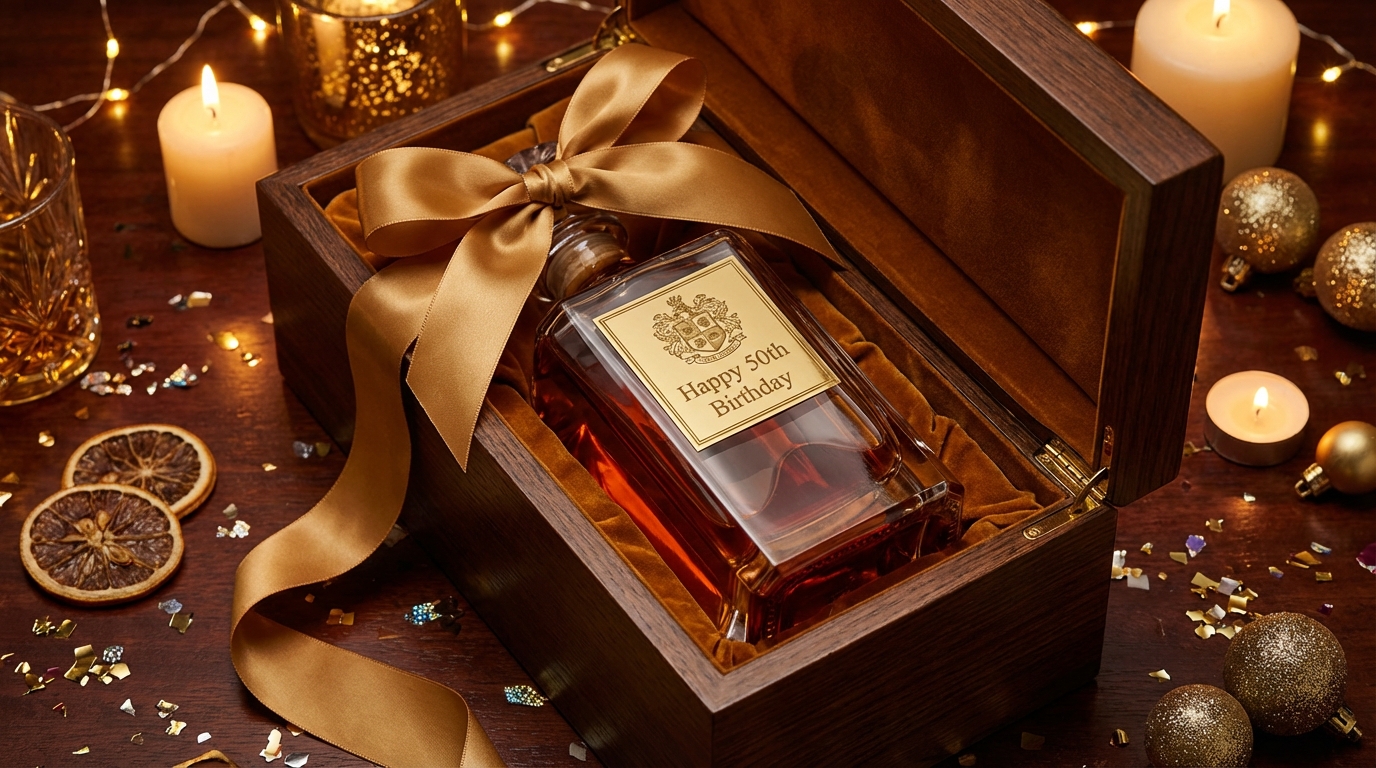
Most vintage bottles at this price level will arrive in a wooden presentation case or a sturdy carton. If the bottle you have sourced does not include one, a quality wooden whisky box is an inexpensive addition that elevates the presentation considerably. Some specialist retailers offer bespoke gift wrapping and presentation as part of their service — worth asking about when you order.
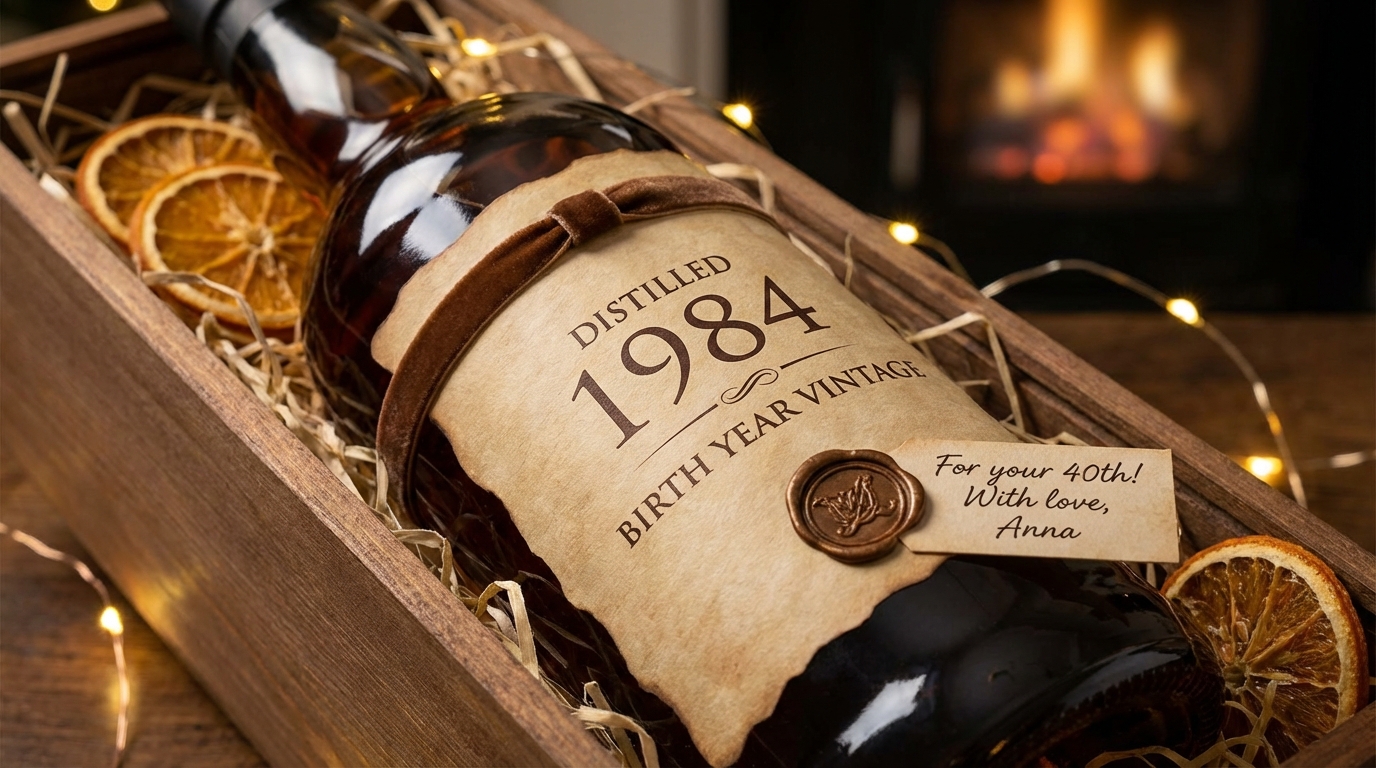
The gift is not just the whisky — it is everything the whisky represents. When you hand it over, have the story ready: where the whisky was distilled, in which year, what was happening in the world at that time, how long it spent in cask, and why you chose this particular bottle. You do not need to be an expert. You need to be a storyteller. A short handwritten note inside the box, connecting the bottle to the person receiving it, will be kept long after the whisky has been enjoyed.
Keep it personal and specific. “This whisky was distilled the same year you were born, at [distillery name] in [region]. It has been quietly maturing for the past fifty years — just like you, it has only got better with time.” That is the kind of message that gets read again. Avoid generic whisky platitudes. Reference something only you would know about them.
This is a genuine question, and the right answer depends on the recipient. If they are a collector who values the bottle as an object and an investment, they may prefer to keep it sealed. If they are a whisky drinker who wants to experience what fifty years in oak actually tastes like, opening it together on the day is an unforgettable experience. Ask yourself — or ask them in advance — which they would prefer. There is no wrong answer.
The honest answer is that genuine 1975 and 1976 bottles do exist — but they are not always available at every price point, and the specific distillery or expression you are hoping for may not be on the market at the moment you are looking. Here is how to navigate that situation.
Consider a different distillery from the same year. If the well-known names are out of your budget or out of stock, a less famous but equally legitimate distillery from 1975 or 1976 still carries the birth year connection that makes this gift meaningful. The year is the anchor; the distillery is context.
Consider a bottle that spans the era. Some expressions are vatted or blended from casks that include 1975 or 1976 spirit, even if they are not labelled as a single-year vintage. A reputable retailer can advise on whether any available expressions include birth year liquid.
Consider a related vintage from a legendary distillery. If a Port Ellen or Brora from 1975-1976 is not available or not within budget, a bottle from 1974 or 1977 from the same distillery carries an almost identical story. The whisky was made at the same place, by the same team, using the same methods, within a year or two of the birth year. The context and the provenance are the gift; the precise vintage is the ideal but not the only option.
Be transparent about it. If you give a 1974 Brora as a 50th birthday gift and explain why — that the 1975 was not available but you found something equally rare from the same distillery, the same era — that honesty becomes part of the story rather than a shortcoming of the gift.
For an in-depth look at the 1980s vintage window (relevant for birthdays just a few years hence), the best birth year whiskies from the 1980s guide is worth bookmarking.
Even well-intentioned buyers can make avoidable errors in this category. These are the ones most worth knowing.
Confusing bottling year with distillation year. As covered earlier, this is the single most common mistake. Always confirm the distillation year, not just the year on the label. A bottle released in 1975 containing three-year-old spirit is not a birth year whisky in any meaningful sense.
Buying purely on price. In the rare whisky market, price is a signal — but it is not the only signal. An unusually cheap 1975 bottle from an unverified seller is a more likely problem than a bargain. Conversely, the most expensive option is not automatically the best gift; it is the bottle with the best story for your recipient.
Leaving it too late. Rare vintage bottles require sourcing, and the best ones go quickly. If the birthday is three months away and you want something specific, start looking now. A specialist retailer with an extensive network can often source bottles that are not in their current listed stock, but that takes time.
Ignoring the recipient’s taste preferences. A heavily peated Islay malt from 1975 is a spectacular bottle — but if the recipient actively dislikes smoky whisky, the gesture may not land as intended. Consider whether they have preferences between styles: lighter, floral Speysides; rich, sherried Highlanders; or peated, coastal Islays.
Skipping the story. A rare vintage bottle handed over without context is just an expensive bottle. The story — where it was made, when, how long it spent in cask — is the gift within the gift. Take ten minutes to understand what you are giving and articulate it.
Not checking condition. Fill levels in very old bottles can drop over time due to evaporation. A good specialist will grade the fill level and point out any relevant condition factors before you buy. A bottle with a low fill level is not necessarily a problem, but you should know about it.
The ultimate whisky collecting guide covers the full landscape of what to look for when buying rare and vintage Scotch, and is worth reading alongside this guide.
A 50th birthday is one of the handful of moments in a person’s life that demands something genuinely exceptional. Birth year whisky — distilled in the same year they were born, matured across the decades they have lived, and presented with care on the day they turn fifty — is one of the very few gifts that rises to meet the occasion.
It is rare, it is personal, and it is the kind of gift that says something no card ever could: that you understood what this milestone meant, and you found something worthy of it.
At Glenbotal, we specialise in sourcing exactly these bottles — rare vintage expressions from private collections across the UK and Europe, authenticated and presented to the standard the occasion deserves. Whether you have a specific distillery in mind or need guidance on where to start, our team can help you find the right bottle for your budget and your recipient.
Browse our 1970s vintage collection at glenbotal.co.uk — or get in touch for a free consultation and we will do the searching for you.
For a genuinely rare birth year bottle from 1975 or 1976, expect to spend at least £200–£500 for an entry-level independent bottling and £500–£2,000 for a well-known distillery expression. Exceptional bottles from closed distilleries like Brora or Port Ellen will sit above £2,000, often significantly so. There is no single right answer — the right spend is whatever puts the best possible bottle in front of your recipient.
This is more common than you might think for 1975-1976 bottles, particularly at specific distilleries. A bottle from 1974 or 1977 from the same distillery is an entirely honourable alternative — the context and provenance are the same, and a good specialist retailer can help you frame the gift accurately. You can also look at different distilleries from the same vintage year.
For gift-giving purposes, an unopened bottle is always preferable. It preserves both the sentimental value and the financial value of the expression. A opened or part-consumed bottle, even at the same vintage, carries neither the same story nor the same investment potential. Always buy sealed unless you are specifically advised otherwise by a specialist.
Glenfarclas (Family Casks programme), Gordon & MacPhail independent bottlings, Brora, Port Ellen, Caol Ila, and Springbank are among the most sought-after names from this era. Glenfarclas offers the most consistent availability; Brora and Port Ellen offer the highest prestige and rarity. The right choice depends on your budget and the recipient’s taste preferences.
These can be the same thing — a 1975 whisky bottled in 2025 is both a birth year expression and a 50-year-old. What matters is that the distillation year matches the birth year. A “50 Years Old” expression distilled in, say, 1970 is an impressive whisky but is not a birth year gift. Confirm the vintage on the label rather than relying on the age statement alone.
Always buy from a reputable specialist retailer who can provide provenance documentation — details of the cask, the distillery, and the chain of ownership where possible. At this price level, you should expect fill level confirmation, capsule and label condition notes, and ideally storage history. If a seller cannot provide basic provenance information, treat it as a warning sign.
Most specialist whisky retailers offer presentation cases for vintage expressions, and many will arrange gift wrapping or bespoke presentation on request. Ask when you order — it is a small addition that makes a significant difference to the moment of giving.
Keep it personal and specific to the bottle. Something along the lines of: “This whisky was distilled at [distillery] in [year] — the same year you were born. It has spent the last fifty years quietly maturing in oak. We thought it was time you two finally met.” Short, meaningful, and connected directly to what you are giving. Avoid generic whisky quotes or clichés.
Yes, they exist — primarily independent bottlings from Speyside distilleries that were producing at high volume in the 1970s, where cask stocks have been more gradually released over the years. A reputable specialist will be able to point you toward the best options at this price point. Be realistic about what £300 can secure from a fifty-year-old vintage: you will find something authentic and interesting, but not a world-famous name.
Reputable rare whisky retailers use specialist packaging designed to protect glass bottles, with insurance available for high-value items. When ordering, confirm the retailer’s packaging standards, whether a signature is required on delivery, and what their policy is if the bottle arrives damaged. For very high-value expressions above £1,000, ask about specialist couriers with whisky insurance. Glenbotal ships throughout the UK with appropriate protective packaging as standard.
For a specific expression from a named distillery, give yourself at least four to six weeks. Some bottles can be sourced quickly from existing stock; others require the retailer to reach into their private collector network, which takes time. If the birthday is approaching and you have a specific bottle in mind, contact a specialist retailer as early as possible rather than leaving it to the last week.
Rare vintage Scotch from closed or historically significant distilleries has shown a consistent long-term trend of appreciation in value. A sealed bottle of 1975 Brora or Port Ellen purchased today is likely to be worth more in ten years than it is now. For a recipient who also collects or invests in whisky, this dual value — sentimental and financial — makes the gift even more compelling. That said, investment should never be the primary motivation; the gift is what it is first and foremost.
Explore the full collection at Glenbotal — rare whisky sourced from private collectors across the UK and Europe.