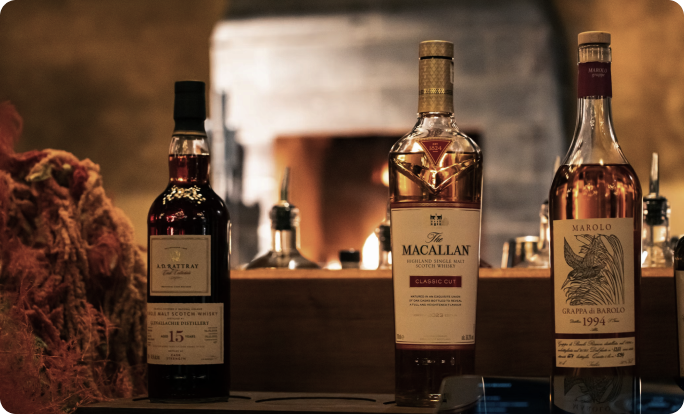
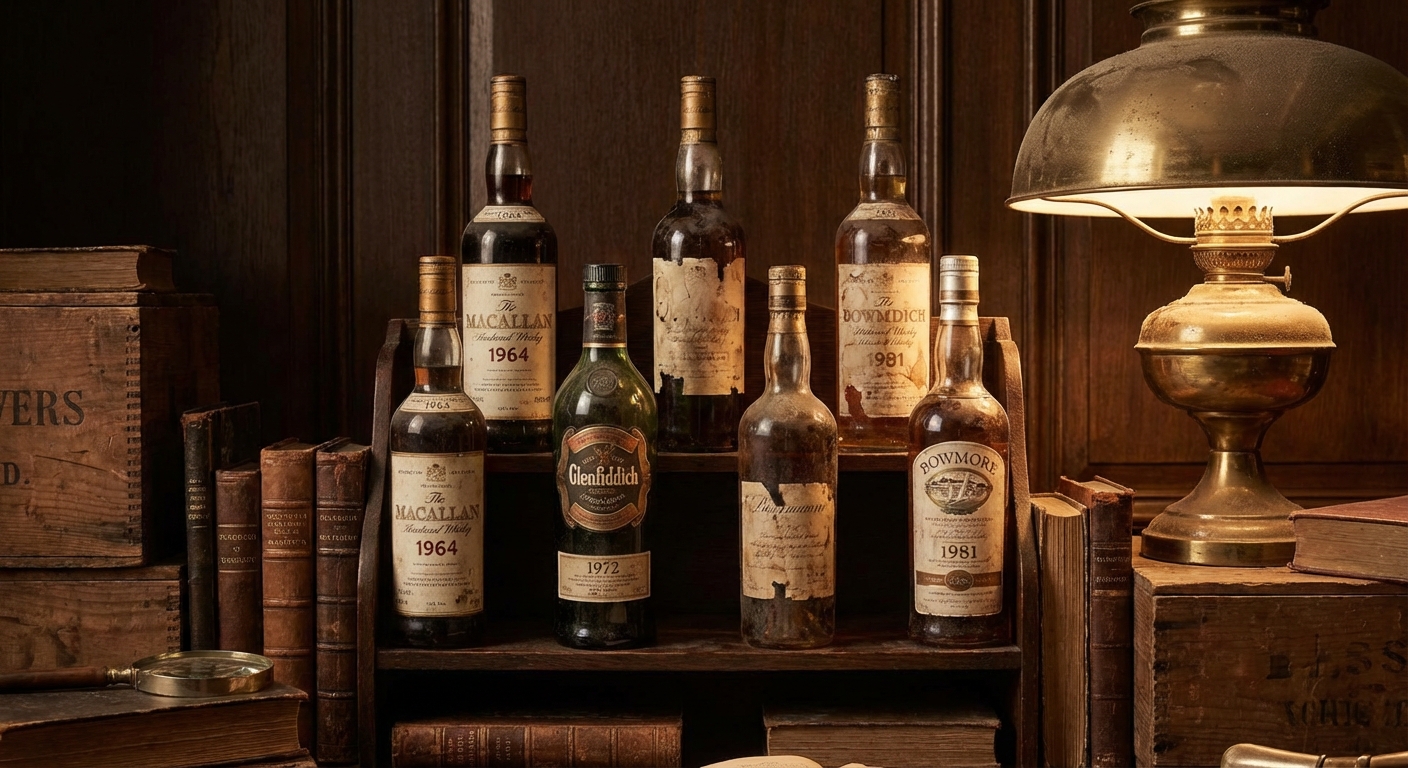
Most people walk past a fortune at auction. These seven bottles prove that the most valuable whiskies aren’t always the most famous names on the shelf.
There’s a bottle at the back of a cupboard somewhere in the UK that’s worth more than the car parked outside.
That’s not an exaggeration. Whisky auction results from the past five years have shown, repeatedly, that bottles bought for under £50 at a supermarket in 1987 or inherited from a grandparent’s drinks cabinet can now sell for hundreds — sometimes thousands — of pounds at platforms like Whisky Auctioneer and Scotch Whisky Auctions.
The catches? Most owners don’t know what they have. And most casual buyers at auction don’t know what they’re passing on.
This list was built for both types of person. We’ve gone through the auction data, the distillery histories, and the collector community’s conversation to find seven bottle categories that consistently outperform expectations — not the six-figure headline lots, but the bottles you might actually encounter, inherit, or find mislabelled in a lot.
Here’s what we found.
Each bottle on this list had to meet four criteria:
| Bottle | Era | Typical Auction Range | Why It Surprises |
|---|---|---|---|
| Springbank 1970s Official | 1970–1980 | £400–£1,200+ | Closed 1979–1989; limited stock |
| Glenfarclas Family Casks | 1968–1994 | £200–£900 | Underrated vs peers |
| Port Ellen 1979–1983 (entry) | 1979–1983 | £300–£800 | Cheaper end of a famous closed distillery |
| G&M Connoisseurs Choice 1970s–80s | 1970–1990 | £150–£600 | Old independent bottlings often overlooked |
| Laphroaig 10yo Old Label 1980s | 1980–1992 | £250–£700 | Pre-Allied, distinct character, ignored at auction |
| Littlemill 1990 & earlier | 1985–1994 | £300–£1,500+ | Scotland’s oldest licensed distillery, demolished 2010 |
| Teacher’s / Grant’s Pre-1980 Blends | 1960–1979 | £80–£400 | Old blends with serious age, routinely undervalued |
If there is one mid-market whisky that consistently rewards the patient buyer, it is Springbank from the late 1970s.
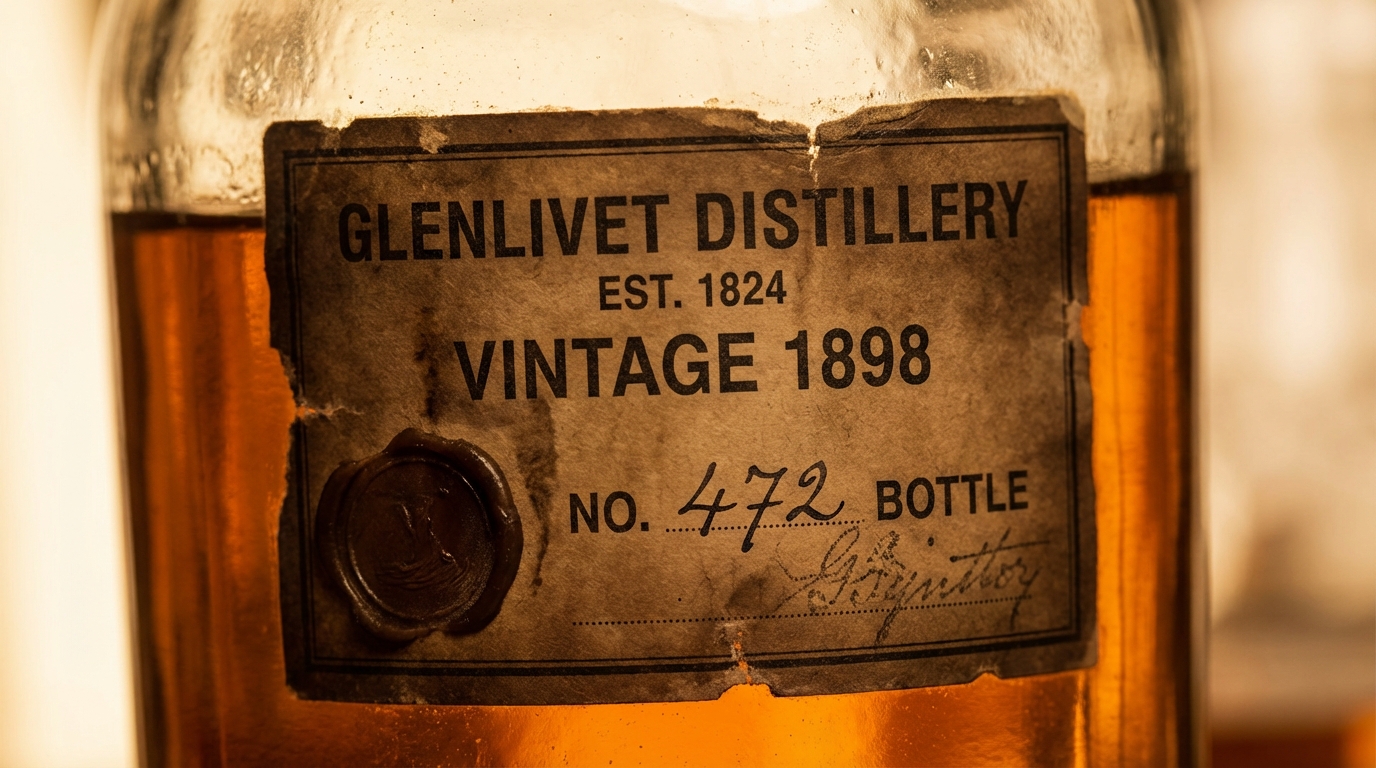
Springbank distillery in Campbeltown closed in 1979 when the UK economy forced a halt to production. It didn’t reopen until 1989. That ten-year silence is the key: any spirit distilled before the closure is now over forty years old, drawn from a production window that will never be replicated.
Here’s the deal: Springbank is one of the very few Scottish distilleries that has always malted its own barley on-site, managed its own bottling, and refused to chill-filter. The result is a house style — slightly oily, coastal, with a complexity that integrates rather than performs — that collectors recognise immediately and others often discover years after they should have.
The bottles to look for are the pre-1985 official releases: 12-year-old and 15-year-old expressions with older label designs, sometimes found with wax seals or cork closures rather than screw caps. These were sold in independent off-licences at the time for well under £20.
What they fetch now: A Springbank 15-year-old bottled in the early 1980s from distillate of the mid-to-late 1960s regularly achieves £600–£1,200 at auction. Earlier vintages — 1960s distillate in 1970s bottlings — can exceed £2,000 for a single bottle. Even the more accessible 1980s-distillate releases have been climbing steadily, with recent auction prices for 1970s-labelled stock in the £400–£700 range.
The tell? Look for the older Springbank font on the label, the absence of any modern branding elements, and a cork rather than a screwcap closure. Bottles with original cardboard tubes or tissue paper wrapping command a premium.
Where to look: Private collections, estate lots, and Scottish auction house sales are the most reliable source. Online platforms list them regularly, though pricing has become more sophisticated as awareness grows.
Glenfarclas is the quiet giant of the Speyside collector market — a family-owned distillery that has been quietly building one of the most significant aged inventories in Scotland.
The Grant family (no relation to the William Grant & Sons empire) has owned Glenfarclas since 1865 and made one decision that now looks like genius: they never sold their casks. While neighbouring distilleries were quietly transferring their oldest stock into blends, Glenfarclas held on. The result is a documented inventory stretching back to 1952 — meaning a bottle you buy today might contain whisky that was distilled before the Beatles released their first single.
The Family Casks series is the expression that most rewards research. Launched in 2007, it covers single-cask bottlings from every year between 1952 and 1994 (later extended). Each bottle gives you the distillation year, the cask number, and the exact bottling date. This transparency is unusual and it makes valuation much more tractable.
Now: the surprising part. Glenfarclas doesn’t carry the cultural cachet of Macallan or the auction frenzy of closed distilleries like Brora. It sits in a middle tier that many casual collectors overlook. That’s changing, but slowly enough that sharp buyers are still finding value.
What they fetch: Early Family Casks releases from the 1960s and 1970s distillation years, bottled in the 2007–2012 window at natural cask strength, now achieve £300–£900 at auction depending on the year and cask. Older distillation years — 1953 through 1965 — have achieved four figures. But the real surprise is how often the 1970s and 1980s vintages still slip through for £150–£350 when they appear in mixed lots or under-described estate sales.
What could be better: Glenfarclas is sometimes overlooked precisely because it is available. Unlike Port Ellen, you can still buy current expressions in shops, which creates a psychological discount in buyers’ minds — even when the vintage being sold is 40 years old.
Best for: Collectors who want documented provenance, consistent house style, and bottles that were commercially available at retail prices within living memory.
For more on what drives Speyside value, see our guide to vintage Scotch whisky — the complete beginner’s overview.
Port Ellen is one of the most famous closed distilleries in Scotland. What most people don’t know is that you can still buy its whisky at auction for under £500.
The distillery on Islay closed in 1983, one of several casualties of the so-called “whisky loch” — the oversupply crisis that shuttered more than a dozen Scottish distilleries in the early 1980s. Since then, most of the remaining casks have been bottled by Diageo as part of their annual Special Releases programme, which started in 2001. Those official releases are what dominate the headlines and the £1,000+ price brackets.
But there’s another category: older independent bottlings and early official releases from the late 1980s and 1990s, when Port Ellen wasn’t yet famous and the bottles moved for ordinary retail prices.
The best part? These are still findable. Gordon & MacPhail, Cadenhead’s, and other independent bottlers filled casks in the 1980s and bottled them quietly through the 1990s without the fanfare that now surrounds the name. These bottles — often simply labelled “Port Ellen 8 year old” or “Islay Single Malt” from a named cask — appear in auction lots regularly, sometimes without the seller understanding exactly what they have.
What they fetch: A Port Ellen 1979 distillate in a 1990s independent bottling can achieve £400–£800 at auction, sometimes more depending on bottler reputation and fill level. The more famous Diageo Annual Release series from 2001 onwards consistently achieves £700–£1,500 for earlier editions. The 1979 cask that sold for £875,000 at Sotheby’s in 2022 was an extreme outlier — but it illustrates what the name now means to serious collectors.
What could be better: Fill level matters enormously with older bottles. A bottle with significant ullage (evaporation loss reducing liquid below the shoulder) will sell for materially less than a full-fill example.
The tell: Look for any bottle simply labelled “Islay Single Malt” with a 1979–1983 distillation date from an independent bottler. Many older bottlers used distillery names only sparingly on labels, which means Port Ellen stock sometimes hides in plain sight.
See our guide to the best vintage whiskies of the 1980s for more context on the closed distillery market.
The most underrated category in the vintage whisky market might be old Gordon & MacPhail independent bottlings — and most people walk straight past them.
Gordon & MacPhail was founded in Elgin in 1895 and has been filling casks from distilleries across Scotland for over 125 years. They were doing this long before independent bottling became fashionable — quietly buying new-make spirit from distilleries, maturing it in their own warehouses, and bottling it under their labels when it was ready.
The Connoisseurs Choice series, launched in the early 1970s, is the range that most rewards investigation. These are single malt bottlings from specific distilleries and specific years, sold at the time for a fraction of what they’d fetch today. Some of these bottles contain spirit from distilleries that no longer exist — Connoisseurs Choice bottlings of Caperdonich, St Magdalene, Rosebank, and Kinclaith appear regularly at auction, representing the only remaining bottled stock from those lost producers.
Here’s what’s interesting: because the G&M label is consistent and the brand doesn’t have the same story weight as a distillery label, these bottles often sell for significantly less than equivalent distillery bottlings from the same year and region. You’re buying the same liquid for less money purely because of label psychology.
What they fetch: A Connoisseurs Choice bottling of a now-closed distillery from the 1970s or early 1980s typically achieves £150–£500 at auction, depending on the distillery and vintage. Caperdonich, Kinclaith, and St Magdalene examples can reach £400–£700 when the distillery name is prominent. Earlier editions — the 1970s Connoisseurs Choice releases in their distinctive green maps label design — attract a premium from label collectors as well as whisky drinkers.
The tell: The original 1970s Connoisseurs Choice design features a green-tinted map of Scotland. Later editions (post-1989) moved to a cream and gold design. Both can be valuable, but the green map bottles from the 1970s and early 1980s are particularly sought after.
Not ideal if: You want a bottle with a famous name on the front. G&M is a specialist’s choice, not a showpiece for the casual collector.
For a deeper look at what makes independent bottlings valuable, see what makes a whisky bottle valuable.
Laphroaig is one of the world’s most recognised whisky brands. What most people don’t realise is that the whisky in bottles from the 1980s is fundamentally different from anything you can buy today — and that difference is starting to show in auction prices.
The distillery on Islay has been producing its distinctive heavily-peated, medicinal single malt since 1815. But the 1980s were a specific era: Allied Distillers owned Laphroaig from 1987, and the production methods, water source usage, and warehousing approach of that period produced a style that current owners Beam Suntory have not replicated.
Pre-Allied bottlings — typically labelled with the old-style elongated Laphroaig script and a different crest design — are the target. These were the 10-year-old expressions sold at retailers for around £15–£20 in the mid-1980s. At that price, most buyers drank them. Very few were saved.
What they fetch: A Laphroaig 10-year-old from an 1980s bottling, in good condition with a full fill, typically achieves £250–£500 at auction. Higher-aged expressions from the same era — the 15-year-old and rare 12-year-old bottlings — have reached £600–£900. The principle here is not about extreme rarity; it’s about the fact that the era’s bottles were consumed rather than stored, and the ones that survived are now meaningfully scarce.
It gets better: A cohort of Laphroaig collectors specifically hunts pre-Allied production, which means there is an active and motivated buyer pool when good bottles come to market. Condition and provenance matter, but the baseline demand is reliably strong.
The tell: Check the label design carefully. Pre-1987 Laphroaig bottles use a different typeface and layout to modern expressions. The back label should not reference Beam Suntory or Allied in any capacity. Many 1980s bottles also used a screw-stopper or cork that differs from current production.
What could be better: Without specialist knowledge, it’s easy to confuse different eras of Laphroaig labelling. If you’re uncertain, a reference photograph from a specialist forum or a query to a reputable auction house pre-submission will quickly confirm the date range.
See our guide to the best vintage whiskies of the 1970s for more on how pre-Allied Islay bottlings compare across the decade.
Scotland’s oldest licensed distillery closed in 1994, was demolished in 1997, and burned in 2004. Every bottle of Littlemill that exists is all that will ever exist.
That is a sentence worth letting settle.
Littlemill, based in Bowling, West Dunbartonshire, is documented as Scotland’s oldest licensed distillery, with evidence of production dating to 1772. The Lowland distillery produced a lighter, triple-distilled style that was prized in blends rather than promoted as a single malt — which is precisely why most people have never heard of it, and why older bottlings remain more accessible than they should be.
The distillery experienced two closures before its final one in 1994: a brief closure in the early 1930s and again in 1984–1989. The post-1989 production run — the final five years before permanent closure — produced whisky that is now reaching its early thirties. Combined with the complete destruction of the distillery site, every cask is a fixed and diminishing resource.
What they fetch: Littlemill bottlings from the late 1980s and early 1990s regularly achieve £300–£700 at auction for standard expressions. Older releases — 1970s and early 1980s distillate — command significantly more, with some examples exceeding £1,000. The Celestial Edition 40-year-old released by Loch Lomond Group (current custodians of remaining stock) achieved around £6,000 at auction, demonstrating the ceiling when age and scarcity combine.
The more accessible opportunity is the official 8-year-old and 12-year-old expressions bottled in the late 1990s and early 2000s from the final production runs. These were not expensive when released and remain underpriced relative to equivalent closed-distillery expressions from more famous Lowland or Highland sites.
The tell: Look for bottles specifically labelled “Littlemill” with Bowling, Dunbartonshire provenance information. Some bottles from the 1990s carry the “Loch Lomond Distillery Co” designation as parent company — this is still authentic Littlemill spirit. Any bottle referencing the distillery’s founding date of 1772 is using the original distillery’s identity.
Not ideal if: You need immediate market depth. Littlemill is a specialist name, and while the collector base is dedicated, it’s smaller than Port Ellen or Brora. Patience at auction is sometimes required to find a buyer at full value.
Here’s the most counterintuitive entry on this list: ordinary blended Scotch whisky from the 1960s and 1970s is now worth serious money, and almost nobody buying it knew that at the time.
Teacher’s Highland Cream and William Grant’s Standfast were both volume blends — sold in supermarkets, in pubs, at Duty Free. They were not premium products. They were the everyday whisky of a generation that didn’t think about age statements or distillery provenance. And because they were ordinary, they were opened and drunk.
The ones that weren’t are now windows into a completely different era of blended Scotch. Pre-1980 blended Scotch contained component whiskies from distilleries that have since closed — Caperdonich, Kinclaith, Inverleven, Port Dundas, Girvan, and others. A bottle of Teacher’s from 1972 is a blend that cannot be remade. The individual whiskies within it no longer exist in that form.
What they fetch: A sealed, full Teacher’s Highland Cream from the early 1970s in its original presentation typically achieves £80–£250 at auction, with exceptional examples — gift sets, older decanters, or bottles with full labels and intact seals — reaching £300–£400. Grant’s Standfast from the same period performs similarly. Older still — 1960s bottlings with tax stamps and original packing — can reach £400–£600.
The best part? These bottles still appear regularly in house clearances and estate lots where the seller doesn’t know what they have. An online auction might list a 1970s Teacher’s alongside a half-empty bottle of modern blended Scotch and price both at the same low estimate.
Question is: why do people pay for blended Scotch from the 1970s? Two reasons. First, the component whiskies are genuinely aged and genuinely unavailable — drinking a 1972 blend is the only way to taste some of those lost distillery contributions. Second, label and packaging collectors are an active market segment for vintage spirits, separate from whisky drinkers entirely.
The tell: Look for tax seals (a paper band across the cap or cork, stamped with HM Customs & Excise), older label designs with no reference to current parent companies, and glass bottle shapes that predate the standardised modern bottle. Teacher’s from this era used a distinctive squat bottle shape. Grant’s used a triangular bottle long before it became a brand identity element.
Not ideal if: You need liquid that drinks beautifully. Older blends can be magnificent, but they can also have deteriorated depending on storage and fill level. These are primarily collector rather than drinker bottles.
See our guide to how much your whisky bottle is worth for a full breakdown of how fill level, label condition, and provenance affect resale value.
Not every old bottle is valuable. Here is a short decision framework for assessing what you have:
If you have a bottle that passes all five checks, it warrants a proper valuation. Whisky Auctioneer offers a free valuation service, as does Scotch Whisky Auctions and several specialist retailers including Glenbotal, who source and appraise private collections across the UK and Europe.
Whisky values can go down as well as up. Results may vary significantly depending on condition, provenance, and market timing. The figures quoted are based on recent auction data and are not a guarantee of future sale prices. Always verify current values with a specialist before buying or selling.
The key indicators are distillery (closed distilleries command premiums), age (older distillation dates are generally more valuable), fill level (bottles should be at or above neck level), and label condition (intact, legible labels are significantly more valuable). If you have a sealed bottle from a closed distillery with a pre-1990 distillation date, it is worth getting a professional appraisal before selling.
Yes, provided they are old enough. Pre-1980 blended Scotch whiskies contain component malts from distilleries that have since closed. The blend cannot be replicated, which gives older bottles genuine scarcity value. Bottles of Teacher’s, Grant’s Standfast, and similar blends from the 1960s and 1970s regularly achieve £80–£400 at auction in good condition.
An official bottling is released directly by the distillery or its current owner. An independent bottling is produced by a third party — Gordon & MacPhail, Cadenhead’s, Signatory — who purchased casks from the distillery and bottled them independently. Both can be highly valuable; independent bottlings are often more diverse in style and sometimes contain spirit from distilleries that never released their own official single malt expressions.
Evaporation through the cork is normal over decades, but a significant reduction in fill level signals either prolonged storage in suboptimal conditions or a possible previous opening. Collectors pay for authenticity and condition. A bottle at 90% fill may sell for 30–50% less than a full bottle of the same expression, and bottles with fill levels below the shoulder can be very difficult to sell at auction.
Springbank is widely regarded as one of the most reliable collector distilleries in Scotland. Its combination of traditional production methods, independent ownership, and the 1979–1989 closure gap makes older expressions structurally scarce. For new collectors, Springbank offers good entry points at the mid-market level without requiring the capital commitment of Brora or Port Ellen. That said, all whisky investments carry risk.
The major online auction platforms — Whisky Auctioneer and Scotch Whisky Auctions — are the most liquid marketplaces. Bonhams and McTear’s run periodic specialist whisky auctions for higher-value lots. For private sale, specialist retailers like Glenbotal source bottles directly from collectors and can offer faster liquidity without auction fees, which typically run 10–20% of the hammer price.
Supply is fixed. Once the stock from a closed distillery is bottled and sold, there is no possibility of further production. With an operating distillery, the brand can always produce more whisky to meet demand. Closed distilleries like Port Ellen, Brora, and Littlemill have a structural scarcity that operating distilleries cannot replicate regardless of how rare their limited editions appear.
For some closed distilleries, G&M bottlings are the primary market. If a distillery never released official single malts — Kinclaith, for instance, produced spirit only for blends — then independent bottlers like G&M are the only source of any bottled expression. In these cases, G&M bottlings carry the same scarcity premium as official releases. For active distilleries, G&M bottlings generally trade at a slight discount to equivalent official expressions, though this gap narrows for very old vintages.
Check the label design against reference databases — Whiskybase and similar collector resources catalogue label variations by era. Look for period-appropriate closure types (cork versus screwcap), glass bottle mould marks consistent with the era, and duty seals appropriate to the country and decade. For significant purchases, a specialist authentication service or a consultation with an established auction house is worthwhile.
The main risks are condition (fill level and seal integrity cannot always be confirmed from photographs), authenticity (counterfeit bottles exist for premium expressions), and liquidity (reselling at auction incurs fees and is not guaranteed). Storage condition also affects liquid quality — bottles stored in direct sunlight or temperature extremes may have deteriorated even if visually perfect. Reputable auction platforms provide condition reports, and buying from established specialists reduces but does not eliminate these risks.
Yes. Closed-distillery expressions from the 1990s — the final Littlemill production years, Caperdonich’s last decade of output before its 2002 closure, and any Brora or Port Ellen from before their 1983 closure that was bottled during the 1990s — already command serious premiums. More broadly, independent bottlings of Lowland malts from the 1990s are underappreciated and likely to appreciate as the pool of available stock diminishes.
The seven categories on this list share one characteristic: they reward knowledge over budget.
A bottle of 1970s Springbank, a pre-Allied Laphroaig, a green-label Gordon & MacPhail Connoisseurs Choice of a lost Lowland distillery — none of these require a six-figure budget. What they require is knowing what you’re looking at before the auction hammer falls.
If you suspect you have something valuable: don’t open it, don’t clean the label with anything, and don’t move it unnecessarily. Get a professional appraisal first. The cost is usually zero and the information is always worthwhile.
If you’re looking to buy: the best opportunities are still in estate lots, mixed auction batches, and private collection sales where bottles aren’t always individually identified. The collector who reads the small print wins.
Glenbotal sources rare and vintage whisky directly from private collections across the UK and Europe. If you think you have something worth investigating — or you’re looking for specific bottles in this category — Get Started with a free appraisal at Glenbotal or browse the current collection directly.
Explore the full collection at Glenbotal — rare whisky sourced from private collectors across the UK and Europe.