43 single cask bottlings. One from every distillery year between 1952 and 1994. No blending, no shortcuts — just whisky drawn straight from the cask, at the strength nature gave it.
When Glenfarclas launched the Family Casks series in 2007, it offered something almost unheard of in Scotch whisky: an unbroken run of single cask bottlings spanning four decades of production, each one a window into a specific year at one of Speyside’s most revered distilleries. No two bottles in the collection are identical. No two ever will be.
The Glenfarclas Family Casks are a collection of 43 single cask bottlings, each drawn from a single year of production at Glenfarclas distillery, covering every year from 1952 through to 1994. The series was first released in 2007 and has since expanded, with subsequent releases taking the collection up to and beyond 2007 vintage years.
Each bottling in the collection represents a single cask — one barrel, selected from Glenfarclas’s extraordinary on-site warehouses. That cask is bottled without dilution, without caramel colouring, and without chill-filtration. What ends up in the bottle is precisely what was in the wood.
The name itself matters. These are not corporate releases designed by a marketing committee. They are called the Family Casks because the Grant family — who have owned Glenfarclas for six generations — made the conscious decision to release some of the most treasured casks in their inventory. In whisky terms, that is a remarkable act of generosity and confidence.
The collection is widely regarded as one of the most comprehensive single cask series ever assembled by a Scotch whisky distillery. For collectors focused on depth, provenance, and history, the Family Casks represent something genuinely rare: the ability to trace a distillery’s character year by year, decade by decade, across more than half a century of production.
Glenfarclas was first licensed in 1836, making it one of the older operating distilleries in Scotland. It sits in Ballindalloch, Speyside — a region whose soft water, fertile barley land, and mild climate have produced some of the most celebrated single malt Scotch whisky in the world.
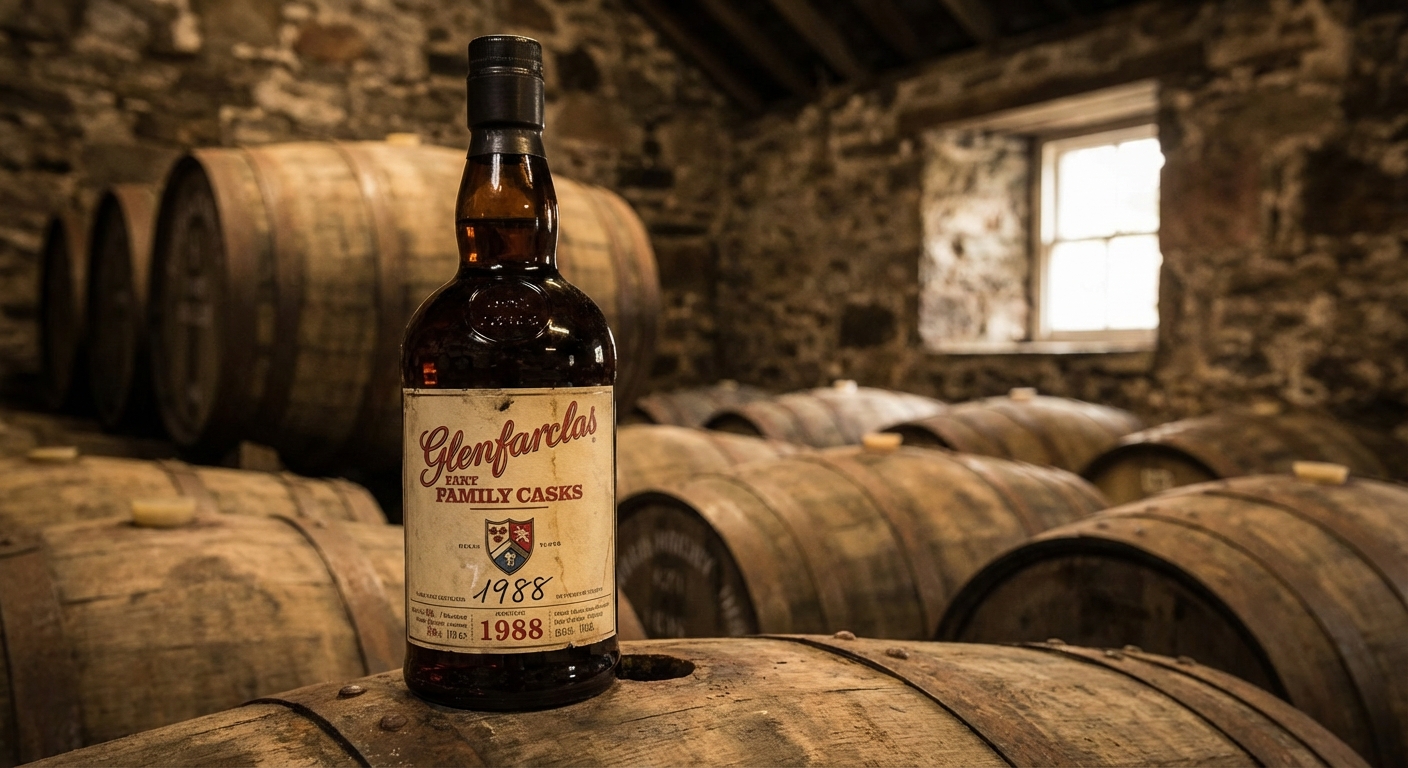
In 1865, John Grant purchased Glenfarclas. His family have owned and operated it ever since — six generations of Grants, an unbroken chain of ownership stretching more than 160 years. In an industry now dominated by multinational conglomerates, that kind of continuity is exceptional. It shapes everything from production decisions to warehousing strategy to the choice of which casks to release and when.
The distillery is located on the slopes of Ben Rinnes, whose springs supply the production water. Glenfarclas operates six stills — among the largest pot stills on Speyside — which contribute to the distillery’s characteristic rich, full-bodied house style. Sherry casks, predominantly oloroso, have long defined that style: the dried fruits, spice, and warmth that Glenfarclas is known for.
Around 68,000 casks are maturing on-site at any given time, in traditional dunnage warehouses. Glenfarclas has cask inventory dating from 1953 onward. That depth of stock is what makes the Family Casks project possible — and what makes it virtually impossible for any other distillery to replicate at the same scale.
The distillery was named Distiller of the Year by Whisky Magazine in 2006, 2020, and 2023. It established one of Scotland’s first visitor centres in 1973. The visitor centre features panelling salvaged from the RMS Empress of Australia — a detail that says a great deal about how the Grant family thinks about heritage.
Glenfarclas is not managed for a quarterly earnings report. It is managed for the next generation. That long-term thinking is visible in every decision the distillery makes — including the decision to hold onto single casks for five, six, or seven decades before releasing them.
Understanding why the Family Casks command so much attention requires understanding what they are — and what they are not. Each of the following characteristics applies to every bottle in the series.
Each Family Cask bottling comes from one individual barrel. A standard whisky expression is vatted — blended from dozens or hundreds of casks to achieve a consistent house flavour. A single cask bottling eliminates that process entirely. The whisky in the bottle came from one specific piece of wood, filled on one specific date, matured in one specific warehouse location.
The consequence is that bottle yields are limited. Depending on the size of the cask and the years it has spent in the warehouse, a single cask might yield anywhere from 150 to 600 bottles. Once they are gone, they are gone. There is no way to replicate that exact bottling because there is only one cask.
The Family Casks are bottled at whatever ABV the whisky naturally reached in the cask. This varies considerably across the series — older casks with greater evaporation loss (the so-called “angel’s share”) may come in at lower strengths, while some younger releases carry significant power. Collectors should always note the ABV on the bottle because it is a fingerprint of that specific cask’s history.
Standard whisky expressions are typically diluted with water to a fixed bottling strength — 43%, 46%, or 48%, depending on the expression. Family Casks are never diluted. What the cask gives is what the bottle holds.
E150a, the permitted caramel colouring used in many Scotch whiskies, is absent from every Family Cask bottling. The colour in the bottle is entirely natural — the result of the wood interaction over the cask’s lifetime. This matters to collectors both aesthetically and as a question of transparency: the colour you see is exactly what the maturation process produced.
Chill-filtration removes fatty acids and esters that can cause haziness in whisky when it is chilled or diluted with water or ice. It also removes some of the compounds that carry flavour and texture. The Family Casks are non-chill-filtered, meaning the full body, mouthfeel, and flavour complexity of the cask’s contents is preserved in every bottle.
For serious collectors and drinkers, these four characteristics — single cask, cask strength, no colouring, no chill-filtration — represent the gold standard of whisky bottling. The Family Casks deliver all four across every vintage year in the collection.
One of the most compelling aspects of the Family Casks is the way the series captures change over time — in the distillery, in Scottish agriculture, in cask sourcing, and in the whisky-making craft itself. Tasting across decades is a form of time travel.
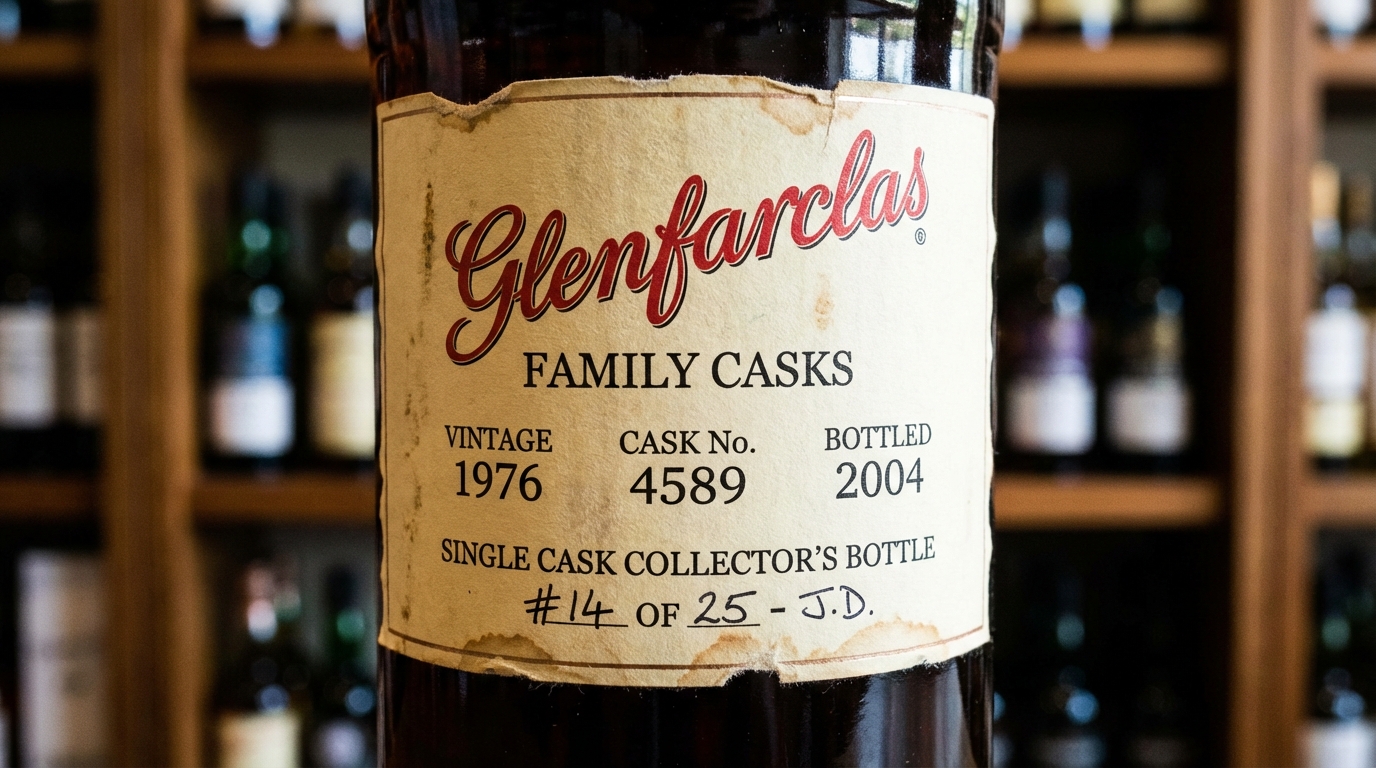
The 1952 vintage was the earliest year released when the Family Casks launched in 2007. Whisky distilled in 1952 was produced in post-war Scotland, when barley supplies were still recovering, distillery equipment was different from anything in operation today, and the casks used were from an era when the global sherry trade operated differently.
By the time these bottles were filled — more than 50 years after distillation — the whisky had spent longer in the cask than most distillery workers had been alive. The evaporation losses over half a century are significant: what remains is extraordinarily concentrated, often deeply coloured, and complex in ways that can be difficult to articulate. These are the rarest bottles in the series, and they command the highest prices on the secondary market.
The 1953, 1954, 1955, 1956, 1957, 1958, and 1959 vintages form an era of Glenfarclas history that is, by definition, closed. There is a finite number of bottles from this period and the inventory will never be replenished.
The 1960s represent Glenfarclas during a period of growth in Scotch whisky’s international profile. The decade saw increasing investment in Speyside production, the modernisation of cask management practices, and the beginning of a broader appreciation for aged single malt that would eventually transform the category.
Whisky from the early 1960s — the 1960, 1961, 1962, 1963, and 1964 vintages — were distilled when the industry’s relationship with sherry casks was at its peak. The supply of genuine oloroso butts from Spain was abundant, and many distilleries filled their warehouses with sherry-seasoned wood. Family Casks from this era often display the classic Glenfarclas signature at its most intense: dark dried fruit, leather, old oak, and a sweetness that decades in the barrel have transformed into something almost crystalline.
The later 1960s — 1965 through to 1969 — capture the distillery at a moment before major changes in cask supply would alter the industry’s flavour landscape. Collectors who focus on the 1960s vintages are investing in a flavour profile that is, in many respects, impossible to recreate.
The 1970s are arguably the most historically significant decade for Scotch whisky collectors. The first half of the decade coincided with the oil crisis and a period of economic uncertainty, but distilleries continued to fill casks — many of which became the legendary bottlings of the 1990s and 2000s.
Glenfarclas 1970s Family Casks occupy an interesting middle ground: they are old enough to carry genuine depth and complexity, but they are available at prices that still — in the context of what comparable bottlings cost — represent real value. For collectors who want to enter the series without committing to the prices that 1950s and 1960s vintages command, the 1970s are often the starting point.
The distillery’s use of sherry casks continued throughout this decade, and many 1970s Family Casks show a beautifully balanced interplay between the distillery’s natural richness and the oxidative influence of long wood maturation.
The 1980s were a difficult decade for Scotch whisky. The industry entered a prolonged downturn often referred to as the “whisky loch” — an oversupply crisis that led several distilleries to mothball or close entirely. Glenfarclas continued operating, and the casks filled during this period have had the benefit of decades of quiet maturation in the distillery’s traditional warehouses.
Family Casks from the 1980s are now carrying 35 to 45 years of age. At that age, the interaction between spirit and wood has reached a point where genuinely complex tertiary notes — tobacco, leather, sandalwood, old furniture polish — begin to emerge alongside the fruit and spice of younger expressions. These bottlings often represent the sweet spot for collectors who prioritise flavour development over absolute age.
The 1980s vintages are also among the more accessible in the series in terms of price, making them a natural entry point for new collectors building a relationship with the Family Casks. They are not easy to find, but they are less elusive than the 1950s and 1960s.
The 1990s saw a renaissance in single malt Scotch whisky’s global reputation, driven in part by publications like the Malt Whisky Yearbook and the growing influence of whisky writers and competitions. Glenfarclas benefited from this rising tide.
Family Casks from the first half of the 1990s are now in their early thirties. They retain more of the fresh distillery character — the cereal notes, the bright sherry fruit, the direct warmth — that the oldest expressions have long since transformed. For drinkers who prefer a more immediate, less heavily evolved style, the 1990s vintages are often revelatory.
The collection covers vintages up to 1994 in the original series, and subsequent releases have extended the range further. Each new wave of Family Cask releases gives collectors the opportunity to acquire bottles that are, in effect, new additions to an ongoing archive.
While every bottle in the Family Casks series is, by definition, rare and unrepeatable, certain vintages and releases attract particular attention from the collector community.
The opening of the series — the oldest vintages — consistently achieve the highest prices when they appear at auction or through specialist retailers. A bottle of Glenfarclas Family Casks 1952 distilled over 70 years ago represents something genuinely irreplaceable. These bottles surface infrequently, and when they do, serious collectors move quickly.
The early-to-mid 1960s represent a particularly sought-after window. The combination of age, the era’s cask profile, and the relative scarcity of surviving bottles creates strong collector demand. These vintages typically sell at a significant premium to the standard range of the series.
When Glenfarclas first released the Family Casks in 2007, each vintage was presented in a distinctive format that marked it as part of the inaugural collection. Bottles from this original release — identifiable by their labelling and presentation — carry an additional layer of collectibility beyond the whisky itself. Provenance matters in this market, and original 2007 release examples command premiums over later releases of the same vintage year.
Within the series, certain casks bottled at unusually high or unusually low strengths attract specialist attention. A very high ABV suggests a cask that has retained exceptional volume despite decades of maturation — a statistical outlier. A very low ABV from a cask that nevertheless remains complex and rewarding can indicate remarkable wood management. Both types interest collectors who look beyond vintage year alone.
The most valuable Family Cask is not always the oldest one. It is the one where everything — the vintage, the cask history, the ABV, the condition — aligns perfectly. That is when serious collectors make serious decisions.
Whisky values can rise and fall. This is not financial advice — this article is for informational purposes only.
Building a Family Casks collection requires patience, knowledge, and access to the right sources. Here is what experienced collectors have learned.
The Family Casks span more than half a century of production. Most collectors do not attempt to acquire every vintage. Instead, they identify a strategic focus: a particular decade, a specific birth year or anniversary year, a preferred flavour profile, or a target price range. Having that focus makes acquisition decisions clearer and prevents the impulse buys that often result in a collection without coherent direction.
If the collection is gift-oriented — finding a bottle from someone’s birth year, for example — the guide to birth year whiskies from the 1960s offers useful context for navigating that specific era. Our vintage Scotch whisky guide provides broader orientation for anyone new to collecting pre-millennium bottles.
The secondary market for rare whisky operates across specialist retailers, auction houses, and private sales. Each channel has its characteristics. Specialist retailers typically offer verified provenance and returns policies. Auction houses provide market-tested pricing but require due diligence on lot descriptions. Private sales offer potential value but demand careful authentication.
For genuine Family Casks, key authentication points include: the correct label format for the release wave (2007 originals look different from later releases), the batch number printed on the bottle, fill level (which should be consistent with proper storage), and capsule integrity. Any bottle missing its original presentation tube or showing evidence of tampering should be treated with caution.
Our guide to what makes a whisky bottle valuable covers the authentication principles that apply across the rare whisky market — including the specific factors that affect Family Cask pricing.
For a single cask bottling at natural cask strength, condition is everything. Fill level — the amount of liquid in the bottle — affects both value and the quality of any eventual drinking experience. A bottle with noticeable evaporation from an imperfect seal is not the same as a full bottle, and pricing should reflect that. Always request photographs or in-person inspection before committing to a significant purchase.
The Family Casks appear regularly through specialist channels in the UK, across Europe, and at major whisky auction platforms. Building a shortlist of the vintages you are looking for, and setting up alerts with trusted retailers, is the most efficient way to act when stock becomes available.
Glenbotal’s free valuation service is available to anyone holding Family Cask bottles — whether you are looking to understand current market value, considering a sale, or simply want an expert second opinion on a potential purchase. With access to one of the largest private collector networks in the UK and Europe, Glenbotal can often locate specific vintages that do not appear through standard retail channels.
The Family Casks do not exist in isolation. The single cask category is well-populated, and collectors making purchasing decisions benefit from understanding where the Family Casks sit relative to comparable series.
Gordon & MacPhail, the Elgin-based independent bottler, has assembled one of the deepest cask inventories in the industry — including extremely old casks from distilleries that no longer exist. Their Private Collection and Generations series offer similar philosophical territory to the Family Casks: single cask, aged expressions from specific vintage years.
The key difference is provenance. Gordon & MacPhail’s releases come from casks they purchased from distilleries and matured themselves. The Family Casks come directly from Glenfarclas’s own warehouses, filled by the distillery itself. For collectors who prioritise direct distillery provenance over the sometimes superior age statements that third-party owners can offer, the Family Casks are the natural choice.
Independent bottlers — Signatory Vintage, Douglas Laing, Cadenhead’s, Berry Bros & Rudd and others — release single cask Glenfarclas bottlings periodically. These can offer genuine value, particularly for more recent vintage years, and some independent bottlings of older Glenfarclas casks are extremely well regarded.
What they cannot offer is what makes the Family Casks unique: the continuity of the series, the direct family connection, and the guarantee that the cask was matured in the distillery’s own warehouses under the Grant family’s direct oversight. The Family Casks are the definitive collection, not one option among many.
The Macallan Fine & Rare collection is the Family Casks’ most obvious comparison point in terms of prestige and collector interest. Both series cover multiple vintage years, both feature single cask or single vintage bottlings, and both command significant secondary market premiums. See our Macallan Edition Series guide for a detailed look at how another distillery has approached the collector market.
The difference lies in scale and intent. Fine & Rare is explicitly positioned as a prestige luxury product with pricing to match. The Family Casks, while commanding serious money for the oldest vintages, were conceived as an act of transparency — sharing the distillery’s archive, not monetising it at maximum possible extraction.
The Family Casks market rewards knowledge and penalises ignorance. These are the errors that inexperienced collectors most often make.
The vintage year is one data point among several. A 1963 cask that was poorly stored, has significant fill loss, or shows signs of a failed capsule is not the same asset as a perfectly preserved 1963 example. Experienced collectors evaluate condition, provenance, and presentation alongside the vintage year before any purchase decision.
The ABV printed on a Family Cask bottle is part of its identity. When tracking values or comparing bottles of the same vintage year, the ABV helps identify the specific bottling — because multiple casks from the same year may have been released at different times and at different strengths. A bottle described only as “Family Casks 1974” without an ABV reference is an incomplete description.
For significant purchases, documentation matters. Original receipts, prior auction records, or letters of provenance from previous owners add a layer of verifiability that affects both confidence and resale value. Ask for whatever documentation exists. A reputable seller will have it or will tell you honestly if they do not.
Some Family Cask vintages — particularly from the 1980s and 1990s — occasionally appear through specialist retailers at prices below the secondary market premium that their rarity might suggest. Before paying an auction premium for a bottle, check whether the same vintage is available through retail channels, where provenance is typically cleaner and the price may be more favourable.
Whisky in bottle does not mature the way cask whisky does, but it is not inert. Prolonged exposure to light, heat, or significant temperature fluctuation can affect the liquid inside. Family Cask bottles should be stored upright, away from direct light, at a consistent temperature. This matters both for drinking quality and for resale value — a collector paying significant money for a bottle will assess storage condition as part of their evaluation.
Our ultimate whisky collecting guide covers storage best practices, authentication, and building a collection that holds its value over time.
The original Family Casks series covers 43 years of production, with one single cask bottling from every distillery year between 1952 and 1994. Subsequent release waves have extended the series beyond 1994, with the collection continuing to grow as additional vintage years become available.
Single cask means that every bottle in a given Family Cask release came from one individual barrel — not a blend of multiple casks. The implications are significant: bottle quantities are limited (typically 150 to 600 bottles per release), no two expressions in the series are exactly the same, and once a bottling is exhausted, it cannot be reproduced.
No. Because each bottling is drawn from a single cask at natural cask strength — with no dilution — the ABV varies across the collection. Older casks that have experienced greater evaporation over decades may come in at lower strengths. Some expressions sit in the high 50s or low 60s, while others from very old casks may be in the mid to high 40s. The ABV is printed on each bottle and is part of its individual identity.
Pricing varies considerably across the collection depending on vintage year, availability, and the secondary market at any given time. Bottles from the 1980s and 1990s can start from a few hundred pounds, while expressions from the 1950s and early 1960s — particularly those in excellent condition — can command several thousand pounds or more. The Family Casks from the original 2007 release in exceptional condition attract the strongest collector premiums.
The oldest vintages consistently achieve the highest values. The 1952, 1953, and early 1950s bottlings are the rarest in the series, with the smallest number of surviving bottles and no possibility of restock. The early 1960s vintages — particularly 1960 through to 1965 — are also highly sought after and regularly command significant premiums when they appear on the secondary market.
Yes. While the original 1952 to 1994 run has been released, Glenfarclas has continued to issue Family Cask bottlings from subsequent vintage years. The series is ongoing, with new releases periodically added as the distillery selects casks from its extensive on-site inventory for bottling.
Key authentication markers include: the correct label format for the specific release wave, a batch number printed on the bottle, intact original capsule with no evidence of re-sealing, fill level consistent with proper storage, and the original presentation tube or packaging. Bottles acquired from reputable specialist retailers or established auction houses with detailed lot descriptions carry the strongest provenance. If you are uncertain about a specific bottle, Glenbotal offers free valuations that include provenance assessment.
Standard Glenfarclas expressions — the 10, 12, 15, 17, 21, 25, 30, and 40 Year Olds — are vatted from multiple casks to achieve a consistent house profile, bottled at a fixed ABV, and available continuously. The Family Casks are single cask, natural cask strength, non-chill-filtered, and represent one unique barrel from one specific year. Each Family Cask bottling is, in effect, a one-off — a fingerprint of a specific cask’s history that cannot be replicated.
The Family Casks appear through specialist whisky retailers, dedicated auction platforms, and private collector sales. In the UK, specialist retailers with strong rare whisky sourcing — including Glenbotal, which sources directly from private collectors across the UK and Europe — are among the most reliable sources for specific vintage years. Glenbotal’s free valuation service also means that if you hold a Family Cask bottle and want to understand its current market value, expert assessment is available at no cost.
The Family Casks have demonstrated strong collector interest and secondary market activity since the series launched in 2007. The oldest vintages in particular have shown consistent demand as the finite supply of surviving bottles becomes clearer over time. However, past performance is not a reliable indicator of future returns, and individual bottle values depend on condition, provenance, and market conditions at the point of sale. Whisky values can rise and fall. This is not financial advice — this article is for informational purposes only.
There is no wrong answer. The Family Casks were bottled to be drunk — the Grant family’s decision to bottle at cask strength without filtration or colouring was made in the service of the drinker’s experience. That said, the scarcity and collectible nature of many vintages means that the decision to open a bottle is one that collectors weigh carefully. Many collectors hold bottles from the oldest and rarest vintages while opening later expressions more readily. The choice depends on your priorities — and your thirst.
Store upright, in a dark location at a consistent, cool temperature. Unlike a cask, a sealed bottle of whisky does not continue to mature significantly, but exposure to direct sunlight or repeated temperature swings can degrade the liquid over time. Original presentation tubes or boxes provide useful protection. If you plan to hold a bottle for years or decades, these storage conditions are not optional — they directly affect both drinking quality and resale value when the time comes.
The Glenfarclas Family Casks are, quite simply, one of the most significant single cask series ever assembled. Forty-three vintages, one from every year between 1952 and 1994, each a unique and unrepeatable expression of what a single cask can become across decades of maturation in a traditional Speyside warehouse. No blending, no dilution, no shortcuts.
What makes the series genuinely special is not just the age of the oldest bottles — it is the continuity. The ability to compare a 1963 and a 1973 and a 1983 from the same distillery, under the same family ownership, using broadly the same production philosophy, is an education in whisky that no masterclass can replicate. That is what the Grant family built when they created the Family Casks, and it is why serious collectors and serious drinkers continue to seek them out.
Whether you are looking for a specific birth year, building a decade-focused collection, or simply want to hold one of Scotland’s most celebrated series in your hands, Glenbotal’s private collector network is one of the most effective ways to locate the specific vintage you are looking for.
Browse our rare Glenfarclas collection at Glenbotal — or Get Started with a free valuation if you already hold a bottle and want to understand what it is worth today.
Explore the full collection at Glenbotal — rare whisky sourced from private collectors across the UK and Europe.