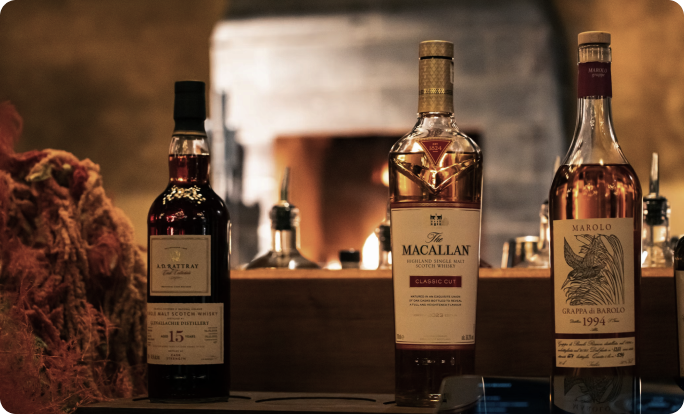
After 6 years sourcing rare bottles from private collectors across the UK and Europe, the team at Glenbotal has seen the same costly errors appear again and again — mistakes that quietly erode the value of a collection, or cost collectors hundreds of pounds they didn’t need to spend.
In six years of working closely with private collectors, Glenbotal has handled thousands of bottles — buying, valuing, and sourcing rare whisky from estates, cellars, and collections across the UK and Europe. That experience reveals something consistent: most of the money collectors lose isn’t lost at the auction or in the shop. It’s lost in the small decisions made before and after the purchase. This guide covers the 10 mistakes we see most often, with specific steps to avoid every one of them. Whether you’re just starting out or you’ve been collecting for a few years, at least one of these will save you money.
Collecting without a defined focus is the fastest way to spend a lot of money building a collection that’s worth less than you paid for it.
The psychology is understandable: early in a collection, everything feels relevant. A Port Ellen here, a limited Macallan there, a Springbank because it looked interesting — each individual decision seems reasonable. The result is a mismatched portfolio with no collector narrative and no auction-room appeal.
Here’s the deal:
Focused collections consistently outperform unfocused ones on the secondary market. A complete run of Macallan Fine & Rare releases, or every Bruichladdich Black Art bottling, tells a story that collectors and dealers will pay a premium for. A drawer of unrelated bottles from a dozen distilleries does not. Auction houses regularly report that themed or complete series achieve 15–30% higher per-bottle realisations than comparable single-bottle entries from the same distilleries.
Here’s how to avoid it:
Pro Tip: A tight focus doesn’t limit your collection — it builds its story. “Every official Glenfarclas Family Cask from the 1960s” is a far more compelling collection than fifty bottles from fifty distilleries, even if the latter cost more to assemble.
Damaged labels, missing original boxes, and low fill levels can reduce a bottle’s secondary market value by 20–50% — and new collectors routinely pay full price for bottles with all three issues.
Condition matters because whisky collecting is part investment, part connoisseurship. Serious buyers at auction expect bottles to present well. A bottle with a torn label and no box isn’t just aesthetically inferior — it has a demonstrably smaller pool of buyers, which depresses its price.
Here’s the deal:
A Macallan 18 Year Old (1980s bottling) in pristine condition with its original box might realise £400–£600 at auction. The same bottle with a water-stained label, no box, and fill level below the shoulder could sell for £180–£250 — sometimes less. That’s the same liquid, and a difference that’s entirely about presentation. Low fill levels also raise authentication questions, which further chills bidding.
Here’s how to avoid it:
Pro Tip: Low fill levels on bottles sealed decades ago can indicate slow evaporation through the cork (“the angel’s share”), which is natural and well-documented. But fills that are significantly below shoulder level — especially on recently-transferred stock — warrant extra scrutiny before purchase.
Many collectors overpay by 30–60% because they buy from retail without checking what the same bottle sold for at auction last month.
The secondary whisky market moves fast. A bottle that was trending upward in 2021 may have softened considerably. Retail prices often lag market reality — shops price bottles based on what they paid, not necessarily what they’ll realise. Checking auction results first takes five minutes and can save a significant amount.
Here’s the deal:
Whisky Auctioneer, Scotch Whisky Auctions, and Whisky Hammer all publish publicly accessible sold-price histories. A quick search for a specific bottling will show you exactly what it has realised over the past 6–12 months, complete with condition notes. If a retailer is listing a bottle at £500 and the auction average is £320, you now have a negotiating position — or a reason to walk away.
Here’s how to avoid it:
Pro Tip: If you’re selling as well as buying, this same research protects you from underselling. Knowing the market means you never leave money on the table in either direction. See our guide to how to sell rare whisky in the UK for more on getting the right price.
Incorrect storage degrades both the liquid and the presentation of a bottle — and the damage is often irreversible.
Unlike wine, whisky is a high-ABV spirit and does not benefit from being stored on its side. The cork in a whisky bottle is not designed to stay permanently moist. Storing bottles horizontally causes the spirit to eat into the cork, potentially contaminating the liquid and causing the cork to swell, break, or disintegrate on opening. It also accelerates evaporation, reducing fill level over time.
Here’s the deal:
Ultraviolet light is the most consistent silent destroyer of rare whisky. Prolonged UV exposure causes chemical changes in the whisky — a process called photodegradation — which affects both flavour and colour. A bottle of 1970s Springbank stored on a bright shelf for five years may look identical on the outside while the liquid has faded in colour and lost aromatic complexity. In addition, a bottle stored near a radiator or in a space with wide temperature swings (like a garage or attic) will experience repeated expansion and contraction through the cork, which accelerates evaporation and increases the risk of seepage.
Here’s how to avoid it:
Pro Tip: If you are displaying bottles rather than storing them, rotate displayed stock periodically so no single bottle receives extended light exposure. Decorative display is fine — permanent display in bright conditions is not.
Collectors who don’t get regular valuations are making decisions — what to buy, what to hold, what to sell — completely blind.
It’s surprisingly common: collectors who have spent five or ten years assembling a collection have only a vague idea of what it’s worth. They remember what they paid for individual bottles years ago, but the market has moved. Some bottles have tripled in value; others have softened. Without a current valuation, there’s no basis for good decisions.
Here’s the deal:
We’ve received collections where the owner expected to realise around £8,000 and the actual valuation came in at over £22,000. We’ve also seen the reverse — collections with significant sentimental value but modest market value, where the collector was relieved to learn they could sell a few bottles to fund better acquisitions without losing much. A valuation doesn’t commit you to anything. It simply tells you where you stand.
Here’s how to avoid it:
Pro Tip: Glenbotal offers free whisky valuations with no obligation to sell. It’s worth doing even if you have no intention of selling — the information is simply useful to have.
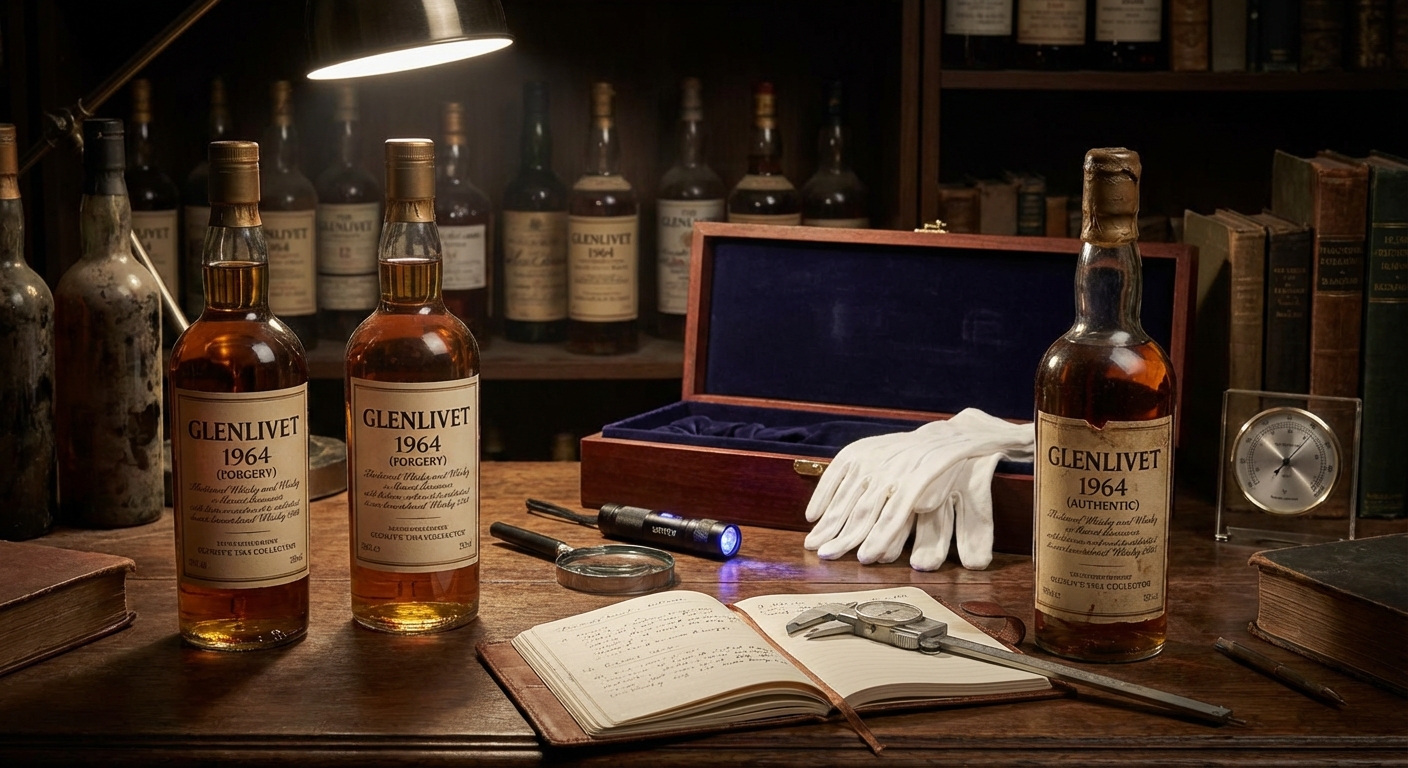
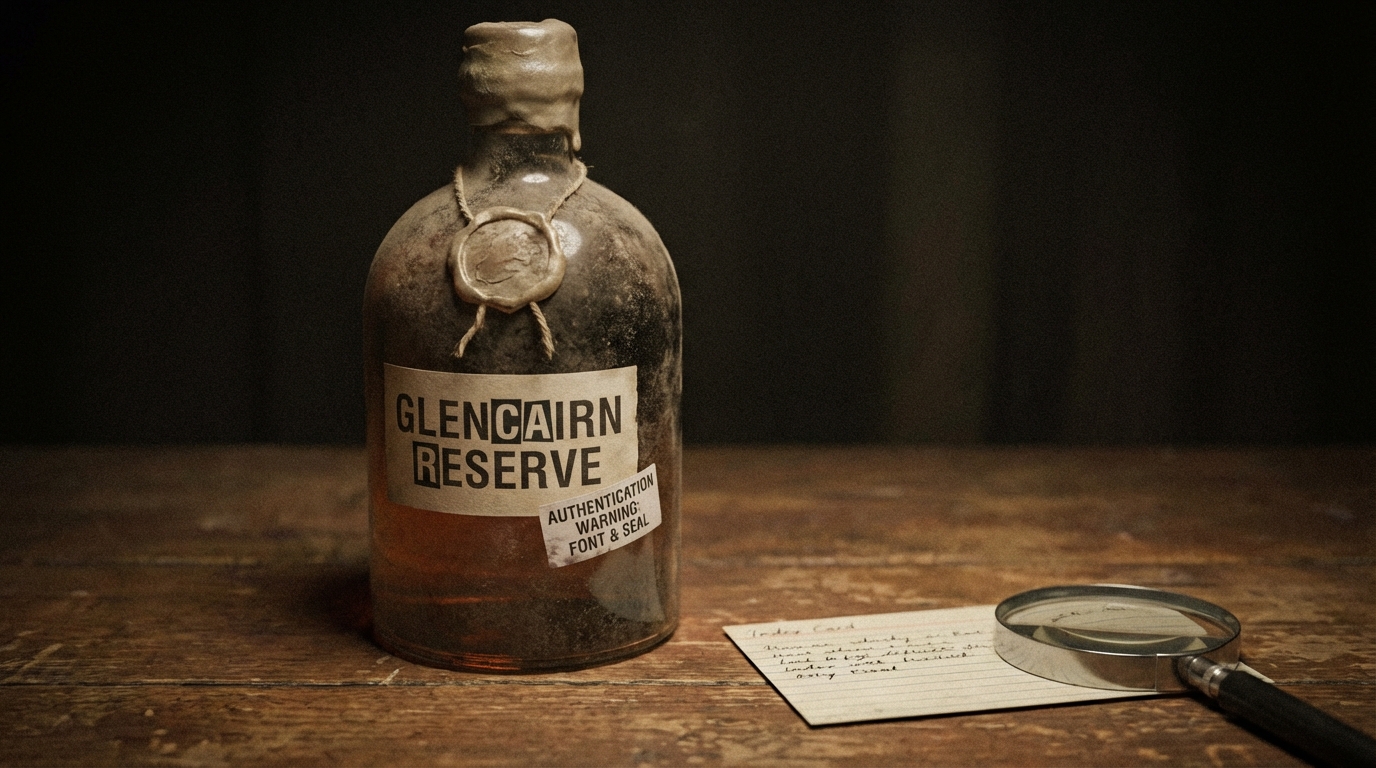
The rare whisky market has a counterfeit problem, and new collectors — who haven’t yet learned what authentic bottles look and feel like — are the most vulnerable buyers.
Counterfeiting in the rare whisky market is not a fringe problem. As values have risen, particularly for aged expressions from prestigious distilleries, the financial incentive to fake bottles has increased proportionally. Sophisticated fakes exist: bottles with period-accurate labels, convincing capsules, and repro boxes, containing lower-value liquid.
Here’s the deal:
The Scotch Whisky Association has documented ongoing seizures of counterfeit spirits across Europe. In 2023 alone, EU customs authorities flagged thousands of bottles of fake Scotch in cross-border shipments. High-value expressions — aged Macallan, old Springbank, Port Ellen, Brora — are the most commonly targeted. The secondary market is particularly exposed because bottles change hands without the verification infrastructure of an authorised retailer.
Here’s how to avoid it:
Pro Tip: For significant purchases, ask the seller for a high-resolution photograph of the base of the bottle. Authentic aged whiskies develop sediment patterns and glass characteristics over time. Also check our guide to what makes a whisky bottle valuable — many of the same factors that drive value also help authenticate genuine bottles.
A bottle bottled in 2020 from a 1974 cask is 46 years old — but collectors unfamiliar with the distinction sometimes overlook it in favour of a bottle with an older-looking release date.
This is one of the most common misconceptions among newer collectors, and it’s one that can lead to genuinely excellent bottles being passed over while inferior, older-looking releases get attention. Whisky ages in the cask, not the bottle. A spirit bottled in 1985 from a 1982 distillation is 3 years old. A spirit bottled in 2024 from a 1978 distillation is 46 years old. The bottling date is simply when it was bottled — the distillation date is what tells you how long it matured.
Here’s the deal:
This confusion most commonly arises with independent bottler releases and single cask expressions, which often carry both dates prominently on the label. A collector focused on bottle aesthetics might pick up a 1990-bottled expression over a 2015-bottled one purely based on the year on the label — missing the fact that the 2015 expression contains a whisky distilled in the early 1970s. The older liquid is worth considerably more. The bottle label, by contrast, means very little.
Here’s how to avoid it:
Pro Tip: Independent bottler single casks often display both dates clearly because the independent bottler is proud of the age. Take that as a signal, not a complication. See our complete whisky collecting guide for more on reading labels correctly.
Some of the most sought-after, genuinely rare whiskies available today don’t come from official distillery releases — they come from independent bottlers that many new collectors have never heard of.
The assumption that official distillery releases are automatically superior — or more valuable — leads collectors to overlook an entire category of remarkable whisky. Independent bottlers purchase casks directly from distilleries (often decades in advance), mature them at their own warehouses, and bottle them without the brand packaging of the parent distillery. The liquid is frequently exceptional.
Here’s the deal:
Gordon & MacPhail, founded in Elgin in 1895, has been bottling single malt Scotch for over 125 years and has released expressions from more than 70 distilleries — including some that no longer exist. Their older releases from closed distilleries like Rosebank, Convalmore, and Caperdonich are among the most prized bottles in serious collections, commanding prices that rival official releases at auction. Cadenhead’s, the oldest surviving independent bottler in Scotland, and Signatory Vintage are similarly well-regarded. An aged single cask expression from any of these three houses, particularly from a now-closed distillery, is not a consolation prize — it is exactly the kind of bottle that defines a serious collection.
Here’s how to avoid it:
Pro Tip: Independent bottlings are also often released at cask strength without chill filtration or added colouring — characteristics that are increasingly prized by serious collectors and command premiums on the secondary market.
Collectors who restrict themselves to one whisky region — typically Speyside or Islay — miss genuine value opportunities and limit the long-term resilience of their collection.
Regional focus has intuitive appeal: if you love Speyside malts, why look elsewhere? But a collection built entirely around one region is exposed to regional market sentiment in ways that a more diversified collection is not. When Islay mania drives Ardbeg and Laphroaig prices to peaks, the collector who also holds Highland and Campbeltown expressions is in a very different position to the one who went all-in on peat.
Here’s the deal:
Some of the strongest performing bottles of the past decade have come from regions that were historically undervalued. Campbeltown — home to Springbank, Glengyle, and the long-silent Glen Scotia — was considered a backwater by mainstream collectors as recently as ten years ago. Springbank 21 Year Old was achievable for under £200 at retail in 2015. Recent auction realisations for the same bottlings have exceeded £1,200. Japanese whisky saw a similar trajectory. Taiwanese expressions from Kavalan have moved from curiosity to serious collectible within a single generation. Collectors who only watched Speyside missed these runs entirely.
Here’s how to avoid it:
Pro Tip: Regions that are currently underappreciated tend to be the ones where you can still buy well. By the time a region is widely discussed on forums and in the specialist press, the best-value entry points have usually passed. Read our guide to how to start a whisky collection for more on building a resilient collection from the beginning.
Collectors without an inventory don’t know what they own, what it’s worth, or when they last had a bottle that might now be worth selling.
This sounds like an administrative problem, but it’s actually a financial one. A collection with no tracking system is a collection that can’t be managed. Bottles get forgotten in storage. Duplicates get purchased by accident. Opportunities to sell at the right moment get missed because the collector doesn’t know the bottle is there. And when it comes to insurance, estate planning, or a sale, the absence of records creates real practical problems.
Here’s the deal:
We regularly receive collections for valuation where the owner genuinely cannot recall every bottle they own. In one recent case, a collector discovered — during the valuation process — that they held two identical bottles of a limited Macallan release: one bought knowingly, one picked up at an estate sale years earlier and never catalogued. The duplicate was sold for over £800. That’s money that existed in the collection for years but was invisible to the collector because there was no inventory.
Here’s how to avoid it:
Pro Tip: Several dedicated apps exist for whisky collection tracking — Distiller and Vivino (for those who collect across spirits) are well-regarded. A shared cloud spreadsheet is equally effective and has the advantage of being instantly accessible for insurance or valuation purposes. Combining your inventory with an annual professional valuation gives you a complete financial picture of your collection.
Of all ten mistakes on this list, buying fakes and ignoring condition tend to be the most immediately costly — they can result in a total loss of investment on a single bottle. But over the long term, buying without a focus causes the most structural damage to a collection’s value. A focused, well-documented, correctly stored collection built with market awareness isn’t just more valuable than a haphazard one — it’s more enjoyable to own and far easier to manage.
If you’re not sure where your collection stands right now, a free valuation is the logical first step. Glenbotal offers no-obligation valuations for collectors across the UK, drawing on six years of active buying and selling from private collections. It takes minutes to arrange and gives you a clear picture of what you’re working with.
Get a free whisky valuation from Glenbotal — no obligation, no pressure, just clarity.
Buying without a focus is the most structurally damaging mistake over time, because it affects every purchase decision from the start. However, buying fakes or overpaying for secondary market bottles are the mistakes that cause the most immediate financial damage on individual transactions. Most new collectors make at least one of these in their first year.
Check provenance first — ask for documentation of where the bottle came from and who owned it previously. Then examine the capsule, label, and fill level together. Authentic aged bottles show natural signs of age: slight label wear, fill levels consistent with the bottle’s history, capsule characteristics appropriate to the era. For high-value purchases, consult a specialist before committing. Glenbotal’s team assesses provenance as standard on all bottles sourced from private collectors.
Store bottles upright, in a dark environment away from UV light, at a consistent temperature between 15–20°C. Avoid direct sunlight, radiators, kitchens, attics, and garages. Never store whisky on its side — unlike wine, whisky corks are not designed for permanent contact with the liquid and the high-ABV spirit will damage the cork over time, causing contamination, seepage, and fill level loss.
Both have a place in a well-rounded collection. Official distillery releases carry brand recognition that helps liquidity at auction. Independent bottlers — Gordon & MacPhail (founded 1895), Cadenhead’s, Signatory Vintage — often offer older expressions at lower prices per year of age, and their bottlings from closed distilleries are among the rarest available anywhere. New collectors often overlook independent bottlers entirely, which is a significant missed opportunity.
Search completed sales on major auction platforms — Whisky Auctioneer, Scotch Whisky Auctions, and Whisky Hammer all publish sold-price histories. Note the median realised price over the last 6–12 months for the specific bottling you’re considering, and remember to add the buyer’s premium (typically 10–15%) to calculate the true cost of an auction purchase. If buying from retail, compare the retail price to recent auction realisations to assess whether you’re paying fairly.
Campbeltown has historically been undervalued relative to Speyside and Islay, though Springbank’s reputation has risen sharply in the past decade. The Islands (Orkney, Jura, Arran, and Mull) offer interesting collecting opportunities with less competition than Islay. Japanese and Taiwanese expressions — particularly older Nikka, Yamazaki, and Kavalan releases — have strong collector interest and remain less explored by UK-based collectors than Scottish whisky.
Start a simple inventory spreadsheet recording bottle name, distillery, vintage or age, purchase price, condition, and storage location. Update it with every acquisition and sale. Add estimated current values annually, using auction data as your benchmark. Supplement the spreadsheet with a professional valuation every year or two — it’s the only way to get an accurate view of what your collection would actually realise if sold. Glenbotal offers free valuations with no obligation to sell.
Only if the purchase price fully reflects the condition discount. A damaged label reduces the pool of serious buyers at auction and typically depresses the realised price by 20–40% relative to a pristine equivalent. If the seller is pricing the bottle at full market rate despite the damage, walk away. If the discount is genuine and substantial, a damaged-label bottle of an otherwise sought-after expression can represent fair value — particularly if you intend to hold it and the label is otherwise complete.
Get a valuation before making any significant purchase decisions, so you understand your current position. Get one annually if your collection is actively growing. Get one immediately if you’ve inherited a collection, are considering selling any bottles, need to insure the collection, or if the market has moved substantially since your last valuation. Glenbotal’s free valuation service is available to collectors at any stage — there is no minimum collection size or obligation to sell.
Choose one or two anchors — a distillery you’re passionate about, a specific series, a decade of releases, or a region — before spending. Research what a “complete” version of that focus looks like, so you’re building toward something coherent. Read our full guide on how to start a whisky collection for a step-by-step approach, and our birth year whisky guide if you’re building around a specific year.
Age, distillery reputation, rarity of the specific expression, condition (label, fill level, original packaging), provenance, and whether the distillery is still operating all contribute to value. Official limited releases, single cask expressions, and bottlings from closed distilleries command the highest premiums. See our detailed breakdown in what makes a whisky bottle valuable.
Always check auction sold prices before buying — not asking prices, but what bottles actually realised. Use at least two platforms for comparison. Factor in condition differences between the bottle you’re considering and the auctioned examples. If a retailer is pricing significantly above recent auction realisations for equivalent condition, you’re likely overpaying. A specialist with active market experience — rather than a shop relying on historical purchase prices — will always give you a more accurate view of current market rates.
Explore the full collection at Glenbotal — rare whisky sourced from private collectors across the UK and Europe.
Follow us on Instagram | ★★★★½ Rated 4.7 on Trustpilot
Disclaimer: Whisky valuations and market price estimates provided in this article are for informational purposes only and are not financial advice. Past auction realisations are not a guarantee of future value. Always verify current prices with auction platforms before buying or selling. Glenbotal’s free valuation service is provided without obligation or fee.