
Speyside dominates on sheer distillery density and global auction demand, but the Highland region offers the breadth, diversity, and hidden-gem potential that sophisticated collectors increasingly prize.
Every serious whisky collector faces the same question eventually: where do you concentrate your focus? The two regions that come up time and again — Highland and Speyside — account for the overwhelming majority of Scotland’s most sought-after bottles, yet they serve very different collecting strategies. Speyside has the name recognition and the auction horsepower; Highland has the geographic scope, the flavour diversity, and a growing pool of under-the-radar expressions that haven’t yet been priced into the market. Understanding where each region excels — and where it falls short — is the single most valuable thing you can do before committing serious capital to a collection. This guide breaks down both regions across every dimension that matters to a collector: value, limited editions, secondary market performance, and the entry points that make sense in 2026.
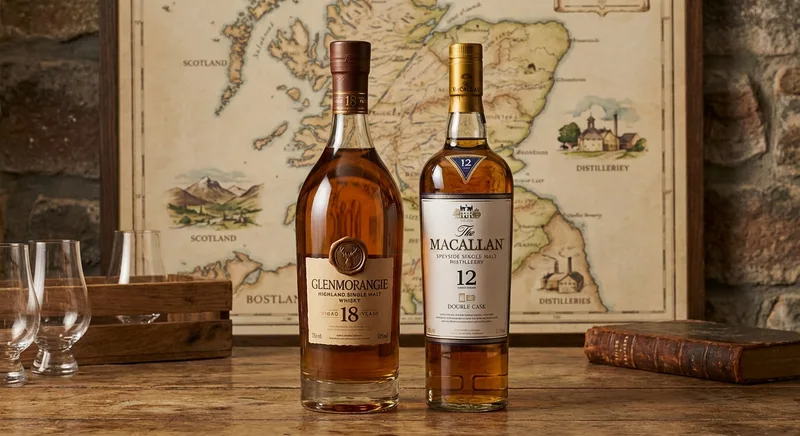
The Highland region is the largest of Scotland’s whisky-producing areas by land mass — a vast sweep of territory covering everything north of an imaginary line drawn from Greenock in the west to Dundee in the east, excluding the separate regions of Islay, Campbeltown, and the Speyside river valley. In practice, this means Highland encompasses the rugged north coast, the eastern lowlands around Perthshire, and the dramatic western seaboard. The Islands — Orkney, Skye, Mull, Arran, Jura — are technically counted within the Highland category by the Scotch Whisky Association, though many producers, retailers, and collectors treat them as a distinct sub-region.
According to data from the Scotch Whisky Association, the Highland mainland hosts more than 30 active distilleries, and when Island distilleries are included, the total rises to approximately 47 — making it one of the most geographically diverse producing areas in the world.[^1]
Ask ten experienced collectors to describe Highland whisky and you’ll get ten different answers — which is precisely the point. The region’s sheer geographic spread means there is no single Highland style. Broadly speaking:
This diversity is a strength for the collector who wants variety within a single regional focus, but it can be challenging for those seeking a clearly defined house style.
Dalmore is the Highland distillery with the strongest established collector following. Its King Alexander III series, Cigar Malt Reserve, and single-vintage releases regularly appear at major auction houses. The Dalmore 62 — a blend of casks from 1868 to 1939 — famously sold for £125,000 at auction in 2011, cementing the distillery’s reputation as a source of genuinely investment-grade bottles.
Glenmorangie has built one of the most consistent limited-edition programmes in Scottish whisky through its Private Edition range, with annual releases including Tusail, Milsean, Dornoch, and Bacalta. Each Private Edition bottle has a clearly defined production run, making them trackable on secondary markets.
Balblair shifted to a vintage-dated release model before most distilleries considered it fashionable. Its single-vintage expressions from the 1960s, 1975, and 1978 are now genuinely rare — distilled when production methods were markedly different — and command significant premiums. The distillery’s switch to NAS releases in 2019 has, if anything, increased collector interest in the pre-2019 vintage catalogue.
Oban produces tiny volumes from one of Scotland’s smallest distilleries. The combination of limited output, consistent quality, and Diageo’s Special Releases programme makes Oban 14 Year Old and the distillery’s annual Special Release one of the more predictably appreciating Highland expressions.
Clynelish deserves a mention for the collector who thinks ahead. Aged expressions of Clynelish — particularly independent bottlings from the 1990s and early 2000s — remain significantly undervalued relative to Speyside equivalents. The 2018 Diageo Special Release Clynelish Select Reserve sold out almost immediately and continues to appreciate on secondary markets.
Speyside is defined by the valley of the River Spey in the northeast of Scotland, taking in the counties of Moray and Badenoch and Strathspey. Geographically it sits entirely within the Highland region, and for much of whisky’s history, Speyside distilleries could label their products as Highland single malts. The Scotch Whisky Regulations formally recognised Speyside as a distinct protected geographical indication in 2014.[^2]
What makes Speyside remarkable is the concentration. Approximately 50 distilleries operate in an area small enough to drive across in under two hours. The town of Dufftown alone — sometimes called the whisky capital of the world — hosts six working distilleries with a combined annual capacity of around 40.4 million litres. Roughly half of all Scotch whisky production takes place in Speyside, making it the engine room of the Scotch industry.[^3]
Speyside has a much more consistent house style than Highland. The region’s whiskies are broadly characterised by:
Peat is rare in Speyside — most distilleries use unpeated malt, which contributes to the approachable, elegant style that has made the region so commercially dominant. Exceptions include Benriach and BenRomach, which produce small peated runs alongside their core expressions.
The consistency of the Speyside style is a genuine collector advantage: secondary market buyers know what they’re getting, which reduces friction and supports premium pricing.
The Macallan is the single most important distillery for serious whisky collectors worldwide. The Estate, the Edition series, the Red Collection, the Rare Cask range, and the 1824 Masters Series all command extraordinary attention at auction. We’ve covered The Macallan in depth in our guide to collecting Macallan whisky and the dedicated Macallan Edition Series breakdown.
Glenfiddich — the world’s best-selling single malt — has paired mass production with a sophisticated limited-edition programme. The Grand Series (Grand Cru, Grand Yozakura), Time Re:Imagined, and various Janet Sheed Roberts Reserve releases sit at the serious-collector end of its catalogue.
The Glenlivet gives collectors strong vintage depth through the Cellar Collection, with bottlings dating back to 1959. Aged expressions of The Glenlivet from the 1960s and 1970s, particularly at cask strength, are among the most consistently appreciated Speyside bottles.
Aberlour is the entry-level Speyside collector’s best friend. The A’bunadh series — an ongoing cask-strength release numbered by batch — offers an accessible starting point with genuine secondary market activity on older batches.
Glenfarclas deserves particular attention for its Family Casks: single-cask bottlings from consecutive vintages stretching back to 1952. In terms of depth, range, and family-ownership heritage, the Glenfarclas Family Casks series is arguably the most complete single-distillery collection available to any collector. The 1952 expression has sold for over £20,000 at auction.
Craigellachie is the Speyside name that serious collectors increasingly discuss in hushed tones. Its robust, sulphurous, Worm-Tub character sets it apart from the regional norm; aged independent bottlings from the 1980s and 1990s represent exceptional value for those who know where to look.
Whisky values can rise and fall. This is not financial advice.
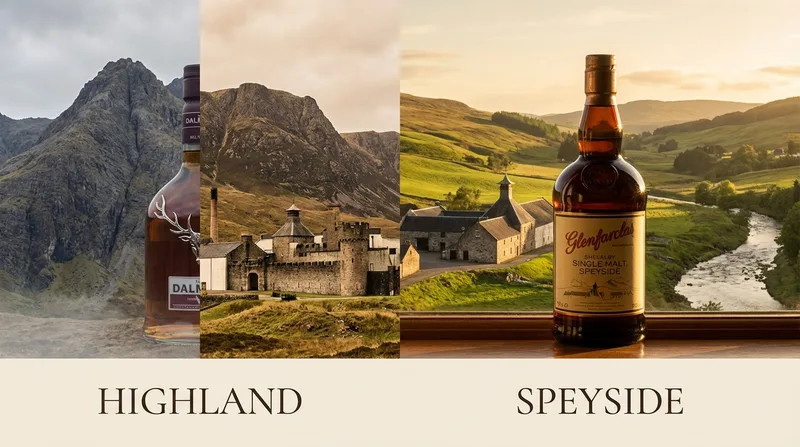
| Factor | Highland | Speyside |
|---|---|---|
| Price range (entry collectibles) | £40–£120 | £60–£200 |
| Price range (serious collecting) | £200–£5,000+ | £500–£50,000+ |
| Undervalued expressions available | High | Low–Medium |
| Closed distillery rarity | Very High (Brora, Ben Wyvis) | High (Caperdonich, Imperial) |
| Appreciation predictability | Moderate | High for top names |
| Independent bottling depth | Deep | Deep |
| Global auction presence | Moderate | Very High |
Analysis: Speyside wins on depth of market and price discovery. If you’re building a collection for eventual resale, the established auction infrastructure around Macallan, Glenfiddich, and Glenfarclas gives you clearer benchmarks and more exit liquidity. Highland wins on value opportunity — the gap between current bottle prices and what comparable Speyside expressions command is meaningful, and collectors who identify the right distilleries now (Clynelish, Balblair, Dalmore aged expressions) can build collections that appreciate significantly as market attention broadens.
For guidance on the factors that drive bottle value in either region, see our guide to what makes a whisky bottle valuable.
Speyside’s limited-edition output is unmatched in volume and variety. The Macallan alone produces more annual limited releases than many entire regions. Glenfiddich’s experimental and prestige series, Aberlour’s A’bunadh batches, Glenfarclas Family Casks, and The Glenlivet’s Cellar Collection all add up to a consistent and well-documented release calendar that collectors can plan around.
Highland’s limited-edition programmes are stronger than they’re often given credit for. Glenmorangie’s Private Edition series has run to 14 releases, each with a defined production run and a clear narrative. Dalmore’s limited luxury expressions are arguably the most ambitious in Scotland in terms of age and price. The Diageo Special Releases programme — which rotates through Highland and Island distilleries each year — provides annual collectible opportunities from Clynelish, Brora, Royal Lochnagar, and others.
| Programme | Region | Frequency | Typical Run Size |
|---|---|---|---|
| Macallan Edition Series | Speyside | Annual (concluded at No.6) | ~35,000–100,000 bottles |
| Macallan Rare Cask | Speyside | Annual | Limited / undisclosed |
| Glenfarclas Family Casks | Speyside | Annual | Single casks (~200–600 bottles) |
| Glenmorangie Private Edition | Highland | Annual | ~12,000–50,000 bottles |
| Dalmore luxury expressions | Highland | Occasional | Very limited (some <100 bottles) |
| Diageo Special Releases | Highland/Island | Annual | ~3,000–6,000 bottles per expression |
| Aberlour A’bunadh | Speyside | ~4–6 batches/year | ~20,000–50,000 bottles |
Verdict: Speyside wins on volume and variety of limited editions. Highland wins on the upper tier of rarity — Dalmore’s most exclusive expressions and Brora releases have smaller production runs than almost anything Speyside produces at equivalent price points.
Whisky values can rise and fall. This is not financial advice.
The secondary market tells a clear story. Speyside — and The Macallan in particular — dominates global whisky auction results. Analysis of major auction platforms consistently shows Macallan accounting for the highest proportion of auction hammer prices among all Scotch single malt categories, often representing 40–50% of the top lots by value at major UK auctions.
Speyside’s secondary market strengths:
Highland’s secondary market strengths:
Key insight for collectors: Speyside offers depth and liquidity. Highland offers asymmetric upside. A portfolio that holds core Speyside positions for price stability, while deploying into undervalued Highland expressions for growth potential, reflects the approach we see from the most sophisticated collectors in our private network.
One of the most practical collector questions is: where can you start without spending £500 on your first bottle?
Highland entry points:
Speyside entry points:
For a full framework covering both regions and beyond, see our ultimate whisky collecting guide.
| Expression | Region | Approx. Price | Collector Potential |
|---|---|---|---|
| Balblair 2005 Vintage | Highland | £55–£80 | Medium — vintage dating adds trackability |
| Clynelish 14 Year Old | Highland | £45–£60 | Medium — gateway to aged expressions |
| Oban 14 Year Old | Highland | £45–£60 | Medium — constrained output |
| Aberlour A’bunadh (current) | Speyside | £50–£70 | Medium-High — older batches appreciate |
| Glenfarclas 105 | Speyside | £40–£55 | Medium — gateway to Family Casks |
| Craigellachie 13 | Speyside | £45–£55 | Medium-High — growing collector interest |
| Glenmorangie Private Edition | Highland | £65–£120 | High — defined run, annual series |
| Macallan Rare Cask | Speyside | £180–£250 | Very High — strong secondary demand |
1. The Flavour-First Collector
If the joy of whisky collecting comes partly from drinking, studying, and exploring different styles, Highland is your region. No other part of Scotland delivers the same range — from the citrus-bright coastal character of Clynelish to the rich, sherried weight of Dalmore to the maritime smoke of Talisker. A Highland collection can be a sensory education.
2. The Value-Hunter
Collectors who want to deploy capital into expressions that haven’t yet been fully priced by the mainstream market should look seriously at Highland. Clynelish aged expressions, Balblair vintages from the 1970s and 1978, and independent bottlings of Brora represent genuine value relative to Speyside equivalents of comparable age and quality. The gap may not persist — but right now, it exists.
3. The Closed-Distillery Specialist
Highland is home to some of Scotland’s most revered closed distilleries: Brora (silent 1983–2021, now reopened but pre-closure bottles are a separate category), Ben Wyvis, Glenury Royal, Lochside, and Millburn. Bottles from these distilleries cannot be replenished — every one sold is a one-way door. For collectors who understand that true rarity is irreplaceable, Highland’s closed-distillery heritage is extraordinary.
4. The Independent Bottling Collector
Scotland’s independent bottling houses — Gordon & MacPhail, Cadenhead’s, Signatory, Berry Bros. & Rudd — have extensive Highland archives. Collectors who prefer the individuality of single-cask, cask-strength bottlings over distillery official releases will find Highland enormously rich territory.
5. The Patient Builder
Highland rewards patience. The region’s best-appreciated expressions have tended to move slowly and then sharply — particularly when a distillery gains broader recognition or announces a significant new release. Collectors willing to hold a five-to-ten year horizon often find Highland more rewarding than Speyside’s already-elevated entry prices suggest.
1. The Macallan Focused Collector
If your collection centres on The Macallan — and for many serious collectors worldwide, it does — Speyside is simply your home. The Edition series, the Fine & Rare range, the Red Collection, and the ongoing annual releases form a coherent long-term collecting programme that is unmatched by any Highland distillery in terms of documentation, community, and secondary market depth. See our full guide to collecting Macallan whisky for the complete framework.
2. The Auction-Active Collector
If you buy and sell regularly — turning over parts of the collection to fund new acquisitions — Speyside’s deep secondary market is a practical necessity. When you need to sell a bottle at short notice, a Glenfarclas Family Cask or a Macallan Edition No.3 will always find a buyer. That liquidity has a real value for active collectors.
3. The Series Completionist
Speyside is the spiritual home of the completionist collector. Glenfarclas Family Casks span 1952 to the present. Macallan Edition Series runs from No.1 to No.6. Aberlour A’bunadh has passed 80 numbered batches. Collecting a complete or near-complete run of any of these series is a meaningful and valuable achievement that Speyside enables in ways Highland simply cannot match.
4. The Heritage and Provenance Collector
Speyside’s concentration of distilleries within a small geographic area creates a rich web of shared heritage — cooperages, maltsters, distillery families, and whisky dynasties. Collectors interested in provenance, family ownership (Glenfarclas’s Grant family, Springbank’s Mitchell family), and the social history of whisky will find Speyside deeply rewarding.
5. The International Investor
For collectors whose primary interest is appreciation and whose collection may eventually be sold to buyers outside the UK, Speyside name recognition is a genuine asset. The Macallan and Glenfiddich are names that resonate in Hong Kong, Singapore, Tokyo, and New York in a way that most Highland distilleries do not — yet. International demand is a price driver, and Speyside benefits from it more directly than Highland at present.
Highland is Scotland’s largest whisky-producing region by land area, covering everything north of the Highland Line (with exceptions for Islay and Campbeltown). Speyside is a concentrated sub-region within the Highland geographic area, defined by the River Spey valley, that has been legally recognised as its own protected designation since 2014. The key difference for collectors is one of style and market depth: Highland whiskies are diverse — from floral and light in the north to rich and coastal in the west — while Speyside whiskies tend to be elegant, fruity, and approachable, with a much deeper secondary market and stronger auction infrastructure.
Neither is objectively superior — both serve different collecting strategies. Speyside is better for collectors who prioritise secondary market liquidity, name recognition, and depth of limited-edition programmes (particularly around The Macallan and Glenfarclas). Highland is better for collectors who want broader flavour diversity, access to undervalued expressions with long-term appreciation potential, and opportunities in the closed-distillery market (Brora, Glenury Royal). Many experienced collectors hold positions in both regions as a deliberate strategy.
Approximately 50 distilleries currently operate in the Speyside region, making it the most densely concentrated whisky-producing area in the world. The town of Dufftown alone hosts six working distilleries. Speyside also accounts for roughly half of all Scotch whisky production by volume.[^3]
The Highland distilleries with the strongest established collector following are Dalmore (aged and luxury expressions), Glenmorangie (Private Edition series), Balblair (vintage-dated expressions), Clynelish (aged and Diageo Special Releases), and Oban (Special Releases and the standard 14-year-old). For the closed-distillery collector, pre-1983 Brora is in a category of its own. Independent bottlings from Highland distilleries by Gordon & MacPhail and Cadenhead’s also represent a strong collecting strand.
The Macallan is a Speyside single malt — its distillery sits on the River Spey near the town of Craigellachie. Speyside sits geographically within the broader Highland region, which sometimes causes confusion; some older Macallan bottlings may be labelled “Highland Single Malt” on the label, which was common before Speyside’s 2014 legal recognition as a separate designation. For collecting and auction purposes, The Macallan is always categorised and discussed as a Speyside whisky.
Speyside produces more limited editions by volume — The Macallan alone releases more annual limited expressions than most regions combined, and the Glenfarclas Family Casks, Glenlivet Cellar Collection, and Glenfiddich Grand Series add considerable further depth. However, Highland’s limited-edition output at the ultra-premium tier (Dalmore rare single malts, Brora releases, and Glenmorangie’s Private Edition series) is extremely strong. If volume of limited editions matters to your collecting strategy, Speyside has the advantage; if exclusivity and run-size rarity matter more, Highland competes well at the top end.
In 2026, Highland offers stronger value opportunities for collectors willing to look beyond the top-tier names. Expressions from Clynelish, Balblair, and Craigellachie remain meaningfully underpriced relative to comparable Speyside bottlings of similar age and quality. Speyside offers better price discovery and liquidity, which has a value of its own — but the entry cost for tier-one Speyside names is significantly higher. A balanced view is that Speyside offers better value for active collectors who need a functioning secondary market; Highland offers better value for patient collectors building long-term positions.
Highland has the larger pool of closed distilleries with collector significance. The most notable include Brora (silent 1983–2021), Ben Wyvis (closed 1977), Glenury Royal (closed 1985), Millburn (closed 1985), and Lochside (closed 1992). Speyside also has important closed distilleries — Caperdonich, Imperial, Convalmore, Coleburn, Dallas Dhu, Parkmore, and Pittyvaich among them — but the Highland roster is broader and its headline name (Brora) commands higher prices and greater collector prestige than any equivalent Speyside closure.
Speyside is generally the better starting point for new collectors, primarily because the secondary market is deeper and more transparent — you can research recent auction results for Macallan, Glenfarclas, and Aberlour expressions easily and accurately. Aberlour A’bunadh and Glenfarclas 105 also offer well-priced entry points to distilleries with serious collecting depth. That said, Highland’s Clynelish 14, Balblair vintage expressions, and Oban 14 are excellent beginner choices for collectors who want to keep their options open and avoid the premium entry cost of tier-one Speyside names. Our ultimate whisky collecting guide covers the full beginner framework across all regions.
Speyside holds the records at the very top end. The Macallan Fine & Rare 60 Year Old 1926 — often described as the Holy Grail of Scotch whisky — sold for £1.5 million at Sotheby’s in 2019, setting the world record for a single bottle of whisky. Speyside dominates the top auction lots consistently. However, Highland is home to some of the most dramatic appreciation stories: pre-1983 Brora single malts have achieved prices of £10,000–£40,000+ at major auction houses, and Dalmore aged single malts have achieved six-figure sums. The short answer: Speyside has the highest headline prices; Highland has some of the most surprising ones.
After examining both regions across every dimension that matters to collectors, the honest verdict is this: Speyside is the dominant collecting region by almost every measurable standard — auction depth, name recognition, limited-edition volume, and price discovery. If you are building a collection that you intend to sell, trade, or insure at known values, Speyside gives you the infrastructure to do it.
But Highland is where the opportunity lives in 2026. The gap between the quality of its aged expressions and the price those expressions command at auction is real and meaningful. Collectors who understand Clynelish, who have followed Balblair’s vintage catalogue, and who are buying closed-distillery expressions before they become headlines are making some of the shrewdest moves in the current market.
The most sophisticated position — and one that reflects the collections we see from serious buyers in our private network — is to hold both. Use Speyside’s established names as the anchor, and use Highland as the growth engine.
At Glenbotal, we’ve spent six years sourcing rare and hard-to-find bottles from private collectors across the UK and Europe. We hold stock from both regions — from Macallan Fine & Rare to aged Clynelish single casks — and offer free valuations for collectors looking to understand what their bottles are worth. If you’re building a collection or looking to sell, explore the current collection at Glenbotal or get in touch directly.
[^1]: Scotch Whisky Association regional distillery data; wikipedia.org/wiki/Scotch_whisky
[^2]: The Scotch Whisky Regulations 2009 (amended); Speyside recognised as protected geographical indication from 2014
[^3]: Wikipedia, “Speyside single malts”: approximately 50 distilleries operating in Speyside; roughly 50% of Scotland’s whisky production by volume
Explore the full collection at Glenbotal — rare whisky sourced from private collectors across the UK and Europe.
About Glenbotal
The idea of Glenbotal came to us naturally: as whisky lovers, we were always on the lookout for new experiences in the whisky world. That’s why we created Glenbotal and became our very own first customers. We buy unique and hard to find spirits from ballots and private collections. Then, we share them with a small circle of friends and people who can appreciate a good dram.