
Midleton Dair Ghaelach is a series of single pot still Irish whiskeys from the Midleton Distillery in County Cork, finished in hogsheads made from virgin Irish oak, with each release named after the forest the oak came from.[1][8] Five forests have been used since the first release in 2015: Grinsell's Wood, Bluebell Forest, Knockrath Forest, Kylebeg Wood and Kilranelagh Wood.[8][10][12]
Every bottle carries the number of the tree its cask was made from, so one release is really a small family of bottlings.[3][6] This guide covers each release in order, what the tree numbers mean, and what to check before you buy one.
Chapter 1
What is Midleton Dair Ghaelach?
It is Midleton's series of single pot still whiskeys finished in virgin Irish oak, one forest per release.
Midleton Dair Ghaelach is a range of Irish whiskeys made by Irish Distillers at the Midleton Distillery in County Cork.[1] The whiskey is single pot still, first matured in American oak bourbon barrels and then finished in hogsheads made from Irish oak that has never held spirit or wine.[1][11]
Each release takes its name from the woodland where the oak was felled. The first came from Grinsell's Wood on the Ballaghtobin Estate in County Kilkenny in 2015, and the fifth from Kilranelagh Estate in County Wicklow in 2023.[1][12]
Dair Ghaelach simply means 'Irish oak' in the Irish language.[10]
| Producer | Irish Distillers, at the Midleton Distillery, County Cork |
|---|---|
| Releases | 5: Grinsell's Wood (2015), Bluebell Forest (2017), Knockrath Forest (2020), Kylebeg Wood (2021), Kilranelagh Wood (2023) |
| Style | Single pot still Irish whiskey, matured in American oak bourbon barrels, finished in virgin Irish oak hogsheads |
| Name | Dair Ghaelach is Irish for 'Irish oak' |
| Trees per release | 10 (Grinsell's Wood), 6 (Bluebell Forest), 7 (Knockrath Forest), 7 (Kylebeg Wood), 6 (Kilranelagh Wood) |
| Strength | Cask strength, different for each tree: from 55.3% (Bluebell Forest) to 58.1% (Grinsell's Wood at launch) |
| Bottle size | 70cl (75cl in the United States) |
| Bottles per release | 12,000 reported for Grinsell's Wood; not published for later releases |
| Available at Glenbotal | 29 bottles today |
What counts as a release in this guide
This guide treats each forest as one release: five releases so far. Inside each release, every tree gave its own casks and its own bottling, labelled with the tree number, and the strength changes from tree to tree.[3][6]
The trees are not sold as separate named whiskeys, so they are covered inside their release rather than listed one by one. A Kylebeg Wood Tree No. 2 and a Kylebeg Wood Tree No. 6 are the same release, finished in casks from two different oaks.
Dair Ghaelach and the Midleton Very Rare name
The first two releases were launched as Midleton Dair Ghaelach.[1][4] From Knockrath Forest in 2020 the series has been presented as Midleton Very Rare Dair Ghaelach.[6][10]
It is still a separate series from the yearly Midleton Very Rare vintages, which are blends of pot still and grain whiskey released once a year. Dair Ghaelach is all single pot still and appears only when a new forest is ready.
Chapter 2
How the series came about
Irish oak had not been used to mature Irish whiskey for more than a century before Midleton revived the idea.
Ireland once had plenty of native oak, but heavy logging left it one of the most deforested countries in Europe, with forest cover down to about four per cent of the island by the 1970s.[8] The whiskey industry had to import its cask wood, and Midleton's records show new Irish oak being bought as far back as the 1820s but nothing in modern times.[8]
Master of maturation Kevin O'Gorman put it plainly at the Knockrath launch: until this project, Irish oak had not been used to mature whiskey for well over 100 years.[6]
The team and the first forest
The project was led by master blender Billy Leighton and Kevin O'Gorman, with master cooper Ger Buckley and consultant forester Paddy Purser.[2][8] Finding oak of the right size was hard, because trees used for coopering need to be well over a century old.[2]
They settled on Grinsell's Wood on the Ballaghtobin Estate in County Kilkenny, where ten oaks about 130 years old were felled in April 2012.[1][2] The Spirits Business described the whole effort as a six-year exploration before the first whiskey was launched in February 2015.[1]
From the forest to Jerez and back
Every release since has followed the same route. The logs go to the Maderbar sawmills in Baralla, in Galicia in north-west Spain, where they are quarter-sawn into staves.[4][11]
The staves then travel to the Antonio Páez Lobato cooperage in Jerez, where they dry in the open air for about 15 months before being made into hogsheads and toasted.[1][4][8] The finished casks return to Midleton to be filled with pot still whiskey that has already spent many years in American oak.
Why Irish oak tastes different
Irish oak is less dense and more open in structure than many other oaks, and it holds more vanillin, vanillic acid and furfural.[8] Used as virgin wood, it gives the whiskey stronger notes of vanilla, caramel and chocolate.[1]
Climate and soil change the wood too. Whisky Magazine noted that County Wicklow's cool summers and heavy rain affect the density of the Knockrath oak, and O'Gorman told The Irish Times that the differences between trees were more marked in that release than in the first two.[8][7]
Looking after the forests
The trees are taken in small numbers from managed woodland. At Kylebeg Wood, the gap left by the felled oaks let light reach the forest floor for a new generation of saplings. Irish Distillers says this way of managing the wood has helped the pine marten return to the Laois countryside, which in turn has helped the native red squirrel.[10][11]
With the Kilranelagh release, Irish Distillers replaced the wooden cabinet of earlier editions with a fully recyclable box.[12]
Chapter 3
Every release, in order
Five forests so far, from Kilkenny in 2015 to Wicklow in 2023.
The releases are listed in the order they came out. Strengths are given as the range across the trees, because each tree was bottled at its own cask strength.[4][6][10]
Irish Distillers has not published bottle counts for any release after the first, so the entries say so rather than guess.
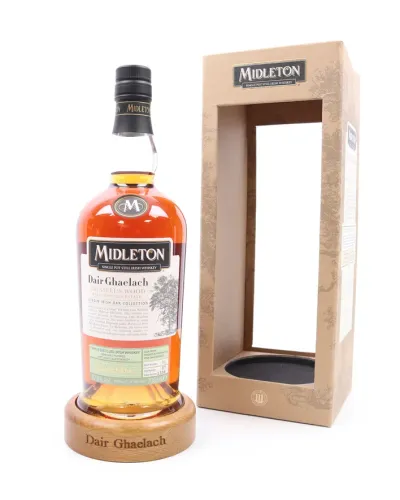
Midleton Dair Ghaelach Grinsell's Wood
Not in stock right now
Grinsell's Wood was the first Dair Ghaelach, launched in 2015. The oak came from ten trees about 130 years old, felled in April 2012 in Grinsell's Wood on the Ballaghtobin Estate in County Kilkenny, which yielded 48 hogsheads with a medium toast.
The casks were filled with single pot still whiskeys aged 15 to 22 years in American oak and left for around ten months before bottling at cask strength. Each tree was bottled on its own, and the launch strength was 58.1%, with individual trees a little above or below that.
Labels name the forest, the tree, the batch (one) and the bottle number. The notes describe pot still spice and Irish oak with vanilla, chocolate honeycomb, coffee beans and tropical fruit.
- Distillery
- Midleton
- Age
- No age statement (pot still whiskeys of 15 to 22 years)
- ABV
- 58.1 (launch figure; each tree differs)%
- Bottle size
- 70cl
- Cask type
- American oak bourbon barrels, finished in virgin Irish oak hogsheads from Grinsell's Wood (medium toast)
- Released
- 2015
- Number of Bottles Produced
- 12,000
12,000 bottles across all trees, as reported at the launch; Irish Distillers has not published a count per tree.
Tasting notes
- Nose
- Pot still spice and Irish oak with vanilla, chocolate honeycomb, coffee beans, red berries, pineapple and ripe banana.
- Palate
- Clove and cinnamon first, then dairy fudge, milk chocolate and a touch of stewed apple.
- Finish
- Very long, with the sweet spices fading slowly and the Irish oak having the last word.
Looking for this bottle?
We can find one for you, usually in 2 to 3 weeks. Nothing to pay until you agree the price.
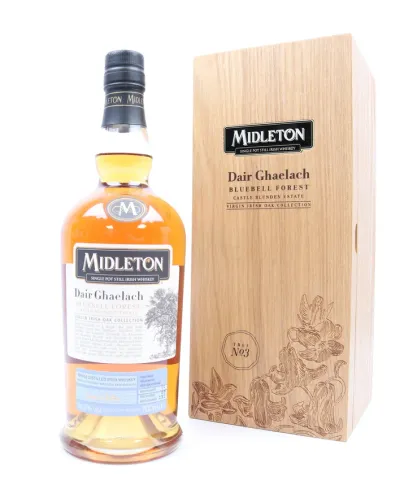
Midleton Dair Ghaelach Bluebell Forest
2 bottles available at Glenbotal
Bluebell Forest was the second release, launched in November 2017. Its oak came from six trees about 130 years old, felled in 2013 in the bluebell forest of the Castle Blunden Estate in County Kilkenny, which the Blunden family has looked after since the 1600s.
The staves were made into 29 lightly toasted hogsheads, which held pot still whiskeys aged 12 to 23 years in American oak for a further year and a half. Each tree was bottled at its own cask strength, between 55.3% and 56.3%, without chill filtration.
Kevin O'Gorman described the Irish oak as giving milk chocolate and honeycomb on the nose and a round, silky texture.
- Distillery
- Midleton
- Age
- No age statement (pot still whiskeys of 12 to 23 years)
- ABV
- 55.3 to 56.3%
- Bottle size
- 70cl
- Cask type
- American oak barrels, finished for 18 months in virgin Irish oak hogsheads from Castle Blunden Estate (light toast)
- Released
- 2017
- Number of Bottles Produced
- Not published
Irish Distillers has not published the number of bottles. Strength varies by tree.
Tasting notes
- Nose
- Pot still spice lifted by toasted Irish oak, fresh woodland notes, pink grapefruit, pineapple, ripe berries and green banana, with milk chocolate and honeycomb.
- Palate
- Round and silky, the oak's natural sweetness meeting pot still spice, with touches of mango and kiwi, then clove and cinnamon.
- Finish
- Very long, the soft sweet spices finally giving way to the Irish oak.
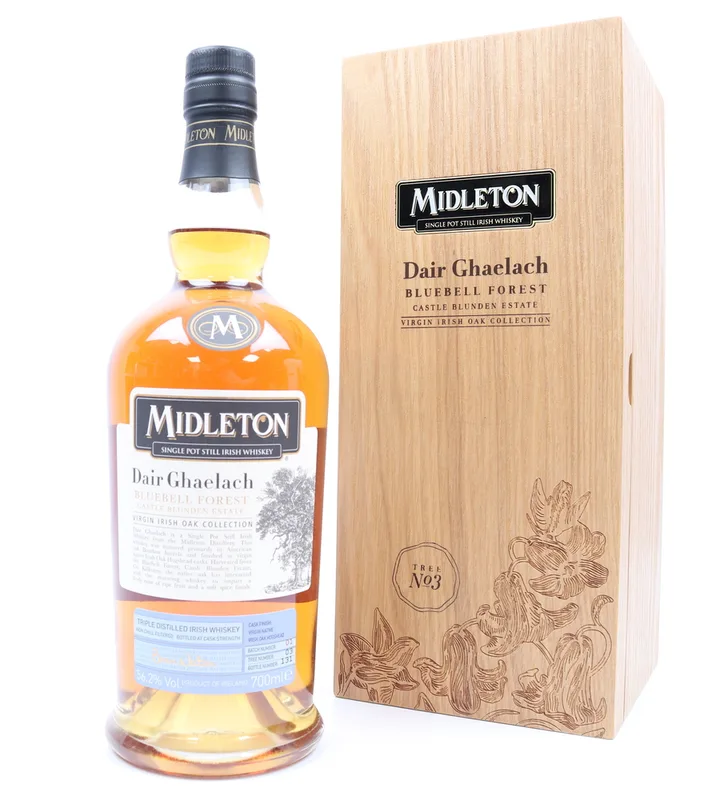
Midleton – Dair Ghaelach Bluebell Forest Tree 3
70cl / 56.2%
US$869.00
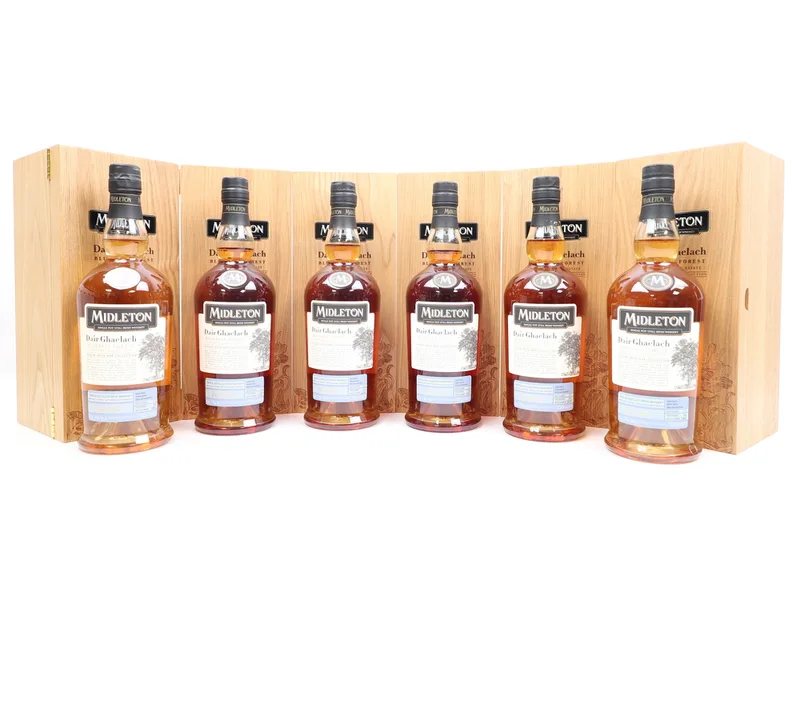
Midleton – Bluebell Forest Set
70cl
US$7,139.00
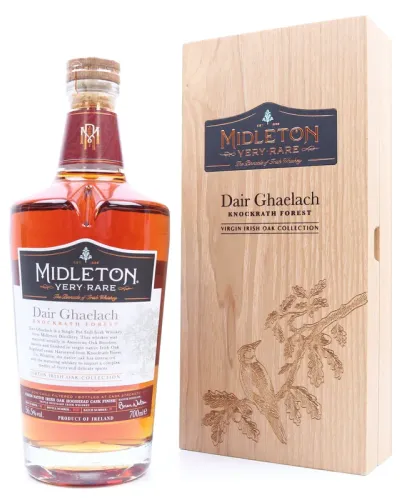
Midleton Very Rare Dair Ghaelach Knockrath Forest
10 bottles available at Glenbotal
Knockrath Forest, the third release, went on sale in January 2020 under the Midleton Very Rare name, which the first two releases did not carry. The oak grew on the Knockrath Estate in the Vale of Clara, County Wicklow, cared for by the Brabazon family since the 16th century.
Seven trees gave 42 hogsheads with a lighter toast than before. Pot still whiskeys aged 13 to 26 years spent two more years in them, and each tree was bottled at cask strength between 56.1% and 56.6%.
The wooden case is engraved with a great spotted woodpecker: the estate was one of the first places the bird settled when it returned to Ireland. Kevin O'Gorman found the differences between trees more marked than in the first two releases, with trees two and six richer in toffee, coconut and chocolate.
- Distillery
- Midleton
- Age
- No age statement (pot still whiskeys of 13 to 26 years)
- ABV
- 56.1 to 56.6%
- Bottle size
- 70cl
- Cask type
- American oak bourbon barrels, finished for two years in virgin Irish oak hogsheads from Knockrath Forest (light toast)
- Released
- 2020
- Number of Bottles Produced
- Not published
Irish Distillers has not published the number of bottles. Strength varies by tree.
Tasting notes
- Nose
- Pot still spice with waves of toasted Irish oak, vanilla and roasted coffee over fresh fruit moving from orchard fruit to tropical notes.
- Palate
- Classic pot still spice and a luscious texture, with the oak adding sweet notes of chocolate and honeycomb.
- Finish
- Remarkably long, the fruit and spice fading to let the Irish oak have the final say.
The 6 lowest-priced of 10 bottles.
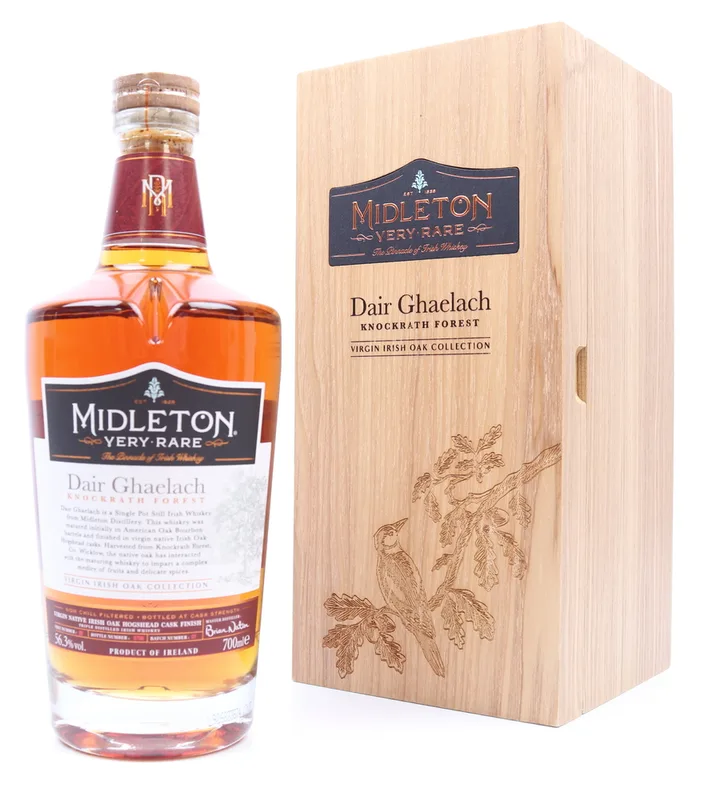
Midleton – Dair Ghaelach Knockrath Forest Tree No. 2
70cl / 56.3%
US$799.00
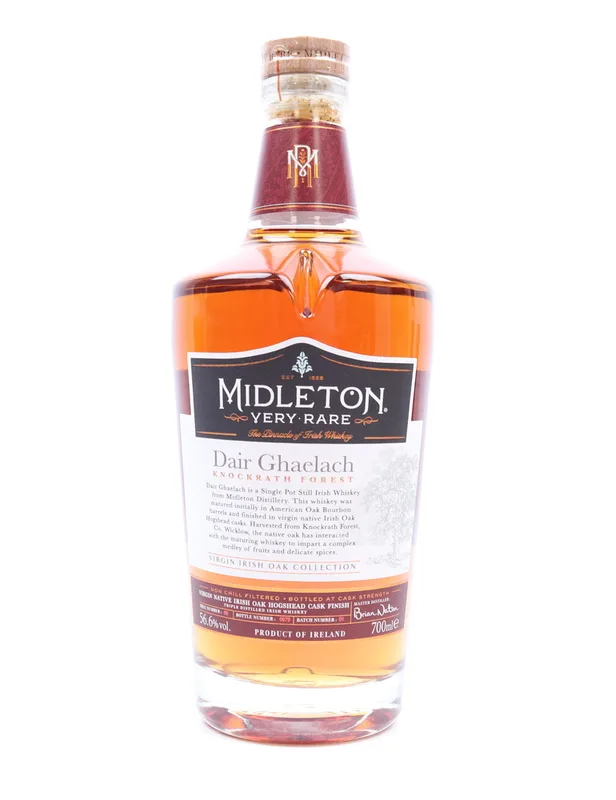
Midleton – Dair Ghaelach Knockrath Forest Tree No. 6
70cl / 56.6%
US$829.00
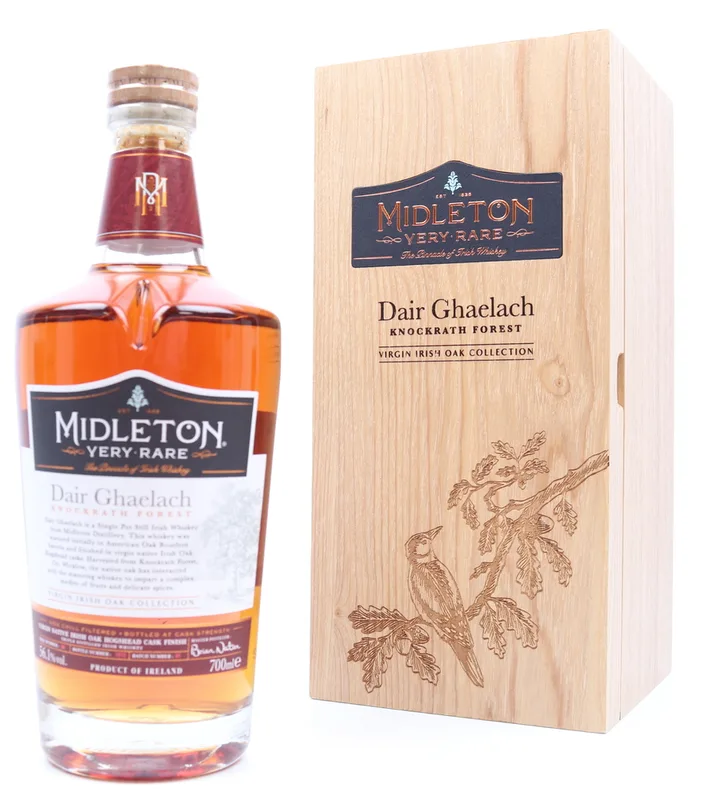
Midleton – Dair Ghaelach Knockrath Forest Tree No. 4
70cl / 56.1%
US$929.00
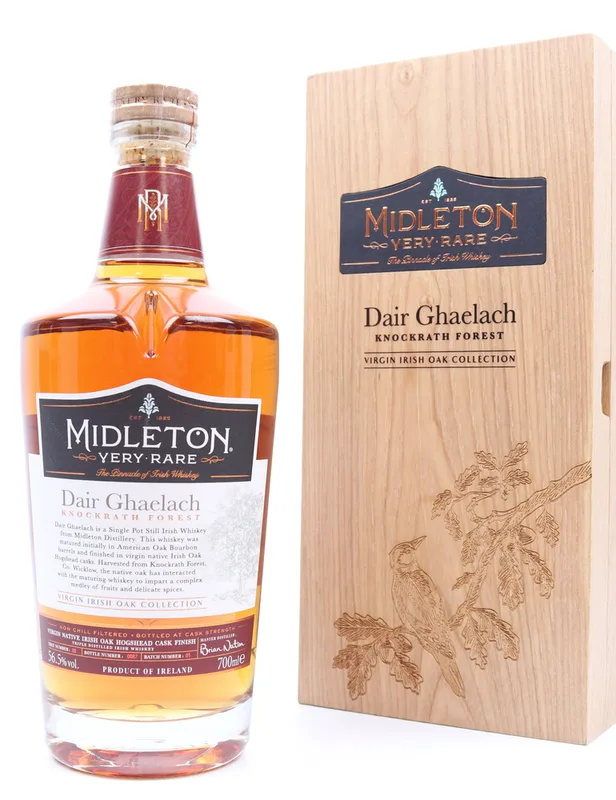
Midleton – Dair Ghaelach Knockrath Forest Tree No. 3
70cl / 56.5%
US$1,139.00
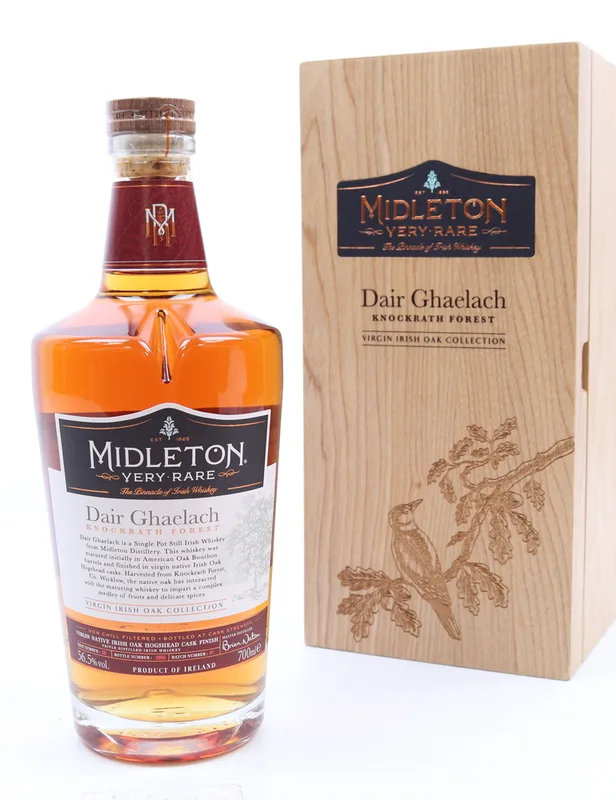
Midleton – Dair Ghaelach Knockrath Forest Tree No. 3
70cl / 56.5%
US$1,139.00
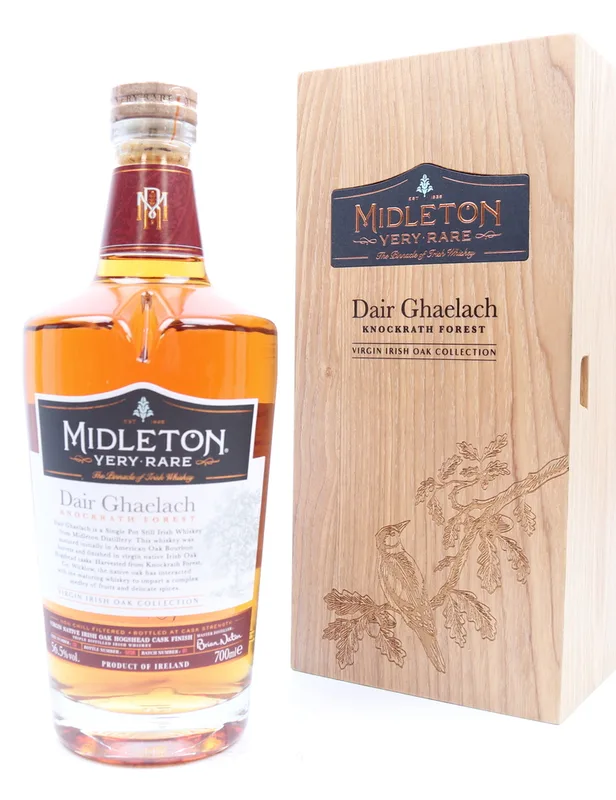
Midleton, Dair Ghaelach, Knockrath Forest Tree No. 3
70cl / 56.5%
US$1,189.00
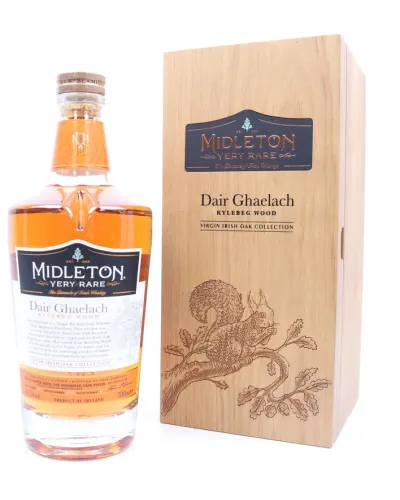
Midleton Very Rare Dair Ghaelach Kylebeg Wood
10 bottles available at Glenbotal
Kylebeg Wood, the fourth release, went on sale worldwide on 19 November 2021. The oak came from Kylebeg Wood on the Ballykilcavan Estate near Stradbally in County Laois, managed by the Walsh-Kemmis family since 1639, where native oak was planted in 1820 to replace trees cut for shipbuilding.
Seven trees gave 42 lightly toasted hogsheads, filled with pot still whiskeys aged 13 to 25 years in American oak and checked every month for a further 15 months. The seven bottlings range from 55.4% to 56.1%.
Kevin O'Gorman summed up the seven as fragrant woodland spice with a heightened intensity of rich wood tannins, letting the Irish oak linger on the palate to the very end.
- Distillery
- Midleton
- Age
- No age statement (pot still whiskeys of 13 to 25 years)
- ABV
- 55.4 to 56.1%
- Bottle size
- 70cl
- Cask type
- American oak bourbon barrels, finished for 15 months in virgin Irish oak hogsheads from Kylebeg Wood (light toast)
- Released
- 2021
- Number of Bottles Produced
- Not published
Irish Distillers has not published the number of bottles. Strength varies by tree.
Tasting notes
- Nose
- Woodland spices, cinnamon and nutmeg with earthy notes, nectarine and white pepper, then dairy fudge, vanilla and a nutty richness.
- Palate
- Pot still spice with rich oak tannins, softening into caramel, stewed apple and orange peel, with dark chocolate, honeycomb and vanilla.
- Finish
- Long, the fruit and spice fading slowly and the Irish oak lingering to the end.
The 6 lowest-priced of 10 bottles.
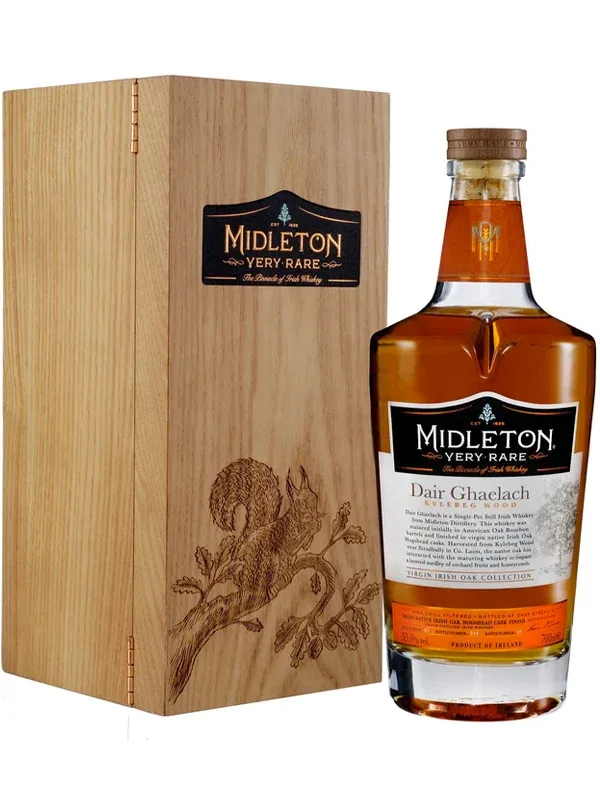
Midleton – Dair Ghaelach Kylebeg Wood
70cl / 56%
US$689.00
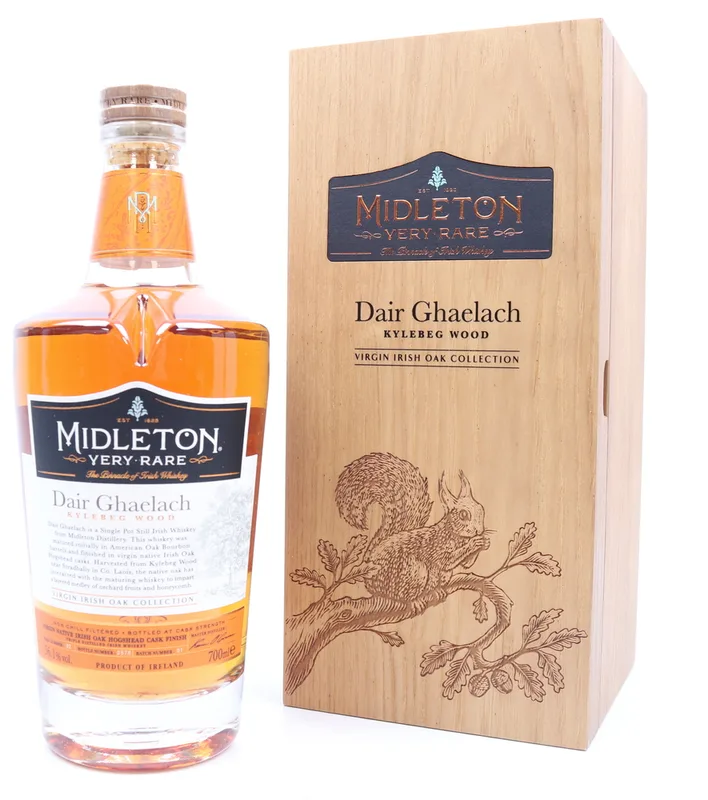
Midleton – Dair Ghaelach Kylebeg Wood Tree 2
70cl / 56.1%
US$729.00
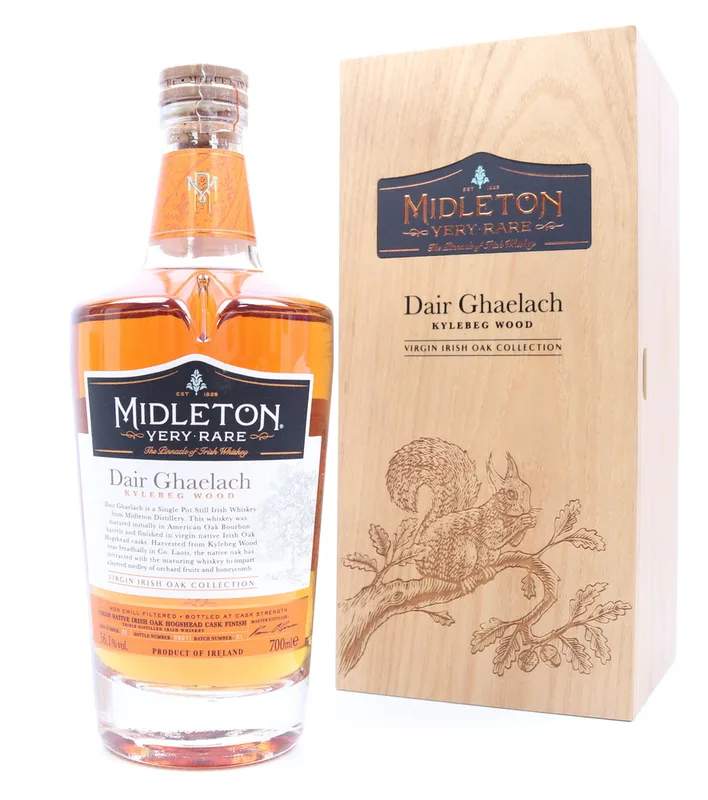
Midleton – Dair Ghaelach Kylebeg Wood Tree 2
70cl / 56.1%
US$729.00
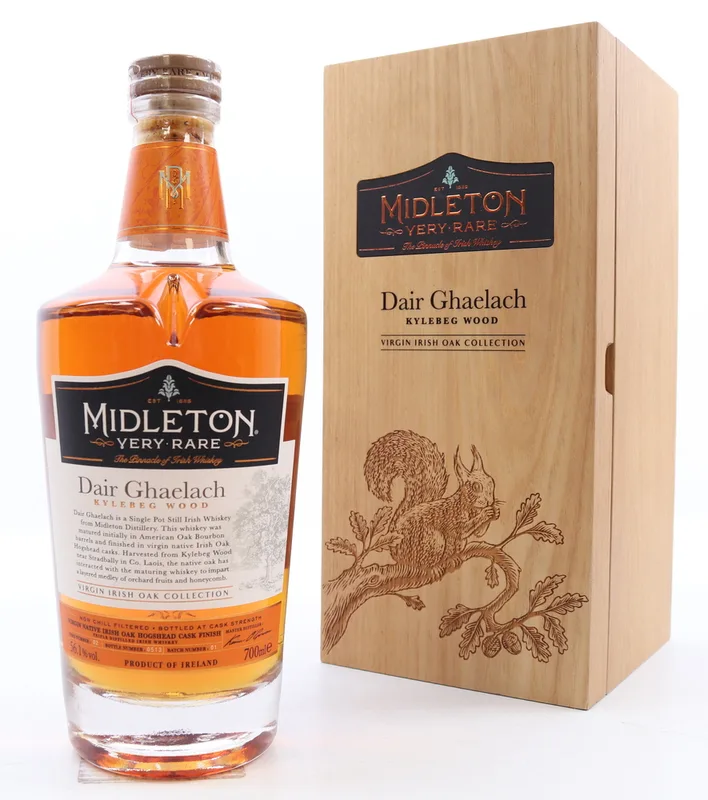
Midleton – Dair Ghaelach Kylebeg Wood Tree 2
70cl / 56.1%
US$729.00
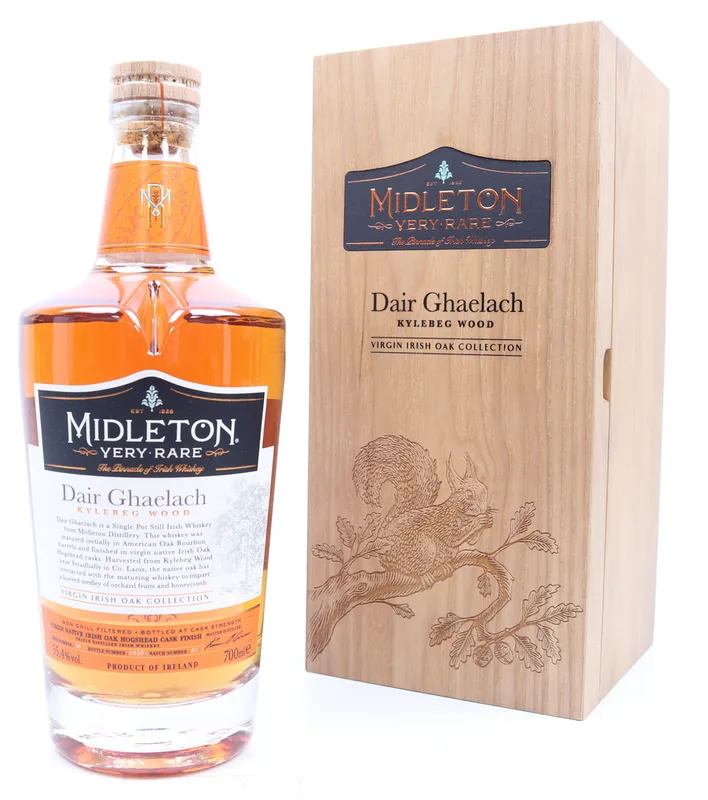
Midleton – Dair Ghaelach Kylebeg Wood Tree 6
70cl / 55.4%
US$749.00
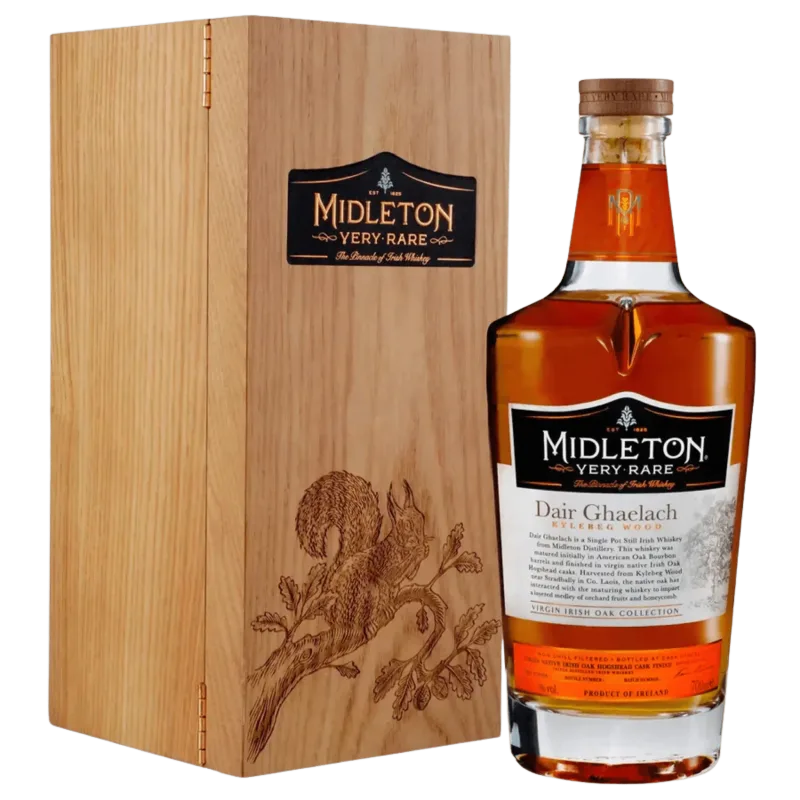
Midleton Very Rare Dair Ghaelach Kylebeg Wood
70cl
US$749.00
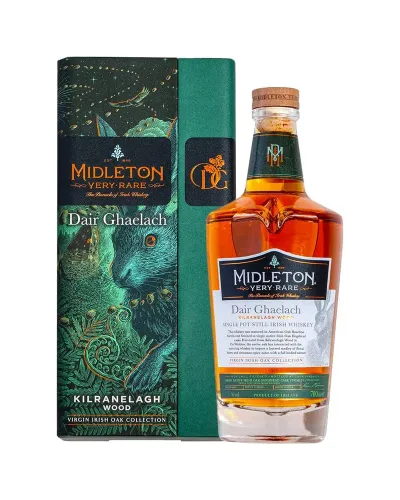
Midleton Very Rare Dair Ghaelach Kilranelagh Wood
7 bottles available at Glenbotal
Kilranelagh Wood is the fifth release, launched in November 2023. Its oak came from six trees on the Kilranelagh Estate in County Wicklow, and the casks held light, medium and heavy styles of pot still whiskey for 20 months.
Each tree was bottled without chill filtration at its own cask strength, from 56.8% to 57.5%, the highest range of the series after Grinsell's Wood. It is also the first release in a recyclable emerald box, illustrated by Irish artist David Rooney with the plants and animals of the estate, in place of the wooden cabinet.
The notes open with fresh pine, floral honey and pepper, and the palate starts lively with chilli and red pepper before candied orange and red apple come through.
- Distillery
- Midleton
- Age
- No age statement
- ABV
- 56.8 to 57.5%
- Bottle size
- 70cl
- Cask type
- American oak bourbon barrels, finished for 20 months in virgin Irish oak from Kilranelagh Estate
- Released
- 2023
- Number of Bottles Produced
- Not published
Irish Distillers has not published the number of bottles. Six trees only; strength varies by tree.
Tasting notes
- Nose
- Fresh pine, floral honey and ground pepper, with tropical fruit, green tea and cut hay, then smoked almonds, vanilla and cinnamon.
- Palate
- Robust at first with dried chilli and red pepper, softening into candied orange and crisp red apple with vanilla and cinnamon.
- Finish
- Very long, with the pot still spice and the oak lingering.
The 6 lowest-priced of 7 bottles.
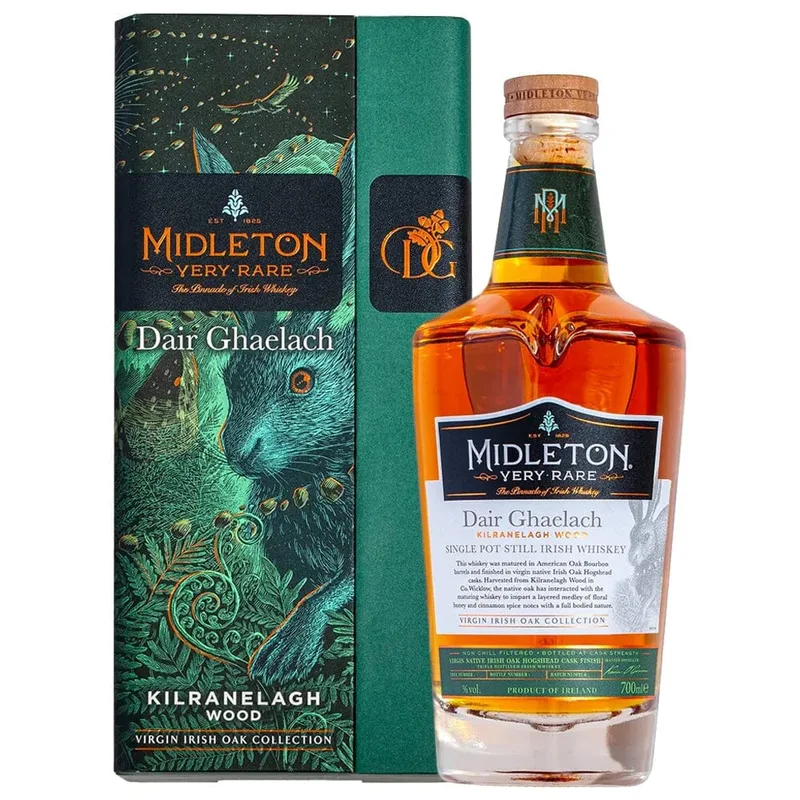
Midleton Very Rare Dair Ghaelach Kilranelagh Wood
70cl / 57%
US$689.00
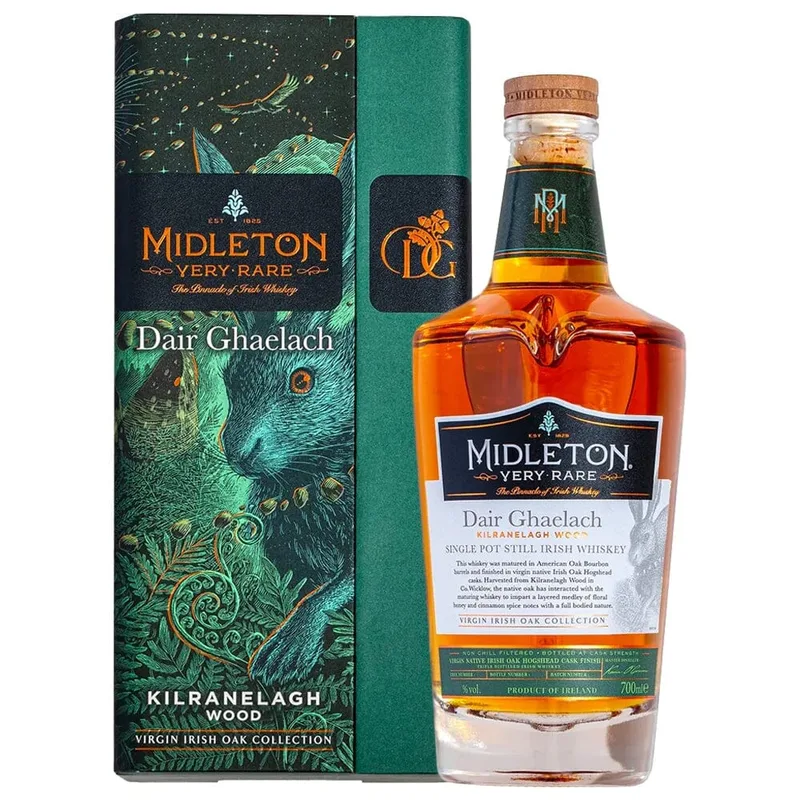
Midleton – Very Rare Dair Ghaelach Kilranelagh Wood
70cl / 57.1%
US$689.00
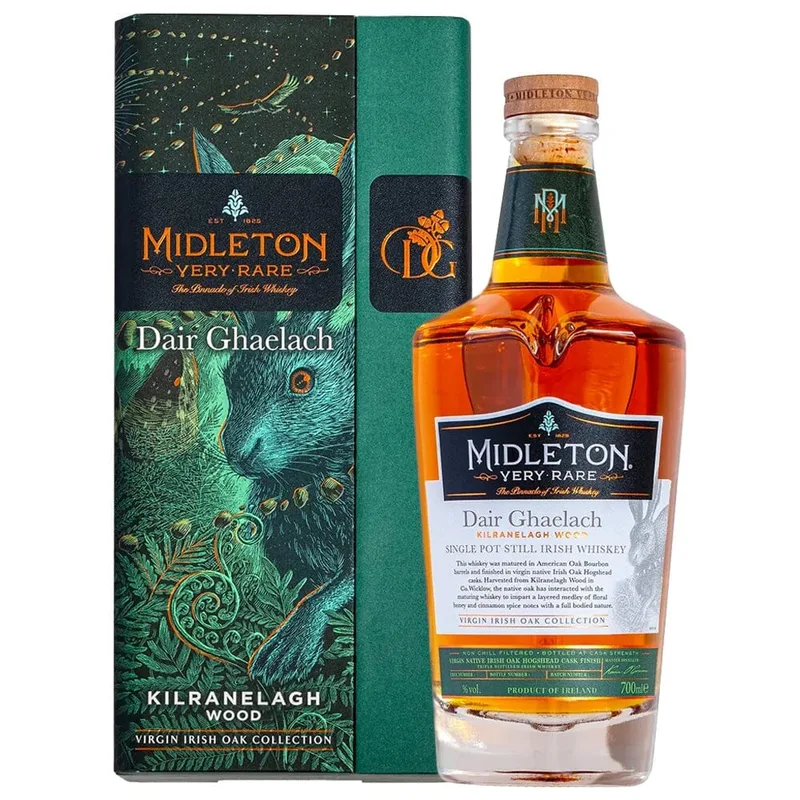
Midleton – Very Rare Dair Ghaelach Kilranelagh Wood Tree No. 2
56.9%
US$689.00
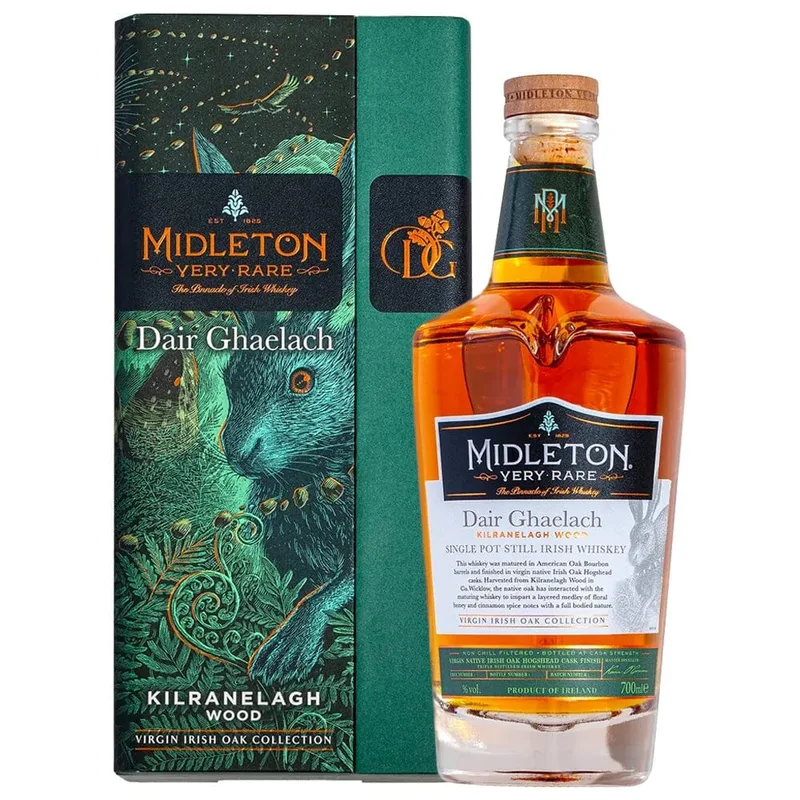
Midleton – Very Rare Dair Ghaelach Kilranelagh Wood
70cl / 57.1%
US$689.00
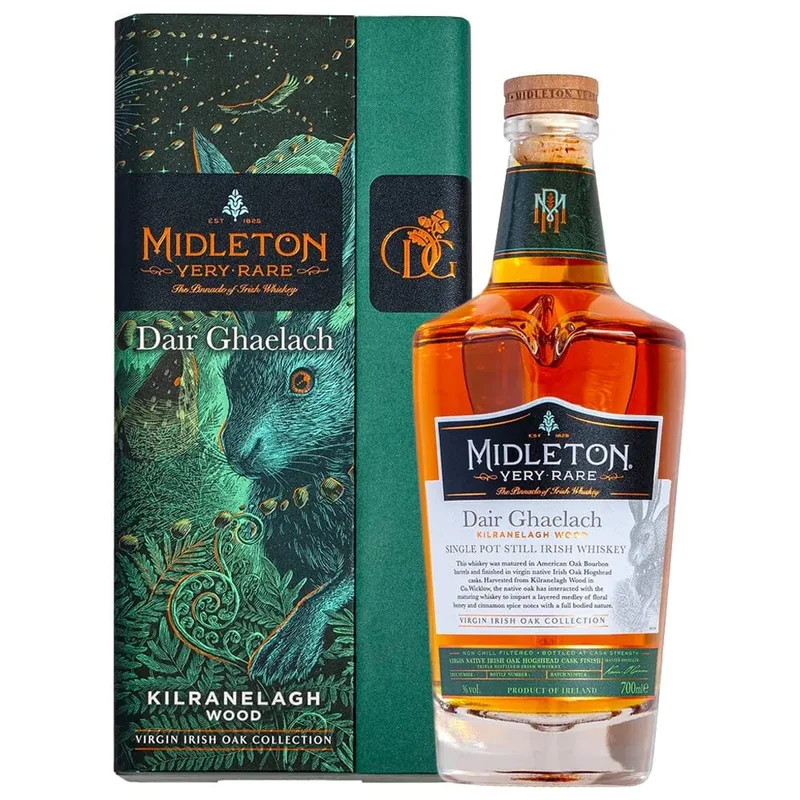
Midleton Very Rare Dair Ghaelach Kilranelagh Wood
70cl / 56.8%
US$689.00
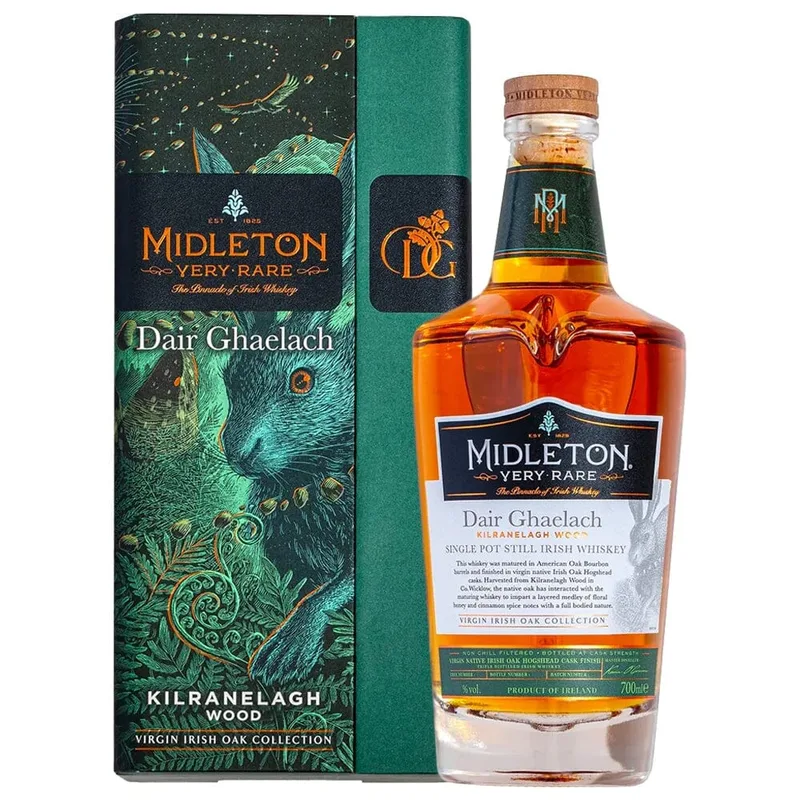
Midleton – Very Rare Dair Ghaelach Kilranelagh Wood Tree No. 5
57.5%
US$689.00
Chapter 4
Tree numbers, and why they matter
The tree number on the label tells you which oak your whiskey was finished in, and it changes the strength and the flavour.
Each Dair Ghaelach bottle names its forest and the number of the tree whose wood made the cask.[2][6] Irish Distillers presents this as traceability: you can follow a bottle back to the very oak that helped to shape it.[6]
The label also carries a batch number and a bottle number. So far every forest has been bottled as batch number one, so the batch number alone does not tell you which release a bottle belongs to.
How much the trees differ
The trees in one release share a forest, a whiskey and a cooperage, but they do not taste the same. For Knockrath Forest, O'Gorman pointed out that trees one and five gave a darker mahogany colour, while trees two and six showed more toffee, coconut and chocolate.[7]
Strength also moves with the tree. Kilranelagh Wood ranges from 56.8% to 57.5%, and Kylebeg Wood from 55.4% to 56.1%.[12][10]
Full sets
Some collectors buy one bottle from every tree in a release, and complete sets of Bluebell Forest, Kylebeg Wood and Kilranelagh Wood do come up. Check that the forest name matches on every bottle and that the tree numbers run without gaps.
Remember how many trees each release had: ten for Grinsell's Wood, six for Bluebell Forest, seven for Knockrath Forest and Kylebeg Wood, and six for Kilranelagh Wood.[1][4][7][10][12]
Chapter 5
What to check before you buy a bottle
Match the forest, the tree number and the strength, then look at the case and the closure.
Dair Ghaelach was sold through specialist shops in several countries, so bottles turn up in more than one format. The checks below cover what changes from one bottle to the next.
Ask for clear photos of the label, the tree and bottle numbers, the closure and the case before you commit.
Forest, tree and strength
The forest name and the tree number should both be on the label, and the strength should fall inside that release's range. A Knockrath Forest bottle, for example, should read between 56.1% and 56.6%.[6]
If the strength is outside the range for the forest named, ask more questions. It may be a different release, or the description may be wrong.
Case and packaging
The first four releases came in a wooden case; the Knockrath Forest case, for instance, is engraved with a great spotted woodpecker, a bird that returned to the estate's woods.[6] Kilranelagh Wood moved to a recyclable emerald box illustrated by Irish artist David Rooney.[12]
A missing case changes how complete the bottle is, so ask whether the original one comes with it.
70cl and 75cl bottles
Bottles for Europe and the UK are 70cl. Bottles made for the United States are 75cl and their labels often give the strength in US proof, so 114.2 proof is the same as 57.1%.
The whiskey inside is the same release, but the size and the proof figure are worth knowing when you compare two listings.
Fill level and closure
These are recent bottlings, so the fill should sit high in the neck. A low level, a damaged seal or signs of leaking around the stopper are reasons to ask how the bottle has been kept.
Store and carry it upright, because cask strength spirit lying against the cork can damage it over time.
Chapter 6
Mistakes collectors make with this series
Most mix-ups come from the shared Midleton Very Rare name and from labels that leave out the forest.
Dair Ghaelach bottles carry plenty of small print: forest, tree, batch and bottle numbers, and from 2020 the Midleton Very Rare name. The mistakes below are the ones we see most often in listings.[6][12]
Until we started this project, Irish oak had not been used to mature whiskey for well over 100 years.
Treating it as a Midleton Very Rare vintage
A bottle called Midleton Very Rare Dair Ghaelach is not part of the yearly Midleton Very Rare vintage series. It has no vintage year, it is single pot still rather than a blend, and it is bottled at cask strength.[6][11]
Our guide to Midleton Very Rare covers the yearly vintages.
Listings that only say 'Batch No. 1'
Some listings describe a bottle only as Dair Ghaelach Virgin Irish Oak Collection, Batch No. 1, with a tree number. Every forest so far has been batch one, so that wording does not tell you which release it is.
Ask for the forest name from the label or the case before you compare it with anything else.
Tree numbers that do not exist
Kilranelagh Wood and Bluebell Forest were each made from six trees, so there is no Tree No. 7 in either release.[12][4] Knockrath Forest and Kylebeg Wood had seven trees each.[7][10]
A bottle offered with a tree number above the release's count has been described wrongly. Check the label photo before going further.
Mixing up the two Kilkenny and the two Wicklow releases
Grinsell's Wood and Bluebell Forest both came from County Kilkenny, and Knockrath Forest and Kilranelagh Wood both came from County Wicklow.[8][12] The county alone is not enough to identify a bottle.
The forest name on the label is what separates them, together with the strength range of each release.
Frequently asked questions
What does Dair Ghaelach mean?
It is Irish for 'Irish oak'. The name refers to the virgin Irish oak hogsheads used to finish every release in the series.
How many Dair Ghaelach releases are there?
Five so far: Grinsell's Wood (2015), Bluebell Forest (2017), Knockrath Forest (2020), Kylebeg Wood (2021) and Kilranelagh Wood (2023).
Is each tree a separate release?
No. Each forest is one release, and within it every tree was bottled separately at its own cask strength and labelled with its tree number. In this guide the trees are treated as bottlings of their release.
How many trees were used for each release?
Ten for Grinsell's Wood, six for Bluebell Forest, seven for Knockrath Forest, seven for Kylebeg Wood and six for Kilranelagh Wood.
Is Dair Ghaelach part of Midleton Very Rare?
Since Knockrath Forest in 2020 it has carried the Midleton Very Rare name, but it is a separate series from the yearly Midleton Very Rare vintages. Dair Ghaelach is single pot still whiskey at cask strength, finished in virgin Irish oak, with no vintage year.
Where are the casks made?
The oak is quarter-sawn into staves at the Maderbar sawmills in Galicia, Spain, then dried for about 15 months and made into hogsheads at the Antonio Páez Lobato cooperage in Jerez, before going back to Midleton to be filled.
What strength is Dair Ghaelach?
Every bottling is at cask strength, so it changes from tree to tree. The ranges are 55.3% to 56.3% for Bluebell Forest, 56.1% to 56.6% for Knockrath Forest, 55.4% to 56.1% for Kylebeg Wood and 56.8% to 57.5% for Kilranelagh Wood; Grinsell's Wood launched at 58.1%.
How many bottles were made?
About 12,000 bottles of Grinsell's Wood were reported at its launch. Irish Distillers has not published bottle numbers for the later releases.
How long does the whiskey spend in Irish oak?
It varies by release: around ten months for Grinsell's Wood, 18 months for Bluebell Forest, two years for Knockrath Forest, 15 months for Kylebeg Wood and 20 months for Kilranelagh Wood.
Why is my bottle 75cl and in proof?
Bottles made for the United States are 75cl and their labels often show US proof. Divide the proof by two to get the percentage, so 114 proof is 57%.
What does 'Batch No. 1' on the label mean?
Each forest so far has been bottled as batch one, so the batch number does not identify the release. The forest name on the label or case does.
Will there be more Dair Ghaelach releases?
Irish Distillers has not announced a sixth forest. When the first whiskey came out in 2015 it was described as the first in a number of planned Irish oak releases, and at the Bluebell Forest launch Kevin O'Gorman said the team looked forward to exploring more of Ireland's woodlands.
Can I buy a bottle from the Midleton Dair Ghaelach at Glenbotal?
Yes. Today we have 29 bottles from this collection (Midleton Dair Ghaelach Bluebell Forest, Midleton Very Rare Dair Ghaelach Knockrath Forest, Midleton Very Rare Dair Ghaelach Kylebeg Wood, Midleton Very Rare Dair Ghaelach Kilranelagh Wood). For any other release, use "Find me this bottle" on this page: we usually find one in 2 to 3 weeks.
The bottom line
Dair Ghaelach is five forests, each split into bottlings by tree, so the forest name, the tree number and the strength are what identify a bottle.
Check those three against the release details in this guide, then look at the case, the closure and the fill level. Keep in mind that the Midleton Very Rare name on the later releases does not make them part of the yearly vintages.
If the bottle or tree you want is not listed right now, use Find my bottle and tell us the forest and tree number you are after. We can look for one for you, and we usually find one within two to three weeks.
For the rest of the distillery's range, see our Midleton page, browse Irish whiskey, or read our guide to Redbreast Dream Cask, another series from Midleton's pot stills.
Sources
- Midleton unveils first Irish oak-finished whiskey (25 February 2015), The Spirits Business
- Review: Midleton Dair Ghaelach 'Grinsell's Wood' (8 March 2015), Whisky For Everyone
- Midleton: Dair Ghaelach (13 May 2015), Miss Whisky
- Midleton grows Irish virgin oak whiskey range (17 November 2017), The Spirits Business
- Midleton Returns To Irish Oak Aging For Whiskey In Line Expansion (17 November 2017), The Whiskey Wash
- Midleton Brings A Third Irish Whiskey To Its Irish Oak Aging Series (27 January 2020), The Whiskey Wash
- Savour the 'subtle differences' of Midleton Very Rare's new whiskey collection (21 February 2020), The Irish Times
- Return of the native, Whisky Magazine
- Midleton Very Rare Dair Ghaelach, Midleton Very Rare
- Kylebeg Wood is the new release in the Midleton Very Rare Dair Ghaelach range, Whisky Magazine
- Irish Distillers Reinforces Sustainability Credentials with new chapter in the Midleton Very Rare Dair Ghaelach story (30 November 2021), TheTaste.ie
- Irish Distillers Unveils Midleton Very Rare Dair Ghaelach Kilranelagh Wood (29 November 2023), One More Dram
- Irish Distillers Debuts Newest Midleton Very Rare Dair Ghaelach (27 November 2021), The Whiskey Wash
Last checked 17 November 2026.